14 Reasons Why The U.S. Economy’s Bubble Of False Prosperity May Be About To Burst

Bubbles - Public DomainDid you know that a major event just happened in the financial markets that we have not seen since the financial crisis of 2008?  If you rely on the mainstream media for your news, you probably didn’t even hear about it.  Just prior to the last stock market crash, a massive amount of money was pulled out of junk bonds.  Now it is happening again.  In fact, as you will read about below, the market for high yield bonds just experienced “a 6-sigma event”.  But this is not the only indication that the U.S. economy could be on the verge of very hard times.  Retail sales are extremely disappointing, mortgage applications are at a 14 year low and growing geopolitical storms around the world have investors spooked.  For a long time now, we have been enjoying a period of relative economic stability even though our underlying economic fundamentals continue to get even worse.  Unfortunately, there are now a bunch of signs that this period of relative stability is about to end.  The following are 14 reasons why the U.S. economy’s bubble of false prosperity may be about to burst…

#1 The U.S. junk bond market just experienced “a 6-sigma event” earlier this month.  In other words, it is an event that is only supposed to have a chance of 1 in 500 million of happening.  Billions of dollars are being pulled out of junk bonds right now, and that has some analysts wondering if a financial crash is right around the corner.

#2 The last time that we saw a junk bond rout of this magnitude was back during the financial crash of 2008.  In fact, as the Telegraph recently explained, bonds usually crash before stocks do…

The credit market usually leads the equity market during turning points, as happened when credit markets cracked first in 2008.

Will the same thing happen this time around?

#3 Retail sales have missed expectations for three months in a row and we just had the worst reading since January.

#4 Things have gotten so bad that even Wal-Mart is really struggling.  Same-store sales at Wal-Mart have declined for five quarters in a row and the outlook for the future is not particularly promising.

#5 The four week moving average for mortgage applications just hit a 14 year low.  It is now even lower than it was during the worst moments of the financial crisis of 2008.

#6 The tech industry is supposed to be booming, but mass layoffs in the tech industry are actually 68 percent ahead of last year’s pace.

#7 According to the Federal Reserve, 40 percent of all households in the United States are currently showing signs of financial stress.

#8 The U.S. homeownership rate has fallen to the lowest level since 1995.

#9 According to one survey, 76 percent of Americans do not have enough money saved to cover six months of expenses.

#10 Rumblings of a stock market correction have become so loud that even the mainstream media is reporting on it.  For example, just check out this CNN headline from earlier this month: “Is a correction near? Wall Street on edge“.

#11 The civil war in Iraq is spiraling out of control, and Barack Obama has just announced that he is going to send 130 troops to the country in a “humanitarian” capacity.  Iraq is the 7th largest oil producing nation on the entire planet, and if the flow of oil is disrupted that could have serious consequences.

#12 As a result of the conflict in Ukraine, the United States, Canada and the European Union have slapped sanctions on Russia.  In return, Russia has slapped sanctions on them.  Will this slowdown in global trade significantly harm the U.S. economy?

#13 The three day cease-fire between Hamas and Israel is about to end, and Hamas officials are saying that they are preparing for a “long battle“.  If a resolution is not found soon, we could potentially see a full-blown regional war erupt in the Middle East.

#14 The number of Ebola deaths continues to grow at an exponential rate, and if the virus starts spreading inside the United States it has the potential to pretty much shut down our entire economy.

Meanwhile, things look even more dire in much of the rest of the globe.

For example, the economic slowdown has gotten so bad in some nations over in Europe that they are actually experiencing deflation

Portugal has crashed into deep deflation and Italy’s inflation rate has fallen to zero as the eurozone flirts with recession, automatically pushing these countries further towards a debt compound spiral.

The slide comes amid signs of a deepening slowdown in the eurozone core, with even Germany flirting with possible recession. Germany’s ZEW index of investor confidence plunged from 27.1 to 8.6 in July, the sharpest fall since June 2012, during the European sovereign debt crisis. “The European Central Bank has to act now,” said Andrew Roberts, credit chief at RBS.

And in Japan, GDP just contracted at a 6.8 percent annual rate during the second quarter…

Japan’s economy suffered its worst contraction since 2011 in the second quarter as consumer spending on big items slumped in the wake of a sales tax rise.

Gross domestic product shrunk by an annualized 6.8% in the three months ended June, Japan’s Cabinet Office said Wednesday. The result was actually better than the 7% contraction expected by economists.

On a quarterly basis, Japan’s GDP dropped by 1.7% as business and housing investment declined. Japan’s economy last suffered a hit of this magnitude after the 2011 tsunami and nuclear disaster.

There is no way that this bubble of false prosperity was going to last forever.  It was never real to begin with.  It was just based on a pyramid of debt and false promises.  In fact, the condition of the global financial system is now far worse than it was just prior to the financial crisis of 2008.

Sadly, most people do not understand these things.  Most people just assume that our leaders have fixed whatever caused the problems last time.  And when the next crisis arrives, they will be totally blindsided by it.
The Head Of ‘The Central Bank Of The World’ Warns That Another Great Financial Crisis May Be Coming

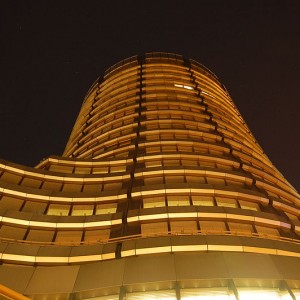
The Bank For International Settlements at Night - Photo by WladyslawMost people have never heard of Jaime Caruana even though he is the head of an immensely powerful organization.  He has been serving as the General Manager of the Bank for International Settlements since 2009, and he will continue in that role until 2017.  The Bank for International Settlements is a rather boring name, and very few people realize that it is at the very core of our centrally-planned global financial system.  So when Jaime Caruana speaks, people should listen.  And the fact that he recently warned that the global financial system is currently “more fragile” in many ways than it was just prior to the collapse of Lehman Brothers should set off all sorts of alarm bells.  Speaking of the financial markets, Caruana ominously declared that “it is hard to avoid the sense of a puzzling disconnect between the markets’ buoyancy and underlying economic developments globally” and he noted that “markets can stay irrational longer than you can stay solvent”.  In other words, he is saying what I have been saying for so long.  The behavior of the financial markets has become completely divorced from economic reality, and at some point there is going to be a massive correction.

So why would the head of ‘the central bank of the world’ choose this moment to issue such a chilling warning?

Does he know something that the rest of us do not?

According to a recent article in the Telegraph by Ambrose Evans-Pritchard, Caruana is extremely concerned about rising debt levels and the current level of euphoria in the financial markets…

The world economy is just as vulnerable to a financial crisis as it was in 2007, with the added danger that debt ratios are now far higher and emerging markets have been drawn into the fire as well, the Bank for International Settlements has warned.

Jaime Caruana, head of the Swiss-based financial watchdog, said investors were ignoring the risk of monetary tightening in their voracious hunt for yield.

“Markets seem to be considering only a very narrow spectrum of potential outcomes. They have become convinced that monetary conditions will remain easy for a very long time, and may be taking more assurance than central banks wish to give,” he told The Telegraph.

Mr Caruana said the international system is in many ways more fragile than it was in the build-up to the Lehman crisis. Debt ratios in the developed economies have risen by 20 percentage points to 275pc of GDP since then.

And you know what?

Caruana is certainly correct to be warning us about these things.

As I have written about previously, the total amount of government debt in the world has grown by about 40 percent since the last recession, and the “too big to fail banks” have collectively gotten 37 percent larger since that time.

The U.S. national debt has grown from about 10 trillion dollars to more than 17.5 trillion dollars, and even the Bank for International Settlements admits that the global derivatives bubble has grown to at least 710 trillion dollars.

The massive financial imbalances that we were facing during the last crisis have not been fixed.  Instead, they have gotten much, much worse.

But should we trust the Bank for International Settlements?

Of course not.

This is a very secretive organization that very few people know about but that possesses absolutely enormous power.  The following is a brief overview of the Bank for International Settlements from one of my previous articles entitled “Who Controls The Money? An Unelected, Unaccountable Central Bank Of The World Secretly Does“…

An immensely powerful international organization that most people have never even heard of secretly controls the money supply of the entire globe.  It is called the Bank for International Settlements, and it is the central bank of central banks.  It is located in Basel, Switzerland, but it also has branches in Hong Kong and Mexico City.  It is essentially an unelected, unaccountable central bank of the world that has complete immunity from taxation and from national laws.  Even Wikipedia admits that “it is not accountable to any single national government.”  The Bank for International Settlements was used to launder money for the Nazis during World War II, but these days the main purpose of the BIS is to guide and direct the centrally-planned global financial system.  Today, 58 global central banks belong to the BIS, and it has far more power over how the U.S. economy (or any other economy for that matter) will perform over the course of the next year than any politician does.  Every two months, the central bankers of the world gather in Basel for another “Global Economy Meeting”.  During those meetings, decisions are made which affect every man, woman and child on the planet, and yet none of us have any say in what goes on.  The Bank for International Settlements is an organization that was founded by the global elite and it operates for the benefit of the global elite, and it is intended to be one of the key cornerstones of the emerging one world economic system.

The role that the Bank for International Settlements is playing today was envisioned by the global elite long ago.  In another previous article, I quoted from a book that Georgetown University history professor Carroll Quigley wrote in 1975 entitled “Tragedy & Hope” in which he discussed how the BIS was to one day become “the apex” of the global financial system…

[T]he powers of financial capitalism had another far-reaching aim, nothing less than to create a world system of financial control in private hands able to dominate the political system of each country and the economy of the world as a whole. This system was to be controlled in a feudalist fashion by the central banks of the world acting in concert, by secret agreements arrived at in frequent private meetings and conferences. The apex of the system was to be the Bank for International Settlements in Basle, Switzerland, a private bank owned and controlled by the world’s central banks which were themselves private corporations.

And it is interesting to note that Professor Quigley was not against the system that the elite were setting up.  He was just an academic that was trying to accurately convey what he had learned about how the global system works.

Sadly, the system that Quigley wrote about all the way back in 1975 has fully blossomed today.

Every two months, the central bankers of the world travel to Switzerland for “Global Economy Meetings” in Basel.  Most people have never heard of them, but these Global Economy Meetings were actually discussed in the Wall Street Journal

Every two months, more than a dozen bankers meet here on Sunday evenings to talk and dine on the 18th floor of a cylindrical building looking out on the Rhine.

The dinner discussions on money and economics are more than academic. At the table are the chiefs of the world’s biggest central banks, representing countries that annually produce more than $51 trillion of gross domestic product, three-quarters of the world’s economic output.

So how do you feel about the fact that the central bankers of the world regularly gather to plot their next moves for the global economy?

Should an unelected group of central bankers that has no accountability to any national government really have so much power?

Please feel free to share what you think by posting a comment below…

Bubbles, Bubbles Everywhere

Financial Bubbles - Public DomainIs there any doubt that we are living in a bubble economy?  At this moment in the United States we are simultaneously experiencing a stock market bubble, a government debt bubble, a corporate bond bubble, a bubble in San Francisco real estate, a farmland bubble, a derivatives bubble and a student loan debt bubble.  And of course similar things could be said about most of the rest of the planet as well.  In fact, the total amount of government debt around the world has risen by about 40 percent just since the last recession.  But it is never sustainable when asset prices and debt levels increase much faster than the overall level of economic growth.  History has shown us that all financial bubbles eventually burst.  And when these current financial bubbles in America burst, the pain is going to be absolutely enormous.

You know that things are getting perilous when even the New York Times starts pointing out financial bubbles everywhere.  The following is a short excerpt from a recent NotQuant article

The New York Times points out that just about everything on Earth is expensive by historical standards.   And then asks the seemingly obvious question:  Does that make it a bubble?

Welcome to the Everything Boom — and, quite possibly, the Everything Bubble. Around the world, nearly every asset class is expensive by historical standards. Stocks and bonds; emerging markets and advanced economies; urban office towers and Iowa farmland; you name it, and it is trading at prices that are high by historical standards relative to fundamentals. The inverse of that is relatively low returns for investors.

Quite possibly?”  We’re not sure what definition of the word “bubble” they’re using.   But in our book when the price of literally everything blasts upwards, obliterating the previous ceilings of historical benchmarks, it’s a pretty good indication that you’re in a bubble.

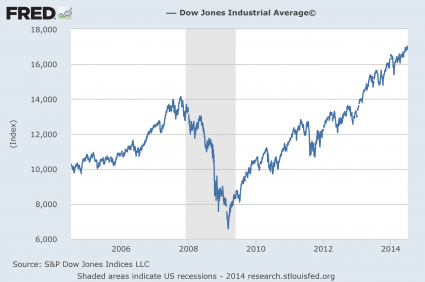
Of course when most people think of financial bubbles the very first thing they think of is the stock market.  And without a doubt we are in a stock market bubble right now.  The Dow has risen more than 10,000 points since the depths of the last recession.  And it is nearly 3,000 points higher than it was at the peak of the last stock market bubble in 2007 when our economy was far stronger than it is now…

Dow Jones Industrial Average 2014

But of course these stock prices do not reflect economic reality in any way whatsoever.  Our economy has not even come close to recovering to the level it was at prior to the last financial crisis, and yet thanks to massive Federal Reserve money printing stock prices have soared to unprecedented heights.

At some point a massive correction is coming.  No stock market bubble lasts forever.  For a whole bunch of technical reasons why serious market turmoil is on the horizon, please see a recent Forbes article entitled “These 23 Charts Prove That Stocks Are Heading For A Devastating Crash“.

The bubbles in the financial markets have become so glaring that even the central bankers are starting to warn us about them.  For example, just consider what the Bank for International Settlements is saying

The Bank for International Settlements has warned that “euphoric” financial markets have become detached from the reality of a lingering post-crisis malaise, as it called for governments to ditch policies that risk stoking unsustainable asset booms.

While the global economy is struggling to escape the shadow of the crisis of 2007-09, capital markets are “extraordinarily buoyant”, the Basel-based bank said, in part because of the ultra-low monetary policy being pursued around the world. Leading central banks should not fall into the trap of raising rates “too slowly and too late”, the BIS said, calling for policy makers to halt the steady rise in debt burdens around the world and embark on reforms to boost productivity.

In its annual report, the BIS also warned of the risks brewing in emerging markets, setting out early warning indicators of possible banking crises in a number of jurisdictions, including most notably China.

“Particularly for countries in the late stages of financial booms, the trade-off is now between the risk of bringing forward the downward leg of the cycle and that of suffering a bigger bust later on,” it said.

Sadly, just like in 2007, most people are choosing not to listen to these warnings.

Another very troubling bubble that is brewing is the massive bubble of consumer credit in the United States.  According to the Wall Street Journal, consumer credit in the United States increased at a 7.4 percent annual rate in May…

The Federal Reserve reported Tuesday that consumer credit—consumer loans excluding real estate debt—in May increased at an annual rate of 7.4% to a record $3.195 trillion. Most of that gain came from a 9.3% increase in nonrevolving credit, the bulk of which is accounted for by auto and student loans. Revolving credit, which is primarily credit-card debt, expanded at a more muted 2.5% rate after jumping 12.3% in May.

That might be okay if our paychecks were increasing at a 7.4% annual rate, but that is not the case at all.  In fact, median household income in America has gone down for five years in a row.  As the quality of our jobs goes down the drain, our paychecks are shrinking even as our bills go up.  This is putting an incredible amount of stress on tens of millions of American families.

And when you look at the overall debt bubble in this country, things become even more frightening.

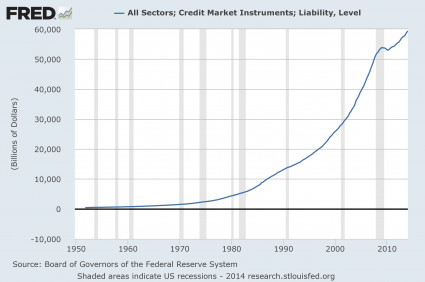
In a previous article, I shared a chart which shows the incredible growth of total debt in the United States.  Over the past 40 years, it has gone from about 2.2 trillion dollars to nearly 60 trillion dollars

Total Debt


Is this sustainable?

Of course not.

None of these financial bubbles are.

It is not a question of “if” they will burst.  It is only a question of “when”.

And some believe that we are rapidly approaching that point.  In fact, Marc Faber believes that we are seeing signs that it may be starting to happen already…

It’s the question investors everywhere are wrestling with: Are asset prices in a bubble, or do they simply reflect the fact that the global economy is growing once again?

For Marc Faber, editor of the Gloom, Boom & Doom Report, the answer is clear. In fact, he says the bubble may already be bursting.

“I think it’s a colossal bubble in all asset prices, and eventually it will burst, and maybe it has begun to burst already,” Faber said Tuesday on CNBC’s ‘Futures Now‘ as the S&P 500 lost ground for the second-straight session.

So what do you think?

How much time do you believe that we have before these bubbles start to burst?

Please feel free to share your thoughts by posting a comment below…

The Size Of The Derivatives Bubble Hanging Over The Global Economy Hits A Record High

Bubble - Photo by Brocken InagloryThe global derivatives bubble is now 20 percent bigger than it was just before the last great financial crisis struck in 2008.  It is a financial bubble far larger than anything the world has ever seen, and when it finally bursts it is going to be a complete and utter nightmare for the financial system of the planet.  According to the Bank for International Settlements, the total notional value of derivatives contracts around the world has ballooned to an astounding 710 trillion dollars ($710,000,000,000,000).  Other estimates put the grand total well over a quadrillion dollars.  If that sounds like a lot of money, that is because it is.  For example, U.S. GDP is projected to be in the neighborhood of around 17 trillion dollars for 2014.  So 710 trillion dollars is an amount of money that is almost incomprehensible.  Instead of actually doing something about the insanely reckless behavior of the big banks, our leaders have allowed the derivatives bubble and these banks to get larger than ever.  In fact, as I have written about previously, the big Wall Street banks are collectively 37 percent larger than they were just prior to the last recession.  “Too big to fail” is a far more massive problem than it was the last time around, and at some point this derivatives bubble is going to burst and start taking those banks down.  When that day arrives, we are going to be facing a crisis that is going to make 2008 look like a Sunday picnic.

If you do not know what a derivative is, Mayra Rodríguez Valladares, a managing principal at MRV Associates, provided a pretty good definition in her recent article for the New York Times

A derivative, put simply, is a contract between two parties whose value is determined by changes in the value of an underlying asset. Those assets could be bonds, equities, commodities or currencies. The majority of contracts are traded over the counter, where details about pricing, risk measurement and collateral, if any, are not available to the public.

In other words, a derivative does not have any intrinsic value.  It is essentially a side bet.  Most commonly, derivative contracts have to do with the movement of interest rates.  But there are many, many other kinds of derivatives as well.  People are betting on just about anything and everything that you can imagine, and Wall Street has been transformed into the largest casino in the history of the planet.

After the last financial crisis, our politicians promised us that they would do something to get derivatives trading under control.  But instead, the size of the derivatives bubble has reached a new record high.  In the New York Times article I mentioned above, Goldman Sachs and Citibank were singled out as two players that have experienced tremendous growth in this area in recent years…

Goldman Sachs has been increasing its derivatives volumes since the crisis, and it had a portfolio of about $48 trillion at the end of 2013. Bloomberg Businessweek recently reported that as part of its growth strategy, Goldman plans to sell more derivatives to clients. Citibank, too, has been increasing its derivatives portfolio, despite the numerous capital and regulatory challenges, In fact, its portfolio has risen by over 65 percent since the crisis — the most of any of the four banks — to $62 trillion.

According to official government numbers, the top 25 banks in the United States now have a grand total of more than 236 trillion dollars of exposure to derivatives.  But there are four banks that dwarf everyone else.  The following are the latest numbers for those four banks…

JPMorgan Chase

Total Assets: $1,945,467,000,000 (nearly 2 trillion dollars)

Total Exposure To Derivatives: $70,088,625,000,000 (more than 70 trillion dollars)

Citibank

Total Assets: $1,346,747,000,000 (a bit more than 1.3 trillion dollars)

Total Exposure To Derivatives: $62,247,698,000,000 (more than 62 trillion dollars)

Bank Of America

Total Assets: $1,433,716,000,000 (a bit more than 1.4 trillion dollars)

Total Exposure To Derivatives: $38,850,900,000,000 (more than 38 trillion dollars)

Goldman Sachs

Total Assets: $105,616,000,000 (just a shade over 105 billion dollars – yes, you read that correctly)

Total Exposure To Derivatives: $48,611,684,000,000 (more than 48 trillion dollars)

If the stock market keeps going up, interest rates stay fairly stable and the global economy does not experience a major downturn, this bubble will probably not burst for a while.

But if there is a major shock to the system, we could easily experience a major derivatives crisis very rapidly and several of those banks could fail simultaneously.

There are many out there that would welcome the collapse of the big banks, but that would also be very bad news for the rest of us.

You see, the truth is that the U.S. economy is like a very sick patient with an extremely advanced case of cancer.  You can try to kill the cancer (the banks), but in the process you will inevitably kill the patient as well.

Right now, the five largest banks account for 42 percent of all loans in the entire country, and the six largest banks control 67 percent of all banking assets.

If they go down, we go down too.

That is why the fact that they have been so reckless is so infuriating.

Just look at the numbers for Goldman Sachs again.  At this point, the total exposure that Goldman Sachs has to derivatives contracts is more than 460 times greater than their total assets.

And this kind of thing is not just happening in the United States.  German banking giant Deutsche Bank has more than 75 trillion dollars of exposure to derivatives.  That is even more than any single U.S. bank has.

This derivatives bubble is a “sword of Damocles” that is hanging over the global economy by a thread day after day, month after month, year after year.

At some point that thread is going to break, the bubble is going to burst, and then all hell is going to break loose.

You see, the truth is that virtually none of the underlying problems that caused the last financial crisis have been fixed.

Instead, our problems have just gotten even bigger and the financial bubbles have gotten even larger.

Never before in the history of the United States have we been faced with the threat of such a great financial catastrophe.

Sadly, most Americans are totally oblivious to all of this.  They just have faith that our leaders know what they are doing, and they have been lulled into complacency by the bubble of false stability that we have been enjoying for the last couple of years.

Unfortunately for them, this bubble of false stability is not going to last much longer.

A financial crisis far greater than what we experienced in 2008 is coming, and it is going to shock the world.

What In The World Is Happening To The Nasdaq?

NASDAQ MarketSite TV studio - Photo by Luis Villa del CampoAll of a sudden, the Nasdaq is absolutely tanking.  On Monday, it fell more than 1 percent after dropping 3.6 percent on Thursday and Friday combined.  At this point, the Nasdaq is off to the worst start to a year that we have seen since 2008, and we all remember what happened back then.  So why is this happening?  In recent years, the Nasdaq has been ground zero for “dotcom bubble 2.0”.  The hottest stocks in the entire world are on the Nasdaq – we are talking about stocks like Yahoo, Netflix, Apple, Tesla, Google and Facebook.  Those stocks have gone to absolutely incredible heights, but now they are starting to fall.  Some are blaming insider selling, and without a doubt the “smart money” is starting to flee the stock market.  Just check out this chart.  Others are blaming low expectations for first-quarter earnings or the tapering of quantitative easing by the Federal Reserve.  But whatever is causing this decline, it is starting to get alarming.  The Nasdaq just experienced its largest three day fall since November 2011.

No stock can resist gravity forever.  What goes up must eventually come down.  This is especially true for stock prices that become grotesquely distorted.

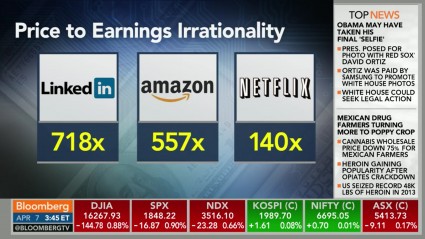
On Wall Street, a price to earnings ratio of 20 to 25 is usually considered fairly normal.  In recent years, the price to earnings ratios for many of these “hot tech stocks” have gone way, way beyond that.  For example, posted below is a screen capture from Bloomberg TV that was featured in a recent Zero Hedge article

Zero Hedge

There is no way in the world that such valuations are justified.

We have been living in another dotcom bubble, and it was inevitable that it was going to burst at some point.

The following is how one financial industry insider described the carnage that we have seen on the Nasdaq over the past few days…

Gary Kaltbaum, president of money-management firm Kaltbaum Capital Management, describes the carnage of once high-flying “growth” names in the Nasdaq composite, that have come crashing down to earth: “The best we can describe what we have been recently seeing in ‘growth-land’ is a 50-car pileup,” Kaltbaum told clients in a morning research note. “Call them what you want … risk areas, growth stocks, froth areas … they are melting away.

And of course it isn’t just the Nasdaq that has been seeing declines over the past few days.  On Monday, some of the biggest names on the Dow also fell precipitiously

Visa, Goldman Sachs and Boeing are among the biggest drags on the Dow Monday, falling 2.1%, 2.9% and 1.4% respectively. Weakness in these stocks is especially problematic since the Dow gives greatest weight to the stocks with the highest per-share prices. And at $203.41, $158.56 and $125.59 respectively, Visa, Goldman and Boeing are the stocks that really matter to the measure.

And the trouble in these stocks isn’t just today. So far this year, Visa is down 8.7%, Goldman is off 10.5% and Boeing is down 8.0%.

This recent decline has many analysts groping for answers.

Some believe that it is simply a “rotation” as investors leave growth stocks that have become overvalued and move into safer, more traditional stocks.

Others are pointing their fingers at the Federal Reserve

Peter Boockvar, chief market strategist at Lindsey Group, believes it’s all about the Fed. “I’m still amazed at the complacency with the Fed taper, and a lot of people still don’t think it’s a big deal,” he said. “I just don’t think it’s a coincidence that the high-fliers are getting popped when the Fed is half way done with QE. We’ve got tightening smack in front of your face with the taper.”

In fact, some believe that the really big stock market decline will happen later this year when the Fed starts to wrap up quantitative easing completely

Once the Fed begins to truly reduce its massive bond buying program later this year, markets could see a quarter of their value wiped off the books, a private equity pro told CNBC on Friday.

Jay Jordan, founder of the Jordan Company, issued the dire warning during an interview on CNBC’s “Squawk Box,” saying a 25 percent drop could extend to all asset classes. He blames the monetary policies of former Fed chair Ben Bernanke for artificially inflating asset prices through super-low interest rates.

Yet others point to the fact that we are now moving into earnings season, and it is being projected that corporate earnings will come in at very poor levels.  In fact, it is being estimated that overall earnings for companies in the S&P 500 for the first quarter will be down 1.2 percent.

So what should we expect to see next?

Whether it happens this month or not, at some point a massive stock market correction is coming.  In recent years, the financial markets have become completely and totally divorced from economic reality, and that is a state of affairs that cannot last indefinitely.

Many have compared the current state of affairs to 2008, but to me what is happening right now is eerily reminiscent of 2007.  The Dow soared to record heights quite a few times that year, but there were constant rumblings of economic trouble in the background.  Stocks began to drop steadily late in the year, and 2008 ultimately turned out to be an utter bloodbath.

I believe that what is happening right now is setting the stage for another financial bloodbath.  I truly believe that we will look back on this two year time period and regard it as a major “turning point” for America.

And as I have written about previously, we are in far worse shape as a nation than we were back in 2008.  We have far more debt, the “too big to fail banks” have a much larger share of the banking industry, the derivatives bubble has gotten completely and totally out of control, and our overall economy is far weaker than it was back then.

In other words, we are now even more vulnerable.  When the next great financial crisis strikes us, it is going to be absolutely crippling.

Now is not the time to get complacent.

Now is the time to get prepared, because time is running out.

The Odds Are Never In Our Favor

Flash BoysHow would you feel if you went to the store to buy something, and someone rushed ahead of you and purchased it first and then sold it to you at a higher price?  Well, in the financial world this happens millions upon millions of times.  In fact, this practice has become so popular that it has spawned an entire industry known as “high frequency trading”.  At this point, high frequency trading makes up about half of all trading volume on Wall Street, and it is costing the rest of us billions of dollars a year.  And the funny thing is that this is all perfectly legal.  High frequency trading firms are exploiting a glitch in the system, and by allowing this to go on, the authorities have essentially given them a license to steal from the rest of us.  Sadly, this is just another example that shows that the odds are never in our favor.  The “little guy” never seems to be able to win, and those at the top of the food chain like it that way.

Making money in the stock market is supposed to be about making wise investment decisions.  It isn’t supposed to be about finding a glitch in a video game and exploiting it.  But that is essentially what these high frequency traders have done.  They have spent an extraordinary amount of time and energy figuring out ways to make pennies (or sometimes just fractions of a penny) on the trades that the rest of us make.

Fortunately, this practice was exposed in front of the entire world by 60 Minutes the other night.  Steve Kroft interviewed a former trader named Michael Lewis that just released a new book entitled “Flash Boys” that is all about the evils of high frequency trading.  The following is an excerpt from that interview…

Steve Kroft: And this is all being done by computers?

Michael Lewis: All being done by computers. It’s too fast to be done by humans. Humans have been completely removed from the marketplace.

“Fast” is the operative word. Machines with secret programs are now trading stocks in tiny fractions of a second, way too fast to be seen or recorded on a stock ticker or computer screen. Faster than the market itself. High-frequency traders, big Wall Street firms and stock exchanges have spent billions to gain an advantage of a millisecond for themselves and their customers, just to get a peek at stock market prices and orders a flash before everyone else, along with the opportunity to act on it.

Michael Lewis: The insiders are able to move faster than you. They’re able to see your order and play it against other orders in ways that you don’t understand. They’re able to front run your order.

Steve Kroft: What do you mean front run?

Michael Lewis: Means they’re able to identify your desire to, to buy shares in Microsoft and buy ’em in front of you and sell ’em back to you at a higher price. It all happens in infinitesimally small periods of time. There’s speed advantage that the faster traders have is milliseconds, some of it is fractions of milliseconds. But it”s enough for them to identify what you’re gonna do and do it before you do it at your expense.

Steve Kroft: So it drives the price up.

Michael Lewis: So it drives the price up, and in turn you pay a higher price.

You can watch the entire interview right here.  Unlike most mainstream media news reports, this one is actually worth your time.  I have watched the entire thing, and I highly recommend it.

Of course there have been many that have been screaming about high frequency trading for many years.  Zero Hedge is just one example.  This practice has gone on year after year and the federal government has looked the other way.

These high frequency trading firms do not add anything to society.  As Barry Ritholtz noted recently, one of these firms has an average holding period for stocks of just 11 seconds, and at one point it stated that it had “not had a losing day of trading in four years“…

The only surprising thing about Lewis’s assertion was that anyone could be even remotely surprised by it.

The math on trading is simple: It is a zero-sum game. One trader’s gain is another trader’s loss. Only in the case of HFT, the losers are the investors — by way of their pension funds, retirement accounts and institutional funds. The HFT’s take — the “skim” — comes out of these large institution’s trade executions.

The technology behind HFT may be complex, but the math is that simple. Once the Securities and Exchange Commission allowed stock exchanges to share with traders all of the unexecuted incoming orders, it was hard not to make money by skimming a few cents or fractions of a cent from each trade. Several years ago, the founder of Tradebot, one of the biggest high-frequency firms, had said that the firm had “not had a losing day of trading in four years.” The firm’s average holding period for stocks is 11 seconds.

How in the world does that kind of behavior add any value to society?

They are just skimming money that should be going to others.  Billions of dollars is essentially being stolen from pension funds and retirement accounts, and it is time that people started getting outraged about this.

Unfortunately, even if this practice is outlawed, the truth is that the odds will still never be in our favor.

There are millions of Americans that dream of getting ahead, but they never seem to be able to get there.  They work incredibly hard, but the more they earn, the more the government taxes them.  If somehow you do manage to scrape together a little bit of money to invest in the financial markets, any profits that you make will be endlessly eroded by fees, commissions and even more taxes.

And it is important to remember that in the financial world, the “little guy” is regarded as easy prey by the hungry wolves that are all too eager to find a way to transfer your money into their own pockets.  If you don’t know what you are doing, it is all too easy to get absolutely slaughtered.

On Wall Street, there are winners and there are losers.

Most of the time, “the little guys” end up losing.

But at least they could try to have a system that at least has the appearance of fairness.  As long as high frequency trading exists, that will never be the case.

Flash Boys


Is “Dr. Copper” Foreshadowing A Stock Market Crash Just Like It Did In 2008?

Stock Market Decline - Photo by NodulationIs the price of copper trying to tell us something?  Traditionally, “Dr. Copper” has been a very accurate indicator of where the global economy is heading next.  For example, back in 2008 the price of copper dropped from nearly $4.00 to under $1.50 in just a matter of months.  And now it appears that another big decline in the price of copper is starting to happen.  So far this year, the price of copper has dropped from a high of $3.40 back in January to a price of $2.95 as I write this article, and many analysts are warning that this is just the beginning.  By itself, this should be quite alarming to investors, but as you will see below there are a whole host of other signs that a stock market crash may be rapidly approaching.

But before we get to those other signs, let us discuss copper a bit more first.  I cannot remember a time since 2008 when there has been such an overwhelming negative consensus about where the price of copper is heading.  The following is from a CNBC article that was posted this week…

Cascading copper prices have multiple root causes that lead to one conclusion: The anticipated global economic recovery may not be all it’s cracked up to be.

Consequently, analysts are in virtual unison that the extended-term trajectory is lower for the metal often used as a growth barometer. Copper futures are off more than 12 percent in 2014 and 7 percent over just the past three days, though they rose less than 1 percent in Wednesday trading.

A slowdown in the global economy, forced selling by Chinese banks and technical factors have converged in multiple calls for more weakness in a commodity known by traders and economists as “Dr. Copper” for its ability to accurately make economic prognoses.

Of course there are some out there that are trying to claim that “this time is different” and that the price of copper is no longer a useful indicator for the global economy as a whole.

We shall see.

Meanwhile, there are lots of other signs that the financial markets are repeating patterns that we have seen in the past.  For instance, the level of margin debt on Wall Street just soared to another brand new record high

The amount of money investors borrowed from Wall Street brokers to buy stocks rose for a seventh straight month in January to a record $451.3 billion, a potential warning sign that in the past has coincided with irrational exuberance and stock market tops.

We saw margin debt spike dramatically like this just prior to the crash of the dotcom bubble in 2000 and just before the great financial crisis of 2008.  Just check out the chart in this article.

Shouldn’t we be alarmed that it is happening again?

If you listen carefully, there are many prominent voices in the financial world that are trying to warn us about this.  Here is one example

“One characteristic of getting closer to a market top is a major expansion in margin debt,” says Gary Kaltbaum, president of Kaltbaum Capital Management. “Expanding market debt fuels the bull market and is an investors’ best friend when stocks are rising. The problem is when the market turns (lower), it is the market’s worst enemy.

And of course margin debt is far from the only sign that indicates that we are in a massive stock market bubble that is about to crash.  The following is a list of 10 signs that comes from a recent article by Lance Roberts of STA Wealth Management

I was recently discussing the market, current sentiment and other investing related issues with a money manager friend of mine in California. (Normally, I would include a credit for the following work but since he works for a major firm he asked me not to identify him directly.)  However, in one of our many email exchanges he sent me the following note detailing the 10 typical warning signs of stock market exuberance.

(1) Expected strong OR acceleration of GDP and EPS  (40% of 2013’s EPS increase occurred in the 4th quarter)

(2) Large number of IPOs of unprofitable AND speculative companies

(3) Parabolic move up in stock prices of hot industries (not just individual stocks)

(4) High valuations (many metrics are at near-record highs, a few at record highs)

(5) Fantastic high valuation of some large mergers (e.g., Facebook & WhatsApp)

(6) High NYSE margin debt

Margin debt/gdp (March 2000: 2.7%, July 2007: 2.6%, Jan 2014: 2.6%)

Margin debt/market cap (March 2000: 1.8%, July 2007: 2.3%, Jan 2014: 2.0%)

(7) Household direct holdings of equities as % of total financial assets at 24%, second-highest level (data back to 1953, highest was 1998-2000)

(8) Highly bullish sentiment (down slightly from year-end peaks; still high or near record high, depending on the source)

(9) Unusually high ratio of selling to buying by corporate senior managers (the buy/sell ratio of senior corporate officers is now at the record post-1990 lows seen in Summer 2007 and Spring 2011)

(10) Stock prices rise following speculative press releases (e.g., Tesla will dominate battery business after they get partner who knows how to build batteries and they build a big factory.  This also assumes that NO ONE else will enter into that business such as GM, Ford or GE.)

All are true today, and it is the third time in the last 15 years these factors have occurred simultaneously which is the most remarkable aspect of the situation.

And for even more technical indicators such as these, please see Charles Hugh Smith’s excellent article entitled “Why 2014 Is Beginning to Look A Lot Like 2008“.

So do all of these numbers and charts actually prove that something is about to happen?

Not necessarily.

But if we do not learn from the past then we are doomed to repeat it.

At this point, even representatives from the big Wall Street banks are warning about the “euphoria” on Wall Street…

The stock market entered “euphoria mode” late last year and has remained there, except for a week in February, as “speculative froth” bubbles around the market’s hottest sectors, Citi’s chief equity strategist told CNBC on Tuesday.

And even market cheerleader Jim Cramer is warning that the stock market is now exhibiting “top behavior“…

The parabolic moves of stocks such as Plug Power and FuelCell Energy have the stock market exhibiting “top behavior,” CNBC’s Jim Cramer said Wednesday.

Cramer said he has tracked the fuel cells stocks since his days as a hedge fund manager. Runups in Freddie Mac and Fannie Mae also had him worried.

None of what you just read above guarantees that the stock market will crash this week, this month or even this year.

And nobody knows the exact date when the next stock market crash will happen.

But one thing is for certain – this massive stock market bubble will burst at some point, and when it does our economy is far less equipped to handle it than it was the last time.

Based on my research, I am entirely convinced that the coming economic crisis is going to be substantially worse than the last one, and that is very bad news for the United States.

So what do you think?

Do you agree or do you think that I am nuts?

Please feel free to share your opinion by posting a comment below…

Stock Prices Have Fallen For Six Weeks In A Row

The Collapse Of Bitcoin

BitcoinBitcoin is a virtual currency that has no intrinsic value.  The only thing giving bitcoin value is the faith that people have in it, and now that faith has been shattered.  This week, the most prominent bitcoin exchange in the entire world, Mt. Gox, totally collapsed.  At one time, Mt. Gox boasted more than a million accounts and it accounted for approximately 25 percent of all global bitcoin trading.  But now the website has been taken down, there are rumors of catastrophic losses, and many investors are concerned that they will lose all of their money.  In fact, according to one report, investors could be facing total losses of up to 367 million dollars.  The collapse of Mt. Gox is also affecting other bitcoin exchanges.  As I write this, the market value of bitcoin had fallen to about $470, but just three months ago it was trading close to $1,200.  Needless to say, a lot of bitcoin investors are going to be licking their wounds tonight.

I have never written much about bitcoin because I never believed in it.  Personally, I have always preferred to stick to silver and gold.  But I can’t blame people for wanting to create a monetary system that worked outside of the central bank-controlled paradigm that we have today.

I just didn’t have any faith in bitcoin.  I considered it something of a Ponzi scheme.  That is why I never recommended it to anyone.  Those that got in early and got out at the peak of the market made a killing.  Good for them.  But most investors are going to end up taking a bath – especially those that got in at the very end.

When you have an imaginary currency that has no intrinsic worth that is being managed and traded by organizations that have very little regulation or accountability, bad things can happen.  And we saw a perfect example of this on Tuesday

A major bitcoin exchange has gone bust after secretly racking up catastrophic losses, other virtual currency companies said Tuesday — a potentially fatal blow for the exotic new form of money.

The website of Tokyo-based Mt. Gox was returning a blank page Tuesday. The disappearance of the site follows the resignation Sunday of Mt. Gox CEO Mark Karpeles from the board of the Bitcoin Foundation, a group seeking legitimacy for the currency, and a withdrawal ban imposed at the exchange earlier this month.

A lot of people out there are insisting that bitcoin can still overcome this and that it is still a sound currency system.  More power to them.  I certainly wish them no ill will.  I just don’t agree with them.

Others are being far more blunt about the matter.  Just consider what Gary North had to say about the collapse of bitcoin…

The biggest Bitcoins exchange has gone bye-bye. It took with it the money that the investors thought was safe.

Reuters reports: “Mt. Gox had $174 million in liabilities against $32.75 million in assets. It was not possible to verify the document or the exchange’s financial situation.”

I say: “A fool and his digital money are soon parted.”

How will the investors prove in a Japanese bankruptcy court that they deserve a part of the supposed $32.75 million? After all, the transactions are all secret.

Anyone that invests in bitcoin needs to realize that they could lose everything.  There is no deposit insurance.  There is very little regulation.  Nobody is going to bail you out if some corrupt businessman takes all of your bitcoins and drops off the map.

It is truly like the wild West.

The amount of money that some bitcoin investors stand to lose from the collapse of Mt. Gox is staggering.

Coinapult and SatoshiDice founder Erik Voorhees says that he may lose about $285,000.

Bitcoin trader Kolin Burgess fears that he may lose about $320,000.

Some people are going to go from being “bitcoin millionaires” to paupers almost overnight.

Yes, I know that there are a lot of people out there that are fervently insisting that this is not the death of bitcoin.

You never know, they may be right.  In the aftermath of the collapse of Mt. Gox, six major bitcoin organizations issued a joint statement.  The following is an excerpt from that statement…

The purpose of this document is to summarize a joint statement to the Bitcoin community regarding the insolvency of Mt.Gox.

This tragic violation of the trust of users of Mt.Gox was the result of one company’s actions and does not reflect the resilience or value of bitcoin and the digital currency industry. There are hundreds of trustworthy and responsible companies involved in bitcoin. These companies will continue to build the future of money by making bitcoin more secure and easy to use for consumers and merchants.  As with any new industry, there are certain bad actors that need to be weeded out, and that is what we are seeing today.

We are confident, however, that strong Bitcoin companies, led by highly competent teams and backed by credible investors, will continue to thrive, and to fulfill the promise that bitcoin offers as the future of payment in the Internet age.

So will the bitcoin community bounce back and be stronger than ever?

You never know.  I certainly wish them the best.  I simply do not plan to participate.

It isn’t just that bitcoin and other alternative currencies are very unstable and offer no protection.  It is also that governments and central banks around the world are starting to crack down on something that they see as a potential threat.  For example, this comes from a Fox News article that was published just this week…

Authorities have been taking an increasingly hard look at Bitcoin and related virtual currencies including Litecoin, Namecoin, Ripple, and countless others. Some countries, including Russia, have effectively banned the currency. In other jurisdictions, authorities are weighing whether to try to tame the marketplace through licenses or other mechanisms.

It is entirely possible that the collapse of Mt. Gox could have been manufactured by a government or a central bank.

Considering the other things that have been revealed over the past couple of years, it would be naive to think that governments and central banks are unwilling to engage in such subterfuge.

In addition, consider what would happen to the other exchanges if the U.S. or the EU publicly announced a complete ban on bitcoin someday.

There are just too many risks.

Like I said, I wish those well that are involved in bitcoin or any of the other alternative virtual currencies that are floating around out there.

Hopefully some of those virtual currencies will succeed.

But most average American families simply cannot afford to put their hard-earned money into schemes that could evaporate literally overnight.

So what do you think about bitcoin?

Please feel free to share your thoughts by posting a comment below…