
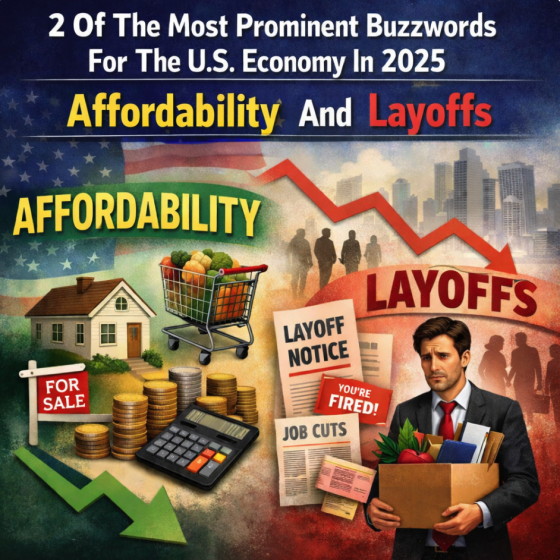
 If you are having a really difficult time keeping up with the rapidly rising cost of living, you are certainly not alone. This year, “affordability” was a buzzword that was constantly on the lips of politicians, economists and talking heads on television. As you will see below, Americans are being slammed by rising prices from a multitude of directions. Meanwhile, “layoffs” has been another buzzword that has been widely used in 2025. Thanks to the rise of AI and our steadily deteriorating economy, we have seen far more mass layoffs this year than we did last year. Unfortunately, one survey has found that executives are gearing up for an even larger round in 2026.
This is what happens when you flood the system with money and you go into unprecedented amounts of debt.
Eventually a day of reckoning arrives.
Ever since the Great Recession, our leaders have been pursuing highly inflationary policies, and now the American people “are yelling about affordability”…
Affordability has been a source of household frustration and a key focus of political discourse in recent months, as prices for everyday goods and services continue to rise.
“People are yelling about affordability,” said Martha Gimbel, executive director and co-founder of the Budget Lab at Yale University. “I think it’s very obviously become a political flash point,” she said.
It wasn’t a foregone conclusion that things would turn out this way.
If we had made different choices, we would have gotten different results.
But we can’t go back and change the past now. At this point, things are so bad that “affordability” has become the number one concern for U.S. voters…
A University of Michigan poll published in December shows that high prices remain a pain point for consumers. About 46% blame high prices for poor personal finances — among the highest shares since the series started in the late 1970s.
Consumers’ views of their current financial situation in December “collapsed” into negative territory for the first time since July 2022, the month after pandemic-era inflation had peaked, according to a poll published Tuesday by the Conference Board.
Overall, 65% of U.S. households say the cost of living has gotten worse or much worse in the past year, according to a recent Politico poll.
Healthcare costs have risen particularly rapidly.
One 62-year-old man that was recently interviewed by Business Insider openly admitted that he cannot afford to get sick, but he can’t afford to be healthy either…
David Deal’s 2026 outlook is what he describes as a “whack-a-mole of worry.” While he’s 62 and presumably approaching retirement, 65 is “just a number” for him, not a milestone marker for throwing in the towel on his career like his parents’ generation. The thing that really has him wound up, though, is healthcare, which he calls a “DEFCON 1” situation. Deal, a marketing consultant who lives in the Chicago suburbs, and his wife pay for their own insurance, and their premiums are going up by 25% next year. He’s worried one slip on the ice this winter could mean financial disaster. A family member’s recent two-hour trip to the ER cost them thousands of dollars, even with insurance, and the episode has him spooked.
“For me, it’s the double-whammy of skyrocketing premiums and also the skyrocketing costs of actually getting care,” he says. “We are literally at a point where we can’t afford to be sick, and we can’t afford to be healthy.”
He emphasizes that he means a collective “we” — he knows he’s far from alone in his predicament.
Health insurance premiums are set to rise even higher in 2026, and many Americans are cancelling their policies as a result.
When you don’t have health insurance, you just pray that you don’t get sick.
If you do get sick, it can be a financial disaster.
Meanwhile, one recent survey discovered that 75 percent of Americans have “reduced spending in other areas” just so that they can afford to pay for their groceries…
But whatever their preferences, many shoppers still fretted about how to pay for their groceries. More than 2 in 3 respondents (67.6%) said that they’re struggling to pay grocery bills because of inflation and rising food prices, according to a survey by Swiftly, which provides digital and media solutions for brick-and-mortar supermarkets.
More than 3 out of 4 (75.2%) responded that they’ve reduced spending in other areas to afford groceries, and in a follow-up question selected what areas they’ve cut spending in the most to pay grocery bills, with entertainment spending the most likely to be cut, followed by spending on travel, clothing, and going out to eat or drink.
Government bureaucrats keep telling us that food prices are not going up very quickly.
But everyone can see that they are wrong.
And going out to eat has become a luxury that most of the population simply cannot afford on a regular basis. As a result, restaurants are closing down at a staggering pace…
New data shows that 2025 was a record year for restaurant closures in the District.
The Restaurant Association of Metropolitan Washington (RAMW) reports 92 restaurants closed their doors this year, compared to 73 closures in 2024 and 48 in 2022.
Purchasing a new vehicle has also become a luxury that most of the population simply cannot afford any longer.
Since the early days of the pandemic, the average price of a new vehicle has gone from less than $38,000 to more than $50,000…
Americans are shelling out record car payments — and now some are signing up for loans stretching nearly a decade to get a new set of wheels.
The average monthly payment for a new car hit about $760 in November, according to industry-research firm J.D. Power, after the typical new-vehicle price surged past the $50,000 mark this fall — up from less than $38,000 in early 2020.
With sticker shock everywhere, buyers are leaning hard on longer financing to keep payments from exploding — even if that means paying far more interest over time.
Some dealers are now stretching out vehicle payments for 100 months so that people can actually afford them.
To me, that is absolutely insane.
But this is the economic system that we live in now.
It is designed to get us into as much debt as possible, and at this stage U.S. households are a whopping 18.6 trillion dollars in debt…
The Federal Reserve signaled a higher bar for 2026 interest rate cuts at its December meeting, potentially snatching away a much-needed reprieve for millions of Americans saddled with debt.
Household debt ballooned to a record $18.6 trillion during the third quarter of 2025, and the central bank is expected to lower its benchmark rate just once or twice next year to soften borrowing costs.
Americans have never been more overextended than they are right now.
It was another record year for credit card debt during the holiday season, but vast numbers of our fellow citizens are still paying off credit card debt from Christmas 2024.
Getting deep into debt in this very challenging economic environment is very foolish, because most people do not have jobs that are secure.
In fact, job security is now the number two concern for U.S. voters…
Job security rose to workers’ second-most pressing concern this year, after covering their monthly expenses, according to a new survey by Mercer.
While “covering monthly expenses” had been the leading concern for the past three annual surveys, fears around job loss jumped from seventh place in 2023 to second place in 2025, where it was tied with being able to retire and work-life balance. Mercer did not conduct this survey in 2024.
Throughout this year, I have documented so many of the mass layoffs that have been occurring all over the nation.
For example, Tyson Foods has announced that a beef processing facility in Lexington, Nebraska will be shut down permanently next month, and that means that approximately 3,200 workers will be losing their jobs.
A reporter that visited Lexington discovered that fear of what those layoffs would mean had gripped the entire area…
On a frigid day after Mass at St. Ann’s Catholic Church in rural Nebraska, worshipers shuffled into the basement and sat on folding chairs, their faces barely masking the fear gripping their town.
There are only about 11,000 people living in Lexington, and so these layoffs have the potential to turn it into a ghost town…
“Suddenly they tell us that there’s no more work. Your world closes in on you,” Alejandra Gutierrez said
She and the others work at Tyson Foods’ beef plant and are among the 3,200 people who will lose their jobs when Lexington’s biggest employer closes the plant next month after more than two decades of operation.
Hundreds of families may be forced to pack up and leave the town of 11,000, heading east to Omaha or Iowa, or south to the meatpacking towns of Kansas or beyond, causing spinoff layoffs in Lexington’s restaurants, barbershops, grocers, convenience stores and taco trucks.
There are so many other examples that I could share with you.
In Michigan, the closure of a facility in Detroit will mean that more than a thousand General Motors employees will be out of work starting on January 5th…
According to WARN Act notices filed in November, 1,140 General Motors employees will be let go from the company’s Factory Zero site in Detroit, Michigan on January 5.
In a filing with the Michigan Department of Labor and Economic Opportunity, General Motors said the cuts would be permanent, affect several roles, and stemmed from adjustments related to the slower-than-expected adoption of electric vehicles.
Sadly, this is just the beginning.
According to one recent survey, over one-third of all large companies intend to slash their payrolls during the months ahead…
In November, executive search firm Spencer Stuart asked 90 chief marketing officers how aggressively they plan to use AI to shrink payrolls, the Wall Street Journal reported.
More than one in three executives said that they expect to hand out pink slips in the next 12 to 24 months as they deploy more computer agents.
The trend is even worse among bigger companies.
Nearly half the executives at firms worth more than $20 billion said they’re planning significant job cuts.
If this survey is accurate, we could see millions of layoffs over the next couple of years.
Just think about that.
We were warned that this was going to happen.
Now it is playing out right in front of our eyes.
And survey after survey is indicating that the American people are quite gloomy about where economic conditions are heading next…
Americans are ending 2025 significantly more pessimistic about the direction of their financial situations than they were at the start of the year, according to the University of Michigan’s consumer sentiment gauge from early December. Its reading on personal finance expectations is 12% below where it was at the beginning of the year. A November consumer survey from the Federal Reserve Bank of New York similarly found that people are increasingly gloomy about their current and future finances, and their expectations for increased medical care costs are at their highest levels since January 2014.
If you understand what is happening, that will help you to make better decisions.
When conditions get tough, those that are wise tighten things up.
Sadly, most of the population continues to party as if tomorrow will never come, but no matter how hard one may try it is impossible to stop the inexorable march of time.
Michael’s new book entitled “10 Prophetic Events That Are Coming Next” is available in paperback and for the Kindle on Amazon.com, and you can subscribe to his Substack newsletter at michaeltsnyder.substack.com.

About the Author: Michael Snyder’s new book entitled “10 Prophetic Events That Are Coming Next” is available in paperback and for the Kindle on Amazon.com. He has also written nine other books that are available on Amazon.com including “Chaos”, “End Times”, “7 Year Apocalypse”, “Lost Prophecies Of The Future Of America”, “The Beginning Of The End”, and “Living A Life That Really Matters”. When you purchase any of Michael’s books you help to support the work that he is doing. You can also get his articles by email as soon as he publishes them by subscribing to his Substack newsletter. Michael has published thousands of articles on The Economic Collapse Blog, End Of The American Dream and The Most Important News, and he always freely and happily allows others to republish those articles on their own websites. These are such troubled times, and people need hope. John 3:16 tells us about the hope that God has given us through Jesus Christ: “For God so loved the world, that he gave his only begotten Son, that whosoever believeth in him should not perish, but have everlasting life.” If you have not already done so, we strongly urge you to invite Jesus Christ to be your Lord and Savior today.