 Iran is still holding traffic through the Strait of Hormuz hostage, and the entire world is going to suffer. Before the war, commercial traffic through the Strait of Hormuz flowed freely, and the global economy functioned normally. But even though there is a temporary ceasefire, Iran continues to maintain a stranglehold on the waterway, and they are insisting that this will continue to be the case when a permanent deal to end the war is reached. In other words, the Iranians are making it clear that this is how things are going to operate from now on, and they know that the U.S. and Europe are not eager to do what it would take militarily to reopen the Strait. Of course even if there is a military operation to reopen the Strait, it will take an extended period of time before it is safe for commercial traffic to pass through the waterway once again. Any way that you look at it, the truth is that this is going to be a complete and utter disaster for the global economy.
The Iranians were supposed to temporarily reopen the Strait of Hormuz as part of the ceasefire deal.
But that has not happened.
In fact, the CEO of Abu Dhabi National Oil Company has ominously declared that “the Strait of Hormuz is not open”…
The Strait of Hormuz has not opened to ship traffic after the U.S. and Iran agreed to a two-week ceasefire, said the CEO of Abu Dhabi National Oil Co., or ADNOC, on Thursday.
“This moment requires clarity,” said Sultan Ahmed Al Jaber in a social media post. “So let’s be clear: the Strait of Hormuz is not open. Access is being restricted, conditioned and controlled.”
Iran has made clear that ships must obtain its permission to pass through the strait, Al Jaber said. “That is not freedom of navigation. That is coercion,” the ADNOC chief said.
Only a handful of ships are getting through right now.
According to the Wall Street Journal, the Iranians are only going to allow about a dozen ships to pass through the Strait each day…
Iran told mediators it will limit the number of ships crossing the strait to around a dozen a day, and the Iranian Navy warned ships anchored near the strait that they would need Tehran’s permission to cross.
Before the war, about 10 times as many vessels were traveling through the Strait of Hormuz on a daily basis.
The Iranians are telling us that any vessels that attempt to pass through without authorization “will be destroyed”…
On Wednesday, Iran warned that oil tankers will be destroyed if they try to travel along the strait without permission, as it seeks to retain control over the passage during the ceasefire.
A radio message was broadcast yesterday by the regime to all oil ships in the vital waterway, saying: ‘If any vessels try to transit without permission, [they] will be destroyed.’
This is going to starve the global economy of desperately needed oil, natural gas, petrochemicals and fertilizer, and Iran fully understands this.
Any ships that Iran authorizes to pass through the Strait must “sail through Iranian waters around Larak Island to avoid the risk of naval mines”…
Iran’s Islamic Revolutionary Guard Corps (IRGC) have told vessels to sail through Iranian waters around Larak Island to avoid the risk of naval mines in the usual lanes through the strait, Iran’s semi-official Tasnim news agency reported on Thursday.
Vessels are to enter the strait north of Larak Island and exit just south of it until further notice in coordination with the IRGC’s navy, Tasnim quoted the IRGC as saying.
Iran has essentially admitted that they have mined the Strait of Hormuz.
Even if the war ended immediately, it would take a long time to make sure that all the mines were gone.
The Iranians are forcing commercial ships to enter their own territorial waters so that they can charge a toll of up to 2 million dollars per vessel…
Iran is charging tolls of up to $2 million per ship to pass through the strait, a maneuver dubbed the “Tehran Toll Booth” in shipping circles.
When asked about what Iran is doing, the White House said that it is “completely unacceptable”…
White House press secretary Karoline Leavitt said the alleged closure of the strait, based on reports from Iranian state media, is “completely unacceptable.”
And President Trump is pledging that once a permanent peace agreement is reached the Strait of Hormuz will be “OPEN & SAFE”…
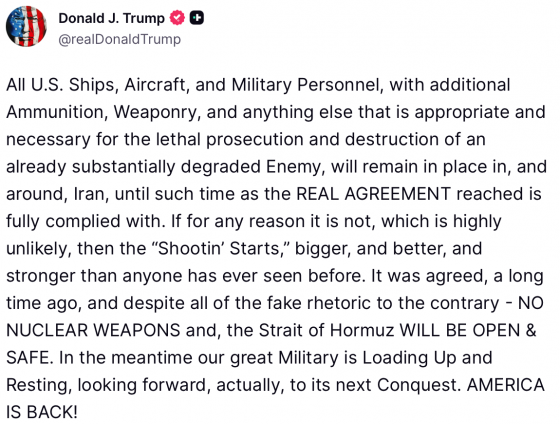
There is just one huge problem.
The Iranians are insisting on control of the Strait of Hormuz as part of any peace deal.
So Trump is going to be faced with a decision.
Either he will give the Iranians what they want, or he will start the war back up again.
But let’s be wildly optimistic for a moment.
Let’s assume that the Iranians totally give in and allow commercial traffic to flow freely through the Strait of Hormuz.
Even if that were to happen, traffic through the Strait of Hormuz would not return to normal levels for a very long time to come.
We know that this is true, because traffic through the Red Sea has still not returned to normal even though there has been a ceasefire with the Houthis for quite some time…
Analysts told CNBC that the Houthis in Yemen disrupting the Red Sea last year provides a reference point to how quickly traffic could recover following a potential ceasefire.
“In the Red Sea with the Houthis, the ceasefire agreement was last January and traffic has not returned,” Nikos Petrakakos, managing director at maritime investment manager Tufton, told CNBC in an interview. “As long as there’s a threat of an attack, that’s enough. You don’t actually need the attack.”
The bottom line is that the crisis in the Middle East is going to continue to massively disrupt the global economy for an extended period no matter what happens next.
The last tankers that departed prior to the war are arriving at their destinations, and we are already starting to see rationing and shortages all over the globe.
In fact, Madagascar just declared a nationwide energy emergency…
Madagascar has declared a two‑week nationwide state of energy emergency amid severe fuel shortages caused by the US and Israel’s war in Iran.
The presidency said the decision was taken following Tuesday’s cabinet meeting over fears the situation could lead to public disorder.
The “severe fuel shortages” that they are now experiencing will not be alleviated any time soon.
In Myanmar, a “rationing system for private vehicles” has just been imposed…
Amid fuel shortages, Myanmar’s military government has implemented a rationing system for private vehicles. Under the singular scheme, vehicles with even-numbered licence plates are only allowed to drive on even dates while those with odd-numbered plates can only drive on odd dates.
This is just the beginning.
Supplies of oil and natural gas are starting to get really tight in Europe, and European Central Bank President Christine Lagarde has warned that what the continent is facing is “probably beyond what we can imagine at the moment”…
For the European Union, the short-term consequences of Iran’s blockade of the Strait of Hormuz — steeply rising gasoline and diesel prices, and a severe jet fuel shortage putting foreign travel at risk — could be dwarfed by the long-term implications of a prolonged closure. An industrial crash, higher manufacturing prices passed on to consumers in the form of damaging inflation, fertilizer shortages and resulting spikes in food prices, and higher household utility bills all have the potential to upend European politics.
What is already being called “the biggest global energy crisis in history” could have still more drastic consequences, and the EU is particularly exposed, with most of its major economies significantly more dependent on fossil fuel imports than the UK. European Central Bank President Christine Lagarde last month described the long-term effects for Europe as “probably beyond what we can imagine at the moment”.
Little wonder, then, that the EU has convened the dreaded European “working group”. EU Energy and Housing Commissioner Dan Jørgensen said on Friday that the bloc is exploring “all possibilities” to deal with a “long-lasting” shock, in which “energy prices will be higher for a very long time.” Jørgensen mentioned fuel rationing and releasing emergency oil reserves as potential steps to mitigate the crisis; fuel rationing has already been introduced in Slovenia, while fuel restrictions have been issued at four Italian airports.
And the International Monetary Fund is publicly admitting that there will be shortages of diesel and jet fuel “for some time”…
The world will experience diesel and jet fuel shortages “for some time” because of the war in Iran, according to the International Monetary Fund (IMF).
The halting of normal flows through the Iran-controlled Strait of Hormuz – the vital oil and gas shipping route – “will for some time continue to have ripple effects”, said the organisation’s managing director Kristalina Georgieva.
She specifically mentioned shortages in refined oil products, diesel and jet fuel.
This is really happening.
Even if Iran surrenders, fully opens the Strait of Hormuz immediately and starts feverishly removing the mines, the world will still experience enormous supply disruptions throughout the remainder of 2026.
Of course the truth is that Iran does not intend to give in on anything.
The Iranians believe that they have won, and they are going to stick to the list of 10 demands that they have been relentlessly sharing with the world on social media.
Meanwhile, the Trump administration plans to stick to the list of 15 demands that it is making.
There is no way that those two lists are compatible.
So it appears that more fighting is probably inevitable, and that will just make economic conditions even worse.
Michael’s new book entitled “10 Prophetic Events That Are Coming Next” is available in paperback and for the Kindle on Amazon.com, and you can subscribe to his Substack newsletter at michaeltsnyder.substack.com.

About the Author: Michael Snyder’s new book entitled “10 Prophetic Events That Are Coming Next” is available in paperback and for the Kindle on Amazon.com. He has also written nine other books that are available on Amazon.com including “Chaos”, “End Times”, “7 Year Apocalypse”, “Lost Prophecies Of The Future Of America”, “The Beginning Of The End”, and “Living A Life That Really Matters”. When you purchase any of Michael’s books you help to support the work that he is doing. You can also get his articles by email as soon as he publishes them by subscribing to his Substack newsletter. Michael has published thousands of articles on The Economic Collapse Blog, End Of The American Dream and The Most Important News, and he always freely and happily allows others to republish those articles on their own websites. These are such troubled times, and people need hope. John 3:16 tells us about the hope that God has given us through Jesus Christ: “For God so loved the world, that he gave his only begotten Son, that whosoever believeth in him should not perish, but have everlasting life.” If you have not already done so, we strongly urge you to invite Jesus Christ to be your Lord and Savior today.