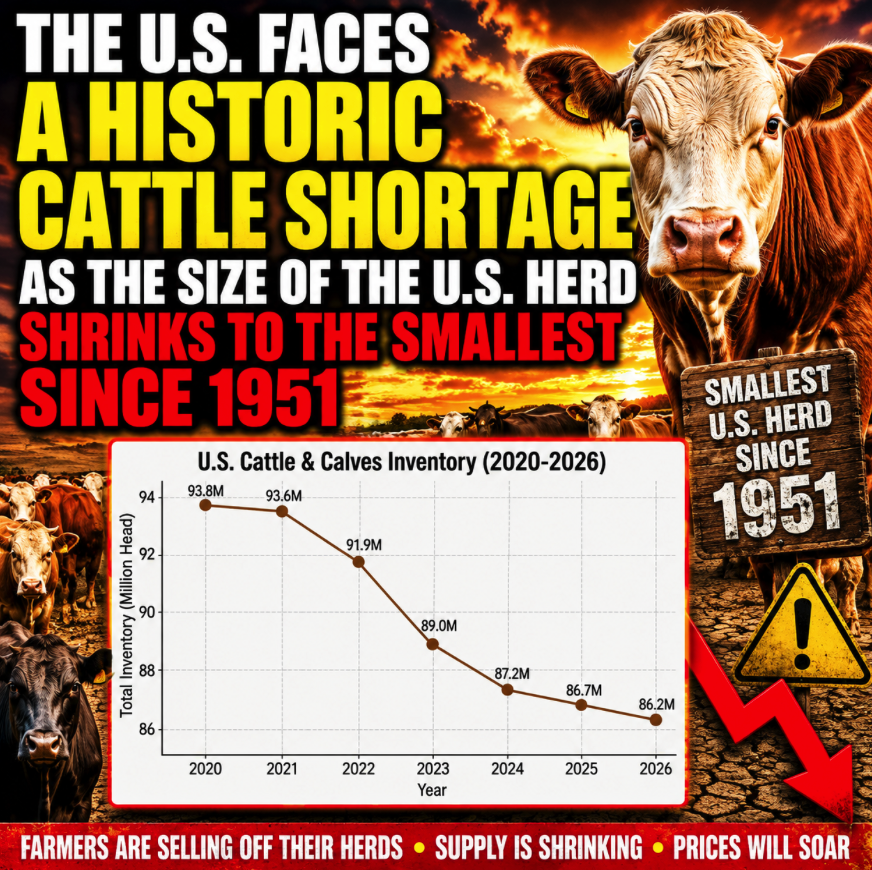
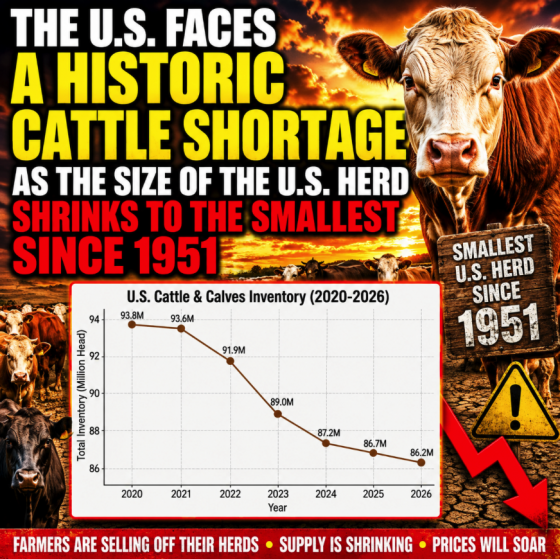
 A multi-year cattle shortage has pushed the price of beef into very painful territory. In fact, in some areas of the country the price of ground beef now exceeds the federal minimum wage. This is the first time in U.S. history that this has ever happened. At the start of 2026, there were only 86.2 million head of cattle and calves in the United States. That is the smallest the national herd has been since 1951. Just think about that for a moment. This is an enormous problem because in 1951 there were 154 million people living in this nation, but there are 342 million people living in this nation today.
We are being told that we are facing a “historic” cattle shortage, and it is causing some of the biggest meatpackers in the country to shut down facilities…
America’s ranchers are facing their smallest cattle herd in 75 years, a shortage now rippling from pastures to some of the nation’s largest meatpackers.
Tyson Foods announced last week that it will close beef facilities in Illinois and Utah and pursue the sale of another in Washington as it reshapes its beef business amid what the company called one of the most historic cattle shortages the country has ever experienced. Tyson said recent USDA data suggest supply constraints are likely to persist.
This is a major national crisis.
According to the USDA, the size of the U.S. cattle herd has fallen by 8 million just since 2019…
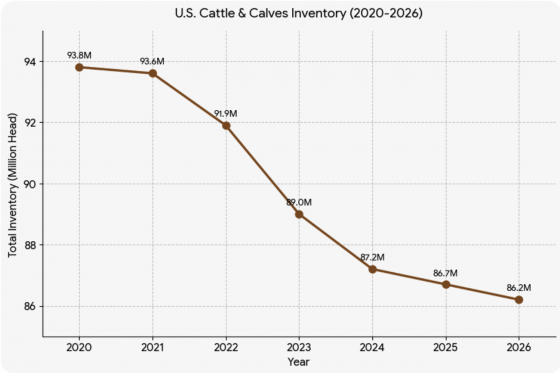
USDA data shows the U.S. entered 2026 with about 86.2 million cattle and calves, the smallest herd since the early 1950s. That’s down from roughly 94.7 million cattle and calves in 2019, a decline of more than 8 million animals.
This is another instance where the trend is not our friend.
I asked Google to create a graph of the size of the U.S. cattle herd by year, and the decline that we have been experiencing since the beginning of the decade is unmistakable…
So why is this happening?
The answer to that question is very clear.
Ranchers throughout the middle of the nation have been dealing with severe drought…
“The biggest thing has been drought,” Eric Belasco, head of the agricultural economics department at Montana State University, previously told Fox News Digital.
He said years of dry weather have depleted grasslands across the West and Plains, leaving ranchers without enough feed or water to sustain their herds. Many have been forced to sell cattle early, including cows needed to produce the next generation of calves, making the road to recovery even longer.
This isn’t a new phenomenon.
In fact, according to Wikipedia a multi-decade drought in the Southwest actually began in the year 2000…
The southwestern North American megadrought is a multidecadal drought in the southwestern region of North America that began in 2000. The 2000–2021 period was the driest 22-year period the region had experienced since at least 800 CE. The megadrought contributed to the first-ever declaration of a water shortage at Lake Mead, one of the two largest reservoirs in the United States by storage capacity.[1] Climate models project increased drought risk and drier soil-moisture conditions in the region through the end of the 21st century.[2]
There had been hope that perhaps the region may be pulling out the megadrought, but then last winter was the driest winter that many areas of the Southwest have experienced in recorded history.
It is really hard to raise cattle if it doesn’t rain, and pastures throughout the Southwest are in very rough shape right now…
Drought is hammering pastures and rangeland across the Plains and Southwest, pushing conditions significantly below where they stood a year ago.
The states with the highest percentage of pasture and range in the very-poor-to-poor category are in those two regions, according to USDA’s weekly Crop Progress report released on Monday. Nebraska, Colorado and Wyoming have the highest percentage of pastures in this category at 73%, 72% and 71%, respectively. These states also lack pasture in the good-to-excellent category, with Nebraska and Colorado both at 8% and Wyoming at 4%.
The reason why all of us should deeply care about this is because the consequences are being keenly felt at the grocery store.
Since 2021, the average price of ground beef in the United States has risen by well over 50 percent…
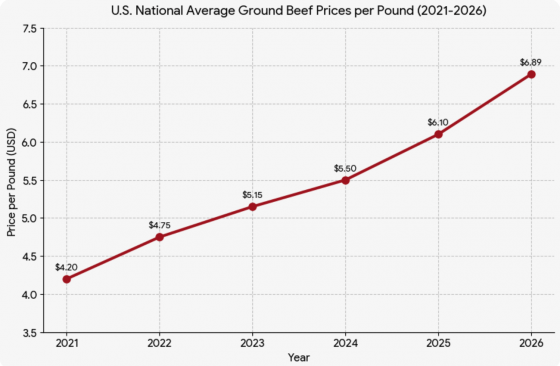
Today, the federal minimum wage is $7.25 an hour.
In some areas of the country the price of ground beef is still a little bit less than the federal minimum wage, and in some areas of the country the price of ground beef is actually higher than the federal minimum wage.
Ground beef is now more unaffordable than it has ever been in the entire history of our country.
In 1988, the average price of a pound of ground beef was $1.36.
In those days we ate like kings.
But now everything has changed, and it isn’t just the price of beef that is going up.
It is being reported that Oxford Economics is projecting that global food prices will go up 11.8 percent this year alone…
Oxford Economics projects that global food prices will rise 11.8% in 2026 and 4.8% in 2027, with the heaviest toll expected on crops—including grains, fruit, and vegetables—as well as dairy products. This outlook follows Europe’s extreme heat and drought, which have harmed harvests, while growers also grapple with steep energy and fertilizer costs, further aggravated by conflicts in the Middle East and Ukraine.
We saw a similar spike in global food prices just prior to the Arab Spring riots in the Middle East many years ago.
And JPMorgan just released a report that is projecting that global food prices will go up another 5 percent during the first half of next year…
That’s a fitting attitude for Americans staring down the possibility of even higher grocery bills. A new report from JPMorgan, Food Security is National Security: A Compounding Storm, warns that global food costs could climb 5% in the first half of 2027.
Personally, I think that JPMorgan’s forecast is way too optimistic.
But that is just my opinion.
JPMorgan is concerned about the dual impact of the Super El Niño and the worldwide fertilizer shortage…
There are two prongs to JPMorgan’s predicted food deficits: a fertilizer shortage and a monumental weather event.
And the Strait of Hormuz’s closure wasn’t just bad for gasoline prices. The strait also sees about a third of the world’s nitrogen fertilizer — an essential form of fertilizer for around half of the world’s crops.
Nitrogen fertilizer shortages are a ticking time bomb. Because it’s needed during the early stages of crop growth, we could still be feeling the effects of a shortage as much as a year later.
Most experts are still anticipating that supplies of fertilizer will be flowing normally through the Strait of Hormuz once we get to next spring.
Of course if that doesn’t actually happen we will have a real nightmare on our hands.
Already, we are facing a harvest season in the fall in which yields will be way down all over the planet thanks to a lack of fertilizer.
Everyone is counting on conditions bouncing back to normal in 2027, but I do not believe that is going to happen.
Approximately 733 million people on this planet go to bed hungry at night now, and I anticipate that number will only grow during the challenging months ahead.
Michael’s new book entitled “10 Prophetic Events That Are Coming Next” is available in paperback and for the Kindle on Amazon.com, and you can subscribe to his Substack newsletter at michaeltsnyder.substack.com.

About the Author: Michael Snyder’s new book entitled “10 Prophetic Events That Are Coming Next” is available in paperback and for the Kindle on Amazon.com. He has also written nine other books that are available on Amazon.com including “Chaos”, “End Times”, “7 Year Apocalypse”, “Lost Prophecies Of The Future Of America”, “The Beginning Of The End”, and “Living A Life That Really Matters”. When you purchase any of Michael’s books you help to support the work that he is doing. You can also get his articles by email as soon as he publishes them by subscribing to his Substack newsletter. Michael has published thousands of articles on The Economic Collapse Blog, End Of The American Dream and The Most Important News, and he always freely and happily allows others to republish those articles on their own websites. These are such troubled times, and people need hope. John 3:16 tells us about the hope that God has given us through Jesus Christ: “For God so loved the world, that he gave his only begotten Son, that whosoever believeth in him should not perish, but have everlasting life.” If you have not already done so, we strongly urge you to invite Jesus Christ to be your Lord and Savior today.