|
|
What is going to happen when the greatest economic bubble in the history of the world pops? The mainstream media never talks about that. They are much too busy covering the latest dogfights in Washington and what Justin Bieber has been up to. And most Americans seem to think that if the Dow keeps setting new all-time highs that everything must be okay. Sadly, that is not the case at all. Right now, the U.S. economy is exhibiting all of the classic symptoms of a bubble economy. You can see this when you step back and take a longer-term view of things. Over the past decade, we have added more than 10 trillion dollars to the national debt. But most Americans have shown very little concern as the balance on our national credit card has soared from 6 trillion dollars to nearly 17 trillion dollars. Meanwhile, Wall Street has been transformed into the biggest casino on the planet, and much of the new money that the Federal Reserve has been recklessly printing up has gone into stocks. But the Dow does not keep setting new records because the underlying economic fundamentals are good. Rather, the reckless euphoria that we are seeing in the financial markets right now reminds me very much of 1929. Margin debt is absolutely soaring, and every time that happens a crash rapidly follows. But this time when a crash happens it could very well be unlike anything that we have ever seen before. The top 25 U.S. banks have more than 212 trillion dollars of exposure to derivatives combined, and when that house of cards comes crashing down there is no way that anyone will be able to prop it back up. After all, U.S. GDP for an entire year is only a bit more than 15 trillion dollars. (Read More....)
[...]
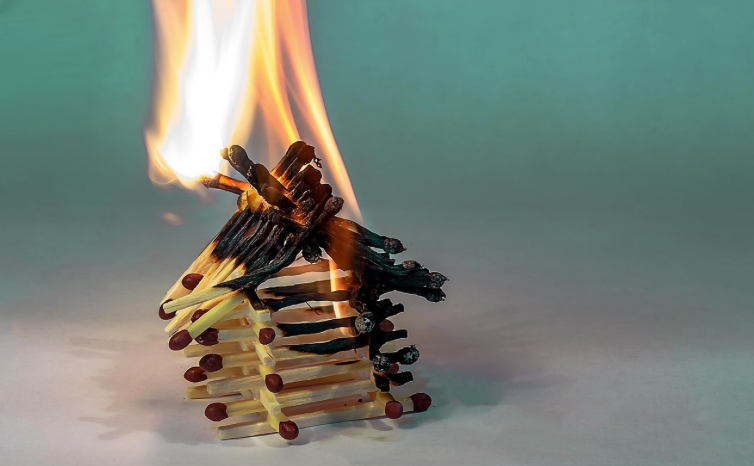
Why is the global economy in so much trouble? How can so many people be so absolutely certain that the world financial system is going to crash? Well, the truth is that when you take a look at the cold, hard numbers it is not difficult to see why the global financial pyramid scheme is destined to fail. In the United States today, there is approximately 56 trillion dollars of total debt in our financial system, but there is only about 9 trillion dollars in our bank accounts. So you could take every single penny out of the banks, multiply it by six, and you still would not have enough money to pay off all of our debts. Overall, there is about 190 trillion dollars of total debt on the planet. But global GDP is only about 70 trillion dollars. And the total notional value of all derivatives around the globe is somewhere between 600 trillion and 1500 trillion dollars. So we have a gigantic problem on our hands. The global financial system is a very shaky house of cards that has been constructed on a foundation of debt, leverage and incredibly risky derivatives. We are living in the greatest financial bubble in world history, and it isn't going to take much to topple the entire thing. And when it falls, it is going to be the largest financial disaster in the history of the planet. (Read More....)
[...]
They didn't see it coming last time either. Back in 2007, President Bush, Federal Reserve Chairman Ben Bernanke and just about every prominent voice in the financial world were all predicting that we would experience tremendous economic prosperity well into the future. In fact, as late as January 2008 Bernanke boldly declared that "the Federal Reserve is not currently forecasting a recession." At the time, only the "doom and gloomers" were warning that everything was about to fall apart. And of course we all know what happened. But just a few short years later, history seems to be repeating itself. Barack Obama, Federal Reserve Chairman Ben Bernanke and almost every prominent voice in the financial world are all promising that the U.S. "economic recovery" is going to continue even though Europe is coming apart like a 20 dollar suit. But the economic fundamentals tell a different story. Our national debt is more than $6,000,000,000,000 larger than it was back in 2008, the number of Americans on food stamps just hit another brand new all-time record, and the bankers up on Wall Street are selling gigantic mountains of the exact same kind of toxic derivatives that caused so much trouble the last time around. But all of our "leaders" swear that everything is going to be okay. You can believe them if you want, but denial is not just a river in Egypt, and another crash is inevitably coming. (Read More....)
[...]
Is the financial system of Europe on the verge of a meltdown? I have always maintained that the next wave of the economic crisis would begin in Europe, and right now the situation in Europe is unraveling at a frightening pace. On Monday, European stocks had their worst day in over six months, and over the past four days we have seen the EUR/USD decline by the most that it has in nearly seven months. Meanwhile, scandals are erupting all over the continent. A political scandal in Spain, a derivatives scandal in Italy and banking scandals all over the eurozone are seriously shaking confidence in the system. If things move much farther in a negative direction, we could be facing a full-blown financial crisis in Europe very rapidly. So watch the financial markets in Europe very carefully. Yes, most Americans tend to ignore Europe because they are convinced that the U.S. is "the center of the universe", but the truth is that Europe actually has a bigger population than we do, they have a bigger economy then we do, and they have a much larger banking system than we do. The global financial system is more integrated today than it ever has been before, and if there is a major stock market crash in Europe it is going to deeply affect the United States and the rest of the globe as well. So pay close attention to what is going on in Europe, because events over there could spark a chain reaction that would have very serious implications for every man, woman and child on the planet. (Read More....)
[...]
When financial markets in the United States crash, so does the U.S. economy. Just remember what happened back in 2008. The financial markets crashed, the credit markets froze up, and suddenly the economy went into cardiac arrest. Well, there are very few things that could cause the financial markets to crash harder or farther than a derivatives panic. Sadly, most Americans don't even understand what derivatives are. Unlike stocks and bonds, a derivative is not an investment in anything real. Rather, a derivative is a legal bet on the future value or performance of something else. Just like you can go to Las Vegas and bet on who will win the football games this weekend, bankers on Wall Street make trillions of dollars of bets about how interest rates will perform in the future and about what credit instruments are likely to default. Wall Street has been transformed into a gigantic casino where people are betting on just about anything that you can imagine. This works fine as long as there are not any wild swings in the economy and risk is managed with strict discipline, but as we have seen, there have been times when derivatives have caused massive problems in recent years. For example, do you know why the largest insurance company in the world, AIG, crashed back in 2008 and required a government bailout? It was because of derivatives. Bad derivatives trades also caused the failure of MF Global, and the 6 billion dollar loss that JPMorgan Chase recently suffered because of derivatives made headlines all over the globe. But all of those incidents were just warm up acts for the coming derivatives panic that will destroy global financial markets. The largest casino in the history of the world is going to go "bust" and the economic fallout from the financial crash that will happen as a result will be absolutely horrific. (Read More....)
[...]
Are we on the verge of societal collapse? Many of the greatest empires throughout world history were not conquered by outside forces. Rather, they crumbled inwardly as extreme social decay set in. There have been many that have compared the last days of the Roman Empire to what America is going through right now. In the decades following World War II, the United States was the most powerful and the most prosperous nation on the entire planet, but now things are rapidly changing. There are literally thousands of signs that our society is collapsing all around us. All you have to do to see this is turn on a television or pick up a newspaper. I spend a lot of time discussing our nightmarish economic and political headaches in this column, but the truth is that our problems go much deeper than that. Even if a major miracle happened and we got the "right person" into the White House, the Federal Reserve was shut down, our 16 trillion dollar national debt was paid off, our trade deficit went to zero, a solution was found for the quadrillion dollar derivatives bubble and the "too big to fail" banks were broken up, we would still be facing a national crisis of unprecedented magnitude. The cold, hard reality of the matter is that America has become an absolute cesspool of filth and corruption, and the thin veneer of civilization that we all take for granted is rapidly disappearing. Until we get our hearts right, there is not much hope for the future of this once great nation. (Read More....)
[...]
Warren Buffett once said that derivatives are "financial weapons of mass destruction", and that statement is more true today than it ever has been before. Recently, JP Morgan made national headlines when it announced that it was going to take a 2 billion dollar loss from derivatives trades gone bad. Well, it turns out that JP Morgan did not tell us the whole truth. As you will see later in this article, most analysts are estimating that the losses will eventually be far larger than 2 billion dollars. But no matter how bad things get for JP Morgan, it will not be allowed to fail. JP Morgan is the largest bank in the United States, so it is essentially the "granddaddy" of the too big to fail banks. If JP Morgan gets to the point where it is about to collapse, the U.S. government and the Federal Reserve will rush in to save it. Because of this "security blanket", banks such as JP Morgan feel free to take outrageous risks. Today, JP Morgan has more exposure to derivatives than anyone else in the world. If they win, they win big. If they lose, U.S. taxpayers will be on the hook. Not only that, but thanks to Dodd-Frank, U.S. taxpayers are on the hook for bailing out the major derivatives clearinghouses if there is ever a major derivatives crisis. So when the derivatives market crashes (and it will) you and I will be left holding a gigantic bill. (Read More....)
[...]
|
|
|
Denial Is Not Just A River In Egypt: 10 Hilarious Examples Of How Clueless Our Leaders Are About The Economy
[...]