Back during the financial crisis of 2008, the American people were told that the largest banks in the United States were "too big to fail" and that was why it was necessary for the federal government to step in and bail them out. The idea was that if several of our biggest banks collapsed at the same time the financial system would not be strong enough to keep things going and economic activity all across America would simply come to a standstill. Congress was told that if the "too big to fail" banks did not receive bailouts that there would be chaos in the streets and this country would plunge into another Great Depression. Since that time, however, essentially no efforts have been made to decentralize the U.S. banking system. Instead, the "too big to fail" banks just keep getting larger and larger and larger. Back in 2002, the top 10 banks controlled 55 percent of all U.S. banking assets. Today, the top 10 banks control 77 percent of all U.S. banking assets. Unfortunately, these giant banks are also colossal mountains of risk, debt and leverage. They are incredibly unstable and they could start coming apart again at any time. None of the major problems that caused the crash of 2008 have been fixed. In fact, the U.S. banking system is more centralized and more vulnerable today than it ever has been before.
It really is difficult for ordinary Americans to get a handle on just how large these financial institutions are. For example, the "big six" U.S. banks (Goldman Sachs, Morgan Stanley, JPMorgan Chase, Citigroup, Bank of America, and Wells Fargo) now possess assets equivalent to approximately 60 percent of America's gross national product.
These huge banks are giant financial vacuum cleaners. Over the past couple of decades we have witnessed a financial consolidation in this country that is absolutely unprecedented.
This trend accelerated during the recent financial crisis. While the big boys were receiving massive bailouts, the hundreds of small banks that were failing were either allowed to collapse or they were told that they should find a big bank that was willing to buy them.
As a group, Citigroup, JPMorgan Chase, Bank of America and Wells Fargo held approximately 22 percent of all banking deposits in FDIC-insured institutions back in 2000.
By the middle of 2009 that figure was up to 39 percent.
That is not just a trend - that is a landslide.
Sadly, smaller banks continue to fail in large numbers and the big banks just keep growing and getting more power.
Today, there are more than 1,000 U.S. banks that are on the "unofficial list" of problem banking institutions.
In the absence of fundamental changes, the consolidation of the banking industry is going to continue.
Meanwhile, the "too big to fail" banks are flush with cash and they are getting serious about expanding. The Federal Reserve has been extremely good to the big boys and they are eager to grow.
For example, Citigroup is becoming extremely aggressive about expanding....
Citigroup has been hiring dozens of investment bankers, dialing up advertising and drawing up plans to add several hundred branches worldwide, including more than 200 in major cities across the United States.
Hopefully the big banks will start lending again. The whole idea behind the bailouts and all of the "quantitative easing" that the Federal Reserve did was to get money into the hands of the big banks so that they would lend it out to ordinary Americans and get the economy rolling again.
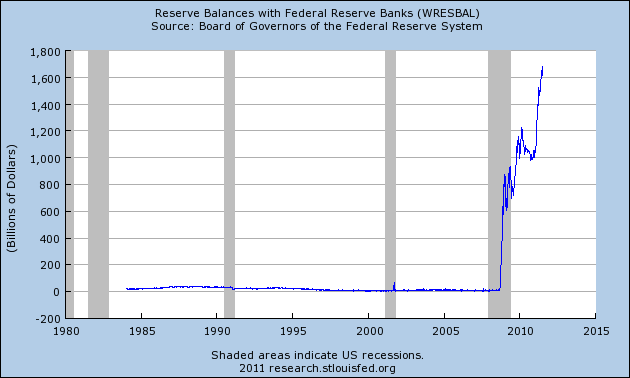
Well, a funny thing happened. The big banks just sat on a lot of that money.
In particular, what they did was they deposited much of it at the Fed and drew interest on it.
Since 2008, excess reserves parked at the Fed have grown by nearly 1.7 trillion dollars. Just check out the chart posted below....
The American people were promised that TARP and all of the other bailouts would enable the big banks to lend out lots of money which would help get the economy going for ordinary Americans again.
Well, it turns out that in 2009 (the first full year after Congress passed the bailout legislation) U.S. banks posted their sharpest decline in lending since 1942.
Lending has never fully recovered since the crash of 2008. The big financial institutions like Goldman Sachs, Morgan Stanley and JPMorgan Chase have been able to get all the cash that they need, but they have not passed that generosity along to ordinary Americans.
In fact, the biggest U.S. banks have actually reduced small business lending by about 50 percent since the crash of 2008.
That doesn't sound like what we were promised.
These "too big to fail" banks have been able to borrow gigantic amounts of money from the Fed for next to nothing and yet they still refuse to let credit flow to local communities. Instead, the big banks have found other purposes for all of the super cheap money that they have been getting from the Fed as Ellen Brown recently explained....
It can be very profitable indeed for the big Wall Street banks, but the purpose of the near-zero interest rates was supposed to be to get banks to lend again. Instead, they are, indeed, paying “outrageous bonuses to their top executives;” using the money to engage in the same sort of unregulated speculation that nearly brought down the economy in 2008; buying up smaller banks; or investing this virtually interest-free money in risk-free government bonds, on which taxpayers are paying 2.5 percent interest (more for longer-term securities).
What makes things even worse is that these big banks often pay next to nothing in taxes.
For example, between 2008 and 2010, Wells Fargo made a total profit of 49.37 billion dollars.
Over that same time period, their tax bill was negative 681 million dollars.
Do you understand what that means? Over that 3 year time period, Wells Fargo actually got 681 million dollars back from the U.S. government.
Isn't that just peachy?
Meanwhile, the big financial giants have not learned their lessons and they continue to do business pretty much as they did it prior to 2008.
The big banks continue to roll up massive amounts of risk, debt and leverage.
Today, Wall Street has become one giant financial casino. More money is made on Wall Street by making side bets (commonly referred to as "derivatives") than on the investments themselves.
If the bets pay off for the big financial institutions, mind blowing profits can be made. But if the bets go against the big financial institutions (as we saw in 2008), firms can collapse almost overnight.
In fact, it was derivatives that almost brought down AIG. The biggest insurance company in the world almost folded in 2008 because of a whole bunch of really bad bets.
The danger from derivatives is so great that Warren Buffet once called them "financial weapons of mass destruction". It has been estimated that the notional value of the worldwide derivatives market is somewhere in the neighborhood of a quadrillion dollars.
The largest banks have tens of trillions of dollars of exposure to derivatives. When the next great financial collapse happens, derivatives will almost certainly be at the center of it once again. These side bets do not create anything real for the economy - they just make and lose huge amounts of money. We never know when the next great derivatives crisis will strike. Derivatives are essentially like a "sword of Damocles" that perpetually hangs over the U.S. financial system.
When I start talking about derivatives I get a lot of people in the financial community mad at me. On Wall Street today you can bet on just about anything you can imagine. Almost everyone in the financial world has gotten so used to making wild bets that they couldn't even imagine a world without them. If anyone even tried to put significant limits on futures, options and swaps it would cause Wall Street to throw a hissy fit.
But someday the dominoes are going to start to fall and the house of cards is going to come crashing down. It is an open secret that our financial system is fundamentally unsound. Even a lot of people working on Wall Street will admit that. It is just that people are so busy making such big piles of money that nobody wants the party to stop.
It is only a matter of time until some of these big banks get into a huge amount of trouble again. When that happens, we might really find out whether they are "too big to fail" or whether we could get along just fine without them.


As a former small business person, I can’t see any indication that the banks are going to lend to small business in the near future.
Federal regulators continue to see small business and construction – the two sectors that took the brunt of the 2007-2008 meltdown – as too risky. In fact, under the leadership of US Treasury Secretary Geithner, they were instructed that TARP money was not to be used to shore up existing loans the banks had made, but only new loans.
That led the banks to call loans under “at will” clauses without cause. Specifically, construction and real estate loans were targeted as banks wiped those loans off their balance sheets through unnecessary foreclosure. (Some astute bankers, seeing valuable property there for the taking, used the foreclosure process to steal those properties through multiple corporations at pennies on the dollar.)
Thousands of jobs were destroyed, hundreds of businesses, directly and indirectly, were forced to close, bankruptcies and home foreclosures followed. The attitude of the Treasurer and the federal regulating system is that “big” is all that matters. The collapse of the construction and small business sectors in 2008 is directly attributable to these policies and to the overwhelming deregulation of the banks that allowed them to renege on such loans without cause and in bad faith.
These sectors of the economy, the ones that provided the bulk of the good-paying jobs, show no sign of coming back. The remaining owners are running scared of the banks and the federal regulators. Those few who could get a loan from a bank have watched the destruction of their fellow businesses and are afraid to increase hiring or grow their business.
It is the “information age” and its ability to maximize the creation of debt money and the profit from its creation with a minimum of personal supervision, which has made it possible for 0.1% of 1% of the population to pull this off. Such is the power of automation at the service of the money creation cartel called the Federal Reserve System.
How can Americans BEST fight back – against the ‘elite’ ‘New World Order’? By becoming more self-sufficient, and less dependent upon government
SELF-SUFFICIENCY CHECKLIST
Think: “No electricity, no running water”
Think: “Made in USA”
Think: “Solar powered” or “Hand-crank” (for cloudy days)
Think: “Prepared for any weather, any environment, any situation”
Think: “Total US Dollar Collapse”
I’ve included some links, just as EXAMPLES – I think it’s good to do a little research, find the best quality and price – and Buy American-
made, as much as possible…
1) Food is second to water, and never forget it. WATER. Rationing is a must for both Water and Food.
- Make sure you have one pot dedicated to boiling water.
- Water purification tablets will work, but be sure to follow directions.
- A small water purification unit works as well as boiling does.
- If in your home, and have no running water – there are “Dolphin air2water” or similar devices (http://www.air2water.net/products.html) that extract drinking water right out of the air. It would be ideal to have a solar-powered generator, to fuel this “air2water” device! And, possibly a Berkey Water Filter, to purify the drinking water! As a last resort – you can drink water right out of the toilet “tank”. Be careful of mold around fixtures. One tank of water should last for approx. 2 days for 2 people. In the greater outdoors – find a way to collect (and purify?) rainwater…
- “Air2water” devices need to be kept sanitary/clean, before use, as well, to avoid ingesting any mold!
2) FOOD. Dry or Freeze Dried food is best.
- Mountain House is a popular brand for storeable canned food items.
- Get a couple boxes of MREs. They are great sources of calories and one meal can last for 2-3 days. (A person CAN survive for 3-4 weeks
without food – not recommended – but, no two people are exactly, the same.) Ration as or where possible.
- Get a good book on edible plants (native to the region you’ll be ‘exploring’).
- Some foods may be eaten raw, however, cooking is always preferred.
Refrain from eating pork, chicken, or ground beef, raw. Some suggest using a small Coleman stove/grill that is powered by a small propane
tank. My only question is – what will you do, when you run out of small propane tanks? (http://www.solarovens.net/) No fuel needed, except Sun-light! Remember, it won’t be bright and sunny every day, so have an alternative for those days. Insects and larvae are a source of protein. One rule of thumb: if you can’t identify it – don’t eat it. Some insects can make you very sick, and/or kill you.
- If you are the game-hunter-type: Get a book on field-dressing animals.
- Salt. Essential to the human body, in appropriate quantities.
3) First Aid Kit. Be sure to have a ‘top notch’ first aid kit.
- It should contain sterile bandages, anti-biotic cream, burn cream, anti-bacterial wipes, insect repellant (citronella is a good, natural anti-wood-tick/deer-tick item), or NEEM oil repellant, insect bite (and/or snake bite) kit, aspirin or non-aspirin (acetominophen), sewing kit/thread/needles, sharp scissors, etc. Get a knife/scissors blade-sharpener.
- Make sure you have at least 60 days of vital, necessary medicines (such as insulin, or aspirin, etc.), and/or vitamin supplements.
- Get a good book on home remedies.
4) Toiletries: toothpaste, toothbrush, shaver, shave cream/soap, anti-bacterial soap, deoderant, shampoo, haircut scissors, comb, skin lotion, lip balm, sunscreen, etc.
__________
Also: Think hearing protection, safety/sun glasses, N95 or similar (respiratory) masks.__________
5) Clothing.
- Be sure to have both warm, and cold weather gear.
- Be sure to have rain-waterproof gear. (Boots, gloves, rain-suit w/hoodie, etc.)
- Durable, and long-lasting clothing is best, especially in terms of work boots, jeans, shirts. (I like Duluth Trading Co. – most of their stuff is imported, though :~(
http://www.duluthtrading.com/store/clothes-workwear/mens/mens-pants/86125.aspx
http://www.duluthtrading.com/store/clothes-workwear/mens/mens-pants/work-pants-for-men/work-pants-for-men.aspx?feature=P9395-C78057-L2&processor=content
- Sewing kit, 35mm film case, with extra boot/shoe laces.
- Waterproof/rain-proof poncho(s).
6) Shelter.
- Obviously, a durable water/rain-proof tent, large enough to house the required number of people, and sturdy enough to withstand high winds, rain. (‘Bath-tub’ bottom, separate ‘rainfly’, aluminum poles).
7) Bedding and linen.
- Make sure your bed is OFF the ground (ie, cot with mat, and sleeping bag, or air mattress, bed-stand, etc.)
- make sure you have a safe, effective way to clean your clothes and bedding/linen. This prevents ‘bed-bugs’, insect infestation and/or disease.
- Some say propane lanterns are best. I say solar-powered or hand-crank lanterns are best.
The more self-reliant you can be, the better. I wouldn’t rely on propane…
- Flashlight(s). An absolute necessity, when there’s a power failure, during a storm, or electrical outage. A durable, aircraft-grade aluminum LED flash- light, with long-lasting (common-sized) batteries, is recommended. Also, a hand-crank flashlight, or a shake-light flashlight is handy. With all
battery-powered tools, re-chargeable batteries are the key. You have to have an alternate source of power, to re-charge your re-chargeable batteries. (Solar-powered battery-chargers, is one example: http://www.ccrane.com/more-categories/batteries-chargers/solar-powered-battery-charger.aspx). Also, a ‘tactical’ flash-light, that has a dis-orienting ‘strobe’ effect feature, is good for self-defense.
http://www.opticsplanet.net/beamshot-td4-led-240-lumen-led-torch-strobe-and-dimmer.html
http://beamshot.com/tactical_light_pd3.html
- Having said all of that (about flashlights) – a ‘head-lamp’ is even better – because putting the light, on your forehead, frees your hands for other necessary work.
- The most reliable source of light (and cooking) is fire (candles, fireplace), if you have a place to find wood, or fuel for a fire, and a place to safely burn.
- Fire needs a source of ignition, such as a Brunton Waterproof Stormproof Lighter.
(http://www.opticsplanet.net/brunton-windproof-sealable-lighter-storm.html)
It operates on butane, however, but is small, durable, good up to 30,000 ignitions)(1,000 before needing a refill)… Otherwise, keep water-proof matches and some bic lighters in abundance. Bic lighters work for about 4 months, but break easily. Be sure to blow out candles when not in use, or there’s no one around to monitor them, or before falling asleep. There is a solar-powered fire-starter, however – go to: http://www.solarovens.net/ and scroll down to the bottom of the page. Of course, there are other, less expensive ways to start a fire, without matches or a lighter: http://www.ehow.com/how_6218457_start-fire-wilderness-matches.html – you’ll just need a magnifying glass.
9) Power. Generators are good, but not necessary.
- A DC power-inverter will (supposedly) power just about anything in your house. It will work, but only as long as you have ‘juice’ in the car battery. Remember, the old-time pioneers lived by fireplace-light, and/or candle-light. We can, too. For warmth in the winter – there’s always warm (fleece) clothing and bedding, absent electricity. Solar-powered generators that are compatible with and operate vital, necessary equipment, such as an “air2water” device – may be the best option, for power outages. Store enough water for cloudy days…
10) Personal defense accessories/self-protection.
- Non-lethal – pepper spray. For women – you can get it, in a lipstick-like container. http://www.guardian-self-defense.com/lipstickpepperspray.htm
(This is a clever way for women to protect themselves – by not alerting the
potential attacker to a more obvious cannister of pepper spray)
- Non-lethal – stun gun. Is another option.
- A hand-crank NOAA weather radio is a must, for power outages, due to storm conditions. http://www.hurricanestore.com/communication.html
- Knives. A person should consider having minimum of 3 durable, and very sharp knives in their possession, at all times (during a camping or survival situation). Buck knives are very popular, and likely the best. Also, have a knife-sharpener, that doesn’t take a lot of the metal off the blade. You’ll want the knife to last as long as possible (even after the camping outing or survival situation is over).
http://www.buckknives.com/index.cfm?event=product.wall&end_use=E#{end_use:%27O%27}
http://www.knife-depot.com/
http://www.duluthtrading.com/search/searchresults/sitesearchresults.aspx?pg=1&p_keyword=knives&p_origin=Tool_Aug11&processor=content
- Warm clothing/bedding is vital, especially in cold environments, with no power.
Fleece (undershirts and bed-covers) retains warmth, extremely well.
- Consider small two-way radios with at least a two-mile range, for communicating with family members.
- If you opt for firearm(s) – for hunting or self-protection – make sure that you know how to fire, clean and store the firearm correctly and safely. Also, keep plenty of ammo for your weapon.
11) Remember, take it easy on your-self. Don’t overwork for anything – ie, make sure the benefit outweighs the cost, as hiking/running requires A LOT of energy. Energy = Food. Avoid dangerous situations – trust your ‘gut’/instinct – it’s usually right.
12) Tansportation. A 4×4 vehicle is obviously preferable to a conventional car.
- A 4×4 can get you around/over debris, much more readily than a car, and is better, in more remote terrain. (Or, a moped? Something electric? Bicycle? Hoof it)?
13) Get a good, durable, quality watch. (I like Timex, they ‘take a licking – and keep on ticking’!)
http://www.timex.com/Timex-Rugged-Field-Metal/dp/B00304L732
http://www.timex.com/s?searchKeywords=expedition+timex&Action=submit
14) What to do, if there’s no running water, in order to use the ‘rest-room’?
- If outdoors, you can always have a small, folding, compact shovel, such as are used by the military: http://www.bing.com/images/search?q=military+folding+shovel&qpvt=military+folding+shovel&FORM=IGRE
- In an urban environment, without access to an outdoor ‘port-o-potty’ or ‘port-o-let’ you’d absolutely, for sanitary and other reasons, have to find an alternative…such as sealable containers to stop bacteria or the buildup of bacteria…
- X-tra TP…
15) Other tools: Kershaw Camp Axe: http://www.kershaw-knives.net/Kershaw-Camp-Axe-KS1018.htm
Camp Saw (even better than an axe)
http://backpackingsaw.com/folding-saw/bahco-laplander-folding-saw-review/
Magnesium Fire Starter
http://www.campingsurvival.com/maflsufistst.html
Duct tape: http://www.duluthtrading.com/search/searchresults/sitesearchresults.aspx?pg=1&p_keyword=duct+tape&p_origin=Tool_Aug11&processor=content (made in usa)
Trauma Pak w/QuickClot: http://www.duluthtrading.com/search/searchresults/sitesearchresults.aspx?pg=1&p_keyword=duct+tape&p_origin=Tool_Aug11&processor=content
Multi-tool
http://www.jomashop.com/leatherman-charge-tti-multitool-830684.html
Work gloves.
16) Additionally, you’ll need to think about having:
- identification
- important documents (& something waterproof to keep them in)
- minimum of $100 cash (small denominations = less change to carry around)
- “smuggler’s belt” http://www.duluthtrading.com/store/clothes-workwear/mens/mens-belts-mens-suspenders/75071.aspx (made in usa)
- large zip-lock (slider-lock) type “freezer” bags/disposable
- thumb-drive in a small, waterproof container
- chewing gum – no aspartame
- pet?: emergency kit, water, food for your pet
- entertainment: cards, book(s), puzzles, small, portable chess set…
____________
Survival websites:
http://www.survivalequipment.net/light.html
http://www.air2water.net/products.html
http://www.solarovens.net/
http://www.duluthtrading.com/store/clothes-workwear/mens/mens-pants/86125.aspx
http://www.ccrane.com/more-categories/batteries-chargers/solar-powered-battery-charger.aspx)
http://www.opticsplanet.net/beamshot-td4-led-240-lumen-led-torch-strobe-and-dimmer.html
http://beamshot.com/tactical_light_pd3.html
http://www.opticsplanet.net/brunton-windproof-sealable-lighter-storm.html
http://www.hurricanestore.com/communication.html
http://www.buckknives.com/index.cfm?event=product.wall&end_use=E#{end_use:%27O%27}
http://www.knife-depot.com/
http://www.coldsteel.com/gurkhakukri.html
http://www.duluthtrading.com/search/searchresults/sitesearchresults.aspx?pg=1&p_keyword=knives&p_origin=Tool_Aug11&processor=content
http://www.timex.com/Timex-Rugged-Field-Metal/dp/B00304L732
http://www.timex.com/s?searchKeywords=expedition+timex&Action=submit
http://www.bing.com/images/search?q=military+folding+shovel&qpvt=military+folding+shovel&FORM=IGRE
Yep. Start buying and storing food while it’s still cheap.
- Mike
click on profile name for more info on my latest video:
“HOW WILL YOU FACE THE AMERICAN APOCALYPSE IN 2011: how you can protect yourself and position yourself for the greatest wealth transfer in history.”
[Central] Bankers Destroy Global Economy by Design to Consolidate Power
http://www.truthistreason.net/bankers-destroy-global-economy-by-design-to-consolidate-power
MUST WATCH VIDEO:
John Perkins: The Global Elite’s Crime Syndicate
http://www.infowars.com/john-perkins-the-global-elites-crime-syndicate/
A MUST Watch Video:
Vox Populi, Methods of Manipulation- featuring David Icke, Jordan Maxwell, Max Igan, Freeman…
http://www.youtube.com/watch?v=HqrdHLzvIV4&feature=player_embedded#!
Targeting the Real Enemy: Occupy the Fed
http://www.infowars.com/targeting-the-real-enemy-occupy-the-fed/
Hello there, just became aware of your blog via Google, and located that it is really informative. I am gonna be careful for brussels. I will appreciate for those who continue this in future. Numerous other people will be benefited from your writing. Cheers!
[...] Electric, no federal taxes were paid in 2010 on U.S. profits of $5.1 billion. Similarly, between 2008 and 2010, Wells Fargo made a total profit of $49.37 billion dollars. Over that same time period, their tax bill was [...]
[...] the “too big to fail” banks are larger than ever. The total assets of the six largest U.S. banks increased by 39 [...]
[...] the “too big to fail” banks are larger than ever. The total assets of the six largest U.S. banks increased by 39 [...]
[...] the “too big to fail” banks are larger than ever. The total assets of the six largest U.S. banks increased by 39 [...]