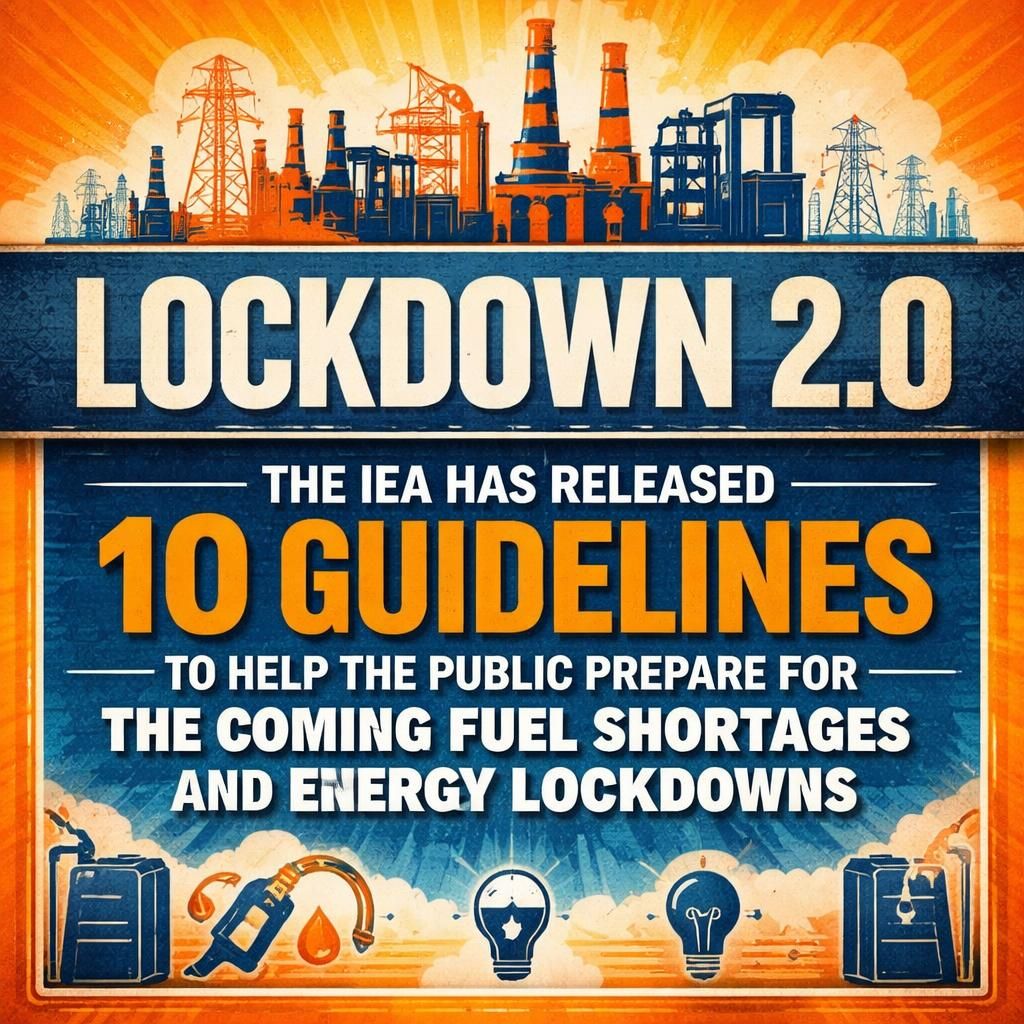
Lockdown 2.0: The IEA Has Released 10 Guidelines To Help The Public Prepare For The Coming Fuel Shortages And “Energy Lockdowns”

Are we really going to go through this again? It appears that the Iranians are absolutely determined to keep traffic through the Strait of Hormuz paralyzed until they get what they want. In order to reopen the Strait of Hormuz, an absolutely massive military operation would be required, and perhaps we will see such an operation in the days ahead. But for now approximately 2,500 ships continue to be trapped inside the Persian Gulf, and this is already starting to create fuel shortages in some parts of the globe. If the Strait of Hormuz is not reopened for months, the fuel shortages will become extremely serious and it is inevitable that “energy lockdowns” will be imposed.

Don’t think that it can’t happen.  Even now, the term “energy lockdown” is trending on social media all over the world…

A new term has begun trending on social media as the global oil crisis deepens: “energy lockdown.” While the phrase evokes memories of COVID-19 restrictions, experts say it describes something very different—a set of government-enforced or encouraged measures to reduce fuel, gas and electricity consumption in response to severe supply shocks.

The term gained traction following the closure of the Strait of Hormuz due to the Iran-Israel-US conflict, which has cut off about 20% of global oil supplies. On March 24, the sixth anniversary of India’s first COVID-19 lockdown, the term peaked as public anxiety mixed with historical memory.

As you will see below, so far most of the energy-saving restrictions which have been introduced are voluntary.

But as global energy supplies get tighter and tighter, it is probably just a matter of time before mandatory restrictions become widespread.

The International Energy Agency is giving us some clear indications of what could be ahead.  They have just released a list of 10 emergency guidelines that some users on social media are calling a “playbook” for future energy lockdowns…

The “World’s energy watchdog” has announced a list of emergency measures the public should take to help deal with the ongoing energy crisis triggered by the war in the Middle East.

Many on social media have branded the emergency energy playbook as “lockdown 2”. One critic said: “We’re not doing this again.” The International Energy Agency (IEA) has released the list of guidelines encouraging countries across the globe to reduce fuel usage.

The suggestions given in the report, called “Sheltering from oil shocks”, consists of 10 steps focused on curbing fuel consumption. The IEA has also advised member countries – such as the UK and Australia – to prepare emergency measures to overcome oil demand.

Needless to say, we are not being encouraged to wear masks this time around.

But we are being encouraged to avoid driving and to stay home.

The following is the full list of 10 guidelines that the IEA has just released…

  • Work from home where possible
  • Reduce highway speed limits by at least 10km/h
  • Encourage public transport
  • Alternate private car access to roads in large cities on different days
  • Increase car sharing and adopt efficient driving practices
  • Efficient driving for road commercial vehicles and delivery of goods
  • Divert LPG (liquified petroleum gas) use from transport
  • Avoid air travel where alternative options exist
  • Where possible, switch to other modern cooking solutions
  • Leverage flexibility with petrochemical feedstocks and implement short term efficiency and maintenace measures

I think that they realize that there simply is not going to be enough fuel for everyone if this war does not end soon.

This is going to be particularly true in Asia, because they buy more than 80 percent of the oil that travels through the Strait of Hormuz…

Countries across Asia are reviving Covid-era playbooks — from work-from-home policies to fuel-saving curbs and subsidies — as they scramble to respond to a deepening energy crisis triggered by the Iran war, Reuters reported.

The region is at the frontline of the disruption, buying more than 80% of the crude that transits the Strait of Hormuz — a vital artery that has been largely blocked since the conflict began on February 28.

This isn’t a crisis that is going to happen in a few weeks or a few months.

This is a crisis that is happening now.

As I write this article, national governments in Asia “are preparing for worst-case energy scenarios”

Governments across Asia are preparing for worst-case energy scenarios that could include a prolonged and severe disruption to supplies, even as the U.S. draws up a plan to end the war in Iran.

South Korea shifted into crisis mode on Wednesday, setting up an emergency economic task force to urgently prepare for adverse scenarios. The Philippines declared a national emergency, citing an “imminent danger of a critically low energy supply.”

Japan is reviewing its entire supply chain of petroleum-related products as the likelihood builds of shortages and knock-on effects across the economy, while India’s Prime Minister Narendra Modi warned the war could cause unprecedented challenges for the nation.

During a couple of his recent speeches, Modi made some comments that have caused a great deal of concern in India…

In his speeches in the Lok Sabha and Rajya Sabha on Monday and Tuesday about the West Asia conflict, Prime Minister Narendra Modi recalled how India faced the COVID-19 pandemic and the associated global supply chain disruptions.

“In the past too, our government did not allow the burden of global crises to fall on the farmers,“ Modi said in his address in Lok Sabha on the West Asia crisis on Monday.

On Tuesday, speaking in the Rajya Sabha, PM Modi almost repeated what he had said the day before in the Lok Sabha. Modi called upon the nation to “remain prepared and united, just as it had stood together during the COVID-19 pandemic.”

Following those speeches, Internet searches for “energy lockdown” absolutely skyrocketed.

People in India really are concerned that we could see a repeat of the darkest days of the pandemic.

Even now, the ceramics industry in the state of Gujurat has been “shut down for the best part of a month” due to a lack of fuel…

In the western state of Gujurat, a shortage of gas rather than oil has seen the region’s ceramics industry shut down for the best part of a month.

With no end in sight to the Iran conflict, the 400,000 people employed in the trade have been left in limbo.

“I will have to go hungry if I continue staying here without work,” Sachin Parashar, a migrant worker, told a local news channel.

In the vast metropolis of Mumbai, approximately 20 percent of the hotels and restaurants have already been shuttered…

In Mumbai – a city of more than 22 million people – as many as a fifth of all hotels and restaurants fully or partially shut in the first weeks of March. Items which take longer to cook are absent from menus. Long queues have formed across the nation as people try to get their hands on gas cylinders, even as the government tries to calm fears of a shortage.

“The situation [in restaurants] is dire. Cooking gas simply isn’t available,” Manpreet Singh, of the National Restaurant Association of India, which represents about 500,000 restaurants, told the BBC.

This war hasn’t even been going on for a month yet.

So what will things look like if this war continues for at least several more months?

In Sri Lanka, every Wednesday is now a “public holiday” in a desperate attempt to conserve fuel.

In Pakistan, schools have been closed for two weeks and cricket fans are being urged to stay home

In Pakistan, authorities have asked cricket fans to stay home and watch matches on television instead of travelling, in an effort to save fuel. At the same time, the government is considering limits on how much fuel vehicles can use, according to sources familiar with the plan.

The situation is also worsening in Bangladesh, where long lines have formed at fuel stations, with some stretching up to a kilometre. Many fertiliser plants have been shut down to conserve energy, while the government is trying to secure about $2 billion in loans to meet rising power demand during the summer months.

Here in the United States, we should be very thankful that we are not as dependent on Middle Eastern oil as we once were.

Because just about everyone in Asia is really hurting right now.

Japan is tapping into their strategic reserves, and South Korea is strongly considering it

The two east Asian nations are being rocked by surging import costs, forcing factories to scale back and governments to tap emergency reserves.

Japan, which imports more than 90% of its oil from the region, has begun tapping strategic reserves. South Korea is weighing reserve releases and emergency support measures.

Just about all of the oil that is used by the Philippines comes from the Middle East, and they have already declared a national energy emergency

The Philippines just became the first country to declare a national energy emergency, warning of “an imminent danger of a critically low energy supply.” The island imports 98% of its oil from the gulf.

Needless to say, this is just the beginning.

If the war does not end soon, Europe will start to run out of fuel next month

However, without a return of crude deliveries from the Gulf to global buyers via the crucial Hormuz channel, Europe could face shortages of fossil fuels within weeks, according to Wael Sawan.

The Shell chief executive told an oil industry conference in Texas: “South Asia was first to get that brunt. That’s moved to south-east Asia, north-east Asia and then more so into Europe as we get into April.”

We have never seen anything like this.

If this war stretches into the summer, there will be global panic.

Already, panic buying has caused shortages at hundreds of gas stations in Australia

Hundreds of service stations across Australia have run out of fuel, with the federal government inking a deal with Singapore, one of the country’s biggest sources of refined petroleum, to keep supplies of diesel and petrol flowing.

Concerns are now broadening to supplies of fertiliser and other chemicals, heaping more pressure on the Albanese government’s leveraging of overseas exports of coal and gas in a bid to handle of the crisis.

The energy minister, Chris Bowen, told federal parliament on Monday that 109 outlets in Victoria had run out of at least one grade of petrol, that there were 47 outlets in Queensland with no diesel and 32 without regular unleaded, and that 37 stations in New South Wales had run out of petrol.

I wish that I could tell you that the war will be over quickly and that conditions will return to normal very soon.

But I can’t do that.

The CEO of BlackRock, Larry Fink, is telling us that he believes that if the price of oil reaches 150 dollars a barrel it will cause a global recession

BlackRock CEO Larry Fink is warning that a prolonged conflict between the United States and the Islamic Republic of Iran could drive the price of oil to $150 a barrel and plunge the world into a “stark and steep recession.” The remarks come as U.S. military operations against the Islamist regime enter their twenty-fifth day, and amid weeks of energy and financial market volatility.

“Rising energy prices is a very regressive tax. It affects the poor more than the wealthy,” Fink notes, while further cautioning that Iran could force “years above $100, closer to $150 oil, which has profound implications in the economy.” The $150-a-barrel benchmark, according to the BlackRock CEO, is an important line to avoid crossing, as doing so would result in “a probably stark and steep recession.”

I believe that he is wrong.

I believe that if the price of oil reaches 150 dollars a barrel and stays there, it will cause a global depression.

I wish that I was exaggerating, but I am not.

We really have entered one of the most chaotic chapters in human history, and most of the population still has no idea what is in front of us.

Michael’s new book entitled “10 Prophetic Events That Are Coming Next” is available in paperback and for the Kindle on Amazon.com, and you can subscribe to his Substack newsletter at michaeltsnyder.substack.com.

About the Author: Michael Snyder’s new book entitled “10 Prophetic Events That Are Coming Next” is available in paperback and for the Kindle on Amazon.com.  He has also written nine other books that are available on Amazon.com including “Chaos”“End Times”“7 Year Apocalypse”“Lost Prophecies Of The Future Of America”“The Beginning Of The End”, and “Living A Life That Really Matters”.  When you purchase any of Michael’s books you help to support the work that he is doing.  You can also get his articles by email as soon as he publishes them by subscribing to his Substack newsletter.  Michael has published thousands of articles on The Economic Collapse BlogEnd Of The American Dream and The Most Important News, and he always freely and happily allows others to republish those articles on their own websites.  These are such troubled times, and people need hope.  John 3:16 tells us about the hope that God has given us through Jesus Christ: “For God so loved the world, that he gave his only begotten Son, that whosoever believeth in him should not perish, but have everlasting life.”  If you have not already done so, we strongly urge you to invite Jesus Christ to be your Lord and Savior today.
Is The World Ready For A Global Energy Catastrophe And A Global Food Catastrophe At The Same Time?

We have reached an unprecedented moment in human history. If this war with Iran continues for an extended period of time, we will be facing the greatest energy disruption in human history and the greatest food production disruption in human history simultaneously. Many were hoping that Iran would agree to the Trump administration’s proposal for a 30 day ceasefire, but it was obvious that was never going to happen. The Iranians have completely rejected Trump’s 15 point plan, and they are demanding that the U.S. must agree to permanent Iranian sovereignty over the Strait of Hormuz before any negotiations even begin. Needless to say, the U.S. will never agree to that, and so the war will rage on.

For now, Iran is determining which vessels are allowed to travel through the Strait of Hormuz…

Iranian crude tankers continue to pass through the maritime chokepoint — vital to about a third of the world’s seaborne crude oil — along with a few others that Iran has let pass through, said Matt Smith, U.S. head analyst at Kpler.

In a post on X Tuesday, MarineTraffic, which is operated by Kpler, said Iran appears to now be pursuing a strategy in the strait where it allows “selective vessel passage” to provide “strategic signaling,” rather than imposing a full disruption of global crude supply through the waterway.

The post included an animated map of sparse maritime traffic traveling through the waterway. Nine vessels have crossed since Monday, according to MarineTraffic data released early Tuesday.

Several news reports indicate Iran has begun charging vessels up to $2 million to pass through the strait. Smith said Kpler could not confirm reports of such tolls.

Some readers may be tempted to think that it is good news that nine vessels have been able to go through the Strait of Hormuz so far this week.

But approximately 2,500 others remain trapped in the Persian Gulf…

On Tuesday, HormuzTracker, which provides a Strait of Hormuz shipping-disruption dashboard, showed that there are around 2,500 vessels still trapped inside the Persian Gulf, with 400 waiting outside of the strait.

This is truly a nightmare scenario.

Desperately needed supplies of oil and natural gas are not going anywhere for the foreseeable future.

And now Iran is threatening to close the Bab el-Mandeb Strait as well

Iran could open a new front in the Bab el-Mandeb Strait if attacks are carried out on its territory or islands, IRGC-affiliated Tasnim reported, citing an unnamed military source.

“If the Americans intend to take action regarding the Strait of Hormuz, they should be careful not to add another strait to their challenges … Iran is fully prepared to escalate the situation,” Tasnim quoted the source as saying.

Iran is literally trying to paralyze the entire global economy in order to gain as much leverage as possible.

One energy industry economist is openly admitting that we have never “seen anything like this”

“We’ve not seen anything like this — there’s been no disruption of this scale in the past,” Gareth Ramsay, chief economist at oil and gas giant BP, told the conference. “It’s every oil analyst’s study piece or worst nightmare — one that we never thought would happen.”

He is right.

This is unprecedented.

And every single day that traffic through the Strait of Hormuz continues to be disrupted things will get even worse.

Already, the price of diesel has reached all-time record highs in California and Washington

The announcement, made by GasBuddy Head of Petroleum Analysis Patrick De Haan on Wednesday, comes as gas prices have continued to rise across the U.S. in recent weeks. The national average cost of a gallon of gas was $3.983 on Wednesday, according to AAA, whereas a week ago, it was at $3.842. A month ago, the national average was below $3 per gallon. Diesel prices have also been climbing higher, with two states setting a new all-time record for the price of a gallon of diesel on Wednesday.

“California and Washington have both now set new all-time records for average diesel price,” De Haan posted with an image of a graph that showed diesel prices surging past $7 in California and $6 in Washington.

There are more than 11 million diesel trucks in the United States.

That number represents about 75 percent of the entire commercial truck population.

If the price of diesel reaches 10 dollars a gallon, it will be absolutely devastating for the commercial trucking industry in this country.

Over in Europe, they are facing widespread energy shortages “as soon as next month”

Europe could face a shortage of energy and fuel as soon as next month without a reopening of the strait of Hormuz, Shell’s chief executive has said.

The boss of Europe’s biggest oil company said it was working with governments to help them address the oil and gas supply crisis, which has already led to energy rationing in Asian countries.

The beginning of next month is just days away.

Will EU politicians start implementing “energy lockdowns” in a desperate attempt to conserve oil and natural gas?

Of course this war isn’t just going to cause a global energy catastrophe.

The spring is when farmers in the northern hemisphere plant their crops, and right now vast quantities of fertilizer are locked up in the Persian Gulf region…

Farmers in the Northern Hemisphere are heading into the crucial spring months, during which major fieldwork must begin. Their peers in the south, meanwhile, are busy harvesting crops before the winter sets in.

However, their work now takes place as the Iran war creates serious supply constraints for essential fertilizer products — fueling massive price spikes and warnings of looming food insecurity.

Around one-third of the global seaborne fertilizer trade passes through the Strait of Hormuz, according to the United Nations.

What are we going to do if we can’t get that fertilizer out of the Persian Gulf before planting season is over?

One industry insider is warning that “this could be catastrophic if it lasts long”

David Delaney, the chief executive officer of phosphate producer Itafos Inc., said he can’t recall a tougher time across his four decades in the industry. After the war broke out, the United Nations warned of record levels of hunger this year. If the conflict continues for even a few more months, tens of millions of people may face severe food insecurity.

“The world is just used to big crop plantings every year and yields and crops getting to where they are needed,” he said. “I don’t want to sound the alarm too much yet, but this could be catastrophic if it lasts long.”

I discussed this in a previous article, but I don’t think that a lot of people out there fully understood that implications of what I shared.

Wheat is an annual crop that is planted every year.

Studies have shown that application of nitrogen fertilizer can increase wheat yields by up to 62 percent.

If we do not get nitrogen fertilizer into the hands of farmers in the northern hemisphere, we are going to have far less wheat in late 2026 and beyond.

Barley is also an annual crop that is planted every year.

Studies have shown that application of nitrogen fertilizer can increase barley yields by up to 25 percent.

For corn, the difference is even greater.

The amount of corn grown on an acre can more than double if nitrogen fertilizer is applied.

Just think about that.

We are talking about a dramatic drop in production.

Of course crops that are not planted annually will not be greatly affected by this fertilizer crisis.

Grape vines can go decades without fertilizer and they will just keep producing year after year.

And some olive trees that have been alive for more than 1,000 years are still bearing plenty of fruit with no problem at all.

The bottom line is that we could see a historic drop in production for annual crops such as wheat and barley, while there may be very little difference for crops that do not have to be planted annually such as grapes and olives.

This is where we are at.

No matter how much some people may want to deny it, the facts will not change.

The only way we can avoid what is ahead is if the war comes to a swift conclusion.

But that is not likely to happen any time soon, and so a lot more pain is on the way.

Michael’s new book entitled “10 Prophetic Events That Are Coming Next” is available in paperback and for the Kindle on Amazon.com, and you can subscribe to his Substack newsletter at michaeltsnyder.substack.com.

About the Author: Michael Snyder’s new book entitled “10 Prophetic Events That Are Coming Next” is available in paperback and for the Kindle on Amazon.com.  He has also written nine other books that are available on Amazon.com including “Chaos”“End Times”“7 Year Apocalypse”“Lost Prophecies Of The Future Of America”“The Beginning Of The End”, and “Living A Life That Really Matters”.  When you purchase any of Michael’s books you help to support the work that he is doing.  You can also get his articles by email as soon as he publishes them by subscribing to his Substack newsletter.  Michael has published thousands of articles on The Economic Collapse BlogEnd Of The American Dream and The Most Important News, and he always freely and happily allows others to republish those articles on their own websites.  These are such troubled times, and people need hope.  John 3:16 tells us about the hope that God has given us through Jesus Christ: “For God so loved the world, that he gave his only begotten Son, that whosoever believeth in him should not perish, but have everlasting life.”  If you have not already done so, we strongly urge you to invite Jesus Christ to be your Lord and Savior today.
Severe Shortages Of Oil And Gas Are Beginning To Happen All Over The World

Why is the mainstream media in the United States being so quiet about this? All over the globe, very serious shortages of oil and gas are starting to occur. The information that I am about to share with you is extremely alarming. Unfortunately, if this war continues for an extended period of time this will only be just the beginning of this crisis. Even if the war were to end tomorrow, and that is not going to happen, it would take time for the tankers that are currently trapped in the Persian Gulf to reach their destinations. And it would take years to fully repair the damage that has already been done to oil and gas infrastructure throughout the Middle East. Whether we like it or not, we are facing a global energy crisis for the foreseeable future, and that is not good news at all.

What would you do if you went to your local gas station and there was no more gasoline?

In Australia, there are dozens of gas stations that have already run out of at least one grade of gasoline

The energy minister, Chris Bowen, told federal parliament on Monday that 109 outlets in Victoria had run out of at least one grade of petrol, that there were 47 outlets in Queensland with no diesel and 32 without regular unleaded, and that 37 stations in New South Wales had run out of petrol.

The NSW premier, Chris Minns, had said earlier in the day that 105 outlets in his state were without diesel.

Bowen didn’t share statistics for Western Australia, the Northern Territory, South Australia or Tasmania. He also declined to say exactly when the government became aware of six shipments of oil not making its way to Australia, a fact he revealed on Sunday, only saying it was an “iterative process” and they had not all been cancelled on the same day.

The Australian government is desperately trying to secure additional supplies.

But many other governments all over the planet are doing the exact same thing.

There is going to be a scramble for whatever is available, and prices are going to spike.

In Europe, Slovenia has become the very first member of the EU to impose fuel rationing

Slovenia has become the first EU member state to implement fuel rationing to tackle disruptions caused by the US-Israeli strikes on Iran and its retaliation on their allies in the Gulf – most major players in world energy markets.

Many countries have been experiencing steep hikes in fuel prices.

In Slovenia, this has resulted in so-called “fuel tourism”, as drivers from neighbouring countries, particularly Austria, take advantage of the lower, regulated prices here.

Under the new measures, private motorists in Slovenia will be restricted to a maximum purchase of 50 litres of fuel per day. Businesses and farmers have a more generous allowance of 200 litres.

Ultimately, a lack of natural gas will be a much bigger problem for Europe.

If this war does not come to a conclusion soon, it will be a very, very cold winter across the continent.

In the Philippines, a national energy emergency was declared on Tuesday

President Ferdinand R. Marcos Jr. of the Philippines declared a national energy emergency on Tuesday, saying that high oil prices caused by the war in the Middle East were threatening the country’s energy security.

The Philippines imports 90 percent of its oil from the Middle East, making it one of the Asian countries most vulnerable to supply disruptions there. With the Strait of Hormuz effectively closed by Iran, the Philippines has had to turn to Russia and China, and to other Southeast Asian countries, for fuel.

They should have never allowed themselves to become so dependent on oil from the Middle East.

But there is one upside to all of this.

Government workers in the Philippines will only have to work four days a week for a while…

Many government offices have switched to a four-day workweek to save energy, and Mr. Marcos has called on the public to car pool. The government has also been handing out 5,000 pesos each to tens of thousands of autorickshaw and jeepney drivers around Manila who are suffering from the higher prices.

Mr. Marcos is under intense pressure to deal with the situation. A coalition of transportation workers has called for mass protests around Manila, the capital, on Thursday and Friday about the price spike and what they consider inadequate measures by the government. On Tuesday, the Philippine Daily Inquirer, a major newspaper, published a column with the headline, “Nation on brink: This oil crisis may destroy everything we built.”

We have never faced a global energy crisis of this magnitude, and there is already talk that we could soon see “lockdowns” all over the world like we witnessed during the last pandemic.

In fact, authorities in one province of Pakistan are already considering “enforcing a smart lockdown” due to a lack of oil…

Sindh authorities are considering enforcing a smart lockdown as part of efforts to reduce fuel consumption, according to Local Government Minister Nasir Hussain Shah. The move comes in response to disruptions in global oil supply linked to tensions in the Middle East.

Speaking in Sukkur, Shah described the current situation as far from ordinary, warning that prolonged conflict could create widespread challenges. He stressed the need for unconventional measures to manage the evolving crisis.

As part of ongoing steps to ease pressure on resources, the provincial government has already cut petrol allocations for official vehicles by 60 percent. The minister added that daily reviews are being conducted to monitor developments and adjust policies accordingly.

This war has only been going on for a few weeks.

What will things look like if the war lasts for a few months?

In India, we are starting to see gas lines that are reminiscent of what we experienced in the 1970s…

By late Monday night, the first signs of unease began to surface at a quiet petrol pump along Ramanthapur main road. On most evenings, the station serves a handful of customers at a time. That night, however, the trickle turned into a stream. Within minutes, motorcycles began clustering near the dispensers, autos lined up in a row, and cars spilled out on to the main road.

If you need to fill up your vehicle, I would do it now.

Gasoline prices are only going to go higher from here.

And supplies of natural gas are only going to get tighter and tighter.

QatarEnergy just sent shockwaves all over the planet when it announced that it was declaring force majeure on long-term natural gas contracts with China, South Korea, Italy and Belgium

QatarEnergy declared force majeure on long-term LNG supply contracts with South Korea, China, and other countries on the 24th. A force majeure declaration is a notification of circumstances beyond control, such as war or natural disasters, that prevent normal contract fulfillment, allowing the party to avoid legal liabilities like compensation.

According to Reuters on the same day, the countries subject to QatarEnergy’s force majeure declaration included South Korea, along with China, Italy, and Belgium.

This declaration follows massive damage to Qatar’s Ras Laffan LNG production hub during Iranian airstrikes on the 18th–19th.

The global natural gas disruption that we are witnessing is the largest in all of human history by a very wide margin.

Since natural gas is so important to fertilizer production, we are also facing an unprecedented fertilizer disruption.

And Russia just made it even worse by temporarily suspending ammonium nitrate exports

The fertilizer crisis appears to be worsening just as the Northern Hemisphere planting season, in some areas, is about to begin, with top ammonium nitrate supplier Russia announcing on Tuesday via state media that exports of the critical crop nutrient will be halted.

Russia’s state-run news agency TASS said Russia will suspend ammonium nitrate exports from March 21 through April 21. The report cited a statement from the Agriculture Ministry.

The temporary restriction is intended to secure domestic fertilizer supplies during the spring planting season. Exports made under intergovernmental agreements are exempt.

Russia is the world’s largest producer of ammonium nitrate. In 2024, the country produced about 12 million tons, roughly 47% of the global output of the plant nutrient. It was also the largest exporter at about 2.7 million tons, around 37% of global export volume and 40% of export value.

As I have discussed in previous articles, there simply is not going to be enough fertilizer to go around, and global food production will be way down this year as a result.

Right now, we are still eating food that was produced last year.

Six to nine months from now, global supplies of food will start getting really tight and prices will soar.

So if you need to stock up, now is the time.

Hopefully this war will end soon.

But I don’t think that it will, and that means that things will soon get far crazier than they are now.

Michael’s new book entitled “10 Prophetic Events That Are Coming Next” is available in paperback and for the Kindle on Amazon.com, and you can subscribe to his Substack newsletter at michaeltsnyder.substack.com.

About the Author: Michael Snyder’s new book entitled “10 Prophetic Events That Are Coming Next” is available in paperback and for the Kindle on Amazon.com.  He has also written nine other books that are available on Amazon.com including “Chaos”“End Times”“7 Year Apocalypse”“Lost Prophecies Of The Future Of America”“The Beginning Of The End”, and “Living A Life That Really Matters”.  When you purchase any of Michael’s books you help to support the work that he is doing.  You can also get his articles by email as soon as he publishes them by subscribing to his Substack newsletter.  Michael has published thousands of articles on The Economic Collapse BlogEnd Of The American Dream and The Most Important News, and he always freely and happily allows others to republish those articles on their own websites.  These are such troubled times, and people need hope.  John 3:16 tells us about the hope that God has given us through Jesus Christ: “For God so loved the world, that he gave his only begotten Son, that whosoever believeth in him should not perish, but have everlasting life.”  If you have not already done so, we strongly urge you to invite Jesus Christ to be your Lord and Savior today.

Has A Global Catastrophe Been Averted, Or Is This Just A Very Temporary Reprieve?

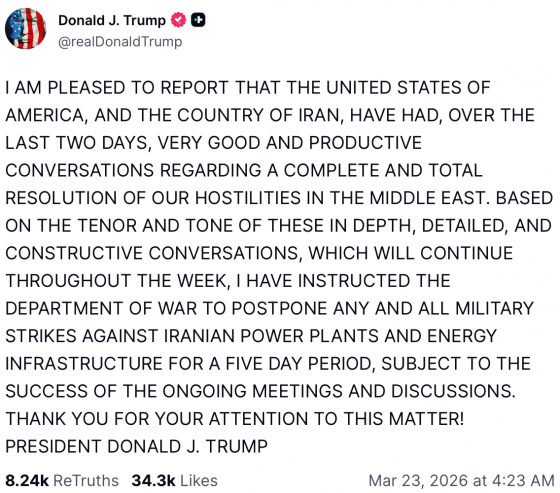
For the moment, we have avoided a global economic cataclysm. President Trump was threatening to completely destroy Iran’s power grid if the Iranians did not reopen the Strait of Hormuz, and in response the Iranians were threatening to destroy oil and gas infrastructure all over the Middle East. Once that infrastructure is gone it would have to be replaced, and that would take years. Meanwhile, the entire world would be forced to endure the worst energy crisis in human history and the economic fallout would be intolerable. The good news is that President Trump has announced that he will not be attacking Iran’s power grid for at least five days. I think that once Iran released the list of oil and gas facilities that would be targeted if their power grid got destroyed, Trump decided to reconsider his plans…

Iran’s IRGC-affiliated Mehr news wrote: “In case of the slightest attack on the electricity infrastructure of the Islamic Republic of Iran, the entire region will go dark.” Here’s the target list it shared:

Saudi Arabia

  • The Village (near Al-Khobar): gas power plant (4,000+ MW)
  • Ras Tanura (Sharqiya Province): major oil and gas facility / power infrastructure

United Arab Emirates

  • Barakah (Al Dhafra, Abu Dhabi): nuclear power plant (~5,600 MW)
  • Jebel Ali (South Dubai): gas power and desalination complex (multi-GW capacity)
  • Mohammed bin Rashid Solar Park (Dubai): large-scale solar power project

Qatar

  • Ras Laffan (north Qatar): gas power plant (one of the largest in Qatar)
  • Umm Al Houl (south of Doha): gas power + desalination plant (multi-GW capacity)

Kuwait

  • Al-Zour South: oil and gas power plant
  • Al-Zour North: combined-cycle power plant (multi-GW capacity)
  • Shaqaya Energy Park (west Kuwait): solar and wind renewable energy complex

Please note that the Ras Laffan natural gas complex in Qatar is on that list.

It normally produces approximately 20 percent of the world’s entire supply of liquified natural gas.

17 percent of that facility has already been destroyed, but if the rest of it gets wiped out that alone would be enough to plunge the globe into an economic death spiral that would last for years.

I am sure that Qatar and the other Gulf countries have been screaming at Trump to pull back before it is too late.

Another reason why Trump could not attack Iranian power plants right now is because pro-regime civilians have started to form “human chains” around some of them…

Civilians in Ahvaz and Mashhad formed human chains around major power plants on Monday, according to footage published by the state‑run Fars news agency on Telegram. The videos show residents standing shoulder‑to‑shoulder outside the Ramin power plant in Ahvaz, many holding Iranian flags, while similar crowds gathered near a facility in Mashhad.

Images of U.S. bombs blowing up women and children would have absolutely horrified people all over the planet.

So there was no way that Trump could make good on his threats.

On Monday morning, Trump told the world that any attacks on the Iranian power grid have been delayed for at least five days…

It would be wonderful if “productive conversations” were taking place.

Let us hope that is the truth.

But the Iranians are completely denying that any conversations are taking place, and they are celebrating that Trump has “backed down”

Shortly after US President Donald Trump announced that he is deferring “any and all” strikes on Iranian power plants and energy infrastructure on productive resolution talks, Iranian media reports denied any ‘direct’ or ‘intermediary’ communication with him.

“Trump, fearing Iran’s response, backed down from his 48-hour ultimatum,” Islamic Republic of Iran Broadcasting said in a post on X.

Ebrahim Rezaei, Spokesperson of the National Security and Foreign Policy Commission reiterated the claims and said, “Trump and America have backed down again. The field is still charging forward. Another defeat for the devil,” in a post on X.

Each side is telling a completely different story.

So what is the truth?

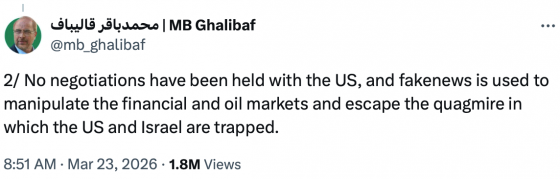
It is being widely reported in the western media that the individual that the Trump administration is communicating with is Mohammad‑Bagher Ghalibaf, but he is strongly denying this…

Multiple news outlets reported in the past hour that U.S. envoys Steve Witkoff and Jared Kushner had been engaged in negotiations with Mohammad‑Bagher Ghalibaf, the speaker of Iran’s parliament. But an X account attributed to Ghalibaf swiftly rejected those claims, saying no discussions with the United States had taken place.

The post accused unnamed actors of spreading “fake news” to manipulate global oil markets and insisted that the Iranian public “demand complete and remorseful punishment of the aggressors.”

Personally, I don’t know how Mohammad-Bagher Ghalibaf could have been much clearer.

And Iran’s Foreign Ministry is also telling us that there have been no negotiations…

Iran’s Foreign Ministry denied on Monday any direct negotiations with U.S. officials, but said “friendly countries” had conveyed messages from Washington seeking negotiations.

“In recent days, messages were delivered through certain friendly countries indicating that the U.S. sought negotiations to end the war. These messages were appropriately addressed in line with our country’s principled positions,” Esmail Baqaei, spokesperson for the Iranian Foreign Ministry, told the country’s state news agency IRNA on Monday. “In our responses, we issued firm warnings about the severe consequences of any attack on Iran’s critical infrastructure, emphasizing that any action against Iran’s energy facilities would be met with a decisive, immediate, and effective response from our armed forces.”

Maybe the Iranians are simply choosing not to tell the truth.

Needless to say, they don’t exactly have a strong track record for veracity.

Despite Iran’s denials, Trump continues to insist that there have been “very, very strong talks”

“Well they’re going to have to get themselves better public relations people,” Mr. Trump said. “We have had very, very strong talks. We’ll see where they lead. We have points, major points of agreement, I would say almost all points of agreement. Perhaps that hasn’t been conveyed. The communication, as you know, has been blown to pieces.”

The president would not say who his administration is speaking to in Iran, only saying it was a “top” person but not the supreme leader. Mr. Trump added that Iran contacted the U.S., saying, “So they called, I didn’t call. They called. They want to make a deal.”

Ultimately, I don’t think that any of this is going anywhere.

As I write this article, missiles continue to fly all over the Middle East.

The Iranians just launched more attacks, and the Israelis continue to pummel targets in Iranian territory.

And thousands of U.S. Marines continue to sail toward the Middle East…

There has been no change in plans to send thousands more Marines and sailors to the Middle East, military sources told CBS News.

A second Marine Expeditionary Unit of about 2,200 Marines and three warships departed California last week, two U.S. officials previously said. It could take at least three weeks to be in place, although maybe more than that.

The first Marine Expeditionary Unit, coming from the Pacific, is still making its way toward the region.

In addition to the Marine units that are on the way, it is also being reported that elements of the 82nd Airborne Division could soon be sent to the Middle East…

Senior military officials are weighing a possible deployment of a combat brigade from the Army’s 82nd Airborne Division and some elements of the division’s headquarters staff to support U.S. military operations in Iran, defense officials said.

I think that Trump is really hoping that Iran will give him the sort of deal that he is seeking.

But that isn’t going to happen.

And Trump can’t pull the U.S. out of the war as long as Iran is preventing commercial ships from traveling through the Strait of Hormuz and as long as Iran is hitting targets all over the Middle East with drones and missiles.

The Iranians feel like they have control over when this war will end, and so they are making all sorts of extremely outrageous demands that the U.S. and Israel can never possibly accept.  They actually want all U.S. forces in the Middle East to be completely removed, they want to continue enriching uranium, and they want the U.S. and Israel to fully pay for all the damage that their bombing has caused.

Needless to say, the U.S. and Israel will never agree to any of that.

So I think that this war is going to continue for quite some time, and I also think that more escalations are inevitable.

And that is really bad news for the global economy, because this war has already had “a worse impact on oil than the two oil shocks of the 1970s combined”

The head of the International Energy Agency said Monday that the global economy faces a “major, major threat” because of the Iran war.

“No country will be immune to the effects of this crisis if it continues to go in this direction,” Fatih Birol said at Australia’s National Press Club in Canberra on Monday.

The ​crisis in ​the Middle ⁠East, he said, has had a worse impact on oil than the two oil shocks of the 1970s combined, and a worse effect on gas than the Russia-Ukraine war.

We should all be thankful that a nightmare scenario has been avoided for the time being.

But it appears that this is just a very temporary reprieve.

The Iranians will never give Trump what he wants, and the U.S. and Israel will never give the Iranians what they are seeking.

The two sides are not even in the same universe as far as what a peace deal should look like, and that means that a lot more fighting is still ahead.

Michael’s new book entitled “10 Prophetic Events That Are Coming Next” is available in paperback and for the Kindle on Amazon.com, and you can subscribe to his Substack newsletter at michaeltsnyder.substack.com.

About the Author: Michael Snyder’s new book entitled “10 Prophetic Events That Are Coming Next” is available in paperback and for the Kindle on Amazon.com.  He has also written nine other books that are available on Amazon.com including “Chaos”“End Times”“7 Year Apocalypse”“Lost Prophecies Of The Future Of America”“The Beginning Of The End”, and “Living A Life That Really Matters”.  When you purchase any of Michael’s books you help to support the work that he is doing.  You can also get his articles by email as soon as he publishes them by subscribing to his Substack newsletter.  Michael has published thousands of articles on The Economic Collapse BlogEnd Of The American Dream and The Most Important News, and he always freely and happily allows others to republish those articles on their own websites.  These are such troubled times, and people need hope.  John 3:16 tells us about the hope that God has given us through Jesus Christ: “For God so loved the world, that he gave his only begotten Son, that whosoever believeth in him should not perish, but have everlasting life.”  If you have not already done so, we strongly urge you to invite Jesus Christ to be your Lord and Savior today.
Apocalypse Rising: We Have Reached A Moment In Human History That Could Change Everything

After this week is over, there may be no turning back. President Trump is literally threatening to “obliterate” Iran’s power grid, and the Iranians cannot do a thing to prevent that from happening. But in response, the Iranians are threatening to destroy oil and gas infrastructure all over the Persian Gulf. The Iranians have already destroyed 17 percent of Qatar’s Ras Laffan natural gas complex, and if they destroy the remaining 83 percent of that facility it will immediately plunge us into the greatest natural gas crisis in human history by a very wide margin. There would be widespread natural gas shortages, fertilizer plants all over the world would be forced to shut down, and hunger would run rampant. Approximately 20 percent of the world’s entire supply of liquified natural gas comes from Ras Laffan, and it will take 3 to 5 years to rebuild the portions of the complex that have already been destroyed. If the rest of the complex gets destroyed by Iran, it will be a cataclysmic event. When I say that, I am not exaggerating one bit. We really have reached a moment in human history that could change everything.

It all depends on what Donald Trump does next.

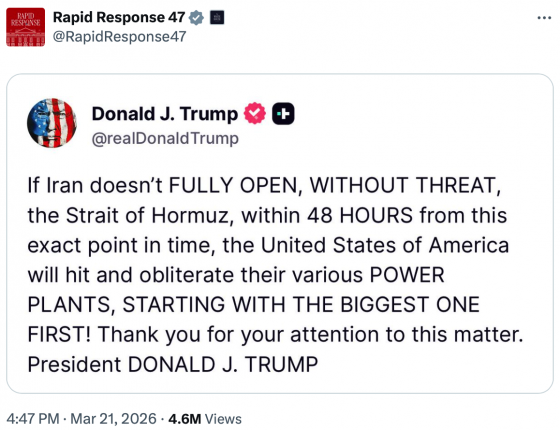
On Saturday, Trump gave the Iranians an ominous ultimatum.

Either they fully open the Strait of Hormuz within 48 hours, or the U.S. military will destroy their power grid

For reasons that I have discussed in previous articles, the Iranians are not going to give Donald Trump what he wants.

It just isn’t going to happen.

Instead of giving in to Trump’s demands, the Iranians are threatening to attack energy infrastructure throughout the Persian Gulf, and they are pledging to completely close the Strait of Hormuz

In a response to Trump’s statements, the Khatam al-Anbiya Central Headquarters, which is the central headquarters of the Iranian armed forces, said that it will fully close the Strait of Hormuz if “America’s threats regarding Iran’s power plants are implemented.”

Iran also warned that it would start targeting “all power plants, energy infrastructure, and information technology,” while any company in the region with American shareholders would also become a target.

Finally, Iran threatened to attack the power plants of any country in the region hosting American military bases.

“Everything is ready for a great jihad with the aim of completely destroying all economic interests of America in the Middle East,” the statement said.

So what happens if the Iranians wipe out Qatar’s Ras Laffan natural gas complex and other extremely critical energy production facilities in other Gulf countries?

What would Trump’s next move be then?

Would he send in U.S. ground troops?

CBS News is already reporting that U.S. officials have “made detailed preparations for deploying U.S. ground forces into Iran”…

Pentagon officials have made detailed preparations for deploying U.S. ground forces into Iran, multiple sources briefed on the discussions told CBS News.

Senior military commanders have submitted specific requests aimed at preparing for such an option as President Trump weighs moves in the U.S.-Israel-led conflict with Iran, the sources said.

The most likely target for U.S. ground troops would be Kharg Island, and the Iranians are promising that we will “suffer losses that are unprecedented since World War II” if Trump tries to do that…

An Iranian military source warned that new U.S. strikes or an invasion of Kharg Island, a key Iranian oil export hub, could prompt Tehran to escalate by threatening nearby waterways, including the Red Sea and the Bab al-Mandab Strait, telling the Islamic Revolutionary Guard Corps (IRGC)-affiliated Tasnim News Agency the United States would face an “unprecedented” response.

On a potential U.S. invasion of the island, the official warned that American troops would struggle to defend it and would “suffer losses that are unprecedented since World War II.”

How far up the escalation ladder are we willing to go?

It sounds like Israel is ready to raise the stakes as well.

The Iranians have been hitting Israeli population centers with cluster munitions, and Israeli Defense Minister Israel Katz is warning that if this continues his nation will “hit Iran so hard it will be sent back decades”

Israeli Defense Minister Israel Katz said Israel would send Iran “back decades” if it continues targeting cities, accusing Tehran of deliberately firing on civilian population centers.

“If this continues, we’ll be sure to hit Iran so hard it will be sent back decades,” Katz said while visiting the site of a missile strike in Arad that injured scores.

If the U.S. and Israel push Iran to the wall, will the Iranians unleash any unconventional weapons that they have been holding in reserve?

In such a scenario, how would the U.S. and Israel react?

We are only a couple of steps away from an apocalyptic scenario.

Already, the damage that this war has done has set the global economy back for years.

The price of oil is causing major problems all over the globe, and experts are warning that we could eventually see it reach $200 a barrel

Vandana Hari, founder of oil market analysis firm Vanda Insights, warned: “Benchmark Middle Eastern crudes like Oman and Dubai have already crossed the $150 threshold, so $200 is already within sight, even if not for Brent and West Texas Intermediate.”

Analysts at consultancy Wood Mackenzie have also said Brent could soon hit $150 and that $200 oil is not “outside the realms of possibility” in 2026.

If this war stretches on for an extended period of time, the pain that we will experience is going to be immense.

I am already hearing of diesel shortages in some parts of the world, and United Airlines has already canceled approximately 5 percent of this year’s planned flights

United Airlines (UAL) CEO Scott ‌Kirby said on ‌Friday the airline will cancel ​about 5% of this year’s planned flights in the short ‌term, as ⁠jet fuel prices surge due to ⁠the Middle East conflict.

“If prices stayed ​at this ​level, ​it would mean ‌an extra $11 billion in annual expense just for jet fuel,” Kirby said in a ‌message to ​employees posted ​on ​its website.

Of course the natural gas crisis that we are facing could potentially be even worse.

If this war lasts for a number of months, we could literally have to deal with “a full-blown economic emergency across Europe, the UK and large parts of Asia”…

Bank of America has warned European gas prices could surge from around €29 to as high as €500 this winter if the strait stays shut for an extended period, far exceeding levels seen after Russia’s invasion of Ukraine.

Such a spike would trigger what analysts describe as a full-blown economic emergency across Europe, the UK and large parts of Asia, with energy costs spiralling and industries forced to cut back, The Telegraph reports

Needless to say, natural gas is also a primary raw material that is used in the production of nitrogen fertilizer.

Normally, close to a third of all fertilizer that is traded globally travels through the Strait of Hormuz

About a third of all fertilizer shipped globally goes through the Strait of Hormuz, the narrow passage between the Persian Gulf and the Gulf of Oman. Now, shipping traffic has been reduced to a trickle because of the U.S.-Israeli war with Iran, and the prices of goods like oil, natural gas, and fertilizer have been rising.

“Fertilizer prices are way up. They’re up around 30 percent more in some parts of the world, and that’s significant,” says Noah Gordon, fellow at the Carnegie Endowment for International Peace.

Gulf countries like Saudi Arabia, the United Arab Emirates, Kuwait and Iran are big global producers of fertilizer, and they export the raw ingredients other countries use to make their own fertilizers, like natural gas and minerals.

But that is only part of the story.

Because they are not able to get liquified natural gas from the Persian Gulf right now, fertilizer plants in other parts of the globe are being forced to close down

The Carnegie Endowment noted fertilizer production in India, Bangladesh and Pakistan has shut down because those countries cannot get natural gas from Qatar, and Egypt, another producer, has had to turn to the more expensive LNG market because its supplies from Israel have been disrupted.

This is planting season for farmers all over the northern hemisphere.

In many poorer countries, there simply won’t be enough fertilizer this year.

In wealthier countries, fertilizer will be available, but it will cost far more than it usually does…

Tennessee farmer Todd Littleton expects to pay $100,000 more for fertilizer this season, a 40% spike from his bill last year thanks to the war in Iran — and he is scrambling to cover that extra cost.

“The problem is, is we’re so strained financially coming into this issue,” said Littleton, a third-generation farmer from Gibson County in the state’s northwest corner. “We have had a couple of record losses the last couple years, so everyone’s kind of grabbing at straws anyway, and then to have input prices increase yet again, it just really couldn’t happen at a worse time.”

Littleton, who grows corn, soybeans and wheat, is among thousands of farmers across the country who will pay far more this spring than they expected for fertilizer that is essential to their crops. Nitrogen-based fertilizer is especially vital for corn, usually the largest crop in the U.S. — and one that feeds the nation’s livestock and is converted into fuel that helps power most U.S. cars and trucks.

The crops that will be primarily affected by this fertilizer crisis will be those that are planted annually.

This is such an important point.

For example, nitrogen fertilizer is widely used by wheat farmers to maximize yield, improve grain quality, and promote healthy growth.  A lack of fertilizer will mean that less wheat will be grown around the world in 2026 and prices will soar.

Barley is another example of an annual crop that is heavily dependent on nitrogen fertilizer because it promotes leaf and stem development, significantly affecting both yield and crop quality.  By the end of this year, barley prices are likely to be far higher than they are now.

On the other hand, crops that do not have to be planted annually will fare much better.

Grape vines can live for 50 to 100 years, and they will just keep producing year after year.

Olive trees commonly live for hundreds of years, and some can even survive for more than 1,000 years.  Incredibly, there are examples of olive trees that have been around for more than a millennium that are still bearing fruit.

What I am saying is that annual crops like wheat and barley could be absolutely devastated by this current crisis, while crops that do not have to be planted annually such as grapes and olives will not experience much disruption.

So much is going to depend on what happens this week.

Decisions that are being made right now are going to deeply affect every single one of us, and so let us hope that our leaders make their decisions wisely.

Michael’s new book entitled “10 Prophetic Events That Are Coming Next” is available in paperback and for the Kindle on Amazon.com, and you can subscribe to his Substack newsletter at michaeltsnyder.substack.com.

About the Author: Michael Snyder’s new book entitled “10 Prophetic Events That Are Coming Next” is available in paperback and for the Kindle on Amazon.com.  He has also written nine other books that are available on Amazon.com including “Chaos”“End Times”“7 Year Apocalypse”“Lost Prophecies Of The Future Of America”“The Beginning Of The End”, and “Living A Life That Really Matters”.  When you purchase any of Michael’s books you help to support the work that he is doing.  You can also get his articles by email as soon as he publishes them by subscribing to his Substack newsletter.  Michael has published thousands of articles on The Economic Collapse BlogEnd Of The American Dream and The Most Important News, and he always freely and happily allows others to republish those articles on their own websites.  These are such troubled times, and people need hope.  John 3:16 tells us about the hope that God has given us through Jesus Christ: “For God so loved the world, that he gave his only begotten Son, that whosoever believeth in him should not perish, but have everlasting life.”  If you have not already done so, we strongly urge you to invite Jesus Christ to be your Lord and Savior today.
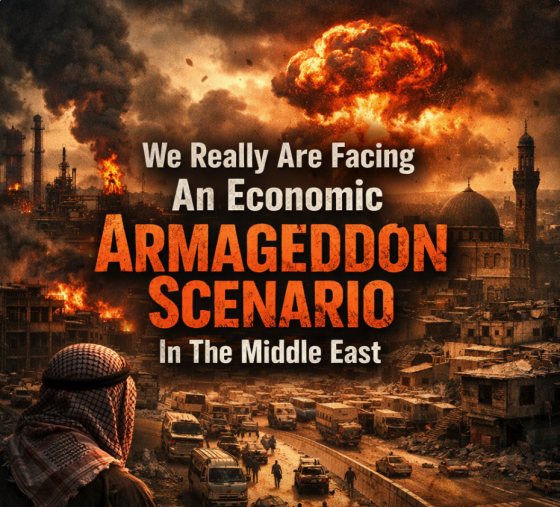
We Really Are Facing An “Economic Armageddon” Scenario In The Middle East

When this war with Iran erupted, everyone knew that it would have an impact on the global economy. But very few anticipated that it would be this bad. We are facing the worst oil disruption in history, the worst natural gas disruption in history, the worst helium disruption in history and the worst fertilizer disruption in history simultaneously. The Iranians have control over which ships are allowed through the Strait of Hormuz, and they are determined to keep it that way for as long as possible. But even if the war ended and traffic through the Strait of Hormuz was fully restored tomorrow, it would take years for the global economy to return to normal because of all the energy infrastructure that has been destroyed on both sides.

With no end in sight for the war, oil prices in the western world just continue to move higher.

But if you want to see where oil prices are eventually headed if this crisis persists, just check out what has been happening in Dubai.

At one point on Thursday, the price of oil in Dubai briefly hit an all-time record of $166 a barrel

The extreme spike in oil prices seen in local markets in the Middle East could give investors a glimpse into to where U.S. and Europe prices are headed if the Strait of Hormuz isn’t opened soon.

Dubai crude oil prices surpassed $166 a barrel to a new record high on Thursday, according to market data provider Platts. Dated Brent and West Texas intermediate Cushing’s are trading around the $100 mark after historic runs higher.

Normally, the price of oil in Dubai falls somewhere between West Texas oil and Brent oil.

But once the war began, it started selling at an unprecedented premium.

In Saudi Arabia, officials are projecting that the price of oil could eventually surpass $180 a barrel if this war persists until the end of next month…

Saudi Arabia’s oil officials are working frantically to project how high oil prices might go if the Iran war and its disruption of energy supplies doesn’t end soon-and they don’t like what they are seeing.

The base case, several oil officials in the Gulf’s biggest producer said, is that prices could soar past $180 a barrel if the disruptions persist until late April.

While that would sound like a bonanza for a kingdom still heavily leveraged to oil revenue, it is deeply concerning. Prices that high could push consumers into habits that slash their oil use-potentially for the long term-or trigger a recession that also hurts demand. They also would risk casting Saudi Arabia in the role of profiteer in a war it didn’t start.

If the price of oil reaches that level and stays there for an extended period of time, it will crash everything.

Our system is simply not designed to be able to handle a shock like that.

Of course we are also facing a historic natural gas crisis as well.

Normally, approximately one-fifth of the world’s supply of liquified natural gas is produced by Qatar’s Ras Laffan complex.

That complex is nearly three times the size of Paris, and it cost hundreds of billions of dollars to build.

So it was a really, really big deal when Iranian missiles started raining down.

The CEO of QatarEnergy is telling us that output at the complex has been reduced by 17 percent, and it will take three to five years to rebuild the capacity that has been lost…

Qatar could face years of reduced natural gas exports after Iranian strikes damaged key energy infrastructure, wiping out a significant share of its liquefied natural gas (LNG) production capacity, QatarEnergy’s chief executive told Reuters.

Saad al-Kaabi said the attacks disabled two LNG production units out of 14 and one gas-to-liquids facility out of two, reducing output by about 17% at a time when Qatar sits at the heart of global gas supply.

He said the affected facilities alone account for roughly 12.8 million tonnes of annual LNG production, and warned repairs could keep them offline for three to five years depending on security conditions and technical recovery timelines.

This is a catastrophic blow for the global economy.

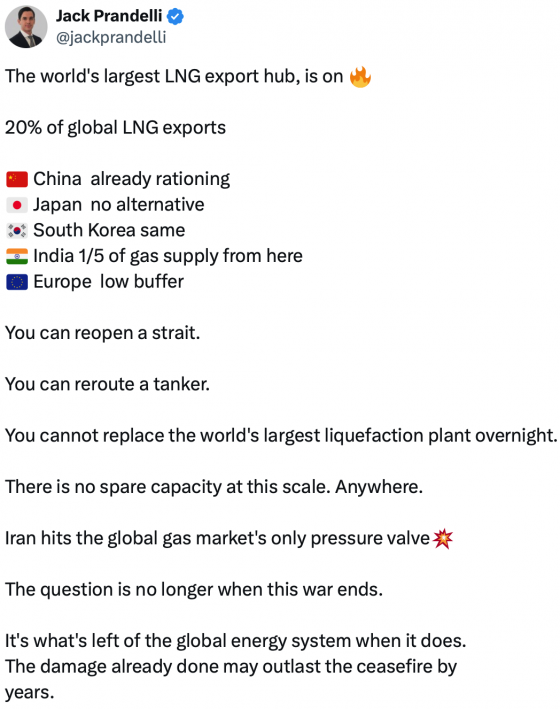
As Jack Prandelli has accurately observed, there is no spare capacity elsewhere on the planet that can replace what has been destroyed…

So what do we do now?

It is going to take years to repair the damage that has already been done.

And what is going to happen if Iran attacks Qatar’s Ras Laffan complex again?

Meanwhile, the world is also facing a looming helium shortage.

Prior to the war, Qatar’s Ras Laffan complex produced over one-third of the world’s entire supply of helium

The war in the Middle East could pose a threat to the semiconductor industry and other sectors dependent on a resource produced in the Gulf — helium.

Helium is a little-known but key input in many industries, most notably technology. In semiconductor manufacturing, its cooling properties are used to transfer heat. Helium is also indispensable in photolithography, a technique used to print each chip’s intricate circuitry.

The U.S. Geological Survey estimates that before the war Qatar produced more than one-third of the world’s helium supply. Lately, however, operations at QatarEnergy’s Ras Laffan Industrial City — the world’s largest liquefied natural gas export facility, which produces helium as a byproduct — were halted after it was struck by an Iranian drone early in the war. On Wednesday, Iranian missiles crippled the plant.

Without that helium, tech companies all over the planet are going to be thrown into a state of chaos.

So that is a huge problem.

But personally I am even more concerned about what this war is going to mean for global food production.

Farmers all over the northern hemisphere are preparing to plant their crops, and so if we can’t get the fertilizer that they need through the Strait of Hormuz we are going to be in for a world of hurt

The Strait of Hormuz is a critical channel for fertilizer, including about 50% of global nitrogen-rich urea fertilizers, according to the Fertilizer Institute, the industry’s trade association. The strait has been effectively impassable since President Donald Trump launched the assault, which is now in its third week with no end in sight.

The closure has spiked fertilizer prices just before planting season, potentially scrambling decision-making for farmers across the U.S. And it comes on top of already low commodity prices that have lingered for years and eaten into farmers’ margins.

There will be a wild scramble for whatever is available, and those with the most money will be victorious.

But since western farmers will be paying much, much more for fertilizer this year, they will be forced to pass those costs along…

“We’re in uncharted territory,” Matt Frostic, a Michigan farmer who sits on the board of the National Corn Growers Association, said in an interview with CNBC. “It’s like a code red.”

Frostic said he purchased nitrogen fertilizer, critical for corn crops, in January for around $350 per ton. That same product, he said, is now closing in on $600 per ton.

Of course large numbers of farmers in poorer nations won’t have access to nitrogen fertilizer at all.

As a result, global food production will be way down and there simply won’t be enough food for everyone.

So we really need traffic to start flowing through the Strait of Hormuz like it normally does.

But that is not going to happen any time soon.

I think that we are about to see a lot of chaos erupt in global financial markets.

Already, we are witnessing a confluence of developments that we haven’t seen since 2008

Thursday’s bond-market selloff caused the Treasury yield curve to exhibit what traders describe as a “bear-flattening” pattern. This actually began back in early February. Typically, the pattern emerges when bond traders are bracing for a difficult economic environment ahead.

The confluence of these three developments — oil above $100 a barrel, a 2-year yield above the fed funds rate, and a bear-steepening dynamic in the bond market — is making some investors nervous.

The last time all three things unfolded simultaneously was in the late spring of 2008, according to Bloomberg data. About four or five months later, Lehman Brothers collapsed, ushering in the most acute phase of the 2008 financial crisis. The S&P 500 declined 38.5% that year. Widespread mortgage defaults also resulted in many Americans losing their homes.

Hold on tight, because if this war doesn’t come to a conclusion soon this is only just the beginning.

The Iranians are trying to inflict so much pain on the rest of the world that the U.S. and Israel will be forced to agree to never attack Iran again.

On the other side, the U.S. and Israel are absolutely determined to win this war, and they would love to bring the regime in Iran to an end.

So I think that this war is going to go on for a while.

If it lasts into the summer, we really will be facing an economic “Armageddon scenario”, and that is not good news for any of us.

Michael’s new book entitled “10 Prophetic Events That Are Coming Next” is available in paperback and for the Kindle on Amazon.com, and you can subscribe to his Substack newsletter at michaeltsnyder.substack.com.

About the Author: Michael Snyder’s new book entitled “10 Prophetic Events That Are Coming Next” is available in paperback and for the Kindle on Amazon.com.  He has also written nine other books that are available on Amazon.com including “Chaos”“End Times”“7 Year Apocalypse”“Lost Prophecies Of The Future Of America”“The Beginning Of The End”, and “Living A Life That Really Matters”.  When you purchase any of Michael’s books you help to support the work that he is doing.  You can also get his articles by email as soon as he publishes them by subscribing to his Substack newsletter.  Michael has published thousands of articles on The Economic Collapse BlogEnd Of The American Dream and The Most Important News, and he always freely and happily allows others to republish those articles on their own websites.  These are such troubled times, and people need hope.  John 3:16 tells us about the hope that God has given us through Jesus Christ: “For God so loved the world, that he gave his only begotten Son, that whosoever believeth in him should not perish, but have everlasting life.”  If you have not already done so, we strongly urge you to invite Jesus Christ to be your Lord and Savior today.
It’s An Energy War Now! Oil And Gas Infrastructure All Over The Middle East Is Being Targeted And This Will Have Devastating Consequences

Prior to the war with Iran, the world had more than enough oil and gas, and as a result it was very inexpensive. Now we have transitioned into a time when that is no longer true at all. Both sides in this war are now specifically targeting oil and gas infrastructure, and that is going to have devastating consequences. Even if the war ended tomorrow and the Strait of Hormuz was immediately reopened, there is no way that conditions would return to how they were just before the war any time soon. Oil and gas facilities that have been damaged could take many months to repair. Oil and gas facilities that have been completely destroyed could take years to rebuild. What this means is that oil and gas prices are going to remain at elevated levels for an extended period of time, and that is really bad news because our entire way of life is based on cheap energy.

On Wednesday, a stunning series of airstrikes absolutely pummeled the South Pars gas field in Iran

Iran said the US and Israel struck its giant South Pars gas field in the Persian Gulf, the latest attack on energy assets in the region-wide conflict.

Oil prices jumped after Iranian state TV reported the airstrike, which raised fears of further risks to global crude and gas supplies. Gulf producers have significantly reduced output during the 19-day war, particularly due to the effective shuttering of the Strait of Hormuz.

If confirmed, the assault would mark the first time the US and Israel have targeted Iran’s upstream oil and gas facilities since starting the war on Feb. 28.

This was an enormous escalation.

Up to this point, the U.S. and Israel had left the South Pars gas field alone.

As a result of the airstrikes, production at two of the primary refineries at South Pars came to a screeching halt

The attack effectively halted production at two of the field’s refineries, which typically put out about 100 million cubic meters of gas a day, according to state media.

It would be difficult for me to overstate how important this is.

South Pars is the home of “the largest known gas reserve in the world”, and it normally produces approximately 70 percent of all natural gas used in Iran…

The South Pars/North Dome mega-field is the largest known gas reserve in the world. The field supplies around 70 percent of Iran’s domestic natural gas. Iran, which shares the massive field with energy giant Qatar, has been developing its side since the late 1990s.

So now Iran will be immediately facing an unprecedented domestic energy crisis.

There simply won’t be enough energy for everyone, and this is going to have a huge impact on Iran’s ability to keep fighting…

The South Pars attack signals a shift in the conduct of the war toward degrading Iran’s economic infrastructure and curbing its ability to continue fighting, according to Hamidreza Azizi, a visiting fellow at the German Institute for International and Security Affairs in Berlin.

“South Pars is central to Iran’s gas supply and, by extension, to electricity generation and industrial activity,” Azizi said by email. “Even limited or temporary disruptions can translate into power shortages, industrial slowdowns, and broader economic strain.”

Needless to say, the Iranians are extremely angry about what has just happened.

In response, they are threatening to attack oil and gas infrastructure in Saudi Arabia, Qatar and the United Arab Emirates

Iranian state media issued a new warning Wednesday urging civilians living near major oil and gas facilities in Saudi Arabia, Qatar and the United Arab Emirates to leave immediately, saying the sites will be targeted “in the coming hours.”

In a Telegram post, the semi‑official Tasnim news agency listed several facilities it said were at risk. The sites included the Samref refinery and Jubail petrochemical complex in Saudi Arabia; the Mesaieed petrochemical complex, Mesaieed Holding Company and Ras Laffan refinery in Qatar; and the Al Hosn gas field in the UAE.

Tasnim said the facilities had become “direct and legitimate targets” and urged residents, workers and nearby communities to move to a safe distance without delay.

Saudi Arabia, Qatar and the United Arab Emirates are apparently taking these threats quite seriously, because it is being reported that oil and gas facilities in those countries are being hastily evacuated

Energy sites across the Middle East were being evacuated on Wednesday as Iran threatened strikes on facilities “in the coming hours”.

The price of oil surged by more than 5pc to $108 a barrel after ‌Iran urged staff to leave sites in Saudi Arabia, the United Arab Emirates and Qatar ahead of a possible strike, according to state media.

Such an assault would further cripple global oil and gas supplies, with Brent crude reaching the highest level in 10 days amid fears of a growing shortage.

As I write this article, reports are circulating on social media that indicate that targets have been hit in Saudi Arabia.

In the coming hours, we shall see if those reports are confirmed or not.

I think that the Saudis are rapidly losing patience with Iran.

In fact, a Saudi analyst just told CBC News that if Saudi Arabia joins the war it “will activate its bilateral defence agreement with Pakistan”

If Saudi Arabia joins the US-Israeli war on Iran, it will activate its mutual defence pact with Pakistan and potentially lean on the South Asian country’s nuclear arsenal, a Saudi Arabian analyst told Canada’s CBC News.

“If the Saudis were to decide to enter with complete force…Iran is going to be the biggest loser because Saudi Arabia will activate its bilateral defence agreement with Pakistan,” Salman al-Ansari, a Saudi Arabian geopolitical researcher, said in an interview.

“We can say it literally that there is a nuclear umbrella over Saudi Arabia,” he added.

We are in such dangerous territory now.

If the Iranians are backed into a corner, there is no telling what they might do.

But there is no turning back now.  A number of Gulf states are actually encouraging the Trump administration to finish the job because they don’t want Iran to ever be in a position to do something like this again…

Battered by Iranian strikes and the disruption of the Strait of Hormuz, the United Arab Emirates and some fellow Persian Gulf states have come to view Iran’s theocracy as an existential enemy. They now want the regime they once courted to be neutered, if not dismantled, when the conflict ends—so the ordeal is never repeated.

The U.A.E. has borne the brunt of Iranian attacks: more than 2,000 drones and missiles have been fired at the country since the U.S. and Israel launched the war on Feb. 28.

Of course it would take quite some time to do what they are asking.

Even a military operation that would be designed to take control of the Strait of Hormuz would extend the duration of this war by months

A number of sources told The Jerusalem Post that if President Donald Trump decides to launch a military operation to take control of the Strait of Hormuz – an operation intended to ensure freedom of navigation – it could significantly prolong the war “by weeks, if not months.”

“This could extend the war by as much as two months,” one source familiar with the discussions said.

If taking control of the Strait of Hormuz would take “months”, how long would full-blown regime change take?

It is becoming clear that this isn’t going to be a short war.

And the longer this war persists, the more damage we will see to oil and gas infrastructure throughout the Middle East.

Energy prices are just going to keep on rising, and the global economy and the global financial system are not going to be able to handle that.

Michael’s new book entitled “10 Prophetic Events That Are Coming Next” is available in paperback and for the Kindle on Amazon.com, and you can subscribe to his Substack newsletter at michaeltsnyder.substack.com.

About the Author: Michael Snyder’s new book entitled “10 Prophetic Events That Are Coming Next” is available in paperback and for the Kindle on Amazon.com.  He has also written nine other books that are available on Amazon.com including “Chaos”“End Times”“7 Year Apocalypse”“Lost Prophecies Of The Future Of America”“The Beginning Of The End”, and “Living A Life That Really Matters”.  When you purchase any of Michael’s books you help to support the work that he is doing.  You can also get his articles by email as soon as he publishes them by subscribing to his Substack newsletter.  Michael has published thousands of articles on The Economic Collapse BlogEnd Of The American Dream and The Most Important News, and he always freely and happily allows others to republish those articles on their own websites.  These are such troubled times, and people need hope.  John 3:16 tells us about the hope that God has given us through Jesus Christ: “For God so loved the world, that he gave his only begotten Son, that whosoever believeth in him should not perish, but have everlasting life.”  If you have not already done so, we strongly urge you to invite Jesus Christ to be your Lord and Savior today.
“Fertilizer Shock”: The Closure Of The Strait Of Hormuz Could Cause Widespread Global Food Shortages

If commercial traffic through the Strait of Hormuz remains paralyzed for months, we will witness a global food crisis on a scale that many experts would have once considered to be unthinkable. Over the past couple of weeks, there has been much written about how the closure of the Strait of Hormuz has caused the price of oil to rise, has caused the price of natural gas to soar to insane levels and has caused the average price of diesel in the United States to jump above five dollars a gallon. But I think that the bigger story is what the closure of the Strait of Hormuz could mean for global food supplies.

Normally, approximately one-third of all globally-traded nitrogen fertilizer and approximately one-half of all globally-traded sulfur passes through the Strait of Hormuz

Another world crisis sparked by the war in Iran may also be in the offing. That’s because the region’s oil and gas production has made it one of the world’s leading exporters of nitrogen fertilizers, which are indispensable to the global food system. To produce the chemicals used to grow much of the planet’s crops, natural gas is broken down to extract hydrogen, which is combined with nitrogen to make ammonia, and then mixed with carbon dioxide to make urea. All told, nearly a third of the global trade for nitrogen fertilizer passes through the Strait of Hormuz, while almost half of the world’s sulfur, essential in producing phosphate fertilizers, also travels through the corridor.

Reading that should chill you to the core.

But that is just part of the story.

Fertilizer producers in other countries will also be forced to shut down if they are not able to get the liquified natural gas that normally comes to them through the Strait of Hormuz…

Already, fertiliser plants in India and Pakistan are facing production declines given the disruption to natural gas supplies from the Middle East. Gulf countries targeted in the war supply nearly all of Pakistan’s LNG imports, 72% of Bangladesh’s and 53% of India’s.

Even if deescalation occurs, the conflict has likely locked in a food price hike in the coming months. The longer the war continues, the greater the shock to food security as energy and fertiliser prices remain elevated.

What we are facing is truly a global problem.

A farmer in Virginia named John Boyd recently admitted to NBC News that local dealers are telling him that “we can’t get the fertilizer” that he needs…

John Boyd Jr., a fourth-generation farmer in Virginia who grows soybeans, corn and wheat, said his fertilizer supplier recently warned him that shipments may not arrive as expected.

“The dealers are telling me we can’t get the fertilizer,” Boyd told NBC News in an interview this week. “Due to the war and the bombing through that area, the fertilizer isn’t moving.”

Fertilizer is essential to food production, he said, and it must be applied before crops are planted.

“If I don’t apply fertilizer, that means I won’t have the yields to make my crop,” Boyd explained.

If one U.S. farmer can’t grow enough, that isn’t a big deal.

But if hundreds of thousands of U.S. farmers can’t grow enough, that will be a full-blown national crisis.

Stacy Simunek, the president of the Oklahoma Farm Bureau, is warning that we really are facing a worst-case scenario

The war in Iran has led to the closure of the Strait of Hormuz, a critical shipping route not only for oil and gas, but also for fertilizers needed to produce the world’s food.

“We cannot grow without it. There is absolutely no way you get around it,” said Stacy Simunek, president, Oklahoma Farm Bureau.

If farmers do not grow our food, we do not eat.

The U.S. is actually in better shape than much of the rest of the world, because we produce much of the fertilizer that we use.

But as Simunek has very aptly observed, if this crisis in the Middle East results in a major global fertilizer shortage, there is no way that we are going to be able to feed the entire world…

“Who’s going to feed us? Where are we going to get the food to eat? Where are we going to feed the world? This is critical,” said Simunek.

Already, hundreds of millions of people around the world go to bed hungry every night.

So a very large disruption to global food production would push us very deep into nightmare territory.

Today, approximately half of the population of the world eats food that is grown using nitrogen fertilizer

About 4 billion people on the planet eat food grown with synthetic nitrogen fertilizers. Roughly half of the global population, in other words, is alive because of these chemicals converted into nutrients for plants, said Lorenzo Rosa, who researches sustainable energy, water, and food systems at the Carnegie Institution for Science at Stanford University.

Spring planting season in the northern hemisphere is rapidly approaching.

The fertilizer that would normally be traveling through the Strait of Hormuz now would get into the hands of farmers around the middle of April.

But that isn’t going to happen, and that means that a lot of farmers around the world are simply not going to have the fertilizer that they need in 2026.

China produces more fertilizer than anyone else, and there was hope that they could help ease the potential global supply shock that we are facing, but instead they have chosen to implement very strict restrictions on fertilizer exports

China is tightening controls on fertilizer exports as disruptions linked to the conflict in Iran ripple through global crop-nutrient markets and push prices higher. Authorities have asked exporters to halt outbound shipments of nitrogen-potassium fertilizer blends while reiterating existing restrictions on urea exports, according to people familiar with the matter. The steps appear aimed at protecting domestic supply and stabilizing prices as farmers prepare for the spring planting season, a period when demand typically peaks in the country’s vast agricultural sector.

People familiar with the situation said the latest directives have effectively paused overseas shipments of most fertilizer types, including compound varieties that had still been moving abroad after China loosened some urea limits last year. One key exception is ammonium sulfate, which accounted for about half of the country’s fertilizer shipments last year and remains unaffected for now.

The Chinese want to make sure that they have enough fertilizer for themselves.

A global scramble for what is available has begun, and nobody can blame the Chinese for putting themselves first.

But what is the rest of the world supposed to do?

White House National Economic Council Director Kevin Hassett is telling us that the Trump administration is “all over the fertilizer problem”

The Trump administration is seeking alternative fertilizer supplies for U.S. farmers as the war in Iran disrupts a key global trade route just weeks before the spring planting season.

“We’ve been all over the fertilizer problem,” White House National Economic Council Director Kevin Hassett said on CNBC Tuesday. “I’m not saying that we can eliminate what disruption there is so far, but we can minimize it for sure.”

Hopefully he is right.

But words alone can’t magically get fertilizer into the hands of the farmers that need it.

What we really need is for traffic through the Strait of Hormuz to return to normal.

Unfortunately, the Iranians are telling us that traffic through the Strait of Hormuz “cannot be the same as before and return to its previous conditions”…

In a televised interview Tuesday, Iranian parliamentary speaker Mohammad Baqer Qalibaf said the Strait of Hormuz remained under threat because of the American and Israeli presence in the Gulf region.

“The Strait of Hormuz cannot be the same as before and return to its previous conditions,” Qalibaf said, adding that “there is no longer any security.” He also cautioned that US bombs and jets could not destroy Iran’s weapons facilities.

Since the Iranians are not willing to allow commercial traffic to flow through the Strait, it will be up to the United States and Israel to reopen it, because everyone else has decided that they do not want to be involved.  This is something that President Trump just posted about on his Truth Social account

The United States has been informed by most of our NATO “Allies” that they don’t want to get involved with our Military Operation against the Terrorist Regime of Iran, in the Middle East, this, despite the fact that almost every Country strongly agreed with what we are doing, and that Iran cannot, in any way, shape, or form, be allowed to have a Nuclear Weapon. I am not surprised by their action, however, because I always considered NATO, where we spend Hundreds of Billions of Dollars per year protecting these same Countries, to be a one way street — We will protect them, but they will do nothing for us, in particular, in a time of need. Fortunately, we have decimated Iran’s Military — Their Navy is gone, their Air Force is gone, their Anti-Aircraft and Radar is gone and perhaps, most importantly, their Leaders, at virtually every level, are gone, never to threaten us, our Middle Eastern Allies, or the World, again! Because of the fact that we have had such Military Success, we no longer “need,” or desire, the NATO Countries’ assistance — WE NEVER DID! Likewise, Japan, Australia, or South Korea. In fact, speaking as President of the United States of America, by far the Most Powerful Country Anywhere in the World, WE DO NOT NEED THE HELP OF ANYONE! Thank you for your attention to this matter. President DONALD J. TRUMP

The Europeans are being hurt by the closure of the Strait of Hormuz, but they have announced that they are simply not willing “to put their people in harm’s way”…

“Nobody is ready to put their people in harm’s way in the Strait of Hormuz,” EU foreign policy chief Kaja Kallas told the Reuters news agency on Tuesday. “We have to find diplomatic ways to keep this open so that we don’t have a food crisis, fertilizers crisis, energy crisis as well.”

I see three ways that the Strait of Hormuz could potentially be reopened soon.

The first option would be for the U.S. and Israel to give the Iranians everything that they are demanding and the war would end.  But that is certainly not going to happen.

The second option would be for the U.S. and Israel to put boots on the ground and secure the Iranian side of the Strait of Hormuz.  But that is not going to happen any time soon.

The third option would be for the U.S. and Israel to completely destroy the Iranian regime using nuclear weapons, but that would be absolutely unthinkable.  The use of nuclear weapons is completely off the table, and I don’t know anyone that would argue with that.

So it appears that the Strait of Hormuz will be closed for an extended period of time.

In the western world, that will mean that food prices will likely be going up quite substantially.

But in impoverished nations all over the globe, the consequences will be much more serious.

We are potentially facing widespread global food shortages, and most of us don’t even want to think about what that could look like.

Michael’s new book entitled “10 Prophetic Events That Are Coming Next” is available in paperback and for the Kindle on Amazon.com, and you can subscribe to his Substack newsletter at michaeltsnyder.substack.com.

About the Author: Michael Snyder’s new book entitled “10 Prophetic Events That Are Coming Next” is available in paperback and for the Kindle on Amazon.com.  He has also written nine other books that are available on Amazon.com including “Chaos”“End Times”“7 Year Apocalypse”“Lost Prophecies Of The Future Of America”“The Beginning Of The End”, and “Living A Life That Really Matters”.  When you purchase any of Michael’s books you help to support the work that he is doing.  You can also get his articles by email as soon as he publishes them by subscribing to his Substack newsletter.  Michael has published thousands of articles on The Economic Collapse BlogEnd Of The American Dream and The Most Important News, and he always freely and happily allows others to republish those articles on their own websites.  These are such troubled times, and people need hope.  John 3:16 tells us about the hope that God has given us through Jesus Christ: “For God so loved the world, that he gave his only begotten Son, that whosoever believeth in him should not perish, but have everlasting life.”  If you have not already done so, we strongly urge you to invite Jesus Christ to be your Lord and Savior today.