Has A Global Catastrophe Been Averted, Or Is This Just A Very Temporary Reprieve?

For the moment, we have avoided a global economic cataclysm. President Trump was threatening to completely destroy Iran’s power grid if the Iranians did not reopen the Strait of Hormuz, and in response the Iranians were threatening to destroy oil and gas infrastructure all over the Middle East. Once that infrastructure is gone it would have to be replaced, and that would take years. Meanwhile, the entire world would be forced to endure the worst energy crisis in human history and the economic fallout would be intolerable. The good news is that President Trump has announced that he will not be attacking Iran’s power grid for at least five days. I think that once Iran released the list of oil and gas facilities that would be targeted if their power grid got destroyed, Trump decided to reconsider his plans…

Iran’s IRGC-affiliated Mehr news wrote: “In case of the slightest attack on the electricity infrastructure of the Islamic Republic of Iran, the entire region will go dark.” Here’s the target list it shared:

Saudi Arabia

  • The Village (near Al-Khobar): gas power plant (4,000+ MW)
  • Ras Tanura (Sharqiya Province): major oil and gas facility / power infrastructure

United Arab Emirates

  • Barakah (Al Dhafra, Abu Dhabi): nuclear power plant (~5,600 MW)
  • Jebel Ali (South Dubai): gas power and desalination complex (multi-GW capacity)
  • Mohammed bin Rashid Solar Park (Dubai): large-scale solar power project

Qatar

  • Ras Laffan (north Qatar): gas power plant (one of the largest in Qatar)
  • Umm Al Houl (south of Doha): gas power + desalination plant (multi-GW capacity)

Kuwait

  • Al-Zour South: oil and gas power plant
  • Al-Zour North: combined-cycle power plant (multi-GW capacity)
  • Shaqaya Energy Park (west Kuwait): solar and wind renewable energy complex

Please note that the Ras Laffan natural gas complex in Qatar is on that list.

It normally produces approximately 20 percent of the world’s entire supply of liquified natural gas.

17 percent of that facility has already been destroyed, but if the rest of it gets wiped out that alone would be enough to plunge the globe into an economic death spiral that would last for years.

I am sure that Qatar and the other Gulf countries have been screaming at Trump to pull back before it is too late.

Another reason why Trump could not attack Iranian power plants right now is because pro-regime civilians have started to form “human chains” around some of them…

Civilians in Ahvaz and Mashhad formed human chains around major power plants on Monday, according to footage published by the state‑run Fars news agency on Telegram. The videos show residents standing shoulder‑to‑shoulder outside the Ramin power plant in Ahvaz, many holding Iranian flags, while similar crowds gathered near a facility in Mashhad.

Images of U.S. bombs blowing up women and children would have absolutely horrified people all over the planet.

So there was no way that Trump could make good on his threats.

On Monday morning, Trump told the world that any attacks on the Iranian power grid have been delayed for at least five days…

It would be wonderful if “productive conversations” were taking place.

Let us hope that is the truth.

But the Iranians are completely denying that any conversations are taking place, and they are celebrating that Trump has “backed down”

Shortly after US President Donald Trump announced that he is deferring “any and all” strikes on Iranian power plants and energy infrastructure on productive resolution talks, Iranian media reports denied any ‘direct’ or ‘intermediary’ communication with him.

“Trump, fearing Iran’s response, backed down from his 48-hour ultimatum,” Islamic Republic of Iran Broadcasting said in a post on X.

Ebrahim Rezaei, Spokesperson of the National Security and Foreign Policy Commission reiterated the claims and said, “Trump and America have backed down again. The field is still charging forward. Another defeat for the devil,” in a post on X.

Each side is telling a completely different story.

So what is the truth?

It is being widely reported in the western media that the individual that the Trump administration is communicating with is Mohammad‑Bagher Ghalibaf, but he is strongly denying this…

Multiple news outlets reported in the past hour that U.S. envoys Steve Witkoff and Jared Kushner had been engaged in negotiations with Mohammad‑Bagher Ghalibaf, the speaker of Iran’s parliament. But an X account attributed to Ghalibaf swiftly rejected those claims, saying no discussions with the United States had taken place.

The post accused unnamed actors of spreading “fake news” to manipulate global oil markets and insisted that the Iranian public “demand complete and remorseful punishment of the aggressors.”

Personally, I don’t know how Mohammad-Bagher Ghalibaf could have been much clearer.

And Iran’s Foreign Ministry is also telling us that there have been no negotiations…

Iran’s Foreign Ministry denied on Monday any direct negotiations with U.S. officials, but said “friendly countries” had conveyed messages from Washington seeking negotiations.

“In recent days, messages were delivered through certain friendly countries indicating that the U.S. sought negotiations to end the war. These messages were appropriately addressed in line with our country’s principled positions,” Esmail Baqaei, spokesperson for the Iranian Foreign Ministry, told the country’s state news agency IRNA on Monday. “In our responses, we issued firm warnings about the severe consequences of any attack on Iran’s critical infrastructure, emphasizing that any action against Iran’s energy facilities would be met with a decisive, immediate, and effective response from our armed forces.”

Maybe the Iranians are simply choosing not to tell the truth.

Needless to say, they don’t exactly have a strong track record for veracity.

Despite Iran’s denials, Trump continues to insist that there have been “very, very strong talks”

“Well they’re going to have to get themselves better public relations people,” Mr. Trump said. “We have had very, very strong talks. We’ll see where they lead. We have points, major points of agreement, I would say almost all points of agreement. Perhaps that hasn’t been conveyed. The communication, as you know, has been blown to pieces.”

The president would not say who his administration is speaking to in Iran, only saying it was a “top” person but not the supreme leader. Mr. Trump added that Iran contacted the U.S., saying, “So they called, I didn’t call. They called. They want to make a deal.”

Ultimately, I don’t think that any of this is going anywhere.

As I write this article, missiles continue to fly all over the Middle East.

The Iranians just launched more attacks, and the Israelis continue to pummel targets in Iranian territory.

And thousands of U.S. Marines continue to sail toward the Middle East…

There has been no change in plans to send thousands more Marines and sailors to the Middle East, military sources told CBS News.

A second Marine Expeditionary Unit of about 2,200 Marines and three warships departed California last week, two U.S. officials previously said. It could take at least three weeks to be in place, although maybe more than that.

The first Marine Expeditionary Unit, coming from the Pacific, is still making its way toward the region.

In addition to the Marine units that are on the way, it is also being reported that elements of the 82nd Airborne Division could soon be sent to the Middle East…

Senior military officials are weighing a possible deployment of a combat brigade from the Army’s 82nd Airborne Division and some elements of the division’s headquarters staff to support U.S. military operations in Iran, defense officials said.

I think that Trump is really hoping that Iran will give him the sort of deal that he is seeking.

But that isn’t going to happen.

And Trump can’t pull the U.S. out of the war as long as Iran is preventing commercial ships from traveling through the Strait of Hormuz and as long as Iran is hitting targets all over the Middle East with drones and missiles.

The Iranians feel like they have control over when this war will end, and so they are making all sorts of extremely outrageous demands that the U.S. and Israel can never possibly accept.  They actually want all U.S. forces in the Middle East to be completely removed, they want to continue enriching uranium, and they want the U.S. and Israel to fully pay for all the damage that their bombing has caused.

Needless to say, the U.S. and Israel will never agree to any of that.

So I think that this war is going to continue for quite some time, and I also think that more escalations are inevitable.

And that is really bad news for the global economy, because this war has already had “a worse impact on oil than the two oil shocks of the 1970s combined”

The head of the International Energy Agency said Monday that the global economy faces a “major, major threat” because of the Iran war.

“No country will be immune to the effects of this crisis if it continues to go in this direction,” Fatih Birol said at Australia’s National Press Club in Canberra on Monday.

The ​crisis in ​the Middle ⁠East, he said, has had a worse impact on oil than the two oil shocks of the 1970s combined, and a worse effect on gas than the Russia-Ukraine war.

We should all be thankful that a nightmare scenario has been avoided for the time being.

But it appears that this is just a very temporary reprieve.

The Iranians will never give Trump what he wants, and the U.S. and Israel will never give the Iranians what they are seeking.

The two sides are not even in the same universe as far as what a peace deal should look like, and that means that a lot more fighting is still ahead.

Michael’s new book entitled “10 Prophetic Events That Are Coming Next” is available in paperback and for the Kindle on Amazon.com, and you can subscribe to his Substack newsletter at michaeltsnyder.substack.com.

About the Author: Michael Snyder’s new book entitled “10 Prophetic Events That Are Coming Next” is available in paperback and for the Kindle on Amazon.com.  He has also written nine other books that are available on Amazon.com including “Chaos”“End Times”“7 Year Apocalypse”“Lost Prophecies Of The Future Of America”“The Beginning Of The End”, and “Living A Life That Really Matters”.  When you purchase any of Michael’s books you help to support the work that he is doing.  You can also get his articles by email as soon as he publishes them by subscribing to his Substack newsletter.  Michael has published thousands of articles on The Economic Collapse BlogEnd Of The American Dream and The Most Important News, and he always freely and happily allows others to republish those articles on their own websites.  These are such troubled times, and people need hope.  John 3:16 tells us about the hope that God has given us through Jesus Christ: “For God so loved the world, that he gave his only begotten Son, that whosoever believeth in him should not perish, but have everlasting life.”  If you have not already done so, we strongly urge you to invite Jesus Christ to be your Lord and Savior today.

Apocalypse Rising: We Have Reached A Moment In Human History That Could Change Everything

After this week is over, there may be no turning back. President Trump is literally threatening to “obliterate” Iran’s power grid, and the Iranians cannot do a thing to prevent that from happening. But in response, the Iranians are threatening to destroy oil and gas infrastructure all over the Persian Gulf. The Iranians have already destroyed 17 percent of Qatar’s Ras Laffan natural gas complex, and if they destroy the remaining 83 percent of that facility it will immediately plunge us into the greatest natural gas crisis in human history by a very wide margin. There would be widespread natural gas shortages, fertilizer plants all over the world would be forced to shut down, and hunger would run rampant. Approximately 20 percent of the world’s entire supply of liquified natural gas comes from Ras Laffan, and it will take 3 to 5 years to rebuild the portions of the complex that have already been destroyed. If the rest of the complex gets destroyed by Iran, it will be a cataclysmic event. When I say that, I am not exaggerating one bit. We really have reached a moment in human history that could change everything.

It all depends on what Donald Trump does next.

On Saturday, Trump gave the Iranians an ominous ultimatum.

Either they fully open the Strait of Hormuz within 48 hours, or the U.S. military will destroy their power grid

For reasons that I have discussed in previous articles, the Iranians are not going to give Donald Trump what he wants.

It just isn’t going to happen.

Instead of giving in to Trump’s demands, the Iranians are threatening to attack energy infrastructure throughout the Persian Gulf, and they are pledging to completely close the Strait of Hormuz

In a response to Trump’s statements, the Khatam al-Anbiya Central Headquarters, which is the central headquarters of the Iranian armed forces, said that it will fully close the Strait of Hormuz if “America’s threats regarding Iran’s power plants are implemented.”

Iran also warned that it would start targeting “all power plants, energy infrastructure, and information technology,” while any company in the region with American shareholders would also become a target.

Finally, Iran threatened to attack the power plants of any country in the region hosting American military bases.

“Everything is ready for a great jihad with the aim of completely destroying all economic interests of America in the Middle East,” the statement said.

So what happens if the Iranians wipe out Qatar’s Ras Laffan natural gas complex and other extremely critical energy production facilities in other Gulf countries?

What would Trump’s next move be then?

Would he send in U.S. ground troops?

CBS News is already reporting that U.S. officials have “made detailed preparations for deploying U.S. ground forces into Iran”…

Pentagon officials have made detailed preparations for deploying U.S. ground forces into Iran, multiple sources briefed on the discussions told CBS News.

Senior military commanders have submitted specific requests aimed at preparing for such an option as President Trump weighs moves in the U.S.-Israel-led conflict with Iran, the sources said.

The most likely target for U.S. ground troops would be Kharg Island, and the Iranians are promising that we will “suffer losses that are unprecedented since World War II” if Trump tries to do that…

An Iranian military source warned that new U.S. strikes or an invasion of Kharg Island, a key Iranian oil export hub, could prompt Tehran to escalate by threatening nearby waterways, including the Red Sea and the Bab al-Mandab Strait, telling the Islamic Revolutionary Guard Corps (IRGC)-affiliated Tasnim News Agency the United States would face an “unprecedented” response.

On a potential U.S. invasion of the island, the official warned that American troops would struggle to defend it and would “suffer losses that are unprecedented since World War II.”

How far up the escalation ladder are we willing to go?

It sounds like Israel is ready to raise the stakes as well.

The Iranians have been hitting Israeli population centers with cluster munitions, and Israeli Defense Minister Israel Katz is warning that if this continues his nation will “hit Iran so hard it will be sent back decades”

Israeli Defense Minister Israel Katz said Israel would send Iran “back decades” if it continues targeting cities, accusing Tehran of deliberately firing on civilian population centers.

“If this continues, we’ll be sure to hit Iran so hard it will be sent back decades,” Katz said while visiting the site of a missile strike in Arad that injured scores.

If the U.S. and Israel push Iran to the wall, will the Iranians unleash any unconventional weapons that they have been holding in reserve?

In such a scenario, how would the U.S. and Israel react?

We are only a couple of steps away from an apocalyptic scenario.

Already, the damage that this war has done has set the global economy back for years.

The price of oil is causing major problems all over the globe, and experts are warning that we could eventually see it reach $200 a barrel

Vandana Hari, founder of oil market analysis firm Vanda Insights, warned: “Benchmark Middle Eastern crudes like Oman and Dubai have already crossed the $150 threshold, so $200 is already within sight, even if not for Brent and West Texas Intermediate.”

Analysts at consultancy Wood Mackenzie have also said Brent could soon hit $150 and that $200 oil is not “outside the realms of possibility” in 2026.

If this war stretches on for an extended period of time, the pain that we will experience is going to be immense.

I am already hearing of diesel shortages in some parts of the world, and United Airlines has already canceled approximately 5 percent of this year’s planned flights

United Airlines (UAL) CEO Scott ‌Kirby said on ‌Friday the airline will cancel ​about 5% of this year’s planned flights in the short ‌term, as ⁠jet fuel prices surge due to ⁠the Middle East conflict.

“If prices stayed ​at this ​level, ​it would mean ‌an extra $11 billion in annual expense just for jet fuel,” Kirby said in a ‌message to ​employees posted ​on ​its website.

Of course the natural gas crisis that we are facing could potentially be even worse.

If this war lasts for a number of months, we could literally have to deal with “a full-blown economic emergency across Europe, the UK and large parts of Asia”…

Bank of America has warned European gas prices could surge from around €29 to as high as €500 this winter if the strait stays shut for an extended period, far exceeding levels seen after Russia’s invasion of Ukraine.

Such a spike would trigger what analysts describe as a full-blown economic emergency across Europe, the UK and large parts of Asia, with energy costs spiralling and industries forced to cut back, The Telegraph reports

Needless to say, natural gas is also a primary raw material that is used in the production of nitrogen fertilizer.

Normally, close to a third of all fertilizer that is traded globally travels through the Strait of Hormuz

About a third of all fertilizer shipped globally goes through the Strait of Hormuz, the narrow passage between the Persian Gulf and the Gulf of Oman. Now, shipping traffic has been reduced to a trickle because of the U.S.-Israeli war with Iran, and the prices of goods like oil, natural gas, and fertilizer have been rising.

“Fertilizer prices are way up. They’re up around 30 percent more in some parts of the world, and that’s significant,” says Noah Gordon, fellow at the Carnegie Endowment for International Peace.

Gulf countries like Saudi Arabia, the United Arab Emirates, Kuwait and Iran are big global producers of fertilizer, and they export the raw ingredients other countries use to make their own fertilizers, like natural gas and minerals.

But that is only part of the story.

Because they are not able to get liquified natural gas from the Persian Gulf right now, fertilizer plants in other parts of the globe are being forced to close down

The Carnegie Endowment noted fertilizer production in India, Bangladesh and Pakistan has shut down because those countries cannot get natural gas from Qatar, and Egypt, another producer, has had to turn to the more expensive LNG market because its supplies from Israel have been disrupted.

This is planting season for farmers all over the northern hemisphere.

In many poorer countries, there simply won’t be enough fertilizer this year.

In wealthier countries, fertilizer will be available, but it will cost far more than it usually does…

Tennessee farmer Todd Littleton expects to pay $100,000 more for fertilizer this season, a 40% spike from his bill last year thanks to the war in Iran — and he is scrambling to cover that extra cost.

“The problem is, is we’re so strained financially coming into this issue,” said Littleton, a third-generation farmer from Gibson County in the state’s northwest corner. “We have had a couple of record losses the last couple years, so everyone’s kind of grabbing at straws anyway, and then to have input prices increase yet again, it just really couldn’t happen at a worse time.”

Littleton, who grows corn, soybeans and wheat, is among thousands of farmers across the country who will pay far more this spring than they expected for fertilizer that is essential to their crops. Nitrogen-based fertilizer is especially vital for corn, usually the largest crop in the U.S. — and one that feeds the nation’s livestock and is converted into fuel that helps power most U.S. cars and trucks.

The crops that will be primarily affected by this fertilizer crisis will be those that are planted annually.

This is such an important point.

For example, nitrogen fertilizer is widely used by wheat farmers to maximize yield, improve grain quality, and promote healthy growth.  A lack of fertilizer will mean that less wheat will be grown around the world in 2026 and prices will soar.

Barley is another example of an annual crop that is heavily dependent on nitrogen fertilizer because it promotes leaf and stem development, significantly affecting both yield and crop quality.  By the end of this year, barley prices are likely to be far higher than they are now.

On the other hand, crops that do not have to be planted annually will fare much better.

Grape vines can live for 50 to 100 years, and they will just keep producing year after year.

Olive trees commonly live for hundreds of years, and some can even survive for more than 1,000 years.  Incredibly, there are examples of olive trees that have been around for more than a millennium that are still bearing fruit.

What I am saying is that annual crops like wheat and barley could be absolutely devastated by this current crisis, while crops that do not have to be planted annually such as grapes and olives will not experience much disruption.

So much is going to depend on what happens this week.

Decisions that are being made right now are going to deeply affect every single one of us, and so let us hope that our leaders make their decisions wisely.

Michael’s new book entitled “10 Prophetic Events That Are Coming Next” is available in paperback and for the Kindle on Amazon.com, and you can subscribe to his Substack newsletter at michaeltsnyder.substack.com.

About the Author: Michael Snyder’s new book entitled “10 Prophetic Events That Are Coming Next” is available in paperback and for the Kindle on Amazon.com.  He has also written nine other books that are available on Amazon.com including “Chaos”“End Times”“7 Year Apocalypse”“Lost Prophecies Of The Future Of America”“The Beginning Of The End”, and “Living A Life That Really Matters”.  When you purchase any of Michael’s books you help to support the work that he is doing.  You can also get his articles by email as soon as he publishes them by subscribing to his Substack newsletter.  Michael has published thousands of articles on The Economic Collapse BlogEnd Of The American Dream and The Most Important News, and he always freely and happily allows others to republish those articles on their own websites.  These are such troubled times, and people need hope.  John 3:16 tells us about the hope that God has given us through Jesus Christ: “For God so loved the world, that he gave his only begotten Son, that whosoever believeth in him should not perish, but have everlasting life.”  If you have not already done so, we strongly urge you to invite Jesus Christ to be your Lord and Savior today.
We Really Are Facing An “Economic Armageddon” Scenario In The Middle East

When this war with Iran erupted, everyone knew that it would have an impact on the global economy. But very few anticipated that it would be this bad. We are facing the worst oil disruption in history, the worst natural gas disruption in history, the worst helium disruption in history and the worst fertilizer disruption in history simultaneously. The Iranians have control over which ships are allowed through the Strait of Hormuz, and they are determined to keep it that way for as long as possible. But even if the war ended and traffic through the Strait of Hormuz was fully restored tomorrow, it would take years for the global economy to return to normal because of all the energy infrastructure that has been destroyed on both sides.

With no end in sight for the war, oil prices in the western world just continue to move higher.

But if you want to see where oil prices are eventually headed if this crisis persists, just check out what has been happening in Dubai.

At one point on Thursday, the price of oil in Dubai briefly hit an all-time record of $166 a barrel

The extreme spike in oil prices seen in local markets in the Middle East could give investors a glimpse into to where U.S. and Europe prices are headed if the Strait of Hormuz isn’t opened soon.

Dubai crude oil prices surpassed $166 a barrel to a new record high on Thursday, according to market data provider Platts. Dated Brent and West Texas intermediate Cushing’s are trading around the $100 mark after historic runs higher.

Normally, the price of oil in Dubai falls somewhere between West Texas oil and Brent oil.

But once the war began, it started selling at an unprecedented premium.

In Saudi Arabia, officials are projecting that the price of oil could eventually surpass $180 a barrel if this war persists until the end of next month…

Saudi Arabia’s oil officials are working frantically to project how high oil prices might go if the Iran war and its disruption of energy supplies doesn’t end soon-and they don’t like what they are seeing.

The base case, several oil officials in the Gulf’s biggest producer said, is that prices could soar past $180 a barrel if the disruptions persist until late April.

While that would sound like a bonanza for a kingdom still heavily leveraged to oil revenue, it is deeply concerning. Prices that high could push consumers into habits that slash their oil use-potentially for the long term-or trigger a recession that also hurts demand. They also would risk casting Saudi Arabia in the role of profiteer in a war it didn’t start.

If the price of oil reaches that level and stays there for an extended period of time, it will crash everything.

Our system is simply not designed to be able to handle a shock like that.

Of course we are also facing a historic natural gas crisis as well.

Normally, approximately one-fifth of the world’s supply of liquified natural gas is produced by Qatar’s Ras Laffan complex.

That complex is nearly three times the size of Paris, and it cost hundreds of billions of dollars to build.

So it was a really, really big deal when Iranian missiles started raining down.

The CEO of QatarEnergy is telling us that output at the complex has been reduced by 17 percent, and it will take three to five years to rebuild the capacity that has been lost…

Qatar could face years of reduced natural gas exports after Iranian strikes damaged key energy infrastructure, wiping out a significant share of its liquefied natural gas (LNG) production capacity, QatarEnergy’s chief executive told Reuters.

Saad al-Kaabi said the attacks disabled two LNG production units out of 14 and one gas-to-liquids facility out of two, reducing output by about 17% at a time when Qatar sits at the heart of global gas supply.

He said the affected facilities alone account for roughly 12.8 million tonnes of annual LNG production, and warned repairs could keep them offline for three to five years depending on security conditions and technical recovery timelines.

This is a catastrophic blow for the global economy.

As Jack Prandelli has accurately observed, there is no spare capacity elsewhere on the planet that can replace what has been destroyed…

So what do we do now?

It is going to take years to repair the damage that has already been done.

And what is going to happen if Iran attacks Qatar’s Ras Laffan complex again?

Meanwhile, the world is also facing a looming helium shortage.

Prior to the war, Qatar’s Ras Laffan complex produced over one-third of the world’s entire supply of helium

The war in the Middle East could pose a threat to the semiconductor industry and other sectors dependent on a resource produced in the Gulf — helium.

Helium is a little-known but key input in many industries, most notably technology. In semiconductor manufacturing, its cooling properties are used to transfer heat. Helium is also indispensable in photolithography, a technique used to print each chip’s intricate circuitry.

The U.S. Geological Survey estimates that before the war Qatar produced more than one-third of the world’s helium supply. Lately, however, operations at QatarEnergy’s Ras Laffan Industrial City — the world’s largest liquefied natural gas export facility, which produces helium as a byproduct — were halted after it was struck by an Iranian drone early in the war. On Wednesday, Iranian missiles crippled the plant.

Without that helium, tech companies all over the planet are going to be thrown into a state of chaos.

So that is a huge problem.

But personally I am even more concerned about what this war is going to mean for global food production.

Farmers all over the northern hemisphere are preparing to plant their crops, and so if we can’t get the fertilizer that they need through the Strait of Hormuz we are going to be in for a world of hurt

The Strait of Hormuz is a critical channel for fertilizer, including about 50% of global nitrogen-rich urea fertilizers, according to the Fertilizer Institute, the industry’s trade association. The strait has been effectively impassable since President Donald Trump launched the assault, which is now in its third week with no end in sight.

The closure has spiked fertilizer prices just before planting season, potentially scrambling decision-making for farmers across the U.S. And it comes on top of already low commodity prices that have lingered for years and eaten into farmers’ margins.

There will be a wild scramble for whatever is available, and those with the most money will be victorious.

But since western farmers will be paying much, much more for fertilizer this year, they will be forced to pass those costs along…

“We’re in uncharted territory,” Matt Frostic, a Michigan farmer who sits on the board of the National Corn Growers Association, said in an interview with CNBC. “It’s like a code red.”

Frostic said he purchased nitrogen fertilizer, critical for corn crops, in January for around $350 per ton. That same product, he said, is now closing in on $600 per ton.

Of course large numbers of farmers in poorer nations won’t have access to nitrogen fertilizer at all.

As a result, global food production will be way down and there simply won’t be enough food for everyone.

So we really need traffic to start flowing through the Strait of Hormuz like it normally does.

But that is not going to happen any time soon.

I think that we are about to see a lot of chaos erupt in global financial markets.

Already, we are witnessing a confluence of developments that we haven’t seen since 2008

Thursday’s bond-market selloff caused the Treasury yield curve to exhibit what traders describe as a “bear-flattening” pattern. This actually began back in early February. Typically, the pattern emerges when bond traders are bracing for a difficult economic environment ahead.

The confluence of these three developments — oil above $100 a barrel, a 2-year yield above the fed funds rate, and a bear-steepening dynamic in the bond market — is making some investors nervous.

The last time all three things unfolded simultaneously was in the late spring of 2008, according to Bloomberg data. About four or five months later, Lehman Brothers collapsed, ushering in the most acute phase of the 2008 financial crisis. The S&P 500 declined 38.5% that year. Widespread mortgage defaults also resulted in many Americans losing their homes.

Hold on tight, because if this war doesn’t come to a conclusion soon this is only just the beginning.

The Iranians are trying to inflict so much pain on the rest of the world that the U.S. and Israel will be forced to agree to never attack Iran again.

On the other side, the U.S. and Israel are absolutely determined to win this war, and they would love to bring the regime in Iran to an end.

So I think that this war is going to go on for a while.

If it lasts into the summer, we really will be facing an economic “Armageddon scenario”, and that is not good news for any of us.

Michael’s new book entitled “10 Prophetic Events That Are Coming Next” is available in paperback and for the Kindle on Amazon.com, and you can subscribe to his Substack newsletter at michaeltsnyder.substack.com.

About the Author: Michael Snyder’s new book entitled “10 Prophetic Events That Are Coming Next” is available in paperback and for the Kindle on Amazon.com.  He has also written nine other books that are available on Amazon.com including “Chaos”“End Times”“7 Year Apocalypse”“Lost Prophecies Of The Future Of America”“The Beginning Of The End”, and “Living A Life That Really Matters”.  When you purchase any of Michael’s books you help to support the work that he is doing.  You can also get his articles by email as soon as he publishes them by subscribing to his Substack newsletter.  Michael has published thousands of articles on The Economic Collapse BlogEnd Of The American Dream and The Most Important News, and he always freely and happily allows others to republish those articles on their own websites.  These are such troubled times, and people need hope.  John 3:16 tells us about the hope that God has given us through Jesus Christ: “For God so loved the world, that he gave his only begotten Son, that whosoever believeth in him should not perish, but have everlasting life.”  If you have not already done so, we strongly urge you to invite Jesus Christ to be your Lord and Savior today.
It’s An Energy War Now! Oil And Gas Infrastructure All Over The Middle East Is Being Targeted And This Will Have Devastating Consequences

Prior to the war with Iran, the world had more than enough oil and gas, and as a result it was very inexpensive. Now we have transitioned into a time when that is no longer true at all. Both sides in this war are now specifically targeting oil and gas infrastructure, and that is going to have devastating consequences. Even if the war ended tomorrow and the Strait of Hormuz was immediately reopened, there is no way that conditions would return to how they were just before the war any time soon. Oil and gas facilities that have been damaged could take many months to repair. Oil and gas facilities that have been completely destroyed could take years to rebuild. What this means is that oil and gas prices are going to remain at elevated levels for an extended period of time, and that is really bad news because our entire way of life is based on cheap energy.

On Wednesday, a stunning series of airstrikes absolutely pummeled the South Pars gas field in Iran

Iran said the US and Israel struck its giant South Pars gas field in the Persian Gulf, the latest attack on energy assets in the region-wide conflict.

Oil prices jumped after Iranian state TV reported the airstrike, which raised fears of further risks to global crude and gas supplies. Gulf producers have significantly reduced output during the 19-day war, particularly due to the effective shuttering of the Strait of Hormuz.

If confirmed, the assault would mark the first time the US and Israel have targeted Iran’s upstream oil and gas facilities since starting the war on Feb. 28.

This was an enormous escalation.

Up to this point, the U.S. and Israel had left the South Pars gas field alone.

As a result of the airstrikes, production at two of the primary refineries at South Pars came to a screeching halt

The attack effectively halted production at two of the field’s refineries, which typically put out about 100 million cubic meters of gas a day, according to state media.

It would be difficult for me to overstate how important this is.

South Pars is the home of “the largest known gas reserve in the world”, and it normally produces approximately 70 percent of all natural gas used in Iran…

The South Pars/North Dome mega-field is the largest known gas reserve in the world. The field supplies around 70 percent of Iran’s domestic natural gas. Iran, which shares the massive field with energy giant Qatar, has been developing its side since the late 1990s.

So now Iran will be immediately facing an unprecedented domestic energy crisis.

There simply won’t be enough energy for everyone, and this is going to have a huge impact on Iran’s ability to keep fighting…

The South Pars attack signals a shift in the conduct of the war toward degrading Iran’s economic infrastructure and curbing its ability to continue fighting, according to Hamidreza Azizi, a visiting fellow at the German Institute for International and Security Affairs in Berlin.

“South Pars is central to Iran’s gas supply and, by extension, to electricity generation and industrial activity,” Azizi said by email. “Even limited or temporary disruptions can translate into power shortages, industrial slowdowns, and broader economic strain.”

Needless to say, the Iranians are extremely angry about what has just happened.

In response, they are threatening to attack oil and gas infrastructure in Saudi Arabia, Qatar and the United Arab Emirates

Iranian state media issued a new warning Wednesday urging civilians living near major oil and gas facilities in Saudi Arabia, Qatar and the United Arab Emirates to leave immediately, saying the sites will be targeted “in the coming hours.”

In a Telegram post, the semi‑official Tasnim news agency listed several facilities it said were at risk. The sites included the Samref refinery and Jubail petrochemical complex in Saudi Arabia; the Mesaieed petrochemical complex, Mesaieed Holding Company and Ras Laffan refinery in Qatar; and the Al Hosn gas field in the UAE.

Tasnim said the facilities had become “direct and legitimate targets” and urged residents, workers and nearby communities to move to a safe distance without delay.

Saudi Arabia, Qatar and the United Arab Emirates are apparently taking these threats quite seriously, because it is being reported that oil and gas facilities in those countries are being hastily evacuated

Energy sites across the Middle East were being evacuated on Wednesday as Iran threatened strikes on facilities “in the coming hours”.

The price of oil surged by more than 5pc to $108 a barrel after ‌Iran urged staff to leave sites in Saudi Arabia, the United Arab Emirates and Qatar ahead of a possible strike, according to state media.

Such an assault would further cripple global oil and gas supplies, with Brent crude reaching the highest level in 10 days amid fears of a growing shortage.

As I write this article, reports are circulating on social media that indicate that targets have been hit in Saudi Arabia.

In the coming hours, we shall see if those reports are confirmed or not.

I think that the Saudis are rapidly losing patience with Iran.

In fact, a Saudi analyst just told CBC News that if Saudi Arabia joins the war it “will activate its bilateral defence agreement with Pakistan”

If Saudi Arabia joins the US-Israeli war on Iran, it will activate its mutual defence pact with Pakistan and potentially lean on the South Asian country’s nuclear arsenal, a Saudi Arabian analyst told Canada’s CBC News.

“If the Saudis were to decide to enter with complete force…Iran is going to be the biggest loser because Saudi Arabia will activate its bilateral defence agreement with Pakistan,” Salman al-Ansari, a Saudi Arabian geopolitical researcher, said in an interview.

“We can say it literally that there is a nuclear umbrella over Saudi Arabia,” he added.

We are in such dangerous territory now.

If the Iranians are backed into a corner, there is no telling what they might do.

But there is no turning back now.  A number of Gulf states are actually encouraging the Trump administration to finish the job because they don’t want Iran to ever be in a position to do something like this again…

Battered by Iranian strikes and the disruption of the Strait of Hormuz, the United Arab Emirates and some fellow Persian Gulf states have come to view Iran’s theocracy as an existential enemy. They now want the regime they once courted to be neutered, if not dismantled, when the conflict ends—so the ordeal is never repeated.

The U.A.E. has borne the brunt of Iranian attacks: more than 2,000 drones and missiles have been fired at the country since the U.S. and Israel launched the war on Feb. 28.

Of course it would take quite some time to do what they are asking.

Even a military operation that would be designed to take control of the Strait of Hormuz would extend the duration of this war by months

A number of sources told The Jerusalem Post that if President Donald Trump decides to launch a military operation to take control of the Strait of Hormuz – an operation intended to ensure freedom of navigation – it could significantly prolong the war “by weeks, if not months.”

“This could extend the war by as much as two months,” one source familiar with the discussions said.

If taking control of the Strait of Hormuz would take “months”, how long would full-blown regime change take?

It is becoming clear that this isn’t going to be a short war.

And the longer this war persists, the more damage we will see to oil and gas infrastructure throughout the Middle East.

Energy prices are just going to keep on rising, and the global economy and the global financial system are not going to be able to handle that.

Michael’s new book entitled “10 Prophetic Events That Are Coming Next” is available in paperback and for the Kindle on Amazon.com, and you can subscribe to his Substack newsletter at michaeltsnyder.substack.com.

About the Author: Michael Snyder’s new book entitled “10 Prophetic Events That Are Coming Next” is available in paperback and for the Kindle on Amazon.com.  He has also written nine other books that are available on Amazon.com including “Chaos”“End Times”“7 Year Apocalypse”“Lost Prophecies Of The Future Of America”“The Beginning Of The End”, and “Living A Life That Really Matters”.  When you purchase any of Michael’s books you help to support the work that he is doing.  You can also get his articles by email as soon as he publishes them by subscribing to his Substack newsletter.  Michael has published thousands of articles on The Economic Collapse BlogEnd Of The American Dream and The Most Important News, and he always freely and happily allows others to republish those articles on their own websites.  These are such troubled times, and people need hope.  John 3:16 tells us about the hope that God has given us through Jesus Christ: “For God so loved the world, that he gave his only begotten Son, that whosoever believeth in him should not perish, but have everlasting life.”  If you have not already done so, we strongly urge you to invite Jesus Christ to be your Lord and Savior today.
“Fertilizer Shock”: The Closure Of The Strait Of Hormuz Could Cause Widespread Global Food Shortages

If commercial traffic through the Strait of Hormuz remains paralyzed for months, we will witness a global food crisis on a scale that many experts would have once considered to be unthinkable. Over the past couple of weeks, there has been much written about how the closure of the Strait of Hormuz has caused the price of oil to rise, has caused the price of natural gas to soar to insane levels and has caused the average price of diesel in the United States to jump above five dollars a gallon. But I think that the bigger story is what the closure of the Strait of Hormuz could mean for global food supplies.

Normally, approximately one-third of all globally-traded nitrogen fertilizer and approximately one-half of all globally-traded sulfur passes through the Strait of Hormuz

Another world crisis sparked by the war in Iran may also be in the offing. That’s because the region’s oil and gas production has made it one of the world’s leading exporters of nitrogen fertilizers, which are indispensable to the global food system. To produce the chemicals used to grow much of the planet’s crops, natural gas is broken down to extract hydrogen, which is combined with nitrogen to make ammonia, and then mixed with carbon dioxide to make urea. All told, nearly a third of the global trade for nitrogen fertilizer passes through the Strait of Hormuz, while almost half of the world’s sulfur, essential in producing phosphate fertilizers, also travels through the corridor.

Reading that should chill you to the core.

But that is just part of the story.

Fertilizer producers in other countries will also be forced to shut down if they are not able to get the liquified natural gas that normally comes to them through the Strait of Hormuz…

Already, fertiliser plants in India and Pakistan are facing production declines given the disruption to natural gas supplies from the Middle East. Gulf countries targeted in the war supply nearly all of Pakistan’s LNG imports, 72% of Bangladesh’s and 53% of India’s.

Even if deescalation occurs, the conflict has likely locked in a food price hike in the coming months. The longer the war continues, the greater the shock to food security as energy and fertiliser prices remain elevated.

What we are facing is truly a global problem.

A farmer in Virginia named John Boyd recently admitted to NBC News that local dealers are telling him that “we can’t get the fertilizer” that he needs…

John Boyd Jr., a fourth-generation farmer in Virginia who grows soybeans, corn and wheat, said his fertilizer supplier recently warned him that shipments may not arrive as expected.

“The dealers are telling me we can’t get the fertilizer,” Boyd told NBC News in an interview this week. “Due to the war and the bombing through that area, the fertilizer isn’t moving.”

Fertilizer is essential to food production, he said, and it must be applied before crops are planted.

“If I don’t apply fertilizer, that means I won’t have the yields to make my crop,” Boyd explained.

If one U.S. farmer can’t grow enough, that isn’t a big deal.

But if hundreds of thousands of U.S. farmers can’t grow enough, that will be a full-blown national crisis.

Stacy Simunek, the president of the Oklahoma Farm Bureau, is warning that we really are facing a worst-case scenario

The war in Iran has led to the closure of the Strait of Hormuz, a critical shipping route not only for oil and gas, but also for fertilizers needed to produce the world’s food.

“We cannot grow without it. There is absolutely no way you get around it,” said Stacy Simunek, president, Oklahoma Farm Bureau.

If farmers do not grow our food, we do not eat.

The U.S. is actually in better shape than much of the rest of the world, because we produce much of the fertilizer that we use.

But as Simunek has very aptly observed, if this crisis in the Middle East results in a major global fertilizer shortage, there is no way that we are going to be able to feed the entire world…

“Who’s going to feed us? Where are we going to get the food to eat? Where are we going to feed the world? This is critical,” said Simunek.

Already, hundreds of millions of people around the world go to bed hungry every night.

So a very large disruption to global food production would push us very deep into nightmare territory.

Today, approximately half of the population of the world eats food that is grown using nitrogen fertilizer

About 4 billion people on the planet eat food grown with synthetic nitrogen fertilizers. Roughly half of the global population, in other words, is alive because of these chemicals converted into nutrients for plants, said Lorenzo Rosa, who researches sustainable energy, water, and food systems at the Carnegie Institution for Science at Stanford University.

Spring planting season in the northern hemisphere is rapidly approaching.

The fertilizer that would normally be traveling through the Strait of Hormuz now would get into the hands of farmers around the middle of April.

But that isn’t going to happen, and that means that a lot of farmers around the world are simply not going to have the fertilizer that they need in 2026.

China produces more fertilizer than anyone else, and there was hope that they could help ease the potential global supply shock that we are facing, but instead they have chosen to implement very strict restrictions on fertilizer exports

China is tightening controls on fertilizer exports as disruptions linked to the conflict in Iran ripple through global crop-nutrient markets and push prices higher. Authorities have asked exporters to halt outbound shipments of nitrogen-potassium fertilizer blends while reiterating existing restrictions on urea exports, according to people familiar with the matter. The steps appear aimed at protecting domestic supply and stabilizing prices as farmers prepare for the spring planting season, a period when demand typically peaks in the country’s vast agricultural sector.

People familiar with the situation said the latest directives have effectively paused overseas shipments of most fertilizer types, including compound varieties that had still been moving abroad after China loosened some urea limits last year. One key exception is ammonium sulfate, which accounted for about half of the country’s fertilizer shipments last year and remains unaffected for now.

The Chinese want to make sure that they have enough fertilizer for themselves.

A global scramble for what is available has begun, and nobody can blame the Chinese for putting themselves first.

But what is the rest of the world supposed to do?

White House National Economic Council Director Kevin Hassett is telling us that the Trump administration is “all over the fertilizer problem”

The Trump administration is seeking alternative fertilizer supplies for U.S. farmers as the war in Iran disrupts a key global trade route just weeks before the spring planting season.

“We’ve been all over the fertilizer problem,” White House National Economic Council Director Kevin Hassett said on CNBC Tuesday. “I’m not saying that we can eliminate what disruption there is so far, but we can minimize it for sure.”

Hopefully he is right.

But words alone can’t magically get fertilizer into the hands of the farmers that need it.

What we really need is for traffic through the Strait of Hormuz to return to normal.

Unfortunately, the Iranians are telling us that traffic through the Strait of Hormuz “cannot be the same as before and return to its previous conditions”…

In a televised interview Tuesday, Iranian parliamentary speaker Mohammad Baqer Qalibaf said the Strait of Hormuz remained under threat because of the American and Israeli presence in the Gulf region.

“The Strait of Hormuz cannot be the same as before and return to its previous conditions,” Qalibaf said, adding that “there is no longer any security.” He also cautioned that US bombs and jets could not destroy Iran’s weapons facilities.

Since the Iranians are not willing to allow commercial traffic to flow through the Strait, it will be up to the United States and Israel to reopen it, because everyone else has decided that they do not want to be involved.  This is something that President Trump just posted about on his Truth Social account

The United States has been informed by most of our NATO “Allies” that they don’t want to get involved with our Military Operation against the Terrorist Regime of Iran, in the Middle East, this, despite the fact that almost every Country strongly agreed with what we are doing, and that Iran cannot, in any way, shape, or form, be allowed to have a Nuclear Weapon. I am not surprised by their action, however, because I always considered NATO, where we spend Hundreds of Billions of Dollars per year protecting these same Countries, to be a one way street — We will protect them, but they will do nothing for us, in particular, in a time of need. Fortunately, we have decimated Iran’s Military — Their Navy is gone, their Air Force is gone, their Anti-Aircraft and Radar is gone and perhaps, most importantly, their Leaders, at virtually every level, are gone, never to threaten us, our Middle Eastern Allies, or the World, again! Because of the fact that we have had such Military Success, we no longer “need,” or desire, the NATO Countries’ assistance — WE NEVER DID! Likewise, Japan, Australia, or South Korea. In fact, speaking as President of the United States of America, by far the Most Powerful Country Anywhere in the World, WE DO NOT NEED THE HELP OF ANYONE! Thank you for your attention to this matter. President DONALD J. TRUMP

The Europeans are being hurt by the closure of the Strait of Hormuz, but they have announced that they are simply not willing “to put their people in harm’s way”…

“Nobody is ready to put their people in harm’s way in the Strait of Hormuz,” EU foreign policy chief Kaja Kallas told the Reuters news agency on Tuesday. “We have to find diplomatic ways to keep this open so that we don’t have a food crisis, fertilizers crisis, energy crisis as well.”

I see three ways that the Strait of Hormuz could potentially be reopened soon.

The first option would be for the U.S. and Israel to give the Iranians everything that they are demanding and the war would end.  But that is certainly not going to happen.

The second option would be for the U.S. and Israel to put boots on the ground and secure the Iranian side of the Strait of Hormuz.  But that is not going to happen any time soon.

The third option would be for the U.S. and Israel to completely destroy the Iranian regime using nuclear weapons, but that would be absolutely unthinkable.  The use of nuclear weapons is completely off the table, and I don’t know anyone that would argue with that.

So it appears that the Strait of Hormuz will be closed for an extended period of time.

In the western world, that will mean that food prices will likely be going up quite substantially.

But in impoverished nations all over the globe, the consequences will be much more serious.

We are potentially facing widespread global food shortages, and most of us don’t even want to think about what that could look like.

Michael’s new book entitled “10 Prophetic Events That Are Coming Next” is available in paperback and for the Kindle on Amazon.com, and you can subscribe to his Substack newsletter at michaeltsnyder.substack.com.

About the Author: Michael Snyder’s new book entitled “10 Prophetic Events That Are Coming Next” is available in paperback and for the Kindle on Amazon.com.  He has also written nine other books that are available on Amazon.com including “Chaos”“End Times”“7 Year Apocalypse”“Lost Prophecies Of The Future Of America”“The Beginning Of The End”, and “Living A Life That Really Matters”.  When you purchase any of Michael’s books you help to support the work that he is doing.  You can also get his articles by email as soon as he publishes them by subscribing to his Substack newsletter.  Michael has published thousands of articles on The Economic Collapse BlogEnd Of The American Dream and The Most Important News, and he always freely and happily allows others to republish those articles on their own websites.  These are such troubled times, and people need hope.  John 3:16 tells us about the hope that God has given us through Jesus Christ: “For God so loved the world, that he gave his only begotten Son, that whosoever believeth in him should not perish, but have everlasting life.”  If you have not already done so, we strongly urge you to invite Jesus Christ to be your Lord and Savior today.
Donald Trump Explained What He Wanted To Do To Iran During An Interview With Barbara Walters All The Way Back In 1987

Almost 40 years ago, a seemingly meaningless interview eerily foreshadowed what is happening in the Middle East right now. What I am about to share with you is absolutely amazing, because it shows that the threat that Iran poses was very much on Donald Trump’s mind even when he was a young man. Now he is in the White House, and we are witnessing things that we have never seen before. The U.S. and Israel are relentlessly destroying thousands of important targets all over Iran, and in return the Iranians continue to launch missiles and drones at targets all over the region. Shockingly, during an interview with Barbara Walters in 1987, Trump warned that there would be “a war” and that it would “start in the Middle East”

‘You’re going to have a war, and it’s going to start in the Middle East,’ Trump predicted to Walters during the interview.

When he made that statement, Trump probably never imagined that he would be the president of the United States when that war finally began.

Sometimes we say things that we do not fully understand at the time.

That has happened to me many times, and I am sure that it has happened to many of you as well.

During that same interview, Trump told Barbara Walters that during a future conflict with Iran the U.S. should “go in and grab one of their big oil installations and I mean grab it and keep it and get back your losses”…

Footage has emerged of President Donald Trump warning of the threat posed by Iran’s Supreme Leader and America’s goals in a war with the nation, 39 years ago.

The video captured an interview with late journalist and television personality Barbara Walters in December 1987, where Trump appeared to predict the current crisis in the Middle East and laid out his war plans if he were president.

At age 41, Trump said: ‘The next time Iran attacks this country, go in and grab one of their big oil installations and I mean grab it and keep it and get back your losses because this country has lost plenty because of Iran.’

The most important oil installation in Iran is Kharg Island, and there has been all sorts of speculation that U.S. forces may soon seize it.

But before that could happen, the U.S. Air Force needed to clear the way.

At the end of last week, there was a massive bombing campaign by U.S. aircraft that resulted in the destruction of all Iranian military targets on Kharg Island…

On Friday, Trump ordered the bombing of Iran’s Kharg Island, the central organ of the country’s oil industry, storing and loading the majority of its crude exports.

The island in the northern Persian Gulf, about 20 miles off the coast of Iran, is Tehran’s most important economic asset and is the launch point of 90 per cent of its oil exports.

The US President said he refrained from hitting the export hub’s oil infrastructure, however, and that the bombardment was limited to military targets only.

It has been widely reported that thousands of U.S. Marines are being deployed to the Middle East.

If the U.S. was going to conduct an amphibious landing on Kharg Island, that is who you would send in.

So I don’t think that this is a coincidence.

For the moment, the Iranians still control Kharg Island, and from that facility they are sending vast amounts of oil through the Strait of Hormuz to China

Data from the commodity intelligence firm Kpler, seen by Iran International, shows Iranian crude exports averaging more than 1.5 million barrels a day (bpd) so far this month through the strait.

Discharges at Chinese ports have also risen, increasing from about 1.17 million bpd in February to more than 1.25 million so far in March. Figures from the International Energy Agency and maritime intelligence provider Lloyd’s List similarly point to a surge in Iran’s shipments.

U.S. Treasury Secretary Scott Bessent is claiming that the reason why the U.S. is allowing this to happen is because “the rest of the world” needs Iranian oil…

The United States is allowing Iranian oil tankers to transit the Strait of Hormuz, Treasury Secretary Scott Bessent told CNBC on Monday.

“The Iranian ships have been getting out already, and we’ve let that happen to supply the rest of the world,” Bessent told CNBC’s Brian Sullivan in a “Squawk Box” interview in Paris. The Treasury secretary is in France for trade talks with China.

You could actually replace “the rest of the world” in that quote with “China”.

Almost all of the oil that Iran exports ends up in China, and the Trump administration realizes this.

If we cut off the flow of Iranian oil to China, the Chinese are going to be very, very angry with us.

But if we invade Kharg Island, that is precisely what is going to happen.

So President Trump is facing some really big decisions.

During his interview with Barbara Walters in 1987, Trump also correctly predicted that the Russians would not send in troops to help defend Iran…

Trump also dismissed the possibility that Russia, formerly the Soviet Union, would send in troops to defend their allies in Iran, adding that he was more concerned about Ayatollah Ruhollah Khomeini, calling him ‘something like nobody’s ever seen.’

The real estate mogul’s prophetic comments came four decades before the US and Israel would launch a devastating military campaign that has already killed Iran’s current supreme leader, Ayatollah Ali Khamenei.

The Russians have their hands full in Ukraine, and so they won’t be intervening in the war in the Middle East.

But they are certainly not happy with us at all.

In fact, much of the world is quite upset that this war has essentially paralyzed commercial traffic through the Strait of Hormuz.

Despite all of the bombing that the U.S. and Israel have done, the Iranians continue to maintain control over that waterway…

Tehran retains anti-ship missiles which continue to inflict severe damage, having hit 20 container ships in total since the outbreak of war on February 28.

The regime utilises truck-mounted launchers to fire them, which are mobile and can be moved around quickly for hit-and-run attacks, presenting US forces with a difficult game of whack-a-mole.

It also has a large supply of cheap Shahed drones in its arsenal, costing as little as $35,000 each.

So far, the Iranians have attacked about 20 commercial vessels.

Nobody wants to be the next victim, and so very few vessels that have not been specifically authorized by the Iranians are attempting to travel through the Strait for Hormuz.

President Trump is trying to get a coalition of nations to agree to escort commercial vessels through the Strait of Hormuz, but his efforts have not been very successful

US President Donald Trump is trying to garner international support for securing the Strait of Hormuz — the vital waterway where the transport of oil has shuddered to a halt since the United States and Israel began their war with Iran.

He claimed the US has gotten “some positive response” after reaching out to countries for help but that a few “would rather not get involved.” So far, Trump’s allies have remained noncommittal, at least publicly, toward the idea of sending warships.

Of course the U.S. Navy is not currently escorting commercial vessels through the Strait of Hormuz either because it is just too dangerous.

At some point that will change, but a lot of work needs to be done first.

The Iranian side of the Strait of Hormuz needs to be cleared of threats, and that is not going to be easy to do at all.

As for the Iranians, they are telling us that they are not even interested in talking about a ceasefire and they are “prepared to continue the war for as long and as far as necessary”

Iran’s foreign minister said Tehran is open to holding discussions with countries wanting to safely access the strait. However, he also said Iran is not seeking a ceasefire, “has no hesitation in defending itself and is prepared to continue the war for as long and as far as necessary.”

As I write this article, there are reports that an Iranian drone has just slammed into a five star hotel in Baghdad.

Hopefully we will get some confirmation as to whether these reports are accurate or not.

In the days ahead, I think that we will see a lot more surprises.

If the Iranians choose to escalate matters, the Israelis won’t hold back.

Of course it is always difficult to predict what President Trump will do, and he now finds himself right in the middle of the war that he once warned Barbara Walters about all the way back in 1987.

Michael’s new book entitled “10 Prophetic Events That Are Coming Next” is available in paperback and for the Kindle on Amazon.com, and you can subscribe to his Substack newsletter at michaeltsnyder.substack.com.

About the Author: Michael Snyder’s new book entitled “10 Prophetic Events That Are Coming Next” is available in paperback and for the Kindle on Amazon.com.  He has also written nine other books that are available on Amazon.com including “Chaos”“End Times”“7 Year Apocalypse”“Lost Prophecies Of The Future Of America”“The Beginning Of The End”, and “Living A Life That Really Matters”.  When you purchase any of Michael’s books you help to support the work that he is doing.  You can also get his articles by email as soon as he publishes them by subscribing to his Substack newsletter.  Michael has published thousands of articles on The Economic Collapse BlogEnd Of The American Dream and The Most Important News, and he always freely and happily allows others to republish those articles on their own websites.  These are such troubled times, and people need hope.  John 3:16 tells us about the hope that God has given us through Jesus Christ: “For God so loved the world, that he gave his only begotten Son, that whosoever believeth in him should not perish, but have everlasting life.”  If you have not already done so, we strongly urge you to invite Jesus Christ to be your Lord and Savior today.
It Is Being Projected That “Peak War Panic” Could Hit The Global Financial System In 1 To 3 Weeks

A worst-case scenario could be just weeks away. Traffic through the Strait of Hormuz has been essentially paralyzed by the war with Iran, and there is a lot of speculation that the Houthis could soon bring commercial traffic through the Red Sea to a screeching halt. If such a scenario actually materializes, it would be catastrophic for the global economy. The good news is that so far we are not witnessing widespread panic among investors. Most of them still seem to believe that this crisis is just temporary. So even though the price of oil is up over 40 percent since the start of the war, the overall global financial system is still relatively stable at this stage…

The S&P 500 is only down 3% so far this year and 5% off its all-time high, still far from reaching bear market territory or even a correction, suggesting investors aren’t panicking yet about the U.S.-Israel war on Iran. But that could change soon.

To be sure, oil prices have soared more than 40% since the war began two weeks ago and are up nearly 70% year to date. But they remain below the peak seen after Russia invaded Ukraine in 2022, despite one-fifth of the world’s oil supplies being bottled up by Iran’s de facto blockade of the Strait of Hormuz.

Of course it certainly wouldn’t take much to push the financial markets over the edge.

Dan Alamariu, the chief geopolitical strategist at Alpine Macro, is warning that if this war with Iran persists we could see “peak war panic” in approximately 1 to 3 weeks

Alamariu acknowledged there’s a growing chance that the war lasts longer than his two-month outlook, and the Strait of Hormuz would likely remain closed for the duration. That means Brent crude prices will stay above $100 a barrel and possibly even top $150. And yet, the market hasn’t reached maximum panic yet.

“Peak war panic is more likely to hit in the next 1 to 3 weeks,” he predicted. “The longer the conflict lasts, the more investors price in economic damage.”

Using oil prices as a gauge for market panics, crude has historically peaked four to eight weeks into similar conflicts, according to Alamariu. The Iran war has now entered its third week.

If the price of oil surpasses $150 a barrel and stays there for an extended period of time, it will cause widespread panic.

I have no doubt about that at all.

What investors would really like to see is an end to the war, but an end to the war is not even on the horizon at this stage…

Iranian Foreign Minister Abbas Araghchi said Sunday that “we don’t see any reason why we should talk with Americans” as President Trump has claimed Iran is seeking a deal to end the war between the U.S. and Iran.

“We never asked for a ceasefire, and we have never asked even for negotiation,” Araghchi said on “Face the Nation with Margaret Brennan.”

As the war entered its third week, Mr. Trump has claimed in recent days that Iran wants to reach a deal. The president said in a post on Truth Social late Friday that Iran “is totally defeated and wants a deal – But not a deal that I would accept!” On Saturday, he told NBC News that “Iran wants to make a deal, and I don’t want to make it because the terms aren’t good enough yet.”

As long as traffic through the Strait of Hormuz is paralyzed, there is no way that the war will end.

An IDF spokesperson is telling us the the Israelis are gearing up “for at least three more weeks of operations”

An Israel Defense Forces (IDF) spokesperson said the military is preparing for at least three more weeks of operations against Iran and still has ‘thousands of targets’ remaining.

Brigadier General Effie Defrin told CNN that Israeli forces are coordinating closely with the United States and have plans extending beyond the Jewish holiday of Passover.

‘We have thousands of targets ahead,’ Defrin said. ‘We are ready, in coordination with our US allies, with plans through at least the Jewish holiday of Passover, about three weeks from now.’

Let us hope that the war will be over in just a matter of weeks.

But from where I am sitting, I think that is a very optimistic target.

There are so many ways that this war could become so much worse.

For example, if the Houthis were to shut down commercial traffic through the Red Sea by blocking the Bab el-Mandeb Strait, we really would be facing a nightmare scenario that would be unlike anything we have ever seen before…

Alamariu noted that it’s likely Iran’s Houthi allies in Yemen will try to close the Red Sea to commercial shipping, heaping additional economic pain on top of the closure of the Strait of Hormuz.

“A simultaneous two-strait disruption would compound the shock, impacting the additional ~5 mb/d oil flows that normally transit the Bab el-Mandeb and impairing a main Europe-Asia trade route,” he warned. “This could stoke inflation further, especially in Europe.”

If the Strait of Hormuz and the Bab el-Mandeb Strait were blocked simultaneously, hardly anything would be getting out of Saudi Arabia or other Gulf countries.

I have already written much about oil, natural gas and fertilizer, but so many other industries would be deeply affected as well.

For example, the largest aluminum smelter in the entire world has just been forced to reduce its output

The world’s largest single-site aluminium smelter in the Middle East cut its output by about 20% on Sunday, marking yet another troubling development for the global economy. The disruption in the Strait of Hormuz is no longer just an energy storyit’s now spreading into industrial metals. These second- and third-order effects could soon disrupt global supply chains and tighten aluminium availability, thus pressuring prices higher.

Bloomberg reports that Aluminium Bahrain (Alba) began a controlled, safe shutdown of three reduction lines on Sunday to preserve business continuity amid heavily disrupted maritime shipping routes through the Hormuz chokepoint.

The global economy has become far more integrated than most people realize.

When the price of oil rises, it rises for everyone.

And the pain is already starting to be felt throughout the entire U.S. economy

Uber and Lyft drivers told us they’re getting more selective about which rides they accept as gas prices rise. That’s because Uber and Lyft control fares, meaning drivers can’t raise prices when their operating costs go up. Some gig drivers are rejecting shorter, lower-paying trips that burn fuel and instead are chasing longer fares that make the math work.

Meanwhile, EV drivers are having a moment. As gas-powered drivers wince at the pump, electric vehicle owners are taking what some have called a “victory lap.” Charging costs haven’t surged in step with oil prices. This is giving EV drivers, including those on rideshare platforms, a meaningful cost advantage.

Higher gas prices are also playing a role in the return-to-office debate. For people who drive to work, pricier fill-ups mean less money in their pockets for everything else.

“When gas prices spike, commuting effectively becomes a pay cut,” one chief operating officer told us.

If this war keeps going for a while, things will get a lot worse.

Just about everything that we purchase on a regular basis is affected by the price of oil, and that includes food.

It takes energy to grow food, and it takes energy to transport food to the stores.

If the price of oil goes up to $150 a barrel and stays there, it is going to become much more expensive to go to the grocery store.

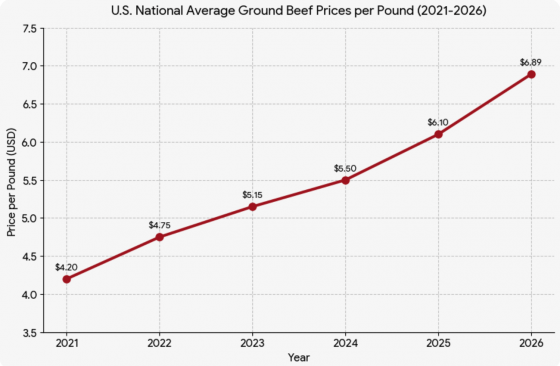
Already, the average price of ground beef has risen almost 20 percent over the past year…

The average price of ground beef, 100% beef, excluding round, chuck, and sirloin, and excluding preformed patties, finally took a breather in February and barely budged, rising by just 0.2%, after spiking month after month almost uninterrupted for a whole year.

At $6.74 per pound, the average price is up by nearly 20% from a year ago and by 73% from January 2020.

By disrupting traffic through the Strait of Hormuz, the Iranians are hitting us where it hurts.

They know that U.S. consumers do not have a very high tolerance for pain.

So they figure that they can sit back and wait for the pain to reach unendurable levels.

But I don’t think that President Trump is going to end this war until he breaks Iranian control over the Strait of Hormuz.

That could take a while, and so it appears that this crisis will be with us for quite some time.

Michael’s new book entitled “10 Prophetic Events That Are Coming Next” is available in paperback and for the Kindle on Amazon.com, and you can subscribe to his Substack newsletter at michaeltsnyder.substack.com.

About the Author: Michael Snyder’s new book entitled “10 Prophetic Events That Are Coming Next” is available in paperback and for the Kindle on Amazon.com.  He has also written nine other books that are available on Amazon.com including “Chaos”“End Times”“7 Year Apocalypse”“Lost Prophecies Of The Future Of America”“The Beginning Of The End”, and “Living A Life That Really Matters”.  When you purchase any of Michael’s books you help to support the work that he is doing.  You can also get his articles by email as soon as he publishes them by subscribing to his Substack newsletter.  Michael has published thousands of articles on The Economic Collapse BlogEnd Of The American Dream and The Most Important News, and he always freely and happily allows others to republish those articles on their own websites.  These are such troubled times, and people need hope.  John 3:16 tells us about the hope that God has given us through Jesus Christ: “For God so loved the world, that he gave his only begotten Son, that whosoever believeth in him should not perish, but have everlasting life.”  If you have not already done so, we strongly urge you to invite Jesus Christ to be your Lord and Savior today.
Thanks To The War In Iran, A Moment Of Reckoning Has Arrived For The Entire Global Economy

Global financial markets are starting to shake, and it is because of what is happening in the Middle East. At this stage, every day is a rollercoaster ride for investors, and that is not likely to change any time soon. The Iranians have paralyzed traffic through the Strait of Hormuz, and trying to reopen it by force is going to be exceptionally difficult to do. As you will see below, this is going to have enormous implications for every nation on the entire planet. We are in the early chapters of a major global crisis, and a tremendous amount of pain is ahead.

On Thursday, Mojtaba Khamenei issued a statement in which he boldly declared that the Strait of Hormuz must remain closed in order to “pressure the enemy”

Iran’s new supreme leader, Mojtaba Khamenei, said Thursday that the closure of the Strait of Hormuz maritime passage should be continued as a “tool to pressure the enemy,” in his first public statement since being appointed.

Khamenei also said all U.S. military bases in the Middle East should close immediately and “those bases will be attacked,” in televised comments translated by Reuters.

Oil prices extended gains following the statement, read out by a state TV broadcaster. The shipping of oil through the Strait of Hormuz has effectively stopped since the war began, causing global oil prices to soar. Iran warned on Wednesday that the price per barrel could climb to $200.

Needless to say, the Iranians are fully capable of carrying out Khamenei’s threats.

Several more vessels have been attacked within the past 48 hours, and that includes a U.S.-owned oil tanker that was completely destroyed

Iran’s semi-official Tasnim news agency also released a dramatic video apparently showing a missile strike on a U.S.-owned tanker in the Persian Gulf. The video shows a massive explosion on a vessel that is then engulfed in flames as people aboard what appears to be an IRGC attack boat celebrate. CBS News Confirmed identified the vessel as the Safesea Vishnu, a crude oil tanker sailing under a Marshall Islands flag, but owned by the New Jersey-based company Safesea Group LLC.

Now that Iran has officially closed the Strait of Hormuz, it will be up to the U.S. military to try to reopen it.

This will not be an easy task.

In fact, some military experts are warning that it could take months to accomplish that goal…

Unblocking the Strait of Hormuz is shaping up as a remarkably complex and time-consuming task.

The fate of the global oil markets—and the global economy—rests on whether ships can traverse the 22-mile-wide waterway from the Persian Gulf to the Gulf of Oman. More than 10 days after the U.S. and Israel attacked Iran, there is no clear plan for reopening it. Military experts say the effort is so daunting it could take months to achieve, absent a fast and full cease-fire.

So exactly why will it be so difficult to reopen the Strait of Hormuz?

As one expert has aptly noted, the Iranians are able to block traffic through the Strait in a multitude of different ways

The problem is that the strait can’t be cleared solely through a bombing campaign, or an attack by destroyers. Iran’s navy has been severely depleted by the U.S., but the country doesn’t need large attack ships to scare commercial vessels away. Its weapons include mines, fast attack boats, missiles and drones. Layered on top of each other, they become exceptionally difficult to remove.

“They’ve created an integrated, vertical stack of threats that can cover the strait from undersea all the way to above the surface,” said Jonathan Schroden, chief research officer at the Center for Naval Analyses, a federally funded nonprofit that does research for the Navy.

If you take out all of their missiles, they would still have thousands of drones.

If you could somehow locate and eliminate all of the drones, they would still have their fast attack boats.

And even if you could eliminate all of their fast attack boats, they would still have thousands of naval mines.

My point is that this crisis is not going to be resolved easily.

And that is really, really bad news for the global economy.

Right now, approximately half of the available global fleet of liquified natural gas carriers is trapped in the Persian Gulf

According to the WSJ, at least 20 LNG carriers about half the available global fleet – are trapped in the Persian Gulf, with daily freight costs soaring as demand from Asia surges, according to ship brokers.

This is a nightmare.

Liquified natural gas prices have already soared in Europe and in Asia, and this is probably only just the beginning

Ship brokers said the 20 ships trapped in the Persian Gulf make up nearly half of all LNG ships currently available for charter, with daily rates rising to more than $200,000 from less than $98,000 before the start of the Iran hostilities.

Energy traders expect LNG prices to rise by early next week, adding to this week’s 40% rise in Asia and Europe. “The effect on LNG shipping will outlast the conflict for a few months,” Karathanos said.

Amid the scramble to procure LNG, more shipments bound for Europe are diverting to Asia. At least nine cargoes initially headed to Europe have changed course to Asia since the start of the fighting, according to ship-tracking data compiled by Bloomberg, with the trend accelerating in recent days. A buffer of spare supply is quickly drying up, threatening more competition and higher prices for both regions.

Meanwhile, a very large percentage of the nitrogen fertilizer that famers in the northern hemisphere are counting on is also stuck in the Persian Gulf region

Nearly half the world’s traded urea — the most widely used nitrogen fertilizer — comes from the Gulf region, with Qatar accounting for one-tenth of the global supply, according to Bloomberg Intelligence.

When QatarEnergy last week halted production after Iranian strikes on Ras Laffan, the world’s biggest LNG and fertilizer hub, hundreds of thousands of tons of key fertilizer nutrients and precursors were sidelined.

The compounding effects of the Iran war threaten the third major risk to global food security in six years, after the COVID-19 pandemic and Moscow’s seizure of farmland and ports used to export Ukrainian grain at the start of Russia’s war in Ukraine in 2022.

If we can’t get that fertilizer into the hands of the farmers that need it, we are going to have a massive problem on our hands.

Approximately half of the entire population of the world eats food that is grown using nitrogen fertilizer

About 4 billion people on the planet eat food grown with synthetic nitrogen fertilizers. Roughly half of the global population, in other words, is alive because of these chemicals converted into nutrients for plants, said Lorenzo Rosa, who researches sustainable energy, water, and food systems at the Carnegie Institution for Science at Stanford University.

If this war persists for an extended period of time, famine will become a major global theme.

Of course the war with Iran has also caused the greatest oil supply disruption in human history

The war in the Middle East is creating the largest supply disruption in the history of the global oil market, the International Energy Agency said in a report on Thursday slashing its annual supply outlook, shortly after the group announced its biggest-ever oil stock release.

It is now being projected that the price of oil could soon hit $150 a barrel, and that would absolutely crush the global economy…

If it remains fully closed for weeks, analysts see oil prices climbing to $150—a level that could send the U.S. and other economies into recession. Countries are going to great lengths—from emptying their strategic oil stockpiles to rerouting supplies through underutilized pipelines—to find other ways to replace the shortage. None of those ideas will come close to replacing all the lost supplies.

Meanwhile, trouble is brewing in the financial markets.

In fact, George Noble is warning that a major crisis is emerging in the private credit market…

George Noble, a longtime Fidelity fund manager and Wall Street veteran, sees big problems brewing in the booming private credit market.

The former director of Fidelity Overseas Fund recently wrote that he sees the makings of a financial crisis in the sector, echoing others who have worried about a spate of negative headlines in recent months.

So what is it specifically that has him so spooked?

Well, it is the fact that so many big players are starting to block investors from withdrawing their money

“We’re watching a financial crisis unfold in real time,” he said in a post on X. “The last time funds started blocking investors from getting their money back, Bear Stearns collapsed six months later.”

The collapse of the investment bank is often seen as one of the first dominoes of the 2008 financial crisis. Noble pointed to recent news of redemptions at major firms, including BlackRock, Blackstone, and Blue Owl.

Noble is right.

We haven’t seen anything like this since 2008.

And now we can add Morgan Stanley to the list

Morgan Stanley’s investment management arm became the latest asset manager to cap withdrawals from a private credit fund, telling investors in a letter Wednesday evening that it saw a wave of redemption requests this quarter.

The company’s North Haven Private Income Fund, which has $7.6 billion in total investments, received investor requests to buy back around 10.9% of outstanding shares in its quarterly tender offer. The fund capped repurchases at 5%, its previously disclosed threshold.

“By maintaining appropriate limits on the quarterly repurchase offer, the [fund] seeks to avoid asset sales during periods of market dislocation and provide for conservative capital structure management through evolving market conditions,” the letter said.

This is it guys.

What we have been waiting for has officially begun.

I hope that you are ready for what is coming next, because the months ahead are going to be absolutely filled with chaos.

Michael’s new book entitled “10 Prophetic Events That Are Coming Next” is available in paperback and for the Kindle on Amazon.com, and you can subscribe to his Substack newsletter at michaeltsnyder.substack.com.

About the Author: Michael Snyder’s new book entitled “10 Prophetic Events That Are Coming Next” is available in paperback and for the Kindle on Amazon.com.  He has also written nine other books that are available on Amazon.com including “Chaos”“End Times”“7 Year Apocalypse”“Lost Prophecies Of The Future Of America”“The Beginning Of The End”, and “Living A Life That Really Matters”.  When you purchase any of Michael’s books you help to support the work that he is doing.  You can also get his articles by email as soon as he publishes them by subscribing to his Substack newsletter.  Michael has published thousands of articles on The Economic Collapse BlogEnd Of The American Dream and The Most Important News, and he always freely and happily allows others to republish those articles on their own websites.  These are such troubled times, and people need hope.  John 3:16 tells us about the hope that God has given us through Jesus Christ: “For God so loved the world, that he gave his only begotten Son, that whosoever believeth in him should not perish, but have everlasting life.”  If you have not already done so, we strongly urge you to invite Jesus Christ to be your Lord and Savior today.