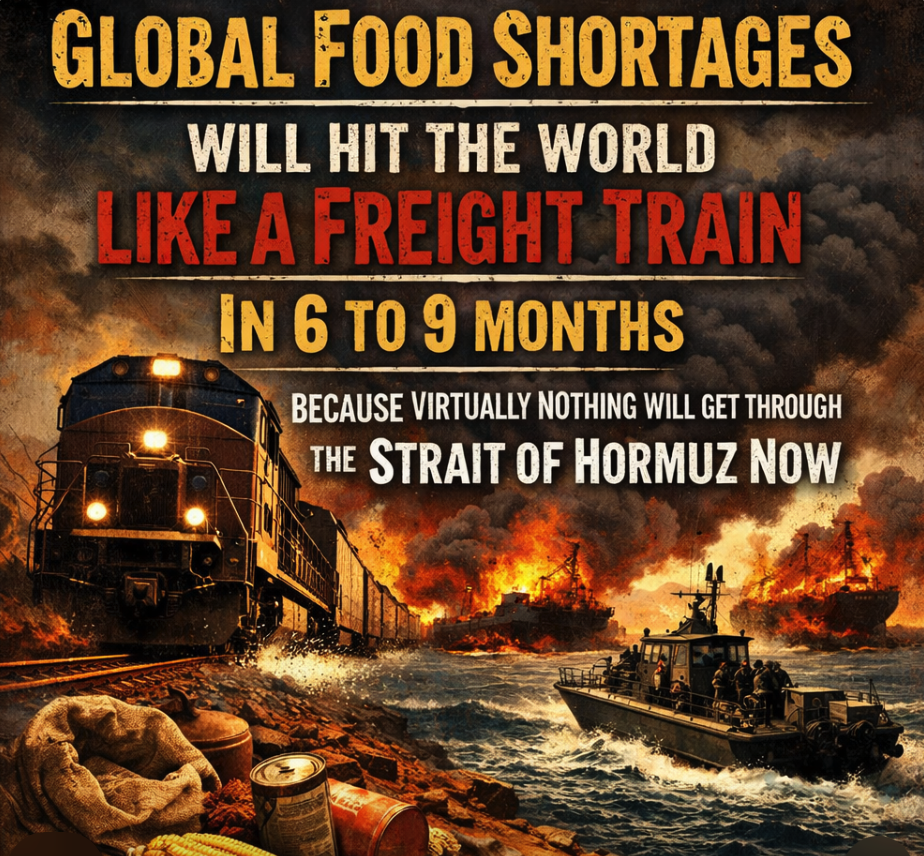
 Where do we go from here? Peace talks with Iran have totally failed, and there appears to be no hope that the gaps between the demands that the U.S. is making and the demands that Iran is making can be bridged. There are several key issues that both sides are not willing to compromise on, and that is going to have very serious implications for the entire planet. In the aftermath of the failed peace talks, Iranian officials warned that the status quo in the Strait of Hormuz would continue. Needless to say, that was completely and totally unacceptable to the Trump administration, and in response President Trump has just announced a full naval blockade of the Strait. What this means is that virtually nothing will get through the Strait of Hormuz for an extended period of time. As a result, the spring planting season in the northern hemisphere will be a total disaster, and global food shortages will hit the world like a freight train about 6 to 9 months from now.
Negotiating teams from the United States and Iran went back and forth for many hours in Pakistan, but ultimately the Iranians were simply not willing to agree to the “final offer” that Vice-President JD Vance set forth…
Vice President JD Vance presented a “final offer” to Iran during negotiations in Islamabad Saturday, outlining six U.S. “red lines,” according to U.S. officials.
The demands included an end all uranium enrichment and to dismantle major nuclear facilities and surrender highly enriched uranium.
The fourth was to accept a broader regional peace and de-escalation framework followed by to stop funding proxy groups including Hamas, Hezbollah and the Houthis.
The sixth demand was to fully open the Strait of Hormuz without tolls.
So this is it.
Our last best chance for peace just went out the window.
The Iranians feel like they have more leverage than the U.S. does, and following the peace talks they warned that “there will be no change in the situation of the Strait of Hormuz”…
‘Iran is not in a hurry, and until the US agrees to a reasonable deal, there will be no change in the situation of the Strait of Hormuz,’ an unnamed Iranian official told the Fars News Agency.
The Iranians seem to believe that if they can just hold the global economy hostage for long enough, the U.S. will eventually be forced to give in.
Right now, approximately 3,200 ships are currently trapped in the Persian Gulf…
Yet even after a fragile ceasefire took hold, around 3,200 vessels, including 800 tankers and cargo ships, remained stranded west of the strait in the Persian Gulf, according to Windward, a maritime intelligence firm in London.
Iran is allowing a trickle of vessels, so long as they pay a toll and hail from nonhostile nations. Iranian authorities, in effect, are acting like a bouncer at a popular nightclub, permitting some fortunate customers to enter the strait while leaving others to idle in frustration.
“You can think of the Hormuz Strait as a form of flow control. The greatest power actually does not come from total blockade. What Iran is showing is that the real power that it conveys is that you can control who passes and who doesn’t,” said Nicholas Mulder, a sanctions expert and history professor at Cornell University.
Since the war began, it has primarily been vessels from Iran and vessels from nations that are allied with Iran that have been able to travel through the Strait.
But now President Trump is putting an end to that.
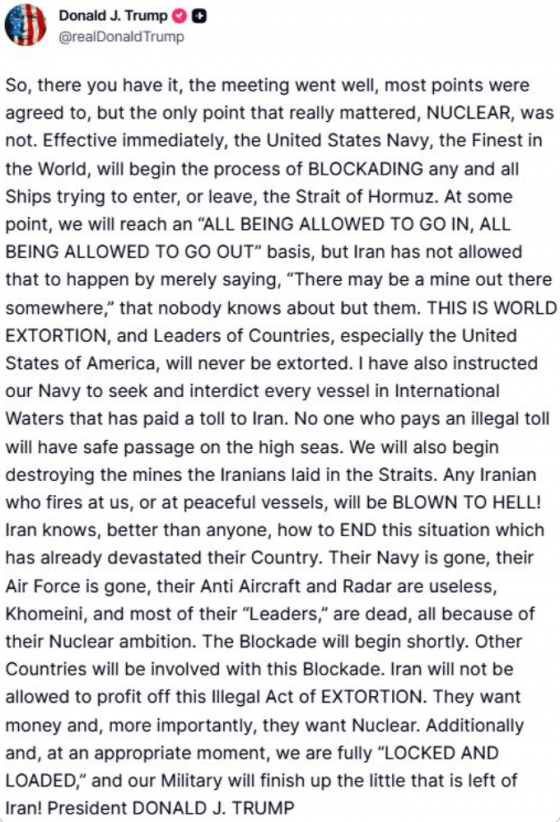
Trump just announced that the United States will conduct a full blockade of the Strait of Hormuz and will intercept any ships that pay tolls to Iran…
This is a big move.
The Iranians have only been allowing a handful of vessels through the Strait each day, and now virtually all of those will be blocked by the U.S. Navy.
In other words, from this point forward traffic through the Strait of Hormuz will almost entirely stop.
This will cut off the flow of oil revenue to the Iranian regime, and Trump seems to believe that this will force them to make a deal.
But I don’t think that it will.
Meanwhile, the Chinese are going to be extremely upset with us, because they normally import a tremendous amount of oil from the Middle East.
In the end, this is not going to work out well for anyone.
It is inevitable that we will see more fighting, and the Iranians are already warning that any military vessels that approach the Strait will be “dealt with strongly”…
Military vessels approaching the Strait of Hormuz would be considered a ceasefire breach and would be dealt with strongly, Iran’s Islamic Revolutionary Guard Corps (IRGC) navy said in a statement on Sunday.
It will be fascinating to watch this showdown play out.
But it will also be horrifying to watch what this showdown is going to do to the global economy.
Physical oil is already selling for more than 140 dollars a barrel, and if it stays at this level the consequences are going to be absolutely devastating…
In the North Sea, the world’s most important physical crude market, traders submitted 40 bids for cargoes last week, only four of which were met by offers. Cargoes for delivery in the coming weeks changed hands at unprecedented prices above $140 a barrel. Elsewhere, refiners have been hunting increasingly further afield for supplies, leading to a series of unusual trades and surging premiums for any oil that’s ready to ship right now.
Traders said the panicky moves across the world’s key physical oil markets demonstrated the scale of the shortfall in crude that’s due to be felt as the loss of supplies from the Middle East leaves a growing gap.
As I have documented in previous articles, shortages have begun to emerge all over the globe, and people are getting really angry.
In Ireland, police are dealing with massive protests that have erupted due to the high price of fuel…
Police removed and arrested protesters on Saturday to reopen Ireland ‘s only oil refinery as a fifth day of disruptive demonstrations over the soaring price of fuel left many gas pumps dry and threatened to cripple transportation across the country.
Trucks and tractors continued to block access to vital fuel depots and a major port, and vehicles clogging traffic led to closures of part of the main highway around Dublin, the capital, as well as sections of other major roadways.
This is just the beginning.
Just wait until you see what happens a few months down the road.
In addition to oil and natural gas, there are a lot of other critical commodities that remain trapped in the Persian Gulf region…
Polyethylene and other kinds of plastics and resins are also greatly affected. More than 40 percent of the world’s polyethylene is exported from the Middle East. And these are used in all stages of production in all sorts of industries—packaging, auto parts, medical equipment, consumer containers, industrial components, electronics, and much, much more.
And there are other often-neglected but extremely important hydrocarbon products being held up, such as petroleum naphtha, which is critical for refining gasoline and producing solvents for cleaning agents and paints. Natural gas condensate is another liquid hydrocarbon used in refining and to dilute other denser hydrocarbons to make them easier to transport. There’s also liquified petroleum gas, or LPG, which is mostly composed of propane and butane. These components are also important for refining as well as residential cooking and heating in many parts of the world. Much of the world’s supply of all these products is produced in the Middle East and exported through the Strait of Hormuz.
Another often-neglected yet critical higher-order good is sulfur. About half the world’s seaborne sulfur trade moves through the Strait. It’s important for refining petroleum and minerals like copper, nickel, and zinc, which are widely used in everything from electronics to medicine.
On top of everything else, approximately one-third of all globally-traded nitrogen fertilizer normally travels through the Strait of Hormuz, and this war is already “causing shortages and price spikes”…
About a third of the world’s fertilizer supply passes through the Strait of Hormuz, and its effective closure is causing shortages and price spikes for fertilizer during the crucial spring planting season. That has led to fears of elevated food prices and lower crop yields.
Nitrogen fertilizer must be applied within a certain window of time for each crop or it will not work correctly.
Farmers all over the northern hemisphere are freaking out, because the entire spring planting season is at risk…
The fertilizer shortage is putting the livelihood of farmers in developing countries — already troubled by rising temperatures and erratic weather systems — further at risk, and could lead to people everywhere paying more for food.
The poorest farmers in the Northern Hemisphere rely on fertilizer imports from the Gulf, and the shortage comes just as planting season begins, said Carl Skau, deputy executive director of the World Food Program.
Yields for annual crops such as wheat, barley and corn will be severely affected if the Strait of Hormuz is not opened very soon.
But yields for crops that do not have to be planted each year such as olives and grapes will not be significantly affected.
At this moment, we are still eating food that was produced in 2025.
So the consequences of the coming crop shortages will not be felt for a while.
But 6 to 9 months from now, we will be hit by much higher prices for wheat, barley and corn.
Of course many Americans are already experiencing a case of “sticker shock” whenever they go to the grocery store these days…
It’s hard to go anywhere right now without experiencing sticker shock. Price change notifications can feel like little acts of financial violence.
Americans continue to reel from prices that soared during the pandemic, never came back to earth, and keep ticking higher. There’s no doubt that it costs more to feed yourself and cover basics like transportation, housing, and health insurance than it did just a few years ago.
But at least most of us have enough food to eat.
In impoverished nations all over the globe, that is certainly not the case.
The United Nations has been telling us that the number of people in the world that are dealing with “acute hunger” was already at an all-time record high even before this war began.
When food shortages dramatically escalate 6 to 9 months from now, things will get so much worse.
We can see this crisis coming way ahead of time, but there is no way out now.
So I hope that you are ready for the nightmare that is ahead of us.
Michael’s new book entitled “10 Prophetic Events That Are Coming Next” is available in paperback and for the Kindle on Amazon.com, and you can subscribe to his Substack newsletter at michaeltsnyder.substack.com.

About the Author: Michael Snyder’s new book entitled “10 Prophetic Events That Are Coming Next” is available in paperback and for the Kindle on Amazon.com. He has also written nine other books that are available on Amazon.com including “Chaos”, “End Times”, “7 Year Apocalypse”, “Lost Prophecies Of The Future Of America”, “The Beginning Of The End”, and “Living A Life That Really Matters”. When you purchase any of Michael’s books you help to support the work that he is doing. You can also get his articles by email as soon as he publishes them by subscribing to his Substack newsletter. Michael has published thousands of articles on The Economic Collapse Blog, End Of The American Dream and The Most Important News, and he always freely and happily allows others to republish those articles on their own websites. These are such troubled times, and people need hope. John 3:16 tells us about the hope that God has given us through Jesus Christ: “For God so loved the world, that he gave his only begotten Son, that whosoever believeth in him should not perish, but have everlasting life.” If you have not already done so, we strongly urge you to invite Jesus Christ to be your Lord and Savior today.