
 We possess technology that would have been unimaginable to people living 100 years ago, we have access to more entertainment than any other generation in human history, and we have been enjoying an artificially-inflated standard of living that has been fueled by an unprecedented debt binge for decades. So why are so many of us so miserable? One out of every eight Americans is taking an antidepressant, more than 48 million Americans have a substance use disorder, the suicide rate has been trending in the wrong direction for years, and according to Gallup the percentage of U.S. adults that are currently dealing with depression has nearly doubled since 2015…
The percentage of U.S. adults who report currently having or being treated for depression has exceeded 18% in both 2024 and 2025, up about eight percentage points since the initial measurement in 2015. The current rate of 18.3% measured so far in 2025 projects to an estimated 47.8 million Americans suffering from depression.
We like to think that we are smarter than all of the generations that have come before us.
If that is true, then why can’t we figure out how to be happy?
What we are doing now is clearly not working, and this is particularly true for our young people.
One study found that approximately 42 percent of Americans that belong to Generation Z have been diagnosed with “anxiety, depression, ADHD, PTSD” or some other mental health condition…
In fact, an estimated 42% of Gen Zers have been diagnosed with anxiety, depression, ADHD, PTSD or other mental health condition, with a staggering 60% reportedly taking medication to manage their mental health, according to a study on the respected Psychiatrist.com website.
Nobody can deny that we have failed our young people, and now we have a colossal mess on our hands.
We have never seen a group of young adults that is as unhappy as Generation Z is, and without a doubt they are feeling an enormous amount of pressure from many different directions…
Analysts point to a host of difficult, anxiety-producing issues facing Gen Z, including widespread financial worries – with college costs in the stratosphere, food more expensive than ever, home ownership out of reach for most, and two jobs often needed just to pay the rent.
Then there’s the disconcerting reality that many Gen Zers are not dating or getting married and having families – partly due to economic pressures, high anxiety and insecurity about the future, disillusionment with marriage due to the high level of divorce in their parents’ generation, and widespread reliance on dating apps. But also because they are spending so much time living in a virtual world where they can plug into and commune with every imaginable – and unimaginable – type of individual, cause, “influencer” and community on earth, all recruiting 24/7.
I think that all of the reasons mentioned in the quote above are valid.
But I think that there is another that is more important than any of them.
Over the years, Gallup has found that there is a very close link between loneliness and depression…
Gallup research has shown a strong link between depression and loneliness, as one-third of those who had experienced loneliness the day before were also currently suffering from depression, compared with 13% among those who had not.
After declining from pandemic-era highs of 25% to a range of 17% to 18% through much of 2022 and 2023, reports of individuals experiencing significant loneliness “a lot of the day yesterday” have inched upward again since the latter half of 2024 to 21%.
Even though we are more “connected” to one another through the Internet in this day and age, the truth is that we are more isolated than ever.
As a result, much of the population is desperately lonely.
We were designed to love others and to be loved by others, and if we want to turn our mental health crisis around we need to rediscover the importance of making real human connections.
But instead, many Americans are turning to drugs and alcohol to ease the emotional pain that they are feeling.
A report that was put out two years ago by the Substance Abuse and Mental Health Services Administration revealed that 48.5 million Americans have a substance abuse disorder…
According to a 2023 report by the federal agency Substance Abuse and Mental Health Services Administration, 48.5 million Americans aged 12 and above have a substance use disorder.
This is a national epidemic that is getting worse every single year.
It has been estimated that substance use disorders are now costing the U.S. economy more than 90 billion dollars annually…
A new study has found that substance use disorders (SUD) cost the U.S. economy just under $93 billion in 2023 from a combination of missed work, reduced work productivity and lost household productivity.
The study, published in the American Journal of Preventive Medicine on December 8, was conducted by a team at the Division of Injury Prevention at the Centers for Disease Control and Prevention (CDC).
Needless to say, drugs and alcohol are not the answer.
So a lot of people that go down that road end up giving up completely.
For decades, the suicide rate in this country has been steadily moving higher…
Since the 1950s, the suicide rate in the United States has been significantly higher among men than women. In 2022, the suicide rate among men was almost four times higher than that of women. However, the rate of suicide for both men and women has increased gradually over the past couple of decades.
This breaks my heart.
So many people are needlessly ending their own lives.
According to the CDC, an American now dies by suicide every 11 minutes…
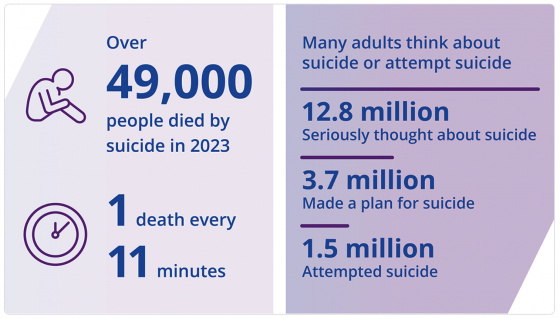
The level of suicides among our young adults is particularly alarming.
It is being reported that the suicide rate for young adults in the 18 to 27-year-old age bracket jumped by almost 20 percent from 2014 to 2024…
The suicide rate for U.S. adults aged 18-27 increased nearly 20% between 2014 and 2024, rising from 13.8 per 100,000 people to 16.4, per a new analysis of CDC data from Stateline, a nonprofit newsroom.
We have failed our young people.
Here we are at what many believe to be “the happiest time of the year”, and yet much of the population is soul-crushingly miserable.
But it doesn’t have to be that way.
Previous generations of Americans were much happier, and today there are lots of people that are living lives that are absolutely teeming with joy.
So if you are feeling depressed right now, I want you to know that there is hope.
You may not realize it yet, but you are greatly loved.
Once you learn how to respond to God’s love and the love that others have for you, everything will start to change.
Michael’s new book entitled “10 Prophetic Events That Are Coming Next” is available in paperback and for the Kindle on Amazon.com, and you can subscribe to his Substack newsletter at michaeltsnyder.substack.com.

About the Author: Michael Snyder’s new book entitled “10 Prophetic Events That Are Coming Next” is available in paperback and for the Kindle on Amazon.com. He has also written nine other books that are available on Amazon.com including “Chaos”, “End Times”, “7 Year Apocalypse”, “Lost Prophecies Of The Future Of America”, “The Beginning Of The End”, and “Living A Life That Really Matters”. When you purchase any of Michael’s books you help to support the work that he is doing. You can also get his articles by email as soon as he publishes them by subscribing to his Substack newsletter. Michael has published thousands of articles on The Economic Collapse Blog, End Of The American Dream and The Most Important News, and he always freely and happily allows others to republish those articles on their own websites. These are such troubled times, and people need hope. John 3:16 tells us about the hope that God has given us through Jesus Christ: “For God so loved the world, that he gave his only begotten Son, that whosoever believeth in him should not perish, but have everlasting life.” If you have not already done so, we strongly urge you to invite Jesus Christ to be your Lord and Savior today.