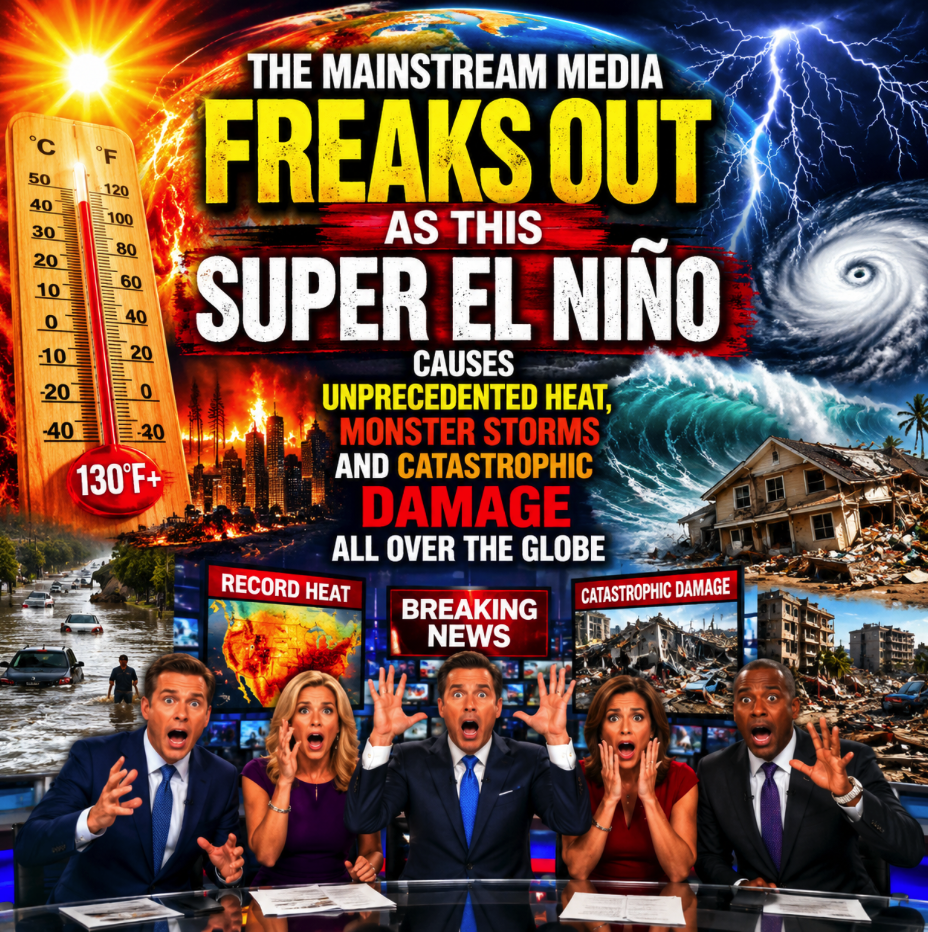
 Global weather patterns have begun to resemble a Hollywood disaster movie, and the mainstream media is starting to admit what many of us have known all along. Thanks to the “Super El Niño” that is now upon us, the second half of this year is going to be really crazy. Europe was just hit by the worst heatwave that it has ever experienced. Throughout all of last week, I was writing about the “mega heat dome” that brought unprecedented temperatures to many areas of the east coast. As I write this article, an absolutely colossal storm is causing apocalyptic damage in the Pacific Ocean, and a severe lack of rainfall threatens to cause a horrifying shortage of rice in India. It is often the case that the mainstream media needlessly freaks out about things, but in this case they are right on target.
I wish that I was exaggerating about the power of this Super El Niño, but I am not.
Every El Niño brings higher temperatures, but this one is really baking us…
We’re officially in an El Niño year, and as predicted, it’s a scorcher.
Record temperatures are already being recorded around the world, from the streets of New York to the icy shelves of the Antarctic. Even the surface waters of the world’s waterways are under unprecedented stress from the heat, with the average global ocean temperature breaking the all-time record high for the month of June.
We are less than a month into this El Niño.
How bad will conditions be once we get a few months down the road?
Even CNN is calling it “a Super El Niño”, and they are openly warning that “computer models are predicting this El Niño could be stronger than any other event”…
El Niño is poised to rapidly strengthen in the tropical Pacific Ocean during the next few months and is forecast to reach the upper echelon of intensity by the time it peaks in late fall to early winter, forecasters warn.
It’s already being referred to colloquially as a Super El Niño. Only a handful of events have reached that level of intensity in the last few decades, with the most recent one occurring in 2015 to 2016.
But now some computer models are predicting this El Niño could be stronger than any other event, back to at least 1950. “I think it’s fair to say that, depending on [the] model, the forecasts are close to unprecedented,” said Michael Tippett, an atmospheric scientist at Columbia University, in an email.
CNN is not supposed to run articles like this.
But they just did.
One expert that CNN interviewed explained that the projections for the intensity of this El Niño have been getting higher each month…
“The consensus is definitely shifting towards an even stronger event,” said Zeke Hausfather, a climate scientist who is closely following El Niño model projections.
“The model runs have been consistently showing higher probabilities for a very strong event compared to a few months ago, and every month sees higher estimates,” he said. “Currently, the odds of seeing a record-strong El Niño event this year are quite large.”
It has become clear that this El Niño is going to dwarf any El Niño that has come before.
It is even going to surpass the Super El Niño of 1877-1878 that resulted in 50 million people starving to death.
India always receives less rain during an El Niño, and rainfall in many key rice producing areas is already way below normal…
The warning comes during India’s kharif planting season, when crops such as rice and maize depend heavily on the southwest monsoon. El Niño can weaken the summer monsoon across much of India, putting rainfed crops under stress during a critical growing period, the FAO said.
Between June 1 and 22, half of India had received deficient rainfall (-20% to -59% below the expected normal), while nearly a quarter had recorded large deficient rainfall (-60% to -99% less than the expected normal), according to the categories used by the India Meteorological Department (IMD).
The FAO analysis, based on 41 years of satellite data from its Agricultural Stress Index System, identifies a broad belt of elevated drought risk across Asia — from Pakistan and India through Myanmar, Thailand, Cambodia and Vietnam, and further east to the Philippines, Indonesia and Timor-Leste.
The world is not going to grow enough rice this year.
In fact, the amount of rice grown won’t even be close to enough to feed everyone.
That is very troubling news, because more than half of the population of the world is heavily dependent on rice…
Over half the world’s population relies on rice. India and China grow more than half of the world’s supply, and rice supplies more than half of all daily calories in countries such as Bangladesh, Vietnam and Cambodia.
Poorer households spend the largest share of income on food, so price spikes hit them first and hardest. In 2007-08, rice prices roughly tripled, food riots broke out in dozens of countries, and in Haiti, the unrest helped bring down the prime minister. Securing rice is about more than food – it underpins public order.
During this “Super El Niño”, some parts of the planet will experience drought, while others will get hammered by absolutely gigantic storms.
Just hours ago, a monstrous “super typhoon” with frighteningly high winds absolutely pummeled the island of Rota…
A “super typhoon” with equivalent force to a category-5 hurricane made landfall on the U.S. island of Rota in the Pacific on Monday, the National Weather Service said, warning of “catastrophic damage and (a) life threatening situation.”
“The western eyewall of Super Typhoon Bavi is currently moving over the island of Rota. The latest forecast intensity is at 180 mph (290 kph) as it passes over Rota,” the NWS said. “Catastrophic winds exceeding 150 mph will continue across Rota during eyewall passage.”
The weather system also brought extremely strong winds and lashing rain to other parts of the Northern Marianas and the nearby separate U.S. territory of Guam, collectively home to around 210,000 people.
Nearly every structure on Rota has been flattened.
According to the National Weather service, the island will be “uninhabitable for weeks”…
Before the NWS had said that a direct hit on Rota would make most of the island “uninhabitable for weeks, perhaps longer. Many non-concrete, non-reinforced homes will be destroyed, with total roof failure and wall collapse.”
“Nearly all trees will be snapped or uprooted and power poles downed. Fallen trees and power poles will isolate residential areas. Power outages will last for weeks to possibly months,” it said.
How would you like to be without power for months?
Now Super Typhoon Bavi is headed for Taiwan and China…
Bavi is expected to produce destructive wind gusts around Taiwan and across eastern China from Friday into Monday. Wind gusts up to 160 mph (260 km/h), with an AccuWeather Local StormMax™ of 200 mph (320 km/h), are anticipated and will result in power outages, structural damage and logistical delays.
The super typhoon is expected to maintain its intensity or strengthen slightly as it tracks west-northwest through at least Thursday, July 9, local time. Bavi is expected to impact Taiwan and eastern China from Friday into Monday.
More giant storms are coming as 2026 rolls along.
You can count on that.
Meanwhile, the weather has been so hot and so dry in Europe, and this has produced ideal conditions for huge wildfires to erupt…
Thousands of people were evacuated in southern France on Monday as ‘catastrophic’ wildfires ravaged the region, while poisonous clouds swept through Greece and Costa Brava in Spain was put on alert.
It comes as temperatures across Europe are on the rise again, predicted to reach 40C in parts still suffering the aftermath of a recent record-breaking heatwave.
Hundreds of firefighters are battling blazes that have devastated more than 19,000 hectares (42,000 acres) of land – an area more than twice the size of Manhattan – across Portugal, Spain, France and Greece.
This is no ordinary heatwave.
Week after week, Europe is getting absolutely cooked, and a lot of people are dying. For example, just check out what has been happening in the Netherlands…
More than 3,500 people died in the Netherlands during last week’s extreme heat, according to provisional mortality figures from the National Institute for Public Health and the Environment (RIVM). The number is about 16 percent higher than what was expected, based on seasonal trends.
RIVM said there were around 480 excess deaths compared with expected levels, with most fatalities among people aged 80 and older. Proportionally, the highest impact was seen in the east and south of the Netherlands, where temperatures were highest during the heat period.
The RIVM noted that the figures are not yet complete, as it can take several weeks for deaths to be officially registered.
Of course people have been dying from the heat in the U.S. as well.
At this point, we are being told that at least 25 residents of New Jersey have died as a result of heat exposure just since Thursday…
At least 25 people died in New Jersey since Thursday amid a sweltering heat wave.
Temperatures soared into the triple digits over the Fourth of July holiday weekend in New Jersey, New York, DC and other East Coast states.
Power outages in New Jersey and New York reportedly affected 1 million customers.
According to officials, many of the deceased were found in their homes with no air conditioning.
After experiencing an extremely hot weekend, now the east coast is facing the threat of severe flash flooding…
A life-threatening flash flood threat is increasing for nearly 60 million people across the Northeast, Mid-Atlantic and southern New England, with more rounds of heavy rain expected to soak the region through Monday night.
Heavy rain and thunderstorms from this weekend saturated the soil across the region, creating prime conditions for flash flooding Monday, particularly in the New York City metro area.
All over the world, this “Super El Niño” is going to produce monster storms, extreme heat and severe drought in 2026.
We were already experiencing a worldwide food crisis before this “Super El Niño” came along, and so there is no way that we are going to avoid very serious global food shortages.
In fact, the number of people on our planet that are experiencing acute hunger was already at an all-time record high before the war with Iran started.
What we are facing is not a theoretical disaster that may or may not happen someday.
It is happening right now.
We are in far more trouble than most people realize, and we are going to witness so much chaos in the months ahead.
Michael’s new book entitled “10 Prophetic Events That Are Coming Next” is available in paperback and for the Kindle on Amazon.com, and you can subscribe to his Substack newsletter at michaeltsnyder.substack.com.

About the Author: Michael Snyder’s new book entitled “10 Prophetic Events That Are Coming Next” is available in paperback and for the Kindle on Amazon.com. He has also written nine other books that are available on Amazon.com including “Chaos”, “End Times”, “7 Year Apocalypse”, “Lost Prophecies Of The Future Of America”, “The Beginning Of The End”, and “Living A Life That Really Matters”. When you purchase any of Michael’s books you help to support the work that he is doing. You can also get his articles by email as soon as he publishes them by subscribing to his Substack newsletter. Michael has published thousands of articles on The Economic Collapse Blog, End Of The American Dream and The Most Important News, and he always freely and happily allows others to republish those articles on their own websites. These are such troubled times, and people need hope. John 3:16 tells us about the hope that God has given us through Jesus Christ: “For God so loved the world, that he gave his only begotten Son, that whosoever believeth in him should not perish, but have everlasting life.” If you have not already done so, we strongly urge you to invite Jesus Christ to be your Lord and Savior today.