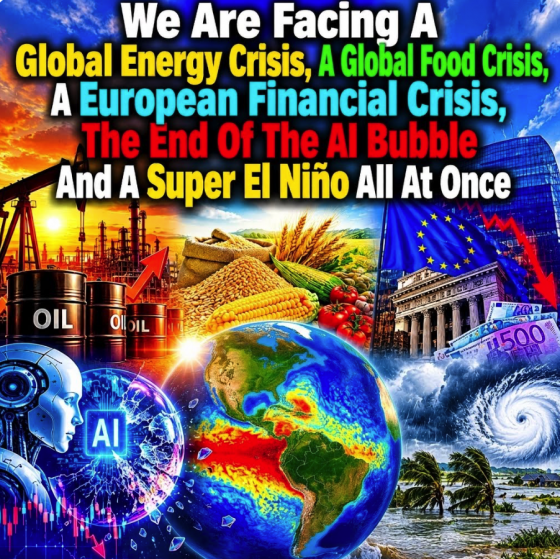
 We have never seen a year quite like 2026, and we are certainly not prepared for what is coming in 2027. There has never been a time when we haven’t had problems, but now we have entered an era when we are just getting hammered by crisis after crisis after crisis. At the moment, we are simultaneously facing an unprecedented global energy crisis, an unprecedented global food crisis, an epic meltdown in Europe, the end of the biggest financial bubble in history and the most powerful Super El Niño ever recorded. To say that we have a lot on our plate would be a massive understatement, and what we have experienced so far is only just the beginning.
For a few months a decent amount of oil was sneaking through the Strait of Hormuz, but now Iran is trying to slam the door shut.
The Iranians have been attacking more oil tankers than ever before this month, and earlier today yet another oil tanker hit an Iranian naval mine…
A violating oil tanker struck a naval mine in the southern Strait of Hormuz, causing an explosion and a fire in its engine room, the Islamic Revolution Guard Corps Navy said in a statement.
The vessel, which was trying to exit the Strait of Hormuz, had switched off all its positioning and navigation systems from the start of its voyage and was attempting to cross the unauthorized southern route of the strait in disregard of its regulations when the incident occurred.
The Islamic Revolution Guard Corps Navy said any ships in the Strait of Hormuz and the Persian Gulf that turn off their navigation and identification systems will be dealt with severely and decisively.
The southern route through the Strait of Hormuz near the coast of Oman used to be clear of mines.
Not anymore.
Every time a single oil tanker is put out of commission that is a major loss.
A new oil tanker costs somewhere between $60 million and $140 million, and once an order is placed it takes 9 to 15 months to build it.
Investors are starting to realize that the global energy crisis is not going to end any time soon, and on Monday the price of Brent crude nearly hit 110 dollars a barrel…
Brent crude futures briefly tagged $109.99 a barrel in overnight trading before retreating from five-month highs during the Asian session and into European trading, as signs of recovering Middle Eastern supply offset renewed attacks on energy infrastructure and critical maritime shipping lanes.
Of course Iran is not able to export much oil either, because the U.S. naval blockade is having a devastating impact on their economy…
In a video message posted on Friday, U.S. Central Command chief Adm. Brad Cooper said the naval blockade has prevented Iran from exporting at least $25 billion worth of crude oil. The U.S. and its partners have also frozen nearly $350 million cryptocurrency assets, he added.
The effects have rippled throughout Iran’s economy, forcing the regime to withhold salaries, pensions, and benefits to workers in the energy, manufacturing, construction and security sectors, including the Islamic Revolutionary Guard Corps, Cooper said.
“The financial strain on Iran’s military has become so significant that there are reports of Iran-aligned militia groups across the region withholding payments to their soldiers in order to funnel money back to the IRGC, which also is not paying its troops,” he explained. “The Islamic regime is clearly feeling the economic pain, and the IRGC is increasingly showing signs of greater desperation as a result.”
What we really need is for the war in the Middle East to end.
But that isn’t going to happen.
In fact, it appears that it could soon greatly escalate.
The fighting in the Middle East has also really driven up fertilizer prices.
Farmers all over the world are paying far more for fertilizer and far more for fuel, and those costs are going to get passed along to everyone else.
Global food prices increased by 13 percent during the third quarter of 2026, and we are being warned that even higher prices are ahead…
Global agricultural prices jumped 13 percent in the third quarter of the year, according to the International Fund for Agricultural Development (IFAD), which warned a “global food crisis is looming”.
The surge in energy prices due to conflict in the Middle East has sparked a sharp increase in the cost of fertilisers and fuel this year, driving up agricultural production and transport costs.
“Over the next six to nine months, we will see continued increases related to food prices, but also I would say even inflation in terms of food, which will impact most of the populations that actually can afford it less,” IFAD President Alvaro Lario told AFP in an interview on Tuesday.
When food prices go up, more people go hungry.
That is just the way that it works.
The outlook for 2027 is extremely grim, and we are already at a point where the number of people in the world experiencing acute hunger has doubled over the past ten years…
Acute hunger has doubled over the last ten years and now affects 266 million people across 47 countries and territories, according to a new report from Action Against Hunger.
But at least the wealthy countries will be fine, right?
Actually, they won’t be fine at all.
We have been witnessing horrifying riots in France, Belgium, Italy and Albania in recent days.
The rioting has been particularly intense in France, and on Monday French stocks were way down…
French markets tumbled on Monday, with bonds, Paris-listed stocks and even the euro falling after widespread protests across France underscored difficulties the government faces in reducing its large deficit.
Already contending with weak growth and ballooning debt, the euro zone’s second-biggest economy witnessed some of its worst unrest in years over the weekend. Thousands of people were arrested and shops were looted during protests over high prices and declining public services.
France just kept borrowing gigantic amounts of money year after year, and currently they are absolutely drowning in debt.
Now French bond prices are crashing hard and everyone is freaking out…
A slide in bond prices on Monday pushed France’s 10-year yield up 13 basis points to 4.9%, on track for its largest one-day rise since late September, while the German 10-year yield, the benchmark for the euro zone, rose 4 bps to 3.45%.
The difference between those two yields, which is a reflection of the premium investors demand to lend to France rather than Germany, was 146 bps, its highest in two weeks, though it has eased from the nearly 160 bps hit in early October.
French banks are facing nightmarish unrealized losses on the French bonds that they are holding.
If there is a run on the banks, we are being warned that many of them could start collapsing as a result of this crisis.
I certainly wouldn’t want my money in French banks at this stage.
Germany is in a lot of trouble too.
The German economy has been in stall mode for years, bond yields have been rising, and even Volkswagen has fallen on hard times…
In another episode of the “death of Europe,” a new report from Germany brings more troubling news for struggling automaker Volkswagen, suggesting to us that globalists in the bloc have squandered not just their inheritance but their economic future through a failing progressive experiment that has neutered Europe’s industrial base.
German daily newspaper Süddeutsche Zeitung (SZ) reports that Volkswagen plans to freeze salaries through the end of the decade as it expands its cost-cutting push after lowering its outlook and doubling its job-reduction target.
“Internal documents reveal that hundreds of thousands of employees are to forgo pay raises. These latest plans represent a further escalation in the conflict between management and employee representatives,” SZ wrote in the article.
Germany, France, Italy and Spain are supposed to be the pillars of the European Union.
Unfortunately, all of them are currently on shaky ground.
This is a story that is still in the early chapters, and I am convinced that the whole world will be shocked by what is about to happen to Europe.
Meanwhile, the AI bubble in the U.S. is beginning to burst.
Many AI stocks have fallen substantially this month.
Investors are starting to realize that AI will never be the income-generating miracle that it was touted to be at one time.
So now there is a lot more hesitancy to fund new data center projects, and some projects are either being delayed or canceled…
More than three years into the AI boom, these ambitious data centre plans are running into reality. At least 47 large projects have been delayed, withdrawn or blocked in 2026, according to data shared by RegLayer, a regulatory intelligence company, which described it as a “conservative estimate” focused on the largest sites.
When there is a stock market bubble, you only get rich if you get out at the top.
Those that hold their AI stocks all the way to the bitter end are going to end up deeply, deeply disappointed.
On top of everything else that I have discussed in this article, we are also facing a Super El Niño.
According to the NOAA, there is an 83 percent chance that this will be the most powerful El Niño ever recorded…
As of October, the National Oceanic and Atmospheric Administration predicts there is an 83 per cent chance that this will be the strongest El Niño since records began in 1950.
Meanwhile, NASA’s satellite measurements show that sea surface temperatures in the eastern Pacific are currently 1.7°C (3°F) above the long–term average, and could jump another fraction of a degree higher in the coming months.
This band of warm water expanded throughout the spring and now covers millions of square miles in an area stretching from the coast of South America to the heart of the Pacific.
In some parts of the world, this Super El Niño has caused monster storms.
In other parts of the world, this Super El Niño has caused crippling droughts and widespread crop failures.
Sadly, this Super El Niño is expected to persist well into 2027.
That is not good news at all.
At the same time, the global energy crisis and the global food crisis are both going to continue to intensify as we roll into next year.
We really are in the midst of a “perfect storm”, and I anticipate that global financial markets will go totally nuts in the months ahead.
Michael’s new book entitled “10 Prophetic Events That Are Coming Next” is available in paperback and for the Kindle on Amazon.com, and you can subscribe to his Substack newsletter at michaeltsnyder.substack.com.

About the Author: Michael Snyder’s new book entitled “10 Prophetic Events That Are Coming Next” is available in paperback and for the Kindle on Amazon.com. He has also written nine other books that are available on Amazon.com including “Chaos”, “End Times”, “7 Year Apocalypse”, “Lost Prophecies Of The Future Of America”, “The Beginning Of The End”, and “Living A Life That Really Matters”. When you purchase any of Michael’s books you help to support the work that he is doing. You can also get his articles by email as soon as he publishes them by subscribing to his Substack newsletter. Michael has published thousands of articles on The Economic Collapse Blog, End Of The American Dream and The Most Important News, and he always freely and happily allows others to republish those articles on their own websites. These are such troubled times, and people need hope. John 3:16 tells us about the hope that God has given us through Jesus Christ: “For God so loved the world, that he gave his only begotten Son, that whosoever believeth in him should not perish, but have everlasting life.” If you have not already done so, we strongly urge you to invite Jesus Christ to be your Lord and Savior today.