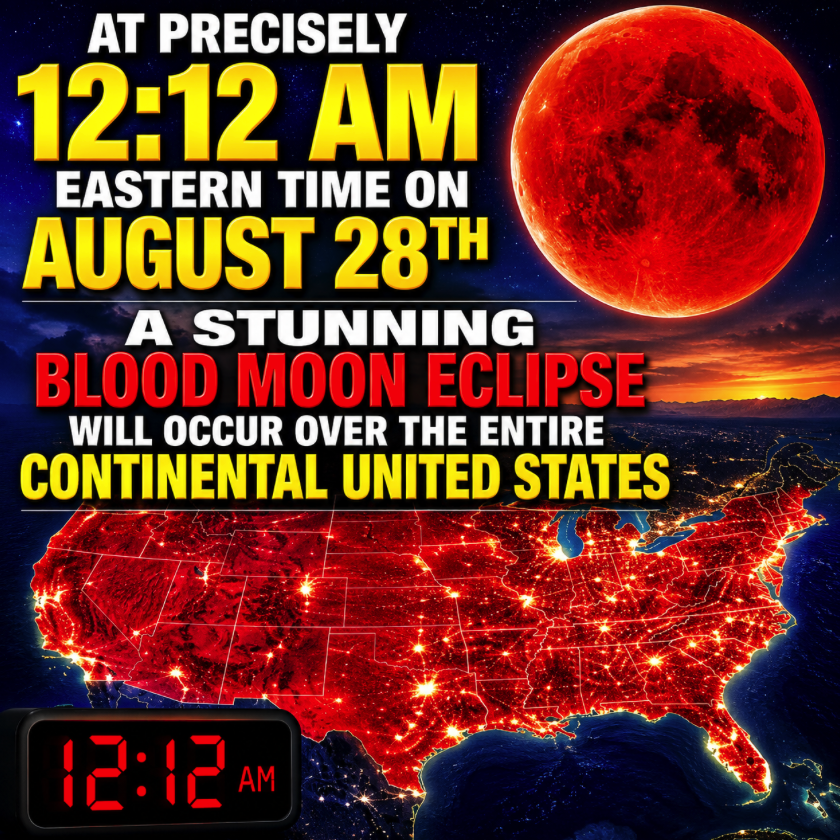
 It is not often that everyone living in the entire continental United States is able to view a blood moon eclipse with their own eyes. On the night of August 27th into the early hours of August 28th, a celestial spectacle will light up the night sky as Earth’s colossal shadow rises to swallow more than 96 percent of the full moon. In a breathtaking cosmic display, the brilliant lunar surface will be plunged into darkness, bleeding into deep shades of copper, fiery orange, and blood red. While a solitary, blazing sliver of light will fight to remain untouched, escaping a technical total eclipse by a razor-thin margin of less than four percent, the agonizingly close near-total blackout will leave onlookers spellbound. Overall, the eclipse will last for a total of five hours and 38 minutes. In the United States, it will start at 9:23 PM eastern time on August 27th, and it will end at 3:01 PM eastern time on August 28th. But it will be at precisely 12:12 AM eastern time that the main event will occur. At that moment the red color of the “blood moon” will reach a peak, and throughout human history many cultures have considered a “blood moon” to be a very ominous sign.
This is not something that happens every day.
Time Magazine has pointed out that 44.4 percent of the entire global population will be able to see this eclipse…
It’s not often that 3.6 billion people—or 44.4% of the world’s population—look at the same thing at the same time. And it’s not often that something comes along that’s worth the attention of all those billions. But that will happen on the evening of Aug. 27 when much of the world will be able to witness a blood moon lunar eclipse, during which 96% of the face of the full moon will fall into Earth’s shadow, glowing a deep orange-red in the process.
Approximately a billion people in the United States, Canada and Latin America will have “prime, hours-long views” as long as the weather cooperates.
I would encourage you to stay up for this if you are able to do so.
A lunar eclipse unfolds in three phases, and the maximum phase for this particular eclipse will last for one hour and 39 minutes…
There are three phases of any lunar eclipse—the penumbral, partial, and total or maximum. The penumbral phase occurs first, when the moon moves into the faint, outer reaches of the Earth’s umbra, or shadow. The partial phase comes next, when the true, darker shadow of the Earth begins to cover the lunar disk. The total or maximum phase is when only a small portion—or none at all—of the moon remains unshadowed. For the upcoming eclipse, the penumbral phase will take one hour and ten minutes, the partial phase one hour and 39 minutes, and the maximum phase, when the moon will be 96% obscured, will also take one hour and 39 minutes. That maximum shadow will occur at 12:12 a.m. ET. The eclipse will then return to the partial and penumbral phases before the moon soars on and leaves the Earth’s shadow behind.
As the maximum phase gets very close, the moon will start to turn red.
And once the moon is 96 percent covered by Earth’s shadow at mid-eclipse at 12:12 AM eastern time, the redness of the moon will be at peak intensity…
As the eclipse become deeper – and approaches maximum – you should begin to notice a red glow on the moon. There are varying opinions as to when this red color might become visible. Some say by 90%. Some say 95%. The darker your sky, the better chance you’ll have of seeing the red color sooner. Since 96% of the moon will be in Earth’s shadow at mid-eclipse, you’ll hopefully see some redness by then.
And you should see a bright white patch along the moon’s northeastern limb. That is the portion of the moon not yet submerged in the shadow. In other words, that’s the unshaded, daytime part of the moon.
So why will the moon turn red?
NASA has explained it in a way that I think is very easy to understand…
A Blood Moon refers to the reddish or copper color the Moon projects during a lunar eclipse. This astronomical event occurs when the Earth moves between the Sun and the Moon. In doing so, it blocks and filters sunlight on the Moon’s surface.
“The same phenomenon that makes our sky blue and our sunsets red causes the Moon to turn reddish-orange during a lunar eclipse,” NASA reports. “Sunlight appears white, but it actually contains a rainbow of components—and different colors of light have different physical properties. Blue light scatters relatively easily as it passes through Earth’s atmosphere. Reddish light, on the other hand, travels more directly through the air.”
“During a lunar eclipse, the Moon appears red or orange because any sunlight that’s not blocked by our planet is filtered through a thick slice of Earth’s atmosphere on its way to the lunar surface,” NASA continues. “It’s as if all the world’s sunrises and sunsets are projected onto the Moon.”
Those living on the east coast will be able to view this eclipse from the very beginning to the very end.
At 9:23 eastern time on August 27th the moon will start to enter the Earth’s shadow, and the eclipse will finally be over at 3:01 eastern time on August 28th…
- The eclipse begins when the moon enters Earth’s faint outer shadow at 9:23 p.m. EDT on Aug. 27 (0123 GMT on Aug. 28).
- Things get much more interesting at 10:33 p.m. EDT (0233 GMT), when the partial eclipse begins and Earth’s dark umbral shadow starts to creep across the lunar surface.
- Maximum eclipse occurs at 12:12 a.m. EDT (0412 GMT) on Aug. 28, when 96.2% of the moon will be immersed in Earth’s umbra.
- The partial phase ends at 1:51 a.m. EDT (0551 GMT), with the penumbral eclipse concluding at 3:01 a.m. EDT (0701 GMT).
This eclipse has sparked a frenzy of speculation on social media.
Many are wondering what it might mean, and even mainstream news sources are bringing up Bible verses in relation to this event…
Several passages in the Bible describe the moon turning red, signaling a major event or God’s intervention.
Key references include Joel 2:31, Acts 2:20, which echoes the same imagery, and Revelation 6:12, which describes the moon becoming like blood during apocalyptic events.
Believers often interpret these verses as signs that a blood moon could herald a time of upheaval, judgment for the wicked, or salvation for the faithful, giving the August eclipse a heightened sense of spiritual significance.
This is going to be the final lunar eclipse of 2026.
But there will be several notable eclipses in 2027, and in 2028 a total lunar eclipse will actually occur on New Year’s Eve…
This week’s lunar eclipse follows a total lunar eclipse in March and will be the second and last of the year. But if you miss it, more celestial events are coming in 2027.
Two solar eclipses will take place next year—one on February 6 and the other on August 2. But you might want to make this lunar eclipse count: three lunar eclipses in 2027 will be “penumbral”—meaning the moon will pass through Earth’s penumbra, the fainter part of its shadow, which won’t make quite as spectacular a view. The next total lunar eclipse will take place on New Year’s Eve in 2028—what a way to ring in 2029!
I did not know about that there will be a total lunar eclipse on New Year’s Eve in 2028.
Every day I am learning something new, and that is a good thing because if you are not learning you are not growing.
Personally, I am going to make it a point to check out the blood moon eclipse that will happen later this week.
It should be spectacular.
So many unusual events have already occurred in 2026, and I am expecting the pace of events to pick up even more during the remaining portion of this year.
Michael’s new book entitled “10 Prophetic Events That Are Coming Next” is available in paperback and for the Kindle on Amazon.com, and you can subscribe to his Substack newsletter at michaeltsnyder.substack.com.

About the Author: Michael Snyder’s new book entitled “10 Prophetic Events That Are Coming Next” is available in paperback and for the Kindle on Amazon.com. He has also written nine other books that are available on Amazon.com including “Chaos”, “End Times”, “7 Year Apocalypse”, “Lost Prophecies Of The Future Of America”, “The Beginning Of The End”, and “Living A Life That Really Matters”. When you purchase any of Michael’s books you help to support the work that he is doing. You can also get his articles by email as soon as he publishes them by subscribing to his Substack newsletter. Michael has published thousands of articles on The Economic Collapse Blog, End Of The American Dream and The Most Important News, and he always freely and happily allows others to republish those articles on their own websites. These are such troubled times, and people need hope. John 3:16 tells us about the hope that God has given us through Jesus Christ: “For God so loved the world, that he gave his only begotten Son, that whosoever believeth in him should not perish, but have everlasting life.” If you have not already done so, we strongly urge you to invite Jesus Christ to be your Lord and Savior today.