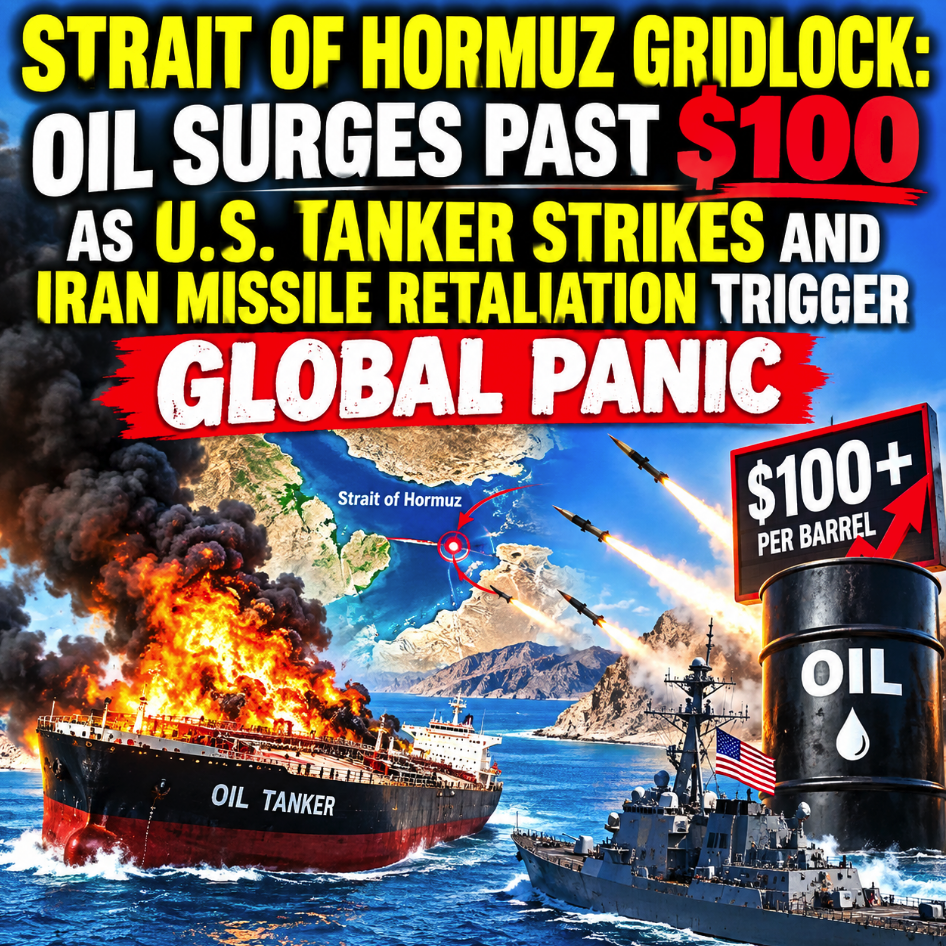
 For decades, foreign policy experts warned about what would happen if someone decided to shut down the Strait of Hormuz. Now we are living that reality. The price of Brent crude just smashed through the $100 barrier after fighting between the U.S. and Iran erupted once again last night. Gasoline and diesel are going to become even more expensive, and that is not good news for our economy at all. But that isn’t the big story. The panic that is starting to spread through global financial markets is not the big story either. The big story is that the war with Iran is dangerously close to spiraling completely and utterly out of control. If that actually happens, we really will be facing an apocalyptic scenario.
As I discussed yesterday, great efforts have been made to keep the price of oil under $100 during this war.
Unfortunately, those efforts have failed…
Oil prices climbed above $100 a barrel Wednesday for the first time in nearly six weeks as escalating attacks on tankers and energy facilities in the Middle East raised fears of further disruptions to global supplies.
Brent crude, the international benchmark for oil prices, rose above $100 a barrel in early trading, while the U.S. benchmark climbed above $95.
When the price of oil rises above $100 a barrel, it acts as a psychological trigger and global investors start to become very nervous.
The reason why the price of oil is spiking is because more fighting suddenly flared up last night.
The U.S. attacked and destroyed five oil tankers that belonged to Iran…
U.S. military forces destroyed five Iranian crude oil tankers Sept. 8, officials said, the latest in an escalating round of exchanges between the United States and Iran.
The strikes targeted five tankers linked to Iran’s Islamic Revolutionary Guard Corps, according to U.S. Central Command, the arm of the military overseeing operations in the Middle East. Central Command shared footage of the strikes showing the aft, or rear, part of the massive non-military vessels.
Central Command footage of the strikes shows missiles hitting the ships and leaving them in flames. Four of the tankers were located in the Gulf of Oman. The other tanker was in the Persian Gulf near Kharg Island, a well-known Iranian oil depot President Donald Trump has repeatedly threatened to attack.
U.S. Central Command has specifically identified all five of the oil tankers for us, and we are being told that they were targeted “because of their role in helping move Iranian oil out of the region”…
The tankers U.S. forces targeted were M/T Kaviz, M/T Charminar, M/T Horizon 1 and M/T Riesco, located in the Gulf of Oman, and M/T Derya, located near Kharg Island, military officials said.
According to Central Command, the vessels were targeted because of their role in helping move Iranian oil out of the region.
It was inevitable that the Iranians would respond.
Shortly after the U.S. attacks, Iran launched missiles at 10 ships…
Iran said on Wednesday it had attacked 10 ships near the Strait of Hormuz after the U.S. sank five Iranian oil tankers, in the biggest declared wave of tit-for-tat attacks on shipping by both sides since the start of the six-month-old war.
Two of the ships that Iran targeted were U.S. warships, and eight of them were commercial vessels.
In addition, Iran also fired a number of missiles at U.S. facilities in Jordan.
The Iranians claim that they successfully hit two U.S. Navy destroyers, but U.S. Central Command is strongly denying this…
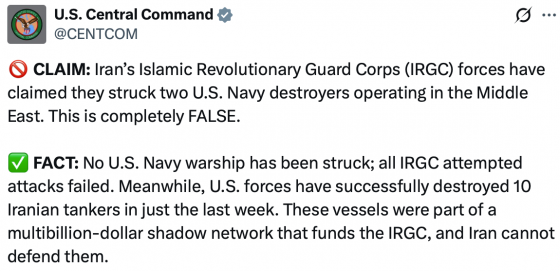
It does appear that there were direct hits in Jordan, but the Pentagon is telling us that all U.S. personnel “are accounted for”…
After a huge Iranian ballistic missile launch on US bases in Jordan overnight, CENTCOM has yet to respond in any major way. The Pentagon has also said all US troops “are accounted for” – but this doesn’t necessarily mean there were no casualties.
Hopefully we will get more clarity about potential casualties in the hours ahead.
It is being reported that the Iranians are starting to use “electro-optical missiles” in some instances.
Electro-optical missiles achieve high precision by tracking and striking targets using built-in cameras and light sensors.
So where did Iran get such technology?
Well, there is speculation that the Iranians may be getting help from Russia or China…
The new missiles suggest Tehran may still be receiving assistance from Russia or China to track the location of US warships, experts have warned.
In April, intelligence reports found that Chinese and Russian satellites were secretly providing the Islamic Republic with critical imagery to target US military bases.
Russia has long exchanged weapons with Iran and provided drone expertise during the war.
In May, the US sanctioned China-based entities for providing satellite imagery to Iran during the war. Two months later, it was revealed that China was sending 400 rocket launchers to Iran in a new deal, underscoring their increased military ties.
If it is confirmed that either Russia or China is assisting the Iranians with their missile program, that would be a deeply troubling development.
I think that the Trump administration was hoping that striking Iranian tankers would cause the Iranians to stop attacking commercial vessels, but that isn’t going to happen.
In fact, the IRGC is warning that “if the enemy hits two or three of our targets, we will respond firmly with 20 targets”…
Iran’s Revolutionary Guard Corps said Wednesday that it will hit 20 targets for every two or three U.S. strikes, while outlining the country’s conditions for ending the war.
“If the enemy wants an end to this situation, it must, while completely stopping the war, refrain from making threats again, the army of the Zionist regime must withdraw from Lebanon, the blockade of Yemen must end, $24 billion of Iran’s frozen assets must be released, and it must refrain from any interference in the country’s nuclear and missile capabilities,” said IRGC spokesman Brig. Gen. Hossein Mohebi, according to pro-regime Iranian outlet Akharin Khabar.
“We even have the capability to hit targets at this distance of 400 kilometers (250 miles), and some time ago, we targeted an American aircraft carrier at a distance of 500 kilometers (310 miles),” Mohebi claimed, adding that Iran has “reached a point where if the enemy hits two or three of our targets, we will respond firmly with 20 targets.”
The Iranians want to make the response to any military action so painful that President Trump will be forced to back off.
But that isn’t going to happen either.
If both sides just continue to escalate matters, the entire region could erupt in flames.
Perhaps that is inevitable.
On Wednesday, Israeli Prime Minister Benjamin Netanyahu once again boldly proclaimed that the end of the regime in Iran is very near…
Israeli Prime Minister Benjamin Netanyahu said victory over Iran is “very close,” declaring on the eve of Rosh Hashanah that bringing down Tehran’s regime remains the country’s “main task.”
“The main task is to defeat the terrorist regime in Iran. We are very close to it,” Netanyahu said in a video message posted to X during a visit to Mount Hermon in Syria. “We know that the entire axis will ultimately fall. We are committed to doing this, and we will do it.”
Netanyahu visited the area alongside Israeli Defense Minister Israel Katz and IDF Deputy Chief of Staff Maj. Gen. Tamir Yadai, receiving a briefing on Israeli military operations in the region.
Netanyahu has said this several times now.
To me, it does not appear that the fall of the Iranian regime is close.
So I would love to learn what he knows that I do not.
Needless to say, the regime in Tehran will not go peacefully.
If what Netanyahu is claiming is accurate, that would seem to indicate that the war in the Middle East is not even close to over.
That means that the global energy crunch is going to get a whole lot worse.
Right now, the Chinese are driving up prices for physical oil as they seek to replace the oil that they normally import from Iran…
China, the world’s largest oil importer, is bidding up crude prices across Africa, Canada, and Latin American markets as disruptions in the Hormuz chokepoint and limited Iranian supplies intensify competition for alternatives. The scramble is squeezing smaller Chinese refineries that once relied on heavily discounted Iranian barrels, according to a new Bloomberg report.
The renewed Chinese buying marks a major shift from a period when subdued Chinese buying helped restrain crude oil prices. With Iranian exports almost entirely shut off by the US blockade and fighting flaring again, as seen Monday when Saudi Aramco’s Jizan oil facilities were reportedly hit, the race to find replacement supplies around the world is becoming an increasingly expensive task for the Chinese.
Pretty soon, there will be a mad scramble as nations all over the globe attempt to secure sufficient energy supplies.
Inventories are getting extremely tight, and we are feeling the pain here in the United States too.
The average price of a gallon of gasoline in the U.S. has never been this high so late in the calendar year, and the average price of a gallon of diesel just reached yet another new record high…
While gas prices often lag oil prices, they also ticked higher this week after reaching a record Labor Day weekend high. As of Sept. 9, the national average price of a gallon of regular gasoline is $4.22, up from $4.01 last month and from $3.19 this time last year, according to AAA.
The jumps come days after average U.S. diesel prices reached record highs. On Sept. 9, diesel continued to set records, jumping to an all-time high of $5.92 per gallon, according to Patrick De Haan, head of petroleum analysis at GasBuddy.
Gas prices have surged 42% since the start of the war on Feb. 28, prompting pain at the pump for some American consumers. The University of Michigan’s measure of consumer sentiment and The Conference Board’s measure of consumer confidence fell in August, as survey respondents cited high gas prices.
If prices continue to rise, it will have a dramatic impact on economic activity.
Meanwhile, global investors will get really spooked if the price of oil stays above $100 a barrel for an extended period of time.
But there is no easy way out now.
Even if the U.S. were to completely pull out of the Middle East, it would be just a matter of time before Iran and Israel started going at it again.
Decades of tension in the Middle East have been building up to this moment.
Now a terrifying war is playing out right in front of our eyes, and there is no end in sight.
Michael’s new book entitled “10 Prophetic Events That Are Coming Next” is available in paperback and for the Kindle on Amazon.com, and you can subscribe to his Substack newsletter at michaeltsnyder.substack.com.

About the Author: Michael Snyder’s new book entitled “10 Prophetic Events That Are Coming Next” is available in paperback and for the Kindle on Amazon.com. He has also written nine other books that are available on Amazon.com including “Chaos”, “End Times”, “7 Year Apocalypse”, “Lost Prophecies Of The Future Of America”, “The Beginning Of The End”, and “Living A Life That Really Matters”. When you purchase any of Michael’s books you help to support the work that he is doing. You can also get his articles by email as soon as he publishes them by subscribing to his Substack newsletter. Michael has published thousands of articles on The Economic Collapse Blog, End Of The American Dream and The Most Important News, and he always freely and happily allows others to republish those articles on their own websites. These are such troubled times, and people need hope. John 3:16 tells us about the hope that God has given us through Jesus Christ: “For God so loved the world, that he gave his only begotten Son, that whosoever believeth in him should not perish, but have everlasting life.” If you have not already done so, we strongly urge you to invite Jesus Christ to be your Lord and Savior today.