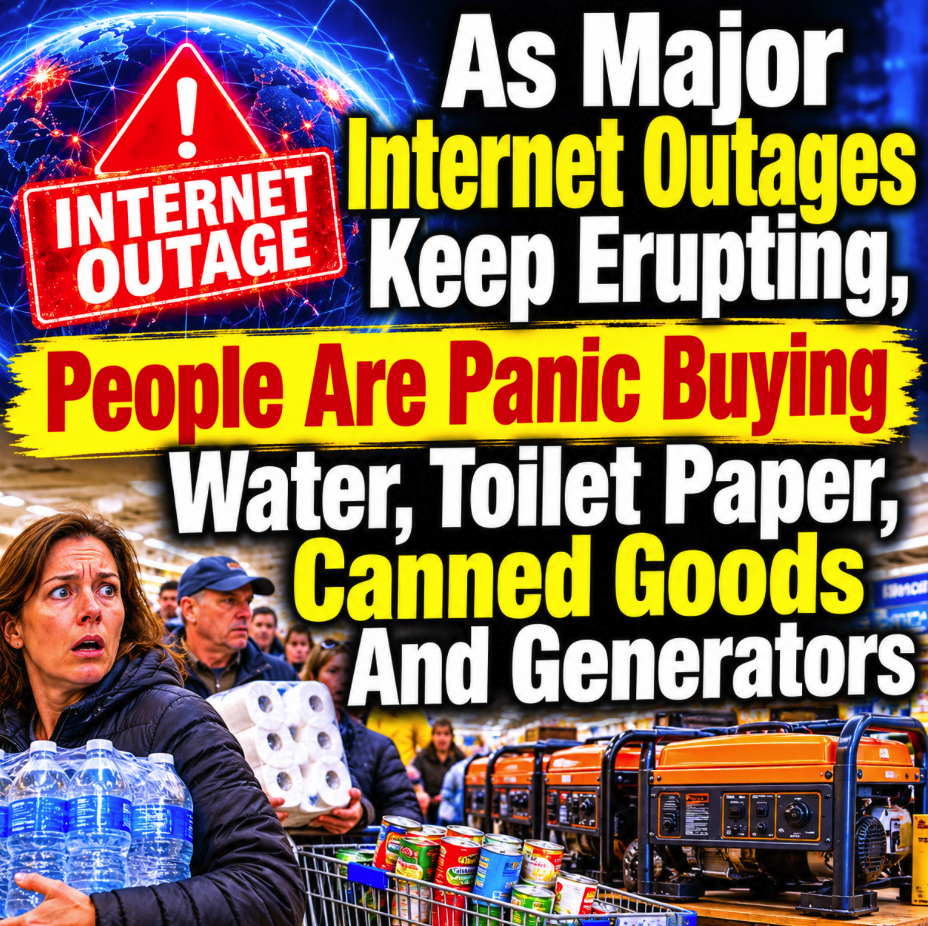
 We are witnessing a string of major Internet outages that is without precedent. Over the past week, it has just been one after another. Needless to say, this has created quite a bit of fear. Just like we saw during the early days of the last pandemic, people are panic buying water, toilet paper, canned goods and generators. When workers brought out a full pallet of bottled water at a Costco in Woodbridge, Virginia it nearly disappeared in just a matter of seconds. In many ways, that reminded me of the frenzied buying that we once witnessed on Black Friday each year. If you don’t have enough bottled water on hand, you might want to go out and grab some while you still can.
Major Internet outages are occurring so frequently now that nobody could possibly keep up with them all.
But there is one that just happened that definitely captured my attention…
Nearly 240,000 people in South Carolina have just been told to BOIL THEIR WATER after a yet-unexplained “power blip” knocked out water pressure across the ENTIRE main system at Spartanburg Water.
Not one neighborhood… the WHOLE system.
Several Spartanburg County schools are sending kids home early, and the advisory has no end date.
The Iranians targeted a number of U.S. water systems back in July.
Are they doing it again?
I don’t think that it is just a coincidence that there have been so many major outages over the past 7 days. The following list of some of the major outages was compiled by Matt Van Swol…
Nov 12–14: Microsoft 365 goes down worldwide ( in 74 countries for nearly 24 hours
Nov 13: FAA issues a NATIONWIDE ground stop after a faulty router disrupts air traffic control, and about 12,000 flights are canceled
Nov 13: Workday, the HR and payroll system for about 11,500 companies, goes DOWN
Nov 14: Marriott hit with outage reports
Nov 15: Amazon Web Services outage knocks out 11 services in its Northern Virginia region
Nov 16: Chase goes down for nearly 8 hours, and customers can’t log in or move money
Nov 16: Wells Fargo, Capital One, Bank of America and Zelle users report problems too
Nov 16: United Airlines “widespread system outage” delays departures
Nov 16–17: Gmail users report trouble sending and receiving email
Nov 17: The NSA’s classified internal network goes DOWN
Nov 17: Marriott’s app and website go down, and guests can’t sign in or book
Nov 17: Charles Schwab reports problems
Nov 18: Outlook hit for a THIRD time, with more than 4,400 reports of users unable to receive email
None of these outages has been permanent.
But people are rushing out to panic buy food and supplies anyway…
Costco shoppers are panic-buying bottled water, generators and batteries as apocalyptic social media posts gain traction online following a series of freak outages over the past few days.
The panic buying at Costco always seems to be more intense than anywhere else.
Why is that?
It is being reported that 21 out of Costco’s 26 “high-ticket generators” were officially sold out on Sunday night…
Consumers are panic-buying at Costco, snapping up generators and other emergency-preparedness items in response to a recent string of technology outages, according to investment firm Mizuho Securities.
“Consumer anxiety following the Microsoft Outlook outage, the ground stoppage for all U.S. airline flights, and apocalyptic concerns flaring up across social media have all contributed to increased emergency prep sales at Costco,” Mizuho analyst David Bellinger wrote in a report.
Shoppers are “pantry-loading,” while 21 of the retailer’s 26 “high-ticket generators” were sold out online as of Sunday night, he added.
If we are witnessing this much panic buying now, what will happen once conditions start getting really crazy in this country?
All of a sudden, even the mainstream media is talking about preparedness.
The following comes from a Newsweek article entitled “Doomsday readiness: Essential preparations as major outages hit US”…
In the United States, federal emergency guidance recommends households keep enough supplies to manage on their own for at least three days after a disaster. That advice broadly resembles guidance overseas, although some countries expect households to remain self-sufficient for longer. The European Union has promoted a minimum 72-hour preparedness standard, while Sweden recommends households be able to cope for at least a week and Germany advises aiming for 10 days of supplies when possible.
Across the guidance, however, the principle is largely the same: households should have enough food, water, medicine and basic supplies to get through the period when power, communications, transportation or emergency services may be disrupted.
For some families, however, building and maintaining an emergency stockpile can be difficult, particularly when the added cost of food, water, medications and other necessities competes with everyday expenses. Even so, experts say that when households have the means and space, keeping more than the minimum recommended supply can provide an additional buffer if an emergency lasts longer than expected.
Last month, governments all over the world were urging their citizens to get prepared for emergencies.
This month, all of a sudden we are experiencing Internet outages on a scale that we have never seen before.
Is there any connection?
Late last week, the FBI warned that cybercriminals have been using a new tool known as “ARTEX” to use LLMs to conduct large-scale cyberattacks all over the world…
In a November 13 Flash Advisory, the Federal Bureau of Investigation (FBI) said cybercriminals had been using the open-source framework since at least August 2026 to target organizations worldwide. The targeted sectors include financial services, government, technology, defense, healthcare, semiconductor, energy, manufacturing, telecommunications and legal services.
One confirmed incident involved a supply-chain compromise of ConnectWise Cloud Backup that allowed attackers to access more than 2,250 downstream tenants.
Written in Go, ARTEX connects to external large language models (LLMs) like DeepSeek, Claude and GPT. What makes it different is its use of specialized AI agents that work on separate tasks after an operator sets an objective. These agents can identify targets, check systems for weaknesses, exploit them and exfiltrate data, with little human involvement.
Is ARTEX responsible for any of the outages that we have been experiencing in recent days?
Clearly something is going on.
Government officials keep telling us that there is no evidence that any of these outages were caused by cyberattacks, but prominent cybersecurity expert Nicole Perlroth is not buying it…
In the span of six days, we’ve experienced;
11/12 — Microsoft outage
11/13 — Nationwide FAA ground stop
11/16 — Major US banking disruptions
11/17 — NSA’s classified internal network goes downWe need far more analysis of why so much is breaking at once. I don’t want to get out over my skis here, and what I am hearing does not contradict the messaging that most of this is the result of screwy updates.
I completely agree.
I don’t think that they are telling us the truth.
Perlroth is also questioning whether we should have ever allowed our entire society to become so deeply dependent on the Internet…
We never stopped to ask: SHOULD WE?
Should we be digitizing every last nook and cranny of our companies, infrastructure, healthcare, homes, cars, bodies, lives? Especially when the complexity, interdependence, and fragility we were introducing overwhelmed our ability to understand/secure/maintain the systems we built?
Nobody every asked: What if, in the name of progress, we were creating the ripest attack surface in human history?
We are now entirely dependent on software systems that almost nobody understands end to end, that increasingly few people can repair, and that attackers can now probe at machine speed. We are hearing that incident response firms, the 911 for breach victims, are backlogged six months. Even those paid on retainer lack the bandwidth to triage every incident. The cavalry is disappearing.
Perlroth is not just some random Internet user.
She is one of the most respected cybersecurity experts in the entire world.
If she is freaking out about how vulnerable we are, what does that tell us?
The good news is that the recent spate of outages doesn’t seem to have done any permanent damage.
But it is probably just a matter of time before AI cyberattacks start hitting us in ways that are really going to hurt.
Michael’s new book entitled “10 Prophetic Events That Are Coming Next” is available in paperback and for the Kindle on Amazon.com, and you can subscribe to his Substack newsletter at michaeltsnyder.substack.com.

About the Author: Michael Snyder’s new book entitled “10 Prophetic Events That Are Coming Next” is available in paperback and for the Kindle on Amazon.com. He has also written nine other books that are available on Amazon.com including “Chaos”, “End Times”, “7 Year Apocalypse”, “Lost Prophecies Of The Future Of America”, “The Beginning Of The End”, and “Living A Life That Really Matters”. When you purchase any of Michael’s books you help to support the work that he is doing. You can also get his articles by email as soon as he publishes them by subscribing to his Substack newsletter. Michael has published thousands of articles on The Economic Collapse Blog, End Of The American Dream and The Most Important News, and he always freely and happily allows others to republish those articles on their own websites. These are such troubled times, and people need hope. John 3:16 tells us about the hope that God has given us through Jesus Christ: “For God so loved the world, that he gave his only begotten Son, that whosoever believeth in him should not perish, but have everlasting life.” If you have not already done so, we strongly urge you to invite Jesus Christ to be your Lord and Savior today.