The Stock Market In Japan Is COLLAPSING

Stock Market Collapse In JapanDid you see what just happened in Japan?  The stock market of the 3rd largest economy on the planet is imploding.  On Tuesday, the Nikkei fell by more than 610 points.  If that sounds like a lot, that is because it is.  The largest one day stock market decline in U.S. history is only 777 points.  So far, the Dow is only down about 1000 points during this “correction”, but the Nikkei is down more than 2,300 points.  The Nikkei has dropped more than 14 percent since the peak of the market, and many analysts believe that this is only just the beginning.  Those that have been waiting for a full-blown stock market collapse may be about to get their wish.  Japan is absolutely drowning in debt, their central bank is printing money like crazy and the Japanese population is aging rapidly.  As far as economic fundamentals go, there is very little good news as far as Japan is concerned.  So will an Asian financial collapse precede the next great financial crisis in the United States?  That is what some have been predicting, and it starting to look increasingly likely.

What happened to the Nikkei early on Tuesday was absolutely breathtaking.  The following is how Bloomberg described the carnage…

At the end of January 2013, Japanese stocks trailed only Portugal for the biggest rally among developed markets. Now the Nikkei 225 Stock Average is leading declines, slumping 8.5 percent last month and today capping a 14 percent drop from its Dec. 30 peak.

Losses snowballed in Tokyo during a global retreat that has erased $2.9 trillion from equity values worldwide this year amid signs of slower growth in China and stimulus cuts by the U.S. Federal Reserve.

As Bloomberg noted, much of the blame for the financial problems that we are seeing all over the planet right now is being placed on the Federal Reserve.

The Fed created this bubble by pumping trillions of fresh dollars into the global financial system, and now they are bursting this bubble by starting to cut off the flow of easy money.

This is something that I warned would happen when the Fed decided to taper, and now RBS is warning of a “market bloodbath” unless the Federal Reserve immediately stops tapering.

Most Americans simply do not realize that our financial markets no longer resemble a free market system.  Instead, they are highly manipulated and distorted by the central banks, and the trillions of dollars of “hot money” that the Fed has poured into the global financial system has infected virtually every financial market on Earth

On Wall Street they call it “hot money”—that seemingly endless flow of cash that goes to the most profitable country du jour—but in the real economy it’s gone cold.

That hot money has come mostly in the form of a low-yielding U.S. dollar, which investors have borrowed en masse to fund investments in other higher-yielding currencies across the globe. The so-called carry trade has helped fuel an investment bonanza across the world that has boosted risk assets thanks primarily to the U.S. Federal Reserve‘s easy-money policy.

But with the Fed tiptoeing away from what initially was an $85 billion-a-month infusion of liquidity, investors are beginning to prepare themselves for a world of rising rates in which the endless cash flow to emerging market economies begins to ebb, then cease.

We never fixed any of the fundamental problems that caused the last financial crisis.  Instead, the Fed seemed to think that the solution to any problem was just to create more money.

It was an incredibly stupid approach, and now our fundamental problems are worse than ever as Marc Faber recently noted

“Total credit as a percent of the global economy is now 30 percent higher than it was at the start of the economic crisis in 2007, we have had rapidly escalating household debt especially in emerging economies and resource economies like Canada and Australia and we have come to a point where household debt has become burdensome on the system—that is, where an economic slowdown follows.”

So what comes next?

Well, unless the Fed or other central banks intervene, we are probably going to have even more carnage.

At least that is what Dennis Gartman, the editor and publisher of “The Gartman Letter”, told CNBC on Tuesday

“I just think you’re going to have a very severe, very substantive and really quite ugly correction that will probably make a lot of people wail and gnash their teeth before it’s done.”

Other analysts share his pessimism.  According to Doug Short, the vice president of research at Advisor Perspectives, the U.S. stock market “still looks 67% overvalued“.

Most sobering of all is what Richard Russell is saying.  In his 60 years of writing about financial issues, he has never been “so filled with foreboding regarding what lies ahead”

I’d be lying if I said that I wasn’t worried about the way things are going.  Frankly, I’m truly scared for myself, my family and the nation.  I have the sinking feeling that the stock market is on the edge of a crash.  If that happens, investor sentiment will turn quickly bearish.  And the bear market will start feeding on itself.  Ironically, the recent action occurred in the face of almost insane bullishness on the part of the crowd and on the part of investors.

Obviously smart heads and institutional money managers know that the US is semi dead in the water.  And all the talk about an improving economy is just wishes and hopes.  Bernanke’s dream of a flourishing new economy, improving without the need of the Fed’s help, is an idle dream.

I’ve been writing about the stock market for over 60 years and I can’t remember a time when I was so filled with foreboding regarding what lies ahead.  The primary trend of the market, like the tide of the ocean, is irresistible, and waits for no man.  What scares me the most in this current situation is that I see no clear island of safety.

You can read the rest of his very disturbing remarks right here.

U.S. stocks may not totally crash this week, this month or even this year, but without a doubt a day of reckoning is coming.  As a society, our total consumer, business and government debt is now equivalent to approximately 345 percent of GDP.

The only way that the game can continue is to keep pumping up the debt bubble even more.

Once the debt bubble stops expanding, it will start collapsing very rapidly.

Those that foolishly still have lots of money in the stock market better hope that the Federal Reserve decides to intervene in a major way very soon.

Because if they don’t, there is a very good chance that we could indeed have a “market bloodbath” on our hands.

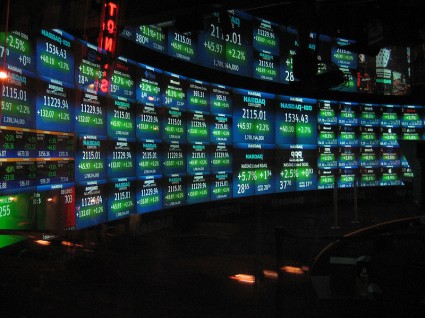
The Dow Has Already Fallen More Than 1000 Points From The Peak Of The Market

Stock Market Decline - Photo by NodulationThat didn’t take long.  On Monday, the Dow was down another 326 points.  Overall, the Dow has now fallen more than 1000 points from the peak of the market (16,588.25) back in late December.  This is the first time that we have seen the Dow drop below its 200-day moving average in more than a year, and there are many that believe that this is just the beginning of a major stock market decline.  Meanwhile, things are even worse in other parts of the world.  For example, the Nikkei is now down about 1700 points from its 2013 high.  This is causing havoc all over Asia, and the sharp movement that we have been seeing in the USD/JPY is creating a tremendous amount of anxiety among Forex traders.  For those that are not interested in the technical details, what all of this means is that global financial markets are starting to become extremely unstable.

Unfortunately, there does not appear to be much hope on the horizon for investors.  In fact, troubling news just continues to pour in from all over the planet.  Just consider the following…

-Major currencies all over South America continue to collapse.

-Massive central bank intervention has done little to slow down the currency collapse in Turkey.

-Investors pulled more than 6 billion dollars out of emerging market equity funds last week alone.

-The CBOE Volatility Index (VIX) has risen above 20 for the first time in four months.

-Last month, new manufacturing orders in the United States declined at the fastest pace that we have seen since December 1980.

-Real disposable income in the United States has just experienced the largest year over year drop that we have seen since 1974.

-In January, vehicle sales for Ford were down 7.5 percent and vehicle sales for GM were down 12 percent.  Both companies are blaming bad weather.

-A major newspaper in the UK is warning that “growing problems in the Chinese banking system could spill over into a wider financial crisis“.

-U.S. Treasury Secretary Jack Lew is warning that the federal government could hit the debt ceiling by the end of this month if Congress does not act.

-It is being reported that Dell Computer plans to lay off more than 15,000 workers.

-The IMF recently said that the the probability that the global economy will fall into a deflation trap “may now be as high as 20%“.

-The Baltic Dry Index is now down 50 percent from its December highs.

If our economic troubles continue to mount, could we be facing a global “financial avalanche” fairly quickly?

That is what some very prominent analysts believe.

Below, I have posted quotes from five men that are greatly respected in the financial world.  What they have to say is quite chilling…

#1 Doug Casey: “Now is a very good time to start thinking financially because I’m afraid that this year, in 2014, we’re going to go back into the financial hurricane. We’ve been in the eye of the storm since 2009, but now we’re going to go back into the trailing edge of the storm, and it’s going to be much longer lasting and much worse and much different than what we had in 2008 and 2009.”

#2 Bill Fleckenstein: “The [price-to-earnings ratio] is 16, 17 times earnings,” Fleckenstein said on Tuesday’s episode of “Futures Now.” “Why would you pay 16 times for an S&P company? I don’t care about where rates are, because rates are artificially suppressed. Why isn’t that worth 11 or 12 times? Just by that analysis, you’d be down by a quarter or 30 percent. So there’s a huge amount of downside.”

#3 Egon von Greyerz of Matterhorn Asset Management: “Nothing goes (down) in a straight line, but the emerging market problems will accelerate and it will spread to the very overbought and the very overvalued stock markets and economies in the West.

So stock markets are now starting a secular bear trend which will last for many years, and we could see falls of massive proportions. At the end of this, the wealth that has been created in the last few decades will be destroyed.”

#4 Peter Schiff: “The crisis is imminent,” Schiff said.  “I don’t think Obama is going to finish his second term without the bottom dropping out. And stock market investors are oblivious to the problems.”

“We’re broke, Schiff added.  “We owe trillions. Look at our budget deficit; look at the debt to GDP ratio, the unfunded liabilities. If we were in the Eurozone, they would kick us out.”

#5 Gerald Celente: “This selloff in the emerging markets, with their currencies going down and their interest rates going up, it’s going to be disastrous and there are going to be riots everywhere…

So as the decline in their economies accelerates, you are going to see the civil unrest intensify.”

—–

Those that do not believe that we could ever see “civil unrest” on the streets of America should take note of what just happened in Seattle.

After the Seahawks won the Super Bowl, fans celebrated by “lighting fires, damaging historic buildings and ripping down street signs“.

If that is how average Americans will behave when something good happens, how will they act when the economy totally collapses and nobody can find work for an extended period of time?

We are rapidly approaching another great financial crisis.  Unfortunately, we didn’t learn any of the lessons that we should have learned last time.  It is being projected that the debt of the federal government will more than double during the Obama years, the “too big to fail banks” have collectively gotten 37 percent larger over the past five years, and the big banks have become more financially reckless than ever before.

When the next great financial crisis arrives (and without a doubt it is inevitable), millions more Americans will lose their jobs and millions more Americans will lose their homes.

Now is not the time to be buying lots of expensive new toys, going on expensive vacations or piling up lots of debt.

Now is the time to build up an emergency fund and to do whatever you can to get prepared for the great storm that is coming.

As you can see from the financial headlines, time is rapidly running out.

NASDAQ MarketSite TV studio - Photo by Luis Villa del Campo

Are We On The Verge Of A Massive Emerging Markets Currency Collapse?

Currency CollapseThis time, the Federal Reserve has created a truly global problem.  A big chunk of the trillions of dollars that it pumped into the financial system over the past several years has flowed into emerging markets.  But now that the Fed has decided to begin “the taper”, investors see it as a sign to pull the “hot money” out of emerging markets as rapidly as possible.  This is causing currencies to collapse and interest rates to soar all over the planet.  Argentina, Turkey, South Africa, Ukraine, Chile, Indonesia, Venezuela, India, Brazil, Taiwan and Malaysia are just some of the emerging markets that have been hit hard so far.  In fact, last week emerging market currencies experienced the biggest decline that we have seen since the financial crisis of 2008.  And all of this chaos in emerging markets is seriously spooking Wall Street as well.  The Dow has fallen nearly 500 points over the last two trading sessions alone.  If the Federal Reserve opts to taper even more in the coming days, this currency crisis could rapidly turn into a complete and total currency collapse.

A lot of Americans have always assumed that the U.S. dollar would be the first currency to collapse when the next great financial crisis happens.  But actually, right now just the opposite is happening and it is causing chaos all over the planet.

For instance, just check out what is happening in Turkey according to a recent report in the New York Times

Turkey’s currency fell to a record low against the dollar on Friday, a drop that will hit the purchasing power of everyone in the country.

On a street corner in Istanbul, Yilmaz Gok, 51, said, “I’m a retiree making ends meet on a small pension and all I care about is a possible increase in prices.”

“I will need to cut further,” he said. “Maybe I should use my natural gas heater less.”

As inflation escalates and interest rates soar in these countries, ordinary citizens are going to feel the squeeze.  Just having enough money to purchase the basics is going to become more difficult.

And this is not just limited to a few countries.  What we are watching right now is truly a global phenomenon

“You’ve had a massive selloff in these emerging-market currencies,” Nick Xanders, a London-based equity strategist at BTIG Ltd., said by telephone. “Ruble, rupee, real, rand: they’ve all fallen and the main cause has been tapering. A lot of companies that have benefited from emerging-markets growth are now seeing it go the other way.”

So why is this happening?  Well, there are a number of factors involved of course.  However, as with so many of our other problems, the actions of the Federal Reserve are at the very heart of this crisis.  A recent USA Today article described how the Fed helped create this massive bubble in the emerging markets…

Emerging markets are the future growth engine of the global economy and an important source of profits for U.S. companies. These developing economies were both recipients and beneficiaries of massive cash inflows the past few years as investors sought out bigger returns fostered by injections of cheap cash from the Federal Reserve and other central bankers.

But now that the Fed has started to dial back its stimulus, many investors are yanking their cash out of emerging markets and bringing the cash back to more stable markets and economies, such as the U.S., hurting the developing nations in the process, explains Russ Koesterich, chief investment strategist at BlackRock.

“Emerging markets need the hot money but capital is exiting now,” says Koesterich. “What you have is people saying, ‘I don’t want to own emerging markets.'”

What we are potentially facing is the bursting of a financial bubble on a global scale.  Just check out what Egon von Greyerz, the founder of Matterhorn Asset Management in Switzerland, recently had to say…

If you take the Turkish lira, that plunged to new lows this week, and the Russian ruble is at the lowest level in 5 years. In South Africa, the rand is at the weakest since 2008. The currencies are also weak in Brazil and Mexico. But there are many other countries whose situation is extremely dire, like India, Indonesia, Hungary, Poland, the Ukraine, and Venezuela.

I’m mentioning these countries individually just to stress that this situation is extremely serious. It is also on a massive scale. In virtually all of these countries currencies are plunging and so are bonds, which is leading to much higher interest rates. And the cost of credit-default swaps in these countries is surging due to the increased credit risks.

And many smaller nations are being deeply affected already as well.

For example, most Americans cannot even find Liberia on a map, but right now the actions of our Federal Reserve have pushed the currency of that small nation to the verge of collapse

Liberia’s finance minister warned against panic today after being summoned to parliament to explain a crash in the value of Liberia’s currency against the US dollar.

“Let’s be careful about what we say about the economy. Inflation, ladies and gentlemen, is not out of control,” Amara Konneh told lawmakers, while adding that the government was “concerned” about the trend.

Closer to home, the Mexican peso tumbled quite a bit last week and is now beginning to show significant weakness.  If Mexico experiences a currency collapse, that would be a huge blow to the U.S. economy.

Like I said, this is something that is happening on a global scale.

If this continues, we will eventually see looting, violence, blackouts, shortages of basic supplies, and runs on the banks in emerging markets all over the planet just like we are already witnessing in Argentina and Venezuela.

Hopefully something can be done to stop this from happening.  But once a bubble starts to burst, it is really difficult to try to hold it together.

Meanwhile, I find it to be very “interesting” that last week we witnessed the largest withdrawal from JPMorgan’s gold vault ever recorded.

Was someone anticipating something?

Once again, hopefully this crisis will be contained shortly.  But if the Fed announces that it has decided to taper some more, that is going to be a signal to investors that they should race for the exits and the crisis in the emerging markets will get a whole lot worse.

And if you listen carefully, global officials are telling us that is precisely what we should expect.  For example, consider the following statement from the finance minister of Mexico

“We expected this year to be a volatile year for EM as the Fed tapers,” Mexican Finance Minister Luis Videgaray said, adding that volatility “will happen throughout the year as tapering goes on”.

Yes indeed – it is looking like this is going to be a very volatile year.

I hope that you are ready for what is coming next.

Wheelbarrow of Money

20 Early Warning Signs That We Are Approaching A Global Economic Meltdown

Earth From SpaceHave you been paying attention to what has been happening in Argentina, Venezuela, Brazil, Ukraine, Turkey and China?  If you are like most Americans, you have not been.  Most Americans don’t seem to really care too much about what is happening in the rest of the world, but they should.  In major cities all over the globe right now, there is looting, violence, shortages of basic supplies, and runs on the banks.  We are not at a “global crisis” stage yet, but things are getting worse with each passing day.  For a while, I have felt that 2014 would turn out to be a major “turning point” for the global economy, and so far that is exactly what it is turning out to be.  The following are 20 early warning signs that we are rapidly approaching a global economic meltdown…

#1 The looting, violence and economic chaos that is happening in Argentina right now is a perfect example of what can happen when you print too much money

For Dominga Kanaza, it wasn’t just the soaring inflation or the weeklong blackouts or even the looting that frayed her nerves.

It was all of them combined.

At one point last month, the 37-year-old shop owner refused to open the metal shutters protecting her corner grocery in downtown Buenos Aires more than a few inches — just enough to sell soda to passersby on a sweltering summer day.

#2 The value of the Argentine Peso is absolutely collapsing.

#3 Widespread shortages, looting and accelerating inflation are also causing huge problems in Venezuela

Economic mismanagement in Venezuela has reached such a level that it risks inciting a violent popular reaction. Venezuela is experiencing declining export revenues, accelerating inflation and widespread shortages of basic consumer goods. At the same time, the Maduro administration has foreclosed peaceful options for Venezuelans to bring about a change in its current policies.

President Maduro, who came to power in a highly-contested election last April, has reacted to the economic crisis with interventionist and increasingly authoritarian measures. His recent orders to slash prices of goods sold in private businesses resulted in episodes of looting, which suggests a latent potential for violence. He has put the armed forces on the street to enforce his economic decrees, exposing them to popular discontent.

#4 In a stunning decision, the Venezuelan government has just announced that it has devalued the Bolivar by more than 40 percent.

#5 Brazilian stocks declined sharply on Thursday.  There is a tremendous amount of concern that the economic meltdown that is happening in Argentina is going to spill over into Brazil.

#6 Ukraine is rapidly coming apart at the seams

A tense ceasefire was announced in Kiev on the fifth day of violence, with radical protesters and riot police holding their position. Opposition leaders are negotiating with the government, but doubts remain that they will be able to stop the rioters.

#7 It appears that a bank run has begun in China

As China’s CNR reports, depositors in some of Yancheng City’s largest farmers’ co-operative mutual fund societies (“banks”) have been unable to withdraw “hundreds of millions” in deposits in the last few weeks. “Everyone wants to borrow and no one wants to save,” warned one ‘salesperson’, “and loan repayments are difficult to recover.” There is “no money” and the doors are locked.

#8 Art Cashin of UBS is warning that credit markets in China “may be broken“.  For much more on this, please see my recent article entitled “The $23 Trillion Credit Bubble In China Is Starting To Collapse – Global Financial Crisis Next?

#9 News that China’s manufacturing sector is contracting shook up financial markets on Thursday…

Wall Street was rattled by a key reading on China’s manufacturing which dropped below the key 50 level in January, according to HSBC. A reading below 50 on the HSBC flash manufacturing PMI suggests economic contraction.

#10 Japanese stocks experienced their biggest drop in 7 months on Thursday.

#11 The value of the Turkish Lira is absolutely collapsing.

#12 The unemployment rate in France has risen for 9 quarters in a row and recently soared to a new 16 year high.

#13 In Italy, the unemployment rate has soared to a brand new all-time record high of 12.7 percent.

#14 The unemployment rate in Spain is sitting at an all-time record high of 26.7 percent.

#15 This year, the Baltic Dry Index experienced the largest two week post-holiday decline that we have ever seen.

#16 Chipmaker Intel recently announced that it plans to eliminate 5,000 jobs over the coming year.

#17 CNBC is reporting that U.S. retailers just experienced “the worst holiday season since 2008“.

#18 A recent CNBC article stated that U.S. consumers should expect a “tsunami” of store closings in the retail industry…

Get ready for the next era in retail—one that will be characterized by far fewer shops and smaller stores.

On Tuesday, Sears said that it will shutter its flagship store in downtown Chicago in April. It’s the latest of about 300 store closures in the U.S. that Sears has made since 2010. The news follows announcements earlier this month of multiple store closings from major department stores J.C. Penney and Macy’s.

Further signs of cuts in the industry came Wednesday, when Target said that it will eliminate 475 jobs worldwide, including some at its Minnesota headquarters, and not fill 700 empty positions.

#19 The U.S. Congress is facing another deadline to raise the debt ceiling in February.

#20 The Dow fell by more than 170 points on Thursday.  It is becoming increasingly likely that “the peak of the market” is now in the rear view mirror.

And I have not even mentioned the extreme drought that has caused the U.S. cattle herd to drop to a 61 year low or the nuclear radiation from Fukushima that is washing up on the west coast.

In light of everything above, is there anyone out there that still wants to claim that “everything is going to be okay” for the global economy?

Sadly, most Americans are not even aware of most of these things.

All over the country today, the number one news headline is about Justin Bieber.  The mainstream media is absolutely obsessed with celebrity scandals, and so is a very large percentage of the U.S. population.

A great economic storm is rapidly approaching, and most people don’t even seem to notice the storm clouds that are gathering on the horizon.

In the end, perhaps we will get what we deserve as a nation.

The $23 Trillion Credit Bubble In China Is Starting To Collapse – Global Financial Crisis Next?

Bubble - Photo by Jeff KubinaDid you know that financial institutions all over the world are warning that we could see a “mega default” on a very prominent high-yield investment product in China on January 31st?  We are being told that this could lead to a cascading collapse of the shadow banking system in China which could potentially result in “sky-high interest rates” and “a precipitous plunge in credit“.  In other words, it could be a “Lehman Brothers moment” for Asia.  And since the global financial system is more interconnected today than ever before, that would be very bad news for the United States as well.  Since Lehman Brothers collapsed in 2008, the level of private domestic credit in China has risen from $9 trillion to an astounding $23 trillion.  That is an increase of $14 trillion in just a little bit more than 5 years.  Much of that “hot money” has flowed into stocks, bonds and real estate in the United States.  So what do you think is going to happen when that bubble collapses?

The bubble of private debt that we have seen inflate in China since the Lehman crisis is unlike anything that the world has ever seen.  Never before has so much private debt been accumulated in such a short period of time.  All of this debt has helped fuel tremendous economic growth in China, but now a whole bunch of Chinese companies are realizing that they have gotten in way, way over their heads.  In fact, it is being projected that Chinese companies will pay out the equivalent of approximately a trillion dollars in interest payments this year alone.  That is more than twice the amount that the U.S. government will pay in interest in 2014.

Over the past several years, the U.S. Federal Reserve, the European Central Bank, the Bank of Japan and the Bank of England have all been criticized for creating too much money.  But the truth is that what has been happening in China surpasses all of their efforts combined.  You can see an incredible chart which graphically illustrates this point right here.  As the Telegraph pointed out a while back, the Chinese have essentially “replicated the entire U.S. commercial banking system” in just five years…

Overall credit has jumped from $9 trillion to $23 trillion since the Lehman crisis. “They have replicated the entire U.S. commercial banking system in five years,” she said.

The ratio of credit to GDP has jumped by 75 percentage points to 200pc of GDP, compared to roughly 40 points in the US over five years leading up to the subprime bubble, or in Japan before the Nikkei bubble burst in 1990. “This is beyond anything we have ever seen before in a large economy. We don’t know how this will play out. The next six months will be crucial,” she said.

As with all other things in the financial world, what goes up must eventually come down.

And right now January 31st is shaping up to be a particularly important day for the Chinese financial system.  The following is from a Reuters article

The trust firm responsible for a troubled high-yield investment product sold through China’s largest banks has warned investors they may not be repaid when the 3 billion-yuan ($496 million)product matures on Jan. 31, state media reported on Friday.

Investors are closely watching the case to see if it will shatter assumptions that the government and state-owned banks will always protect investors from losses on risky off-balance-sheet investment products sold through a murky shadow banking system.

If there is a major default on January 31st, the effects could ripple throughout the entire Chinese financial system very rapidly.  A recent Forbes article explained why this is the case…

A WMP default, whether relating to Liansheng or Zhenfu, could devastate the Chinese banking system and the larger economy as well.  In short, China’s growth since the end of 2008 has been dependent on ultra-loose credit first channeled through state banks, like ICBC and Construction Bank, and then through the WMPs, which permitted the state banks to avoid credit risk.  Any disruption in the flow of cash from investors to dodgy borrowers through WMPs would rock China with sky-high interest rates or a precipitous plunge in credit, probably both.  The result?  The best outcome would be decades of misery, what we saw in Japan after its bubble burst in the early 1990s.

The big underlying problem is the fact that private debt and the money supply have both been growing far too rapidly in China.  According to Forbes, M2 in China increased by 13.6 percent last year…

And at the same time China’s money supply and credit are still expanding.  Last year, the closely watched M2 increased by only 13.6%, down from 2012’s 13.8% growth.  Optimists say China is getting its credit addiction under control, but that’s not correct.  In fact, credit expanded by at least 20% last year as money poured into new channels not measured by traditional statistics.

Overall, M2 in China is up by about 1000 percent since 1999.  That is absolutely insane.

And of course China is not the only place in the world where financial trouble signs are erupting.  Things in Europe just keep getting worse, and we have just learned that the largest bank in Germany just suffered ” a surprise fourth-quarter loss”

Deutsche Bank shares tumbled on Monday following a surprise fourth-quarter loss due to a steep drop in debt trading revenues and heavy litigation and restructuring costs that prompted the bank to warn of a challenging 2014.

Germany’s biggest bank said revenue at its important debt-trading division, fell 31 percent in the quarter, a much bigger drop than at U.S. rivals, which have also suffered from sluggish fixed-income trading.

If current trends continue, many other big banks will soon be experiencing a “bond headache” as well.  At this point, Treasury Bond sentiment is about the lowest that it has been in about 20 years.  Investors overwhelmingly believe that yields are heading higher.

If that does indeed turn out to be the case, interest rates throughout our economy are going to be rising, economic activity will start slowing down significantly and it could set up the “nightmare scenario” that I keep talking about.

But I am not the only one talking about it.

In fact, the World Economic Forum is warning about the exact same thing…

Fiscal crises triggered by ballooning debt levels in advanced economies pose the biggest threat to the global economy in 2014, a report by the World Economic Forum has warned.

Ahead of next week’s WEF annual meeting in Davos, Switzerland, the forum’s annual assessment of global dangers said high levels of debt in advanced economies, including Japan and America, could lead to an investor backlash.

This would create a “vicious cycle” of ballooning interest payments, rising debt piles and investor doubt that would force interest rates up further.

So will a default event in China on January 31st be the next “Lehman Brothers moment” or will it be something else?

In the end, it doesn’t really matter.  The truth is that what has been going on in the global financial system is completely and totally unsustainable, and it is inevitable that it is all going to come horribly crashing down at some point during the next few years.

It is just a matter of time.

Why Is Goldman Sachs Warning That The Stock Market Could Decline By 10 Percent Or More?

Time Is Running OutWhy has Goldman Sachs chosen this moment to publicly declare that stocks are overpriced?  Why has Goldman Sachs suddenly decided to warn all of us that the stock market could decline by 10 percent or more in the coming months?  Goldman Sachs has to know that when they release a report like this that it will move the market.  And that is precisely what happened on Monday.  U.S. stocks dropped precipitously.  So is Goldman Sachs just honestly trying to warn their clients that stocks may have become overvalued at this point, or is another agenda at work here?  To be fair, the truth is that all of the big banks should be warning their clients about the stock market bubble.  Personally, I have stated that the stock market has officially entered “crazytown territory“.  So it would be hard to blame Goldman Sachs for trying to tell the truth.  But Goldman Sachs also had to know that a warning that the stock market could potentially fall by more than 10 percent would rattle nerves on Wall Street.

This report that has just been released by Goldman Sachs has gotten a lot of attention.  In fact, an article about this report was featured at the top of the CNBC website for quite a while on Monday.  Needless to say, news of this report spread on Wall Street like wildfire.  The following is a short excerpt from the CNBC article

A stock market correction is approaching the level of near certainty as Wall Street faces a major paradigm shift in how to achieve price gains, according to a Goldman Sachs analysis.

In a market outlook that garnered significant attention from traders Monday, the firm’s strategists called the S&P 500 valuation “lofty by almost any measure” and attached a 67 percent probability to the chance that the market would fall by 10 percent or more, which is the technical yardstick for a correction.

Of course Goldman Sachs is quite correct to be warning about an imminent stock market correction.  Right now stocks are overvalued according to just about any measure that you could imagine

The current valuation of the S&P 500 is lofty by almost any measure, both for the aggregate market as well as the median stock: (1) The P/E ratio; (2) the current P/E expansion cycle; (3) EV/Sales; (4) EV/EBITDA; (5) Free Cash Flow yield; (6) Price/Book as well as the ROE and P/B relationship; and compared with the levels of (6) inflation; (7) nominal 10-year Treasury yields; and (8) real interest rates. Furthermore, the cyclically-adjusted P/E ratio suggests the S&P 500 is currently 30% overvalued in terms of (9) Operating EPS and (10) about 45% overvalued using As Reported earnings.

There is a lot of technical jargon in the paragraph above, but essentially what it is saying is that stock prices are unusually high right now according to a whole host of key indicators.

And in case you were wondering, stocks did fall dramatically on Monday.  The Dow fell by 179 points, which was the biggest decline of the year by far.

So is Goldman Sachs correct about what could be coming?

Well, the truth is that there are many other analysts that are far more pessimistic than Goldman Sachs is.  For example, David Stockman, the Director of the Office of Management and Budget under President Reagan, believes that the U.S. stock market is heading for “a pretty rude day of awakening”

“This (2014) is the year of the end game. The party is over. We are now just at the point where they are rounding up the Wall Street drunks who are swilling on the fifth consecutive seasonally maladjusted phony recovery. That will become evident in the weeks and months ahead. Then I think the markets are going to have a pretty rude day of awakening.”

For many more forecasts that are similar to this, please see my previous article entitled “Dent, Faber, Celente, Maloney, Rogers – What Do They Say Is Coming In 2014?

There are also some other signs that we are rapidly heading toward a major “turning point” in the financial world in 2014.  One of those signs is the continual decline of Comex gold inventories.  Someone out there (China?) is voraciously gobbling up physical gold.  The following is a short excerpt from a recent article by Steve St. Angelo

After a brief pause in the decline of Comex Gold inventories, it looks like it has continued once again as there were several big withdrawals over the past few days. Not only was there a large removal of gold from the Comex today, the Registered (Dealer) inventories are now at a new record low.

And of course the overall economy continues to get even weaker.  The Baltic Dry Index (a very important indicator of global economic activity) has fallen by more than 40 percent over the past couple of weeks

We noted Friday that the much-heralded Baltic Dry Index has seen the worst start to the year in over 30 years. Today it got worse. At 1,395, the the Baltic Dry index, which reflects the daily charter rate for vessels carrying cargoes such as iron ore, coal and grain, is now down 18% in the last 2 days alone (biggest drop in 6 years), back at 4-month lows. The shipping index has utterly collapsed over 40% in the last 2 weeks.

So does this mean that tough times are just around the corner?

Maybe.

Or perhaps things will stabilize again and this little bubble of false prosperity that we have been enjoying will be extended for a little while longer.

The important thing is to not get too caught up in the short-term numbers.

If you look at our long-term national “balance sheet numbers” and the long-term trends that are systematically destroying our economy, it becomes abundantly clear that a massive economic collapse is on the way.  Our national debt is on pace to more than double during the Obama years, our “too big to fail” banks are now much bigger and much more reckless than they were before the financial crash of 2008, and the middle class in America is steadily shrinking.  In other words, our long-term national “balance sheet numbers” are worse than ever.

We consume far more wealth than we produce, and our entire nation is drowning in a massive ocean of red ink that stretches from sea to shining sea.

This is not sustainable, and it is inevitable that the stock market will catch up with economic reality at some point.

It is just a matter of time.

The Stock Market Has Officially Entered Crazytown Territory

Looney Tunes - Photo by Ramon F VelasquezIt is time to crank up the Looney Tunes theme song because Wall Street has officially entered crazytown territory.  Stocks just keep going higher and higher, and at this point what is happening in the stock market does not bear any resemblance to what is going on in the overall economy whatsoever.  So how long can this irrational state of affairs possibly continue?  Stocks seem to go up no matter what happens.  If there is good news, stocks go up.  If there is bad news, stocks go up.  If there is no news, stocks go up.  On Thursday, the day after Christmas, the Dow was up another 122 points to another new all-time record high.  In fact, the Dow has had an astonishing 50 record high closes this year.  This reminds me of the kind of euphoria that we witnessed during the peak of the housing bubble.  At the time, housing prices just kept going higher and higher and everyone rushed to buy before they were “priced out of the market”.  But we all know how that ended, and this stock market bubble is headed for a similar ending.

It is almost as if Wall Street has not learned any lessons from the last two major stock market crashes at all.  Just look at Twitter.  At the current price, Twitter is supposedly worth 40.7 BILLION dollars.  But Twitter is not profitable.  It is a seven-year-old company that has never made a single dollar of profit.

Not one single dollar.

In fact, Twitter actually lost 64.6 million dollars last quarter alone.  And Twitter is expected to continue losing money for all of 2015 as well.

But Twitter stock is up 82 percent over the last 30 days, and nobody can really give a rational reason for why this is happening.

Overall, the Dow is up more than 25 percent so far this year.  Unless something really weird happens over the next few days, it will be the best year for the Dow since 1996.

It has been a wonderful run for Wall Street.  Unfortunately, there are a whole host of signs that we have entered very dangerous territory.

The median price-to-earnings ratio on the S&P 500 has reached an all-time record high, and margin debt at the New York Stock Exchange has reached a level that we have never seen before.  In other words, stocks are massively overpriced and people have been borrowing huge amounts of money to buy stocks.  These are behaviors that we also saw just before the last two stock market bubbles burst.

And of course the most troubling sign is that even as the stock market soars to unprecedented heights, the state of the overall U.S. economy is actually getting worse…

-During the last full week before Christmas, U.S. store visits were 21 percent lower than a year earlier and retail sales were 3.1 percent lower than a year earlier.

-The number of mortgage applications just hit a new 13 year low.

-The yield on 10 year U.S. Treasuries just hit 3 percent.

For many more signs like this, please see my previous article entitled “37 Reasons Why ‘The Economic Recovery Of 2013’ Is A Giant Lie“.

And most Americans don’t realize this, but the U.S. financial system and the overall U.S. economy are now in much weaker condition than they were the last time we had a major financial crash back in 2008.  Employment is at a much lower level than it was back then and our banking system is much more vulnerable than it was back then.  Just before the last financial crash, the U.S. national debt was sitting at about 10 trillion dollars, but today it has risen to more than 17.2 trillion dollars.  The following excerpt from a recent article posted on thedailycrux.com contains even more facts and figures which show how our “balance sheet numbers” continue to get even worse…

Since the fourth quarter of 2009, the U.S. current account deficit has been more than $100 billion per quarter. As a result, foreigners now own $4.2 trillion more U.S. investment assets than we own abroad. That’s $1.7 trillion more than when Buffett first warned about this huge problem in 2003. Said another way, the problem is 68% bigger now.

And here’s a number no one else will tell you – not even Buffett. Foreigners now own $25 trillion in U.S. assets. And yet… we continue to consume far more than we produce, and we borrow massively to finance our deficits.

Since 2007, the total government debt in the U.S. (federal, state, and local) has doubled from around $10 trillion to $20 trillion.

Meanwhile, the size of Fannie and Freddie’s mortgage book declined slightly since 2007, falling from $4.9 trillion to $4.6 trillion. That’s some good news, right?

Nope. The excesses just moved to a new agency. The “other” federal mortgage bank, the Federal Housing Administration, now is originating 20% of all mortgages in the U.S., up from less than 5% in 2007.

Student debt, also spurred on by government guarantees, has also boomed, doubling since 2007 to more than $1 trillion. Altogether, total debt in our economy has grown from around $50 trillion to more than $60 trillion since 2007.

So don’t be fooled by this irrational stock market bubble.

Just because a bunch of half-crazed investors are going into massive amounts of debt in a desperate attempt to make a quick buck does not mean that the overall economy is in good shape.

In fact, much of the country is in such rough shape that “reverse shopping” has become a huge trend.  Even big corporations such as McDonald’s are urging their employees to return their Christmas gifts in order to bring in some much needed money…

In a stark reminder of how tough things still are for low-income families in America, McDonalds has advised workers to dig themselves “out of holiday debt” by cashing in their Christmas haul.

“You may want to consider returning some of your unopened purchases that may not seem as appealing as they did,” said a website set up for employees.

“Selling some of your unwanted possessions on eBay or Craigslist could bring in some quick cash.”

This irrational stock market bubble is not going to last for too much longer.  And a lot of top financial experts are now warning their clients to prepare for the worst.  For example, David John Marotta of Marotta Wealth Management recently told his clients that they should all have a “bug-out bag” that contains food, a gun and some ammunition…

A top financial advisor, worried that Obamacare, the NSA spying scandal and spiraling national debt is increasing the chances for a fiscal and social disaster, is recommending that Americans prepare a “bug-out bag” that includes food, a gun and ammo to help them stay alive.

David John Marotta, a Wall Street expert and financial advisor and Forbes contributor, said in a note to investors, “Firearms are the last item on the list, but they are on the list. There are some terrible people in this world. And you are safer when your trusted neighbors have firearms.”

His memo is part of a series addressing the potential for a “financial apocalypse.” His view, however, is that the problems plaguing the country won’t result in armageddon. “There is the possibility of a precipitous decline, although a long and drawn out malaise is much more likely,” said the Charlottesville, Va.-based president of Marotta Wealth Management.

So what do you think is coming in 2014?

Please feel free to share your thoughts by posting a comment below…

How Far Will Stocks Fall This Time When The Fed Decides To Slow Down Quantitative Easing?

Bear Market - Photo by Appalachian EncountersWhen QE1 ended there was a substantial stock market correction, and when QE2 ended there was a substantial stock market correction.  And if you will remember, the financial markets threw a massive hissy fit a few months ago when Federal Reserve Chairman Ben Bernanke suggested that the Fed may soon start tapering QE3.  Clearly Wall Street does not like it when their supply of monetary heroin is interrupted.  The Federal Reserve has tricked the American people into supporting quantitative easing by insisting that it is about “stimulating the economy”, but that has turned out to be a massive hoax.  In fact, I just wrote an article that contained 37 statistics that prove that things just keep getting even worse for ordinary Americans.  But quantitative easing has been exceptionally good for Wall Street.  During QE1, the S&P 500 rose by about 300 points.  During QE2, the S&P 500 rose by about 200 points.  And during QE3, the S&P 500 has risen by about 400 points.  The S&P 500 is now in unprecedented territory, and stock prices have become completely and totally divorced from reality.  In essence, we are in the midst of the largest financial bubble this nation has ever seen.  So what is going to happen when the Fed starts pulling back the monetary crack and the bubble bursts?

A lot of people out there are claiming that the Federal Reserve will never end this round of quantitative easing.  They are suggesting that the Fed may hint at tapering from time to time, but that when push comes to shove they will just keep printing more money.

There is just one big problem with that theory.

The rest of the world is watching, and they are very troubled by quantitative easing.  Therefore the Fed must end it at some point because they desperately need the rest of the world to keep playing our game.

Our current economic prosperity greatly depends upon the rest of the planet using our dollars as the reserve currency of the world and lending trillions of dollars to us at ultra-low interest rates.  If the rest of the world decides to stop going along with the program, the system would come crashing down very rapidly.

That is why it was so alarming when China recently announced that they are going to quit stockpiling more U.S. dollars.  For a long time China has been warning us to quit recklessly printing money, and now China is starting to make moves that will make them more independent of us financially.

If the Fed does not bring quantitative easing to an end soon, other nations may start doing the same thing.

So the Fed knows that they are on borrowed time.  Faith in the U.S. financial system is declining very fast.

But the Fed also knows that ending QE3 is going to be very tricky for the financial markets.  The other times that the Fed has ended quantitative easing, it has turned out to be very painful for Wall Street.

So this time, the Fed seems to be trying to do what it can to use the media to mentally prepare investors ahead of time.  For example, the following is what Jon Hilsenrath of the Wall Street Journal wrote just a few days ago

Markets are positioned more to the Fed’s liking today than they were in September, when it put off reducing, or “tapering,” the monthly bond purchases. Most notably, the Fed’s message is sinking in that a wind down of the program won’t mean it’s in a hurry to raise short-term interest rates. Futures markets place a very low probability on Fed rate increases before 2015, in contrast to September, when fed funds futures markets indicated rate increases were expected by the end of 2014. The Fed has been trying to drive home the idea that “tapering is not tightening” for months and is likely to feel comforted that investors believe it as a pullback gets serious consideration.

In case you missed the subtle messages contained in that paragraph, here is a rough translation…

“Don’t worry.  The Federal Reserve is your friend and they say that everything is going to be okay.  Investors believe what the Fed says and you should too.  Pay no attention to the man behind the curtain.  Tapering is not tightening, and when the Federal Reserve does decide to taper the financial markets are going to take it very calmly.”

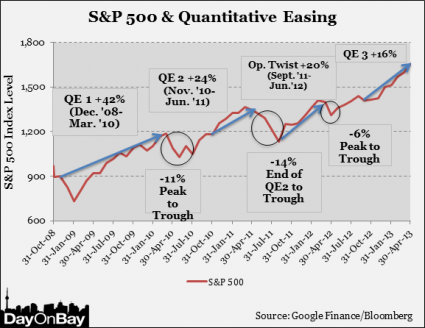
The Fed (and their messengers) very much want to avoid a repeat of what has happened before.  As you can see from the chart posted below, every round of quantitative easing has driven the S&P 500 much higher.  And when each round has ended, there has been a substantial stock market correction.  The following chart was originally produced by DayOnBay.org

Chart By DayOnBay

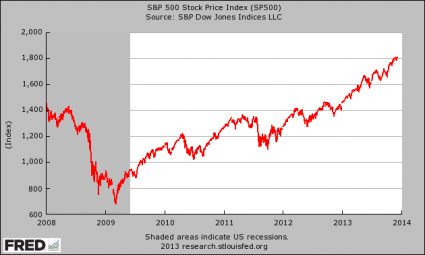
And of course the chart above is incomplete.  As you can see below, the S&P 500 is now sitting at about 1,800…

S&P 500

So let’s recap.

From the time that QE1 was announced to the time that it ended, the S&P 500 rose from about 900 to about 1,200.

When QE1 ended, the S&P 500 fell back below 1,100.

In a panic, the Federal Reserve first hinted at QE2 and then finally formally announced it.  That round of QE drove the S&P 500 up to a bit above the 1,300 mark.

Once QE2 ended, there was another market correction.  The S&P 500 fell all the way down to 1,123 at one point.

In another panic, the Federal Reserve first announced “Operation Twist” and then later added QE3.  Since that time, the S&P 500 has been on an unprecedented tear.  At this point, the S&P is sitting at about 1,800.

And of course those massively inflated stock prices have absolutely no relation to what is going on in the U.S. economy as a whole.  In fact, the truth is that economic conditions for most of the country are steadily getting worse.  Just today we found out that for the week ending November 30th, U.S. rail traffic was down 16.3 percent from the same week one year earlier.  That is a hugely negative sign.  It means that the flow of goods is slowing down substantially.

So the Federal Reserve has created this massive financial bubble that is totally disconnected from reality.  The only way that the Federal Reserve can keep this bubble going is to keep printing lots more money, but they also know that they cannot do that indefinitely because the rest of the world is watching.

In essence, the Federal Reserve is caught between a rock and a hard place.

When the Fed does ultimately decide to taper (whether it be December, January, February, etc.), the consequences are likely to be quite dramatic for the financial markets.  The following is a brief excerpt from a recent article by Howard Kunstler

But even in a world of seemingly no consequence, things happen. One pretty sure thing is rising interest rates, especially when, at the same time as a head-fake taper, foreigners send a torrent of US Treasury paper back to the redemption window. This paper is what other nations, especially in Asia, have been trading to hose up hard assets, including gold and real estate, around the world, and the traders of last resort — the chumps who took US T bonds for boatloads of copper ore or cocoa pods — now have nowhere else to go. China alone announced very loudly last month that US Treasury debt paper was giving them a migraine and they were done buying anymore of it. Japan is in a financial psychotic delirium scarfing up its own debt paper to infinity. Who’s left out there? Burkina Faso and the Kyrgystan Cobblers’ Union Pension Fund?

The interest rate on the US 10-year bond is close to bumping up on the ominous 3.0 percent level again. Apart from the effect on car and house loans, readers have pointed out to dim-little-me that the real action will be around the interest rate swaps. Last time this happened, in late summer, the too-big-to-fail banks wobbled from their losses on these bets, providing a glimpse into the aperture of a black hole compressive deflation where cascading chains of unmet promises blow financial systems past the event horizon of universal default and paralysis where money stops moving anywhere and people must seriously reevaluate what money actually is.

What Kunstler is talking about is something that I have written about previously many times.  When QE3 slows down (or ends), that is likely going to cause the yield on 10 year U.S. Treasuries to rise substantially, and that would have a whole host of negative consequences for the U.S. economy.

Most notably, it would threaten to blow up the quadrillion dollar derivatives casino that Wall Street usually manages to keep so delicately balanced.

The truth is that we are going to have massive problems no matter what the Federal Reserve does now.

If the Federal Reserve keeps wildly printing money, our financial system will become a massive joke to the rest of the planet and other nations will stop using our dollars and will stop lending us money.

That would be absolutely disastrous.

If the Federal Reserve stops wildly printing money, the massive financial bubble that Wall Street is enjoying right now will burst and we could have a financial crisis even greater than what we experienced back in 2008.

That would also be absolutely disastrous.

So does anyone out there see an easy way out of this under the current system?  If you think that you have such a plan, please feel free to share it below…