
The Worst Fertilizer Crisis In The History Of The World Will Result In Widespread Famine In The Poorest Nations

Thanks to the crisis in the Strait of Hormuz, there isn’t going to be enough fertilizer for everyone in 2026. What is available is going to be gobbled up by the wealthy countries because they have the most money. Of course higher fertilizer costs will ultimately be passed along to consumers, and so we will all be paying much higher prices for food in the months ahead. But in the poorest nations on the entire planet, a lack of fertilizer could mean the difference between life and death. A dramatic reduction in the amount of fertilizer that farmers use will result in a dramatic reduction in the amount of food that is grown in those countries. Of course many of those countries were already dealing with very high levels of food insecurity, and the UN has admitted that acute hunger was already at the highest level ever recorded even before the war with Iran began. What the world is facing is unlike anything that any of us have ever seen before, and large numbers of people could literally end up starving to death.

I wish that I was exaggerating.

Without sufficient quantities of fertilizer, there is no way that we could possibly feed the 8 billion people that are living on this planet today.

Unfortunately for all of us, spring planting season is here and much of the world’s supply of fertilizer is trapped because the Strait of Hormuz is closed…

But the share of world supply of urea – the most popular commonly used fertiliser – that typically passed through the strait before the conflict was more than twice that, at 43%.

For sulphur – used to produce phosphate fertilisers – the figure is 44%.

For anhydrous ammonia – another nitrogen fertiliser – 27% of global supply on average passed through the strait between 2019 and 2023.

In addition, many nations normally use natural gas that is exported through the Strait of Hormuz to make their own fertilizer.

So this is why it is so important for the Strait of Hormuz to be opened as soon as possible.

If that does not happen, one UN official is warning that the consequences will be “very significant and severe, particularly for the poorest countries and for the poorest citizens”…

In response, United Nations Secretary-General António Guterres established a task force to facilitate the safe passage of fertilizers and related raw materials for humanitarian purposes.

It is headed by Jorge Moreira da Silva, Executive Director of the UN Office for Project Services (UNOPS), which provides infrastructure, procurement and project management services across the world.

“We can’t wait until everything has been fixed,” he said in an exclusive interview with UN News.

“The planting season has already started…So if we don’t get some solution immediately the crisis will be very significant and severe, particularly for the poorest countries and for the poorest citizens.”

This is really happening.

I have many regular readers in Africa, and it is being reported that African farmers are facing a major fertilizer shortage this year…

Food security in Africa could face major disruptions due to continuing uncertainty in the Strait of Hormuz.

The conflict between the United States, Israel and Iran is disrupting global fertiliser trade flows – and this stands to leave millions of African farmers without the ammonia, urea, phosphate, sulphur and other fertiliser inputs vital to growing more food in sub-Saharan Africa.

Even a small drop in fertilizer availability could be catastrophic.

The UN’s Food and Agriculture Organization is telling us that just a 10 percent reduction in the fertilizer supply in Africa could mean that 25 percent less maize, rice and what is grown this year…

According to the Food and Agriculture Organization, even a 10 percent reduction in fertiliser availability could result in up to 25 percent less maize, rice and wheat grown in sub-Saharan Africa.

Nitrogen fertilizer causes explosive crop development.

Without it, many farmers will grow far less food in 2026.

Even here in the U.S., there are farmers that have decided not to use any nitrogen fertilizer this year because it now costs way too much

The drought compounds economic strains, including elevated fertilizer costs tied to global events. US Representative Frank Lucas, a Republican from Oklahoma, noted he skipped nitrogen applications on his western Oklahoma wheat fields.

“I didn’t have enough moisture — it wouldn’t have done any good,’’ Lucas said. “Number two, I’m not even sure what the cost would be.”

U.S. farmers are currently facing a double crisis.

In addition to skyrocketing fertilizer prices, conditions throughout much of the middle of the nation are bone dry.

On Friday, I explained to my core supporters that March 2026 was the third driest month ever recorded in the United States.

Only July 1934 and August 1934 were drier, and that was during the Dust Bowl days.

Because things are so dry, massive wildfires are erupting with alarming frequency. For instance, two extremely large wildfires have already burned more than 40,000 acres in Georgia

Two massive wildfires in south Georgia have scorched more than 40,000 acres and destroyed over 120 homes.

Extreme drought has turned the region into a tinderbox and allowed flames to spread. Overnight, new fires sparked in rural south Georgia. High winds have made efforts to contain the fires difficult, officials said in a news conference Saturday afternoon.

Brantley County Manager Joey Cason called the wildfires a “dynamic situation” in a Saturday morning video posted to social media and begged residents to “please evacuate” if they are ordered to do so. New evacuation orders were issued as the fire spread.

This is going to be such a challenging year.

Far less food will be produced in the U.S. than normal this year, and the same thing could be said about many other major food exporters.

In Australia, they are projecting that wheat production could be down by up to 25 percent.

If farmers do not grow our food, we do not eat.

What we really need is for the Strait of Hormuz to be reopened as quickly as possible, but that isn’t going to happen.

In fact, talks between the U.S. and Iran have totally broken down

Hopes of a diplomatic breakthrough in the U.S.-Israeli war with Iran faded on Sunday, as efforts to revive talks stalled and ⁠both Tehran and Washington showed little sign of softening their positions.

Iranian Foreign Minister Abbas Araghchi flew back to the Middle East from mediation talks in Pakistan over the weekend, while U.S. President Donald Trump scrapped a planned visit to Islamabad by his envoys Steve Witkoff and Jared Kushner.

The Trump administration is not going to compromise on their key demands, because they are afraid that Israel could be destroyed “within minutes” if Iran is able to produce nuclear weapons…

US President Donald Trump said Sunday that Israel would be destroyed “within minutes” if Iran obtained a nuclear weapon, warning the world would be in danger.

He added that previous US administrations should have acted earlier to stop Iran’s nuclear ambitions.

On the other side, the Iranians have stated that they will not move from their key list of demands, and they are insisting that they are more than ready for fighting to resume…

Iran produces more than 1,000 types of weapons domestically, including missiles, drones and military systems, defence ministry spokesperson Reza Talaei-Nik said.

“Today, more than 1,000 types of weapons… are produced entirely domestically,” he said, adding the capability is the result of over 25 years of investment in the defence sector.

He said production is spread across the country so it can continue even if some facilities are damaged, and added that around 9,000 companies are involved in supporting the defence industry.

The Iranians can hit us much harder and in a lot more ways than most people realize.

Even the Trump administration is greatly underestimating Iran’s capabilities, and that could have tragic consequences for the entire globe.

Once fighting resumes, I am entirely convinced that we will witness some shocking escalations.

And it appears that the Strait of Hormuz will remain closed for the foreseeable future, and that probably means that widespread famine is inevitable now.

Michael’s new book entitled “10 Prophetic Events That Are Coming Next” is available in paperback and for the Kindle on Amazon.com, and you can subscribe to his Substack newsletter at michaeltsnyder.substack.com.

About the Author: Michael Snyder’s new book entitled “10 Prophetic Events That Are Coming Next” is available in paperback and for the Kindle on Amazon.com.  He has also written nine other books that are available on Amazon.com including “Chaos”“End Times”“7 Year Apocalypse”“Lost Prophecies Of The Future Of America”“The Beginning Of The End”, and “Living A Life That Really Matters”.  When you purchase any of Michael’s books you help to support the work that he is doing.  You can also get his articles by email as soon as he publishes them by subscribing to his Substack newsletter.  Michael has published thousands of articles on The Economic Collapse BlogEnd Of The American Dream and The Most Important News, and he always freely and happily allows others to republish those articles on their own websites.  These are such troubled times, and people need hope.  John 3:16 tells us about the hope that God has given us through Jesus Christ: “For God so loved the world, that he gave his only begotten Son, that whosoever believeth in him should not perish, but have everlasting life.”  If you have not already done so, we strongly urge you to invite Jesus Christ to be your Lord and Savior today.

What Is Going To Happen When The Oil Reserves Run Out And The Tankers Stop Arriving?

A lot of people out there seem to think that the crisis in the Strait of Hormuz is not that big of a deal, and that is because we aren’t feeling the consequences yet. By the end of this month, the last oil tankers that left the Persian Gulf before the war with Iran began will have arrived at their destinations. And right now nations all over the globe are running through their strategic energy reserves. Some nations have months of oil left, and some nations only have weeks of oil left. As those reserves start to run dry, we are going to witness a supply crunch that is absolutely unprecedented.

If you don’t believe me, perhaps you will believe the head of the International Energy Agency.

He is warning that we are “facing the biggest energy security threat in history”

“We are facing the biggest energy security threat in history,” Fatih Birol, the head of the International Energy Agency, or IEA, told CNBC on Thursday.

“As of today, we’ve lost 13 million barrels per day of oil … and there are major disruptions in vital commodities,” he told Steve Sedgwick virtually at CNBC’s CONVERGE LIVE in Singapore.

Birol has previously warned that the Iran war and ongoing closure of the Strait of Hormuz would result in “the largest energy crisis we have ever faced” and urged governments to bolster their resilience with alternative energy sources.

For now, we are only witnessing limited rationing and limited shortages around the world because everyone is running through their strategic reserves.

And so it feels like we are going to come through this okay.

But the truth is that we aren’t.

Global supplies of oil and natural gas will get steadily tighter during the months ahead.

The Iranians are hardly letting any commercial vessels get through the Strait of Hormuz, and even if they suddenly changed their minds tomorrow we are being told that it could take up to six months to clear all of the mines out of the Strait of Hormuz…

It may take up to six months to completely clear the Strait of Hormuz of Iranian mines, according to a new report.

A Defense Department official relayed the estimate to lawmakers during a closed-door congressional briefing on Tuesday, three sources familiar with the matter told The Washington Post.

The assessment points to potentially long-lasting economic consequences, as the strait — now subject to dueling U.S. and Iranian blockades — is a critical trade artery that carried 20 percent of the world’s oil before the war.

It appears that Iran has been using this temporary ceasefire to lay more mines in the Strait.

And clearing them will not even begin until the end of the war

Any efforts to remove the mines won’t even begin until the war ends, the official warned.

The Iranian navy began placing mines in the Strait of Hormuz in March, as US-Israeli forces continued their joint attacks on the country.

Meanwhile, Donald Trump is promising that the U.S. blockade of Iranian ports will continue until Iran finally agrees to make a deal

I am convinced that Trump is quite serious about this.

According to CENTCOM, more than 30 vessels have been redirected by the U.S. Navy since the blockade was initiated…

The last update by CENTCOM, on Wednesday night, said 31 ships had been redirected since the start of the blockade.

Iran has called the blockade a violation of the ceasefire agreement, while the U.S. says it will remain in place as a condition of negotiations.

With Iran and the U.S. both blocking traffic, barely anything is getting out of the Persian Gulf.

It is a ticking time bomb for the entire global economy, and we are potentially facing catastrophic supply disruptions

The scale of these observed and potential supply disruptions is without precedent. The 1973 oil embargo wiped roughly 7 percent of global oil production off the market but was politically reversible. The present crisis has reduced 13 percent of global supply, at least temporarily, and it is a physical disruption. The recovery of damaged infrastructure will take months or even years. Finally, the Middle East accounts for about 30 percent of total global oil supply; in a worst-case scenario, virtually all these volumes could be at risk.

The nations that will be the least affected are those that either do not need to import oil or that have accumulated large reserves.

For example, China possesses the largest strategic oil reserves in the entire world

New data from the US government released this week shows just how aggressively China added to its oil reserves ahead of the war in Iran.

The US Energy Information Administration estimates China ended 2025 with nearly 1.4 billion barrels of oil stocked away, compared to 1.2 billion barrels among the 32 members of the International Energy Agency (IEA), which includes 413 million barrels in US coffers.

And the US has been drawing down its stockpile, with the latest US reserve levels showing about 405 million barrels following the sale of over 8 million barrels in the first half of April.

Even though the Chinese buy more oil and natural gas from the Middle East than anyone else, they will be able to function normally for many months.

Other countries will not have that luxury.

Before the war, it was being projected that the strategic reserves that the UK is holding can only last for about 90 days

As of February 26, according to the UK Department of Energy Security and Net Zero, the UK holds about 38 million ⁠barrels of crude oil and 30 million barrels of refined products, as strategic reserves. The reserves are thought to be able to last around 90 days.

Other European countries are in even tougher positions.

Shortages of jet fuel will probably start to show up first.

At this point, we are being told that Europe only has about six weeks of jet fuel left

Jet fuel prices have risen even faster, doubling in price to almost $200 a barrel. And as the war drags on, jet fuel is getting harder to come by for countries that don’t produce it or have limited supplies.

“In Europe, we have maybe six weeks or so (of) jet fuel left,” the International Energy Agency’s executive director, Fatih Birol, told the Associated Press on April 16.

It appears to be inevitable that flights will be canceled and planes will be grounded on a widespread basis.

In fact, Lufthansa has already announced that it will be eliminating about 20,000 short-haul flights

Lufthansa is cutting roughly 20,000 short-haul flights this summer, citing a spike in jet fuel prices that has rendered many routes “unprofitable” as the global aviation industry grapples with rising costs.

The German carrier said Tuesday the cuts, which will run through October, are expected to save about 40,000 metric tons of jet fuel. The airline noted that fuel prices have roughly doubled since the outbreak of the Iran war.

“In total, 20,000 short-haul flights will be removed from the schedule through October, equivalent to approximately 40,000 metric tons of jet fuel, the price of which has doubled since the outbreak of the Iran conflict,” the company said in a statement. “The schedule adjustments reduce the number of unprofitable short-haul flights across the Lufthansa Group network.”

If the Strait of Hormuz is not opened soon, this will only be just the very beginning.

David Roche can see what is happening, and he is suggesting that a worst case scenario is ahead of us

Irishman David Roche see’s what’s coming:

“We are going to run out of fuel in the global economy”

“The markets are in cloud cuckoo land”

“We are moving beyond initial inflationary affects to the second stage where there is no gas to price”

“Within a few months we will be in an economy which has to adjust downwards to eliminate demand for fuel that’s not there”

Sadly, if we can’t get the Strait of Hormuz opened we really will experience a global nightmare.

It is so frustrating to me that so many people out there do not seem to understand this.

Just because we aren’t experiencing the full consequences of this crisis today does not mean that those consequences are not coming.

It is going to take time for the strategic oil reserves to run dry.

But once they do, things are going to get really crazy.

Michael’s new book entitled “10 Prophetic Events That Are Coming Next” is available in paperback and for the Kindle on Amazon.com, and you can subscribe to his Substack newsletter at michaeltsnyder.substack.com.

About the Author: Michael Snyder’s new book entitled “10 Prophetic Events That Are Coming Next” is available in paperback and for the Kindle on Amazon.com.  He has also written nine other books that are available on Amazon.com including “Chaos”“End Times”“7 Year Apocalypse”“Lost Prophecies Of The Future Of America”“The Beginning Of The End”, and “Living A Life That Really Matters”.  When you purchase any of Michael’s books you help to support the work that he is doing.  You can also get his articles by email as soon as he publishes them by subscribing to his Substack newsletter.  Michael has published thousands of articles on The Economic Collapse BlogEnd Of The American Dream and The Most Important News, and he always freely and happily allows others to republish those articles on their own websites.  These are such troubled times, and people need hope.  John 3:16 tells us about the hope that God has given us through Jesus Christ: “For God so loved the world, that he gave his only begotten Son, that whosoever believeth in him should not perish, but have everlasting life.”  If you have not already done so, we strongly urge you to invite Jesus Christ to be your Lord and Savior today.

18 Shocking Facts That Prove That The U.S. Economy Is In Far Worse Shape Than Most People Realize

The economy has been the number one issue for U.S. voters for several years in a row, and it isn’t because things are good. Consumer confidence is at an all-time low, inflation is starting to accelerate once again, mass layoffs are being conducted all over the nation, and delinquencies and foreclosures are soaring. Nobody can dispute any of the facts that I am about to share with you. We have an enormous economic mess on our hands, and now the crisis in the Middle East threatens to plunge the entire global economic system into chaos in the months ahead. In other words, conditions are not good now and the outlook for the future is not promising at all. The following are 18 shocking facts that prove that the U.S. economy is in far worse shape than most people realize…

#1 Consumer confidence in the United States has fallen to an all-time record low

Consumer confidence plunged to a record low in April as fears mounted over rising energy prices and the broader impact of the Iran war, according to a University of Michigan survey Friday.

The university’s headline index of consumer sentiment tumbled to 47.6, down 10.7% from the March survey to its lowest on record. Current conditions and expectations indexes also saw double-digit monthly declines.

#2 Student loan delinquencies have exploded to a level that we have never seen before

Student loan delinquency has climbed to roughly 25 percent of borrowers with payments due during the first year of the current Trump administration, according to new analysis.

Researchers from The Century Foundation and Protect Borrowers said the sharp rise in missed payments, nearly triple the pre-coronavirus pandemic rate, has pushed millions into default risk and lowered credit scores, warning of broader financial fallout for households and colleges facing higher nonpayment rates.

#3 The monthly cost of owning a home has risen to absurd heights

All in, the median monthly housing payment for an owner — including mortgage principal and interest, taxes, homeowners insurance, and estimated maintenance expenses — has ballooned to more than $2,800, a staggering 72% jump from $1,635 six years earlier.

#4 Foreclosure filings were way up in 2025, and so far in 2026 we are 26 percent above last year’s pace…

A fresh wave of foreclosures is sweeping across the United States, with more than 118,000 homes caught up in the crisis in just the first three months of 2026.

It is a grim omen – with echoes of the run up to the 2008 Great Recession – that financial pressure is mounting for thousands of families.

New Attom data shows 118,727 properties were hit with a foreclosure filing in the first quarter – up 26 percent on the same period last year.

#5 The number of Americans that cannot pay their credit card bills in full each month has reached another record high

More than 111 million people could not pay off their monthly credit-card bills in full at the end of last year, marking a new record, according to new estimates from consumer advocates. That’s roughly 2 million more people unable to pay in full compared to the end of 2024, they noted.

These card holders now owe banks more than $1 trillion — and most are inching closer to maxing out their credit lines, according to researchers at the Century Foundation, a progressive think tank, and Protect Borrowers, a nonprofit group that advocates for borrowers.

#6 As the cost of living soars, people are pulling money out of their 401(k) plans at a record rate in a desperate attempt to make ends meet…

More Americans are digging into their retirement savings because of financial emergencies.

Last year, a record 6% of workers in 401(k) plans administered by Vanguard Group took a hardship withdrawal. That is up from 4.8% in 2024 and a prepandemic average of about 2%, according to Vanguard.

#7 Food prices continue to escalate, and the price of coffee has more than doubled since 2019…

A 16-item basket of groceries made up of staples like eggs, bread, and meat — no truffle cheese in our cart — rang in nearly 43% higher in March compared to the same month in 2019.

A few key categories are behind the rise: Coffee prices have more than doubled since the pandemic, while beef prices have soared more recently.

#8 For the first time ever, the price of a pound of ground beef is now higher than the federal minimum wage in many parts of the country…

The cost of a pound of ground beef has hit a major threshold. Depending on where you shop, the grocery staple likely costs more than the federal minimum wage.

Money analyzed ground beef prices at seven of the most popular grocery chains across the U.S., finding that 1 pound of the typical 20% fat ground beef costs between $6.49 and $8.96. Organic, grass-fed and leaner varieties tend to cost much more.

On the other hand, the federal minimum wage sits at $7.25 per hour.

#9 The Federal Reserve is telling us that 42.5 percent of recent college graduates were underemployed at the end of 2025…

Historically, college graduates have tended to find jobs faster and experience lower unemployment than workers without a degree. But recent data suggests it’s now harder to find a job that fits your skill set once you graduate.

According to the Federal Reserve of New York, 42.5% of recent college graduates (aged 22 to 27 with a bachelor’s degree or higher) are underemployed as of December 2025 — the highest rate since October 2020. Underemployment refers to working in a role that underutilizes your skills, usually at a lower wage or in a part-time position.

#10 We continue to see retailers close locations all over the nation at a staggering rate. For example, Grocery Outlet has announced that they will be permanently closing 36 stores

Grocery Outlet – the California-based retailer famous for selling products at steep discounts – says it will close 36 stores nationwide as part of a sweeping restructuring plan designed to improve profitability.

The company revealed the move while reporting its latest financial results, saying it had conducted a ‘strategic, financial and operational analysis’ of its entire store network.

#11 Not to be outdone, Papa John’s has announced that they will be closing approximately 300 restaurants

Pizza chain Papa John’s said it plans to close hundreds of underperforming restaurants in North America by the end of next year.

“We have identified approximately 300 underperforming restaurants across North America that are not meeting brand expectations or lack a clear path to sustainable financial improvement, as well as locations where we can effectively transfer sales to a nearby restaurant,” Papa John’s Chief Financial Officer Ravi Thanawala said last week during the company’s fourth-quarter earnings call.

#12 One of our “too big to fail” banks has decided that now is the time to cut about 2,500 jobs

Morgan Stanley is slashing about 3% of its global workforce — roughly 2,500 jobs — across its key divisions, as the Wall Street giant realigns priorities amid a banner year for profits, sources familiar with the matter have told The Post.

The cuts hit the Ted Pick-led lender’s investment banking, trading, and wealth management units, the people close to the situation said.

#13 EBay will be conducting yet another round of layoffs. This time around approximately 800 workers will get the axe…

EBay said Thursday it is cutting about 800 roles, or 6% of its workforce, in the latest round of layoffs at the e-commerce company.

“We are taking steps to reinvest across our business and align our structure with our strategic priorities, which will affect certain roles across our workforce,” an eBay spokesperson said in a statement. “We are grateful for the contributions of the employees impacted and are committed to supporting them with care and respect.”

#14 At one time Wendy’s was doing great, but in 2026 it will be permanently shuttering hundreds of locations

Fast-food chain Wendy’s will shutter 5% to 6% of its stores nationwide in the first half of 2026 as part of an ongoing downsizing plan.

Interim CEO Ken Cook first told investors in a Nov. 7 quarterly earnings call that the company would be closing a “mid single-digit percentage” of its nearly 6,000 locations nationwide.

#15 Meta, the parent company of Facebook, apparently intends to let nearly 8,000 employees go in the very near future…

Meta is preparing to cut thousands of jobs as early as next month, with deeper layoffs expected later this year, according to a report.

The tech giant intends to slash roughly 10% of its global workforce — or nearly 8,000 employees — in an initial round of cuts on May 20, sources told Reuters.

The company is also planning additional layoffs in the second half of the year, though details including timing and scope remain unclear, the outlet reported.

#16 From coast to coast, thousands of supply chain workers have been told to hit the bricks in recent weeks…

A wave of layoffs across U.S. supply chains — from EV battery plants and auto parts factories to warehouses and rail terminals — has affected nearly 4,000 workers in recent weeks, according to company announcements and WARN filings across multiple states.

Recent WARN filings and company announcements show job cuts across at least a dozen companies in states including California, Georgia, Tennessee, Texas, Ohio, South Carolina, Pennsylvania and Alabama.

The largest layoffs in the recent wave are coming from the automotive and industrial supply chain. SK Battery America said it laid off 958 workers — about 37% of its workforce — at its electric vehicle battery plant in Commerce, Georgia, citing shifting EV demand as automakers reassess production plans.

#17 According to Newsweek, the following list of companies have all announced layoffs during the month of April…

  • Blue Shield of California
  • Zenith Logistics
  • Perdue Foods
  • ERN Services
  • Boston Electrometallurgical Corporation
  • First Brands Group
  • GEODIS
  • MicroVision
  • IPIC Theaters
  • Goulet Trucking
  • CJ Logistics
  • L3Harris
  • Supernal
  • Heritage Bank of Commerce
  • Angel City Brewery
  • VCA Bay Area Veterinary Specialists
  • Monroe Operations
  • Meteor Creative
  • Viskon-Aire Corporation
  • C3.ai
  • Safari West
  • Main Street Sports Group Cincinnati
  • Raley’s
  • Koppers
  • Wells Fargo
  • Lucid Group
  • Hornblower Cruises and Events
  • Charles River Laboratories
  • Wescom Financial
  • Bluum USA
  • CHS Northwest
  • Catalent
  • Liberty Dental Plan
  • GXO Logistics

#18 The total unfunded obligations of the U.S. government have now reached a staggering total of 130.12 trillion dollars

On March 17, 2026, the U.S. Department of the Treasury quietly released the federal government’s fiscal year 2025 financial report. Buried in its tables is a number that should dominate our national conversation – but doesn’t: Total federal obligations now stand at $130.12 trillion.

That figure is not a rounding error or a political talking point. It is derived from the government’s own accounting – combining the reported negative net position (driven largely by bonded debt) with the present value of projected shortfalls in major social insurance programs. Yet public debate continues to revolve almost exclusively around the much smaller figure of Treasury securities outstanding.

There is no way that anyone can spin the facts that I have just shared with you to make them look good.

So if conditions are already this bad, what will things be like six months from now if the Strait of Hormuz is still closed?

We really are in unprecedented territory, and the truth is the economic conditions could easily get a lot worse during the months ahead.

Michael’s new book entitled “10 Prophetic Events That Are Coming Next” is available in paperback and for the Kindle on Amazon.com, and you can subscribe to his Substack newsletter at michaeltsnyder.substack.com.

About the Author: Michael Snyder’s new book entitled “10 Prophetic Events That Are Coming Next” is available in paperback and for the Kindle on Amazon.com.  He has also written nine other books that are available on Amazon.com including “Chaos”“End Times”“7 Year Apocalypse”“Lost Prophecies Of The Future Of America”“The Beginning Of The End”, and “Living A Life That Really Matters”.  When you purchase any of Michael’s books you help to support the work that he is doing.  You can also get his articles by email as soon as he publishes them by subscribing to his Substack newsletter.  Michael has published thousands of articles on The Economic Collapse BlogEnd Of The American Dream and The Most Important News, and he always freely and happily allows others to republish those articles on their own websites.  These are such troubled times, and people need hope.  John 3:16 tells us about the hope that God has given us through Jesus Christ: “For God so loved the world, that he gave his only begotten Son, that whosoever believeth in him should not perish, but have everlasting life.”  If you have not already done so, we strongly urge you to invite Jesus Christ to be your Lord and Savior today.
Florida Orange Production Down 95%, U.S. Cattle Herd Smallest Since 1951, And Winter Wheat Is Being Suffocated By Severe Drought

We live at a time when most people don’t know where their food comes from, and so they have no idea that we are facing an agricultural nightmare in 2026. Yesterday, I published an article about the historic drought that is devastating our heartland and the nightmarish fertilizer crisis that has been caused by the war in the Middle East. Today, I am going to talk about the stunning decline of the U.S. cattle herd, concerns about the winter wheat harvest, and the frightening drop that we have witnessed in Florida orange production.

I have said this before, but I will say it again.

If farmers don’t grow our food, we don’t eat.

When I was growing up, everyone was drinking Florida orange juice.

Sadly, that is no longer true.

This year, the number of oranges that will be harvested in Florida will be down 95 percent from 1996…

But now, the fruit that helped build Florida is disappearing. The orange is falling victim to disease, disasters and development.

Just how far the orange crop has fallen is shocking. Thirty years ago, 225 million boxes of oranges were picked from Florida orange groves. That was almost enough for one box of oranges for every American in the mid-1990s. This year, the forecast from the U.S. Agriculture Department is 12 million boxes. That is a drop of 95% in one generation.

How in the world could this have happened?

Well, the cold weather that Florida experienced during the month of February severely damaged orange production. But the far bigger problem is citrus greening disease. It is not going to go away, and it could potentially completely wipe out Florida’s oranges

The cold weather in February cost the citrus industry almost $700 million according to a preliminary estimate from the state agricultural commission. Most of the loss is from a smaller crop and damaged trees.

And then there’s the decades-long fight against a small bug that has been turning Florida’s oranges green. Citrus greening disease is caused by a bacterial infection spread by the Asian citrus psyllid. The bug showed up in Florida almost 30 years ago. The first signs of the disease were visible in citrus groves about 20 years ago.

Meanwhile, the multi-year drought that the heartland of America is experiencing is making it very difficult to produce sufficient quantities of hard red winter wheat…

Hard red winter wheat (HRW) futures widened to their largest premium over soft red wheat (SRW) in more than two years as severe drought intensified across key breadbasket regions in the Great Plains and Midwest. This means traders are pricing in weather impacts and tightening expectations for higher-protein wheat supplies.

It is important to note that HRW is a more valuable protein and is primarily used in bread, rolls, and all-purpose flour. It is grown in the U.S. Plains (Kansas, Oklahoma, Texas), while SRW is used in cakes, cookies, crackers, and pastries, and is grown in the Eastern U.S. (Ohio Valley, Midwest, Southeast).

Just think about all of the things that you eat on a regular basis that have wheat in them.

If you feel that those products are expensive now, just wait until you see what the prices will be like later this year.

Beef prices have also become very painful, and that is because the size of the U.S. cattle herd has fallen to the lowest level that we have seen since 1951

The U.S. cattle herd dwindled to its smallest size since 1951, the U.S. Department of Agriculture said on Friday, signaling that beef prices will stay high for consumers after setting records last year.

The nation had 86.2 million cattle and calves as of Jan. 1, the USDA said in a biannual report, after a persistent drought drove ranchers to slash their herds. That was down 0.4% from a year earlier, when the herd also hit its lowest level since 1951.

In 1951, approximately 154 million people lived in the United States.

Today, approximately 342 million people live in the United States.

So we are trying to feed more than twice as many people with the same amount of cattle that we had in 1951.

Unfortunately, this could be just the beginning of this crisis because the New World screwworm is on a relentless march north

The flesh-eating parasite, called the New World screwworm, was detected this month in the Mexican state of Nuevo León, just 90 miles away from the U.S. border. As of last year, the insect was still 400 miles away.

“The New World screwworm is not some distant problem,” Texas Agriculture Commissioner Sid Miller said. “It is a direct and imminent threat to Texas, and we are treating it that way. This is a high-stakes situation for our ranchers, our livestock industry and our food supply, and we are moving aggressively to stay ahead of it.”

Ranchers are frightened out of their minds, because these little parasites love to ravage cattle.

All it takes for disaster to strike is for one female fly to find a body opening or an open wound

This insect is attracted to the smell of wounds and body openings, including the nose, eyes, ears, mouth and genitals.

Once a female fly makes contact, it can lay 200 to 300 eggs in a wound or opening that can be as small as a tick bite. In some cases, the fly may lay up to 3,000 eggs during its 10 to 30-day lifespan.

The eggs then hatch into maggots that burrow into the wound or opening and feed on the flesh. After about seven days of feeding, the larvae drop to the ground and eventually emerge as adult screwworm flies.

Even without the war in the Middle East, this would be an exceedingly challenging year for our farmers and our ranchers.

But now thanks to the war, we are facing skyrocketing fuel costs and global fertilizer shortages

Farmers around the world are facing fertilizer shortages and rising costs due to supply disruption caused by the war in Iran, which could make food more expensive later this year.

The war has almost halted shipments through the Strait of Hormuz, a narrow passage off Iran that handles about a fifth of the world’s oil and nearly a third of global fertilizer trade.

As I discussed yesterday, one survey found that 70 percent of U.S. farmers are admitting that they won’t be able to buy enough fertilizer this year because prices have simply gotten too high.

Diesel prices are spiking as well, and they are only going to go higher as global supplies of fuel get tighter and tighter

Nobody can dispute any of the facts that I have presented in this article.

Food prices have risen steadily in recent years, but the truth is that what is ahead will be even worse.

In impoverished nations, the number of people experiencing acute hunger was already at an all-time record high before the war with Iran erupted, and now many experts are warning of widespread famines.

But most people out there just expect everything to turn out just fine somehow, because that is how the stories that they watch on television always end.

Of course what we are living through is not a television show.

This is the real world, and in the real world bad decisions can lead to severe consequences.

Michael’s new book entitled “10 Prophetic Events That Are Coming Next” is available in paperback and for the Kindle on Amazon.com, and you can subscribe to his Substack newsletter at michaeltsnyder.substack.com.

About the Author: Michael Snyder’s new book entitled “10 Prophetic Events That Are Coming Next” is available in paperback and for the Kindle on Amazon.com.  He has also written nine other books that are available on Amazon.com including “Chaos”“End Times”“7 Year Apocalypse”“Lost Prophecies Of The Future Of America”“The Beginning Of The End”, and “Living A Life That Really Matters”.  When you purchase any of Michael’s books you help to support the work that he is doing.  You can also get his articles by email as soon as he publishes them by subscribing to his Substack newsletter.  Michael has published thousands of articles on The Economic Collapse BlogEnd Of The American Dream and The Most Important News, and he always freely and happily allows others to republish those articles on their own websites.  These are such troubled times, and people need hope.  John 3:16 tells us about the hope that God has given us through Jesus Christ: “For God so loved the world, that he gave his only begotten Son, that whosoever believeth in him should not perish, but have everlasting life.”  If you have not already done so, we strongly urge you to invite Jesus Christ to be your Lord and Savior today.
The Trump Administration Has Been Negotiating With The Wrong People In Iran This Entire Time

It turns out that the Iranian officials that the U.S. has been negotiating with do not actually have the power to make a peace deal. So this may help to explain why there has been so much confusion. The truth is that the U.S. has been negotiating with the wrong people in Iran this entire time, and the Trump administration is finally starting to realize this. Unfortunately, as you will see below, those that are now in charge in Iran are extreme hardliners. They are not inclined to compromise at all, and that is really bad news for the entire planet, because President Trump is warning that it is “highly unlikely” that the ceasefire will be extended if Iran does not agree to a peace deal by tomorrow night

Speaking Monday to Bloomberg, President Trump reiterated that the U.S. blockade would not be dropped until a final peace deal with Iran is reached, and he told the news outlet it was “highly unlikely” that he would extend the current ceasefire beyond its expiration on Tuesday night U.S. time if no agreement is nailed down.

As I discussed yesterday, Trump has publicly stated that “the whole country is getting blown up” if Iran does not accept the deal that he has put on the table.

Trump is certainly willing to do more fighting if that is what it takes to reach an acceptable conclusion to this crisis, and he is pledging that he will not make enormous compromises just to get some sort of a deal done

Only a day after threatening that Iran would be “getting blown up” unless the regime signed a U.S.-backed deal, the president on Monday said he’s in no rush to reach an agreement with Tehran.

“The Democrats are doing everything possible to hurt the very strong position we are in with respect to Iran,” Mr. Trump wrote on Truth Social, noting that Democrats “like to say that I promised 6 weeks to defeat Iran.”

The president insisted that from a military standpoint, it was “far faster” than six weeks to defeat Iran. Still, he said, “I’m not going to let them rush the United States into making a deal that is not as good as it could have been.”

Of course the Iranians are in no mood to do much compromising either, and they have made that abundantly clear.

And it turns out that the people that we have been negotiating with do not actually have the power to agree to a deal.

According to Axios, one U.S. official is admitting that the Trump administration “thought they were negotiating with the right people”, but now they have figured out that wasn’t actually true…

A US official said Washington is uncertain who is in charge in Iran as efforts continue to secure a deal and extend the ceasefire, Axios reported on Monday.

“We aren’t sure who’s in charge and neither do they. That’s going to have work itself out,” it quoted the official as saying.

“We thought they were negotiating with the right people, they had reached the cocktail of what they had agreed to, what could be announced. But what happened is the Iranian team went back and the IRGC and those kinds of people said ‘oh, no, no. You don’t speak for us,’” a second senior administration official said.

“Now they have a real divide over there between these factions and we’re not sure who’s going to win it. We hope the team we negotiated with will.”

Weeks ago, I told my readers that the head of the Islamic Revolutionary Guard Corps, Ahmad Vahidi, is running the show in Iran.

Now the mainstream media is finally starting to catch up. The following comes from Fox News

As President Donald Trump’s deadline for Iran to decide whether to extend a two-week ceasefire between the countries approaches, attention is increasingly turning not to Iran’s president, Masoud Pezeshkian, but to a shadowy Revolutionary Guard commander with a long record of terror, repression and hardline ideology.

Ahmad Vahidi, recently elevated to the top of the Islamic Revolutionary Guard Corps, the elite paramilitary force within Iran’s military, is emerging as one of the most powerful men in Iran and, according to analysts, one of the key figures likely deciding whether Tehran resumes fighting or continues talks.

There isn’t going to be any deal unless Vahidi approves.

Unfortunately, Vahidi is “considered a radical even within the regime’s hardline elite”

“By any standard, Vahidi is considered a radical even within the regime’s hardline elite, and his rise is a warning that Tehran’s war machine now calls the shots,” Lisa Daftari, foreign policy analyst and journalist, told Fox News Digital.

“Putting someone with such a bloody and murderous record at the top of the Revolutionary Guard Corps confirms that the regime is not moderating under pressure. On the contrary,” Daftari added, “it is doubling down on men whose careers are built on hostage‑taking, assassinations, and domestic repression. By any standard, Vahidi is considered a radical even within the regime’s hardline elite, and his rise is a warning that Tehran’s war machine now calls the shots.”

Vahidi isn’t going to give Trump what he wants.

I suppose the U.S. and Israel could try to take Vahidi out, but the upper ranks of the IRGC are filled with other extremists that are just like Vahidi.

Theoretically, Iran’s Supreme Leader Mojtaba Khamenei is supposed to have final decision making power, but it appears that he is either dead or incapacitated.

So the IRGC is in control now, and that is not likely to change any time soon.

I know that a lot of people out there are desperately hoping for a peace deal with Iran.

But it doesn’t appear that one is in the cards.

And if a deal is not made before the deadline, Trump is warning that it will mean “lots of bombs start going off”

President Donald Trump told PBS News on Monday morning that if the ceasefire with Iran expires Tuesday, “then lots of bombs start going off.”

The statement came during a phone call with White House correspondent Liz Landers focused on the Iran war, as a U.S. delegation is preparing for more peace talks.

The Iranians have been preparing for the next phase of the war too.

They still have thousands upon thousands of missiles and drones at their disposal, and oil and gas infrastructure throughout the Middle East is extremely vulnerable.

Beyond that, I am entirely convinced that the IRGC still has quite a few other ways that they could dramatically escalate the conflict.

So let us hope that some sort of a diplomatic miracle happens, because we are rapidly approaching a point of no return.

Michael’s new book entitled “10 Prophetic Events That Are Coming Next” is available in paperback and for the Kindle on Amazon.com, and you can subscribe to his Substack newsletter at michaeltsnyder.substack.com.

About the Author: Michael Snyder’s new book entitled “10 Prophetic Events That Are Coming Next” is available in paperback and for the Kindle on Amazon.com.  He has also written nine other books that are available on Amazon.com including “Chaos”“End Times”“7 Year Apocalypse”“Lost Prophecies Of The Future Of America”“The Beginning Of The End”, and “Living A Life That Really Matters”.  When you purchase any of Michael’s books you help to support the work that he is doing.  You can also get his articles by email as soon as he publishes them by subscribing to his Substack newsletter.  Michael has published thousands of articles on The Economic Collapse BlogEnd Of The American Dream and The Most Important News, and he always freely and happily allows others to republish those articles on their own websites.  These are such troubled times, and people need hope.  John 3:16 tells us about the hope that God has given us through Jesus Christ: “For God so loved the world, that he gave his only begotten Son, that whosoever believeth in him should not perish, but have everlasting life.”  If you have not already done so, we strongly urge you to invite Jesus Christ to be your Lord and Savior today.
The U.S. Navy Just Blew A Giant Hole In An Iranian Cargo Ship As The Crisis In The Strait Of Hormuz Escalates To An Entirely New Level

Apparently the Trump administration was not kidding when it warned that no Iranian ships would be allowed through the blockade. Just a little while ago, Donald Trump announced that the U.S. Navy has blown an enormous hole in the side of an Iranian cargo vessel that willingly chose to ignore a warning to turn around. Just two days after the completely irrational euphoria that we witnessed on Friday, the crisis in the Strait of Hormuz is worse than ever, and there is no end in sight.

On Friday, I explained why the extremely positive headlines that we were reading in the western world were dead wrong. When the two week ceasefire with Iran was originally unveiled, the Iranians were supposed to completely open the Strait of Hormuz for that two week period. But they hesitated because fighting was still raging in Lebanon, and the Iranians believed that the fighting in Lebanon was supposed to be part of the ceasefire. When Israel and Hezbollah finally agreed to a ten day ceasefire late last week, the Iranians finally fulfilled their obligation by opening the Strait of Hormuz for the remainder of the ceasefire. But the Iranians also warned that if the U.S. did not respond by lifting the naval blockade for the rest of the ceasefire the Strait of Hormuz would be quickly closed once again, and that is precisely what happened.

Just hours after opening it, the IRGC shut down all traffic through the Strait of Hormuz and announced that any attempt to pass through would be “considered cooperation with the enemy, and the violating vessel will be targeted”

Iran’s Islamic Revolutionary Guard Corps (IRGC) reportedly issued a sweeping warning to ships in the region on Saturday, saying any movement toward the Strait of Hormuz will be viewed as cooperation with “the enemy.”

“Following the violation of the ceasefire conditions, the American enemy did not lift the naval blockade of Iranian vessels and ports; therefore, from this afternoon, the Strait of Hormuz is closed until this blockade is lifted,” the IRGC said, according to Tehran-based WANA News Agency.

The IRGC also instructed vessels in the Persian Gulf and Gulf of Oman to remain at anchor, warning that any ship approaching the strategic waterway “will be considered cooperation with the enemy, and the violating vessel will be targeted.”

Needless to say, the Iranians were not bluffing.

On Saturday, multiple commercial vessels were fired upon

Gunfire was reported after at least two vessels tried to pass through the waterway on Saturday – with the captain of one tanker claiming his ship was approached by two Iranian gunboats.

US security sources claimed that Iran carried out at least three attacks on ships, Axios reports.

The UK Maritime Trade Operations centre confirmed a cargo vessel was attacked by a projectile near Oman – damaging containers on board.

The captain of an Indian oil tanker that was completely convinced that he had permission to go through the Strait was desperately asking for permission to turn around once the Iranians started shooting at his ship…

In the radio transmission, the captain of the Sanmar Herald oil tanker addresses ‘Sepah navy,’ which is the name of the Islamic Revolutionary Guard Corps (IRGC) Navy.

Clearly alarmed, he continues: ‘This is Motor Vessel Sanmar Herald. You gave me clearance to go! My name is second on your list.

‘You gave me clearance to go! You a firing now. Let me turn back!’

Marine tracking data shows the Sanmar got part of the way through the Strait before sharply doubling back on itself.

If the Trump administration would have just lifted the blockade for the duration of the ceasefire, a lot of tankers could have potentially gotten through the Strait, and that would have been a huge blessing to everyone.

But instead we are back to square one, and the Iranians are mocking us

Ebrahim Azizi, the head of the Iranian parliament’s national security and foreign policy committee, taunted Trump over the closure.

In a post on social media, he said: “We warned you, but you ignored it. Now ENJOY the Strait of Hormuz returning to the status quo.”

This is a very alarming turn of events.

A reporter for CBS News traveled to the Strait of Hormuz to see things for himself, and he encountered dozens of large commercial vessels just sitting still in the water

We crossed from one Gulf country into another and eventually found ourselves on a coastal road that felt almost too beautiful for the tensions that lay just offshore.

On one side were jagged mountains rising straight out of the earth, completely bare of vegetation. On the other, clear blue water stretched out into the Gulf.

And then, as the road curved, we saw the ships. Not one or two, but dozens. Sitting still. Waiting.

Overall, there are more than 3,000 ships that are currently trapped in the Persian Gulf with no way out.

Of course the Iranians cannot get any ships out either now that a U.S. Navy blockade is in place.

On Sunday, one of our guided missile destroyers blew a giant hole in the side of an Iranian cargo ship named “TOUSKA”…

It took a while for that to sink in when I first came across that post by President Trump.

I could hardly believe what I had just read.

This is a major escalation.

And the U.S. is also threatening to seize Iranian vessels anywhere in the world during the days ahead…

The US military is preparing to board Iran-linked vessels and oil tankers in the coming days, a move that will expand a conflict largely confined to the Strait of Hormuz into a global crackdown.

General Dan Caine, the chairman of the Joint Chiefs of Staff, announced the escalation on Thursday, according to US officials who spoke with The Wall Street Journal.

Caine said the US ‘will actively pursue any Iranian-flagged vessel or any vessel attempting to provide material support to Iran’.

The Trump administration is convinced that this blockade is the key to ending the war.

They believe that the Iranians will be forced to give in eventually.

On the other side, the Iranians are convinced that holding the global economy hostage will force the Trump administration to give in.

Both sides are making tragic miscalculations, and meanwhile the entire world is suffering.

It is spring planting season, and we can’t get fertilizer from the Middle East into the hands of farmers all over the northern hemisphere that desperately need it

Beginning in the 1960s, in an effort to diversify their economies, the Gulf countries invested heavily in their fertilizer industries, leveraging their abundant natural resources. Foreign fertilizer companies began flocking to Dubai in the United Arab Emirates, drawn by low taxes, a favorable geographic location, and the city’s seamless air and sea transport hubs.

The Gulf’s investment in fertilizer paid off, as by 2026, much of the developing world was reliant on Gulf fertilizers. Three of the top ten global urea exporters, the world’s most commonly used nitrogen-based fertilizer, are located within the Persian Gulf. One-third of internationally traded fertilizers and roughly 45% of sulphur exports, a key ingredient in phosphate fertilizers, pass through the Strait of Hormuz.

Iran’s blockade has brought all of these exports to a near-halt. The timing could hardly be worse, coming during planting season for much of the world.

In addition, nations such as India that normally import large amounts of natural gas from the Middle East in order to make their own fertilizer are being forced to cut back production

The effects go well beyond halting shipments of fertilizer produced in the Gulf, which is situated at the head of a vast global supply chain. India, itself a big fertilizer producer, has had to scale back production due to fuel shortages linked to the war. New Delhi ordered fertilizer plants to scale back production to 70% capacity to cope with the shortage.

“This is not only an energy shock. It is a systematic shock affecting agrifood systems globally,” Chief Economist of the Food and Agriculture Organization of the United Nations, Máximo Torero, warned on Thursday.

We are facing a global fertilizer crisis that is far beyond anything that we have ever seen before.

Here in the United States, this has come at a time when we are already in the midst of a historic drought

A massive drought has emerged across large swaths of the US agricultural belt, threatening crops and livestock and eventually affecting food prices, at a time when fertilizer and diesel costs are soaring. As of early April, 60% of the Lower 48 is in drought as the Northern Hemisphere growing season begins and farmers begin plantings, according to NOAA.

The southern US is already experiencing severe, extreme, and even exceptional drought conditions, putting pressure on key crops such as sugarcane, rice, and peanuts, while fruit trees have also been damaged by extreme temperatures.

Food production is going to be way down all over the planet in 2026.

José Andrés is warning that we are headed for “a very big increase in famine across the world by the fall of 2026 and 2027″…

The celebrity chef and humanitarian José Andrés has a warning for the suits in Washington and around the world: stop looking at the oil tickers and start looking at the soil.

The World Central Kitchen (WCK) founder believes that the world is sleepwalking into a massive, multi-year famine, being slow-walked by the “silent” collapse of the global fertilizer trade as a byproduct of the war with Iran.

“I foresee a very big increase in famine across the world by the fall of 2026 and 2027,” Andrés told the Guardian on the sidelines of Semafor’s global economy conference in Washington.

He is right.

If the Strait of Hormuz does not open soon, food shortages will hit the world like a freight train in 6 to 9 months.

But unless consequences are going to hit us immediately, most people in the western world don’t seem to care.

Instead, most of us just continue to go about our lives as if nothing unusual is going on, and for the moment ignorance is bliss.

Michael’s new book entitled “10 Prophetic Events That Are Coming Next” is available in paperback and for the Kindle on Amazon.com, and you can subscribe to his Substack newsletter at michaeltsnyder.substack.com.

About the Author: Michael Snyder’s new book entitled “10 Prophetic Events That Are Coming Next” is available in paperback and for the Kindle on Amazon.com.  He has also written nine other books that are available on Amazon.com including “Chaos”“End Times”“7 Year Apocalypse”“Lost Prophecies Of The Future Of America”“The Beginning Of The End”, and “Living A Life That Really Matters”.  When you purchase any of Michael’s books you help to support the work that he is doing.  You can also get his articles by email as soon as he publishes them by subscribing to his Substack newsletter.  Michael has published thousands of articles on The Economic Collapse BlogEnd Of The American Dream and The Most Important News, and he always freely and happily allows others to republish those articles on their own websites.  These are such troubled times, and people need hope.  John 3:16 tells us about the hope that God has given us through Jesus Christ: “For God so loved the world, that he gave his only begotten Son, that whosoever believeth in him should not perish, but have everlasting life.”  If you have not already done so, we strongly urge you to invite Jesus Christ to be your Lord and Savior today.
Prices For Physical Oil And Fertilizer Go Absolutely Nuts As A “Summer Of Shortages” Looms On The Horizon

Most people out there still seem to believe that the war in the Middle East will rapidly come to a conclusion and economic conditions will return to normal soon. Meanwhile, the price of physical oil is going absolutely nuts, the price of fertilizer is going absolutely nuts, and we are being warned that a “summer of shortages” is looming on the horizon if the Strait of Hormuz remains closed. What we are going to be facing in the months ahead very much depends upon the duration of the war. Unfortunately, as you will see below, it does not appear that a peace deal with Iran is going to happen any time soon.

According to the Daily Mail, citizens of the UK are being warned to brace themselves for a “summer of shortages”…

Brits are being braced for a summer of shortages with warnings that chicken and pork are among a swathe of products at risk from the Iran war.

We have never seen a “summer of shortages” in the western world.

So most of us have no idea what that would look like.

According to the BBC, in a “worst case scenario” there could actually be shortages of chicken and pork in the months ahead…

The UK could face food shortages, including chicken and pork, by the summer if the Iran war continues, in a worst case scenario drawn up by government officials.

A government source told the BBC it was planning for a scenario which would involve the continued closure of the Strait of Hormuz and breakdowns in the supply of carbon dioxide (CO2), which is used in the slaughter of some animals and in food preservation.

A spokesperson from the Department for Environment, Food & Rural Affairs said it would continue to work closely with businesses to tackle the impact of the war.

Hopefully a worst case scenario will not materialize.

But right now the Iranians seem to be in no mood to release the stranglehold that they have on the Strait of Hormuz.

As a result, there could be widespread shortages of jet fuel in Europe in just six weeks

Europe may have just six weeks left of jet fuel, with serious consequences for the continent’s economy, the International Energy Agency warned on Thursday.

“Several European countries may start to face shortages of jet fuel in the next 6 weeks, depending how much they are able to import from international markets to replace the lost supply from the Middle East, which accounted for 75% of Europe’s net imports of jet fuel previously,” the IEA told CNBC in an emailed statement.

Earlier, IEA Executive Director Fatih Birol said the Strait of Hormuz blockade will result in “the largest energy crisis we have ever faced,” in an interview with The Associated Press on Thursday.

If you need to fly somewhere, I wouldn’t wait too much longer.

During the months ahead we could also see rationing of fuel and electricity.

In fact, it is being reported that Pakistan is already shutting down electricity generation “for about two hours during the evenings”…

Pakistan will suspend electricity supply for about two hours during the evenings, an effort to manage the cost of power as the Iran war further shakes the energy-poor country, reported Bloomberg on Wednesday.

Demand raises significantly between 5 p.m. and 1 a.m., due in part to reduced hydropower generation, the Pakistani government said in a statement on Wednesday. Potential gaps would have to be met through fossil fuels that have become more expensive after the Iran war disrupted flows plunging the region into an energy crisis.

Some people in Pakistan are claiming that electricity generation is down for much more than just two hours a day.

But those are just anecdotal reports at this point.

Sadly, things will get so much worse if the Strait of Hormuz does not get reopened soon.

Earlier this week, HSBC Group CEO Georges Elhedery made headlines when he discussed the historic crisis that is now upon us.

He is claiming that the highest price that he has seen so far for a barrel of physical oil is 286 dollars

“What worries me is not the headlines. I mean, oil headline is above $100, $110. Realistically, if you are now trying to get oil from the Middle East, you may be paying $140, $150.

Realistically, if you try to get oil from the Red Sea, you are paying more than $30, $40 for shipping. Insurance costs, which used to be 25 basis points, is more like 5%, and war insurance has been scrapped — you’re paying 5% without even the war insurance component.

So the barrel of oil door to door or the barrel of refined oil door to door is way above the headline price of oil. The highest I’ve seen, and I’m hoping we don’t see more of that, but the highest I’ve seen is $286 for a barrel of oil that reached Sri Lanka. This is not a country and an economy that can easily afford these kind of prices sustainably.”

I was absolutely stunned when I read that.

I knew that the price of physical oil for immediate delivery had become completely disconnected from oil futures, but I didn’t realize that things were already this bad.

And the price of fertilizer has been rising at an exponential rate in recent weeks…

If you have been keeping up with my recent articles, you already know why that chart is such a big deal.

Needless to say, we desperately need a diplomatic breakthrough.

It would be so wonderful if Iran would just allow traffic to flow through the Strait of Hormuz like it did before.

But the Iranians are insisting that they are in charge of the Strait from now on, and they are demanding that any commercial vessels that they allow to pass through the waterway must pay a very large toll that is to be paid using Iranian banks

An Iranian parliament official has been cited in newswires as saying the country’s planned Strait of Hormuz toll for ships seeking to pass is to be paid through Iranian banks. Previously it was said to be through cryptocurrency, and could be as a high as $2 million Oil rose higher, given this is another indicator this game of chicken in the narrow waterway could soon lead to fresh hostilities, despite the 2-week ceasefire still being in place, soon to expire.

The Trump administration is hoping to break Iran’s resolve by blockading all Iranian ports.

So far, 13 vessels that attempted to travel to or from Iranian ports have been turned back…

The U.S. Navy has turned back 13 ships since its blockade of Iranian ports in the Persian Gulf and the Gulf of Oman began more than 24 hours earlier, the Pentagon said Thursday.

President Donald Trump announced the blockade on Sunday after complaining that Tehran has not appeared to reopen the Strait of Hormuz, one of his conditions for agreeing to the fragile two-week ceasefire that is currently in effect.

The attempt to ratchet pressure on Iran began after an initial round of U.S.-Iran peace talks failed over the weekend.

I don’t think that this blockade is going to force the Iranians to give in.

If that doesn’t work, U.S. Secretary of War Pete Hegseth is warning that the U.S. military is ready to bomb them into oblivion

Secretary Hegseth sends a DIRECT MESSAGE to Iran from the Pentagon

“To IRGC leadership, we’re watching you.

Our capabilities are NOT the same, our military and yours.

Remember, this is NOT a fair fight, and we know what military assets you are moving and where you are moving them to.

You are digging out, which is exactly what you’re doing— digging out of bombed out and devastated facilities, and we are only getting stronger.”

“We are locked and loaded on your critical dual-use infrastructure, on your remaining power generation, and your energy industry.

We’d rather not have to do it, we are ready to go at command of our president and the push of a button.”

Unfortunately, Iranian leaders have not been swayed by such threats.

In fact, they do not plan to meet with U.S. negotiators again until the U.S. quits making “excessive demands”

Right now, the U.S. and Iran are not even in the same universe as far as what a reasonable conclusion to this war would look like.

During the recent peace talks in Pakistan, Vice-President JD Vance delivered the Trump administration’s “final offer” to the Iranians.

Sadly, the Iranians were not interested at all, and they are making all sorts of threats. Here is just one example

Iran’s Seyed Mohammad Marandi:

“Because of Netanyahu and Trump, Iran is preparing to destroy everything in the Persian Gulf – including all critical infrastructure in the UAE, Saudi, Qatar, Bahrain, and Kuwait. Temperatures will rise, the Peninsula will become uninhabitable, and the global economy will crash.”

It appears that a lot more fighting is still ahead.

Of course that means that the Strait of Hormuz will likely be closed for an extended period of time.

So I would encourage you to prepare yourself for a “summer of shortages”, because a “worst case scenario” appears to be the most likely scenario at this stage.

Michael’s new book entitled “10 Prophetic Events That Are Coming Next” is available in paperback and for the Kindle on Amazon.com, and you can subscribe to his Substack newsletter at michaeltsnyder.substack.com.

About the Author: Michael Snyder’s new book entitled “10 Prophetic Events That Are Coming Next” is available in paperback and for the Kindle on Amazon.com.  He has also written nine other books that are available on Amazon.com including “Chaos”“End Times”“7 Year Apocalypse”“Lost Prophecies Of The Future Of America”“The Beginning Of The End”, and “Living A Life That Really Matters”.  When you purchase any of Michael’s books you help to support the work that he is doing.  You can also get his articles by email as soon as he publishes them by subscribing to his Substack newsletter.  Michael has published thousands of articles on The Economic Collapse BlogEnd Of The American Dream and The Most Important News, and he always freely and happily allows others to republish those articles on their own websites.  These are such troubled times, and people need hope.  John 3:16 tells us about the hope that God has given us through Jesus Christ: “For God so loved the world, that he gave his only begotten Son, that whosoever believeth in him should not perish, but have everlasting life.”  If you have not already done so, we strongly urge you to invite Jesus Christ to be your Lord and Savior today.
70 Percent Of U.S. Farmers Say That They Will Not Be Able To Purchase All The Fertilizer That They Need In 2026

We might want to listen to what the farmers are telling us, because if they don’t grow our food we do not eat. Coming into this year, we were already facing the worst farming crisis in America in at least 50 years. Farmers all over the nation are drowning in debt, and farm bankruptcies have been soaring. In all my years, I have never seen America’s farmers so angry, and now the crisis in the Strait of Hormuz has made things much worse. Spring planting season is here and there is a global scramble for whatever supplies of nitrogen fertilizer that happen to be available. As a result, prices have skyrocketed and farmers all over the planet are facing some incredibly tough choices.

That is even true here in the United States.

According to a brand new survey that was just conducted by the American Farm Bureau Federation, 70 percent of U.S. farmers say that they will not be able to purchase all of the fertilizer that they need in 2026 because it has become so expensive…

Conducted by the American Farm Bureau Federation April 3-11, the survey shows 70% of respondents say fertilizer is so expensive that they will not be able to buy all the fertilizer they need.

More than 5,700 farmers, both Farm Bureau members and non-members, from every state and Puerto Rico took the survey. Farm Bureau economists analyzed the results in the latest Market Intel.

The analysis reveals that almost 8 in 10 farmers in the southern U.S. say they can’t afford all needed supplies this year, followed by the Northeast and West at 69% and 66%, respectively, compared to 48% of the farmers in the Midwest.

Fertilizer prices were already at frighteningly high levels even before the war with Iran started, and since that time they have surged dramatically

Nitrogen fertilizer prices have gone up more than 30 percent since the start of the conflict on Feb. 28, according to Market Intel. Combined fuel and fertilizer costs have also risen between 20 and 40 percent, with urea prices jumping 47 percent since late February.

Many people out there don’t seem to understand this yet, but this is going to affect all of us.

If 70 percent of U.S. farmers use less fertilizer this year, those farmers will grow less food.

If there is less food available, prices will go up.

Needless to say, food prices are already at ridiculous levels, but they are going to go even higher.

In impoverished countries, conditions will be even worse.

Due to a historic lack of nitrogen fertilizer, hundreds of millions of families that are currently barely existing “may soon find they are only able to afford little or no food”

In many parts of the world, vulnerable families who today are currently managing to put some food on the table may soon find they are only able to afford little or no food.

“If this conflict continues, it will send shockwaves across the globe, and families who already cannot afford their next meal will be hit the hardest,” said WFP Deputy Executive Director and Chief Operating Officer Carl Skau.

I wish that I could get people to understand how serious this is.

Goldman Sachs is publicly admitting that the global fertilizer crisis is spreading a lot faster than they were originally projecting.

We desperately need the Strait of Hormuz to be reopened immediately, but that simply isn’t going to happen.

The Iranians continue to strangle commercial traffic through the Strait, and the U.S. has now “completely” cut off traffic to Iranian ports…

The U.S. blockade of Iranian ports is now fully into effect, “completely” cutting off Tehran’s international sea trade that powers about 90% of its economy, the U.S. Central Command said late Tuesday stateside.

The announcement comes at a time when the White House has been signaling a diplomatic solution to the conflict in the Middle East, as discussions around continuing negotiations with Iran are underway.

“A blockade of Iranian ports has been fully implemented as U.S. forces maintain maritime superiority in the Middle East,” said Brad Cooper, Centcom commander, highlighting that it was achieved under 36 hours of President Donald Trump’s order.

The Trump administration is convinced that this blockade will force the Iranians to give in.

According to U.S. Central Command, the first 48 hours of the blockade have been a resounding success…

But the Iranians are showing no signs of backing down.

On Wednesday, an official with the IRGC warned of severe consequences if the U.S. does not end the blockade…

Iran’s Revolutionary Guard announced Wednesday that Tehran would not allow the import or export of goods through the Persian Gulf, the nearby Gulf of Oman and the Red Sea unless the United States lifts the blockade it imposed earlier this week around the Strait of Hormuz.

Ali Abdollahi, commander of Iran’s Khatam al-Anbiya emergency headquarters, said the measures would be “firm and decisive” steps to protect Iran’s national interests and sovereignty.

According to Abdollahi, if the U.S. continues the blockade Iran has decided that it “will not allow any exports or imports to continue in the Persian Gulf, the Sea of Oman, and the Red Sea”…

In his statement broadcast by Iranian state television, Abdollahi said Iran would move to disrupt shipping routes in the Red Sea and elsewhere if the U.S. continued its blockade, initiated by President Donald Trump.

“The powerful armed forces of the Islamic Republic will not allow any exports or imports to continue in the Persian Gulf, the Sea of Oman, and the Red Sea,” the commander of the Khatam al-Anbiya Central Headquarters said.

If Iran is able to successfully stop commercial traffic from traveling through all of those waterways, it will greatly intensify the economic problems that we are starting to witness all over the globe.

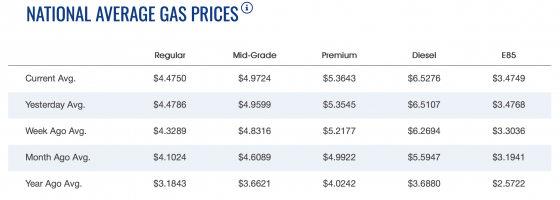
In California, the average price of a gallon of gasoline has already almost reached 6 dollars

Gas prices are soaring across the country, but especially in California. The Golden State average is now nearly $6 per gallon — 40 percent above the national figure. That gap is likely to widen: UC Davis economists estimate that Californians could soon be paying more than $2.50 a gallon above the national average.

In the United Kingdom, officials are bracing for widespread fuel shortages in “two or three weeks”

Sources told ITV News that the UK is ‘two or three weeks away’ from shortages of diesel and jet fuel, although petrol supplies are healthier.

The Government is said to be facing ‘difficult decisions’ over how to allot fuel supplies, including how to keep ‘ancillary power’ going for NHS hospitals.

If the war with Iran is not resolved quickly, this will only be the tip of the iceberg.

The Iranians are holding the global economy hostage, and they fully realize that this gives them a tremendous amount of leverage.

But there is no way that the U.S. and Israel will ever agree to their demands.

So for now we seem to have an unsolvable problem on our hands, and meanwhile the damage that is being done to the global economy is getting worse with each passing day.

Michael’s new book entitled “10 Prophetic Events That Are Coming Next” is available in paperback and for the Kindle on Amazon.com, and you can subscribe to his Substack newsletter at michaeltsnyder.substack.com.

About the Author: Michael Snyder’s new book entitled “10 Prophetic Events That Are Coming Next” is available in paperback and for the Kindle on Amazon.com.  He has also written nine other books that are available on Amazon.com including “Chaos”“End Times”“7 Year Apocalypse”“Lost Prophecies Of The Future Of America”“The Beginning Of The End”, and “Living A Life That Really Matters”.  When you purchase any of Michael’s books you help to support the work that he is doing.  You can also get his articles by email as soon as he publishes them by subscribing to his Substack newsletter.  Michael has published thousands of articles on The Economic Collapse BlogEnd Of The American Dream and The Most Important News, and he always freely and happily allows others to republish those articles on their own websites.  These are such troubled times, and people need hope.  John 3:16 tells us about the hope that God has given us through Jesus Christ: “For God so loved the world, that he gave his only begotten Son, that whosoever believeth in him should not perish, but have everlasting life.”  If you have not already done so, we strongly urge you to invite Jesus Christ to be your Lord and Savior today.