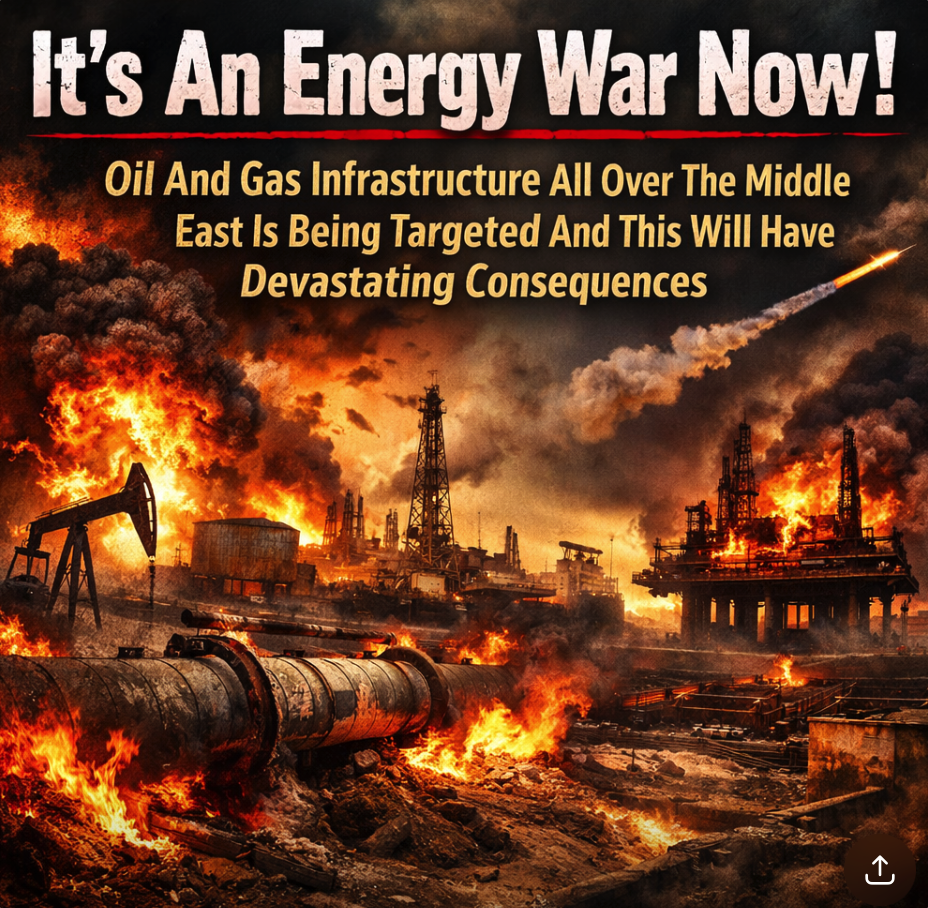
 Prior to the war with Iran, the world had more than enough oil and gas, and as a result it was very inexpensive. Now we have transitioned into a time when that is no longer true at all. Both sides in this war are now specifically targeting oil and gas infrastructure, and that is going to have devastating consequences. Even if the war ended tomorrow and the Strait of Hormuz was immediately reopened, there is no way that conditions would return to how they were just before the war any time soon. Oil and gas facilities that have been damaged could take many months to repair. Oil and gas facilities that have been completely destroyed could take years to rebuild. What this means is that oil and gas prices are going to remain at elevated levels for an extended period of time, and that is really bad news because our entire way of life is based on cheap energy.
On Wednesday, a stunning series of airstrikes absolutely pummeled the South Pars gas field in Iran…
Iran said the US and Israel struck its giant South Pars gas field in the Persian Gulf, the latest attack on energy assets in the region-wide conflict.
Oil prices jumped after Iranian state TV reported the airstrike, which raised fears of further risks to global crude and gas supplies. Gulf producers have significantly reduced output during the 19-day war, particularly due to the effective shuttering of the Strait of Hormuz.
If confirmed, the assault would mark the first time the US and Israel have targeted Iran’s upstream oil and gas facilities since starting the war on Feb. 28.
This was an enormous escalation.
Up to this point, the U.S. and Israel had left the South Pars gas field alone.
As a result of the airstrikes, production at two of the primary refineries at South Pars came to a screeching halt…
The attack effectively halted production at two of the field’s refineries, which typically put out about 100 million cubic meters of gas a day, according to state media.
It would be difficult for me to overstate how important this is.
South Pars is the home of “the largest known gas reserve in the world”, and it normally produces approximately 70 percent of all natural gas used in Iran…
The South Pars/North Dome mega-field is the largest known gas reserve in the world. The field supplies around 70 percent of Iran’s domestic natural gas. Iran, which shares the massive field with energy giant Qatar, has been developing its side since the late 1990s.
So now Iran will be immediately facing an unprecedented domestic energy crisis.
There simply won’t be enough energy for everyone, and this is going to have a huge impact on Iran’s ability to keep fighting…
The South Pars attack signals a shift in the conduct of the war toward degrading Iran’s economic infrastructure and curbing its ability to continue fighting, according to Hamidreza Azizi, a visiting fellow at the German Institute for International and Security Affairs in Berlin.
“South Pars is central to Iran’s gas supply and, by extension, to electricity generation and industrial activity,” Azizi said by email. “Even limited or temporary disruptions can translate into power shortages, industrial slowdowns, and broader economic strain.”
Needless to say, the Iranians are extremely angry about what has just happened.
In response, they are threatening to attack oil and gas infrastructure in Saudi Arabia, Qatar and the United Arab Emirates…
Iranian state media issued a new warning Wednesday urging civilians living near major oil and gas facilities in Saudi Arabia, Qatar and the United Arab Emirates to leave immediately, saying the sites will be targeted “in the coming hours.”
In a Telegram post, the semi‑official Tasnim news agency listed several facilities it said were at risk. The sites included the Samref refinery and Jubail petrochemical complex in Saudi Arabia; the Mesaieed petrochemical complex, Mesaieed Holding Company and Ras Laffan refinery in Qatar; and the Al Hosn gas field in the UAE.
Tasnim said the facilities had become “direct and legitimate targets” and urged residents, workers and nearby communities to move to a safe distance without delay.
Saudi Arabia, Qatar and the United Arab Emirates are apparently taking these threats quite seriously, because it is being reported that oil and gas facilities in those countries are being hastily evacuated…
Energy sites across the Middle East were being evacuated on Wednesday as Iran threatened strikes on facilities “in the coming hours”.
The price of oil surged by more than 5pc to $108 a barrel after Iran urged staff to leave sites in Saudi Arabia, the United Arab Emirates and Qatar ahead of a possible strike, according to state media.
Such an assault would further cripple global oil and gas supplies, with Brent crude reaching the highest level in 10 days amid fears of a growing shortage.
As I write this article, reports are circulating on social media that indicate that targets have been hit in Saudi Arabia.
In the coming hours, we shall see if those reports are confirmed or not.
I think that the Saudis are rapidly losing patience with Iran.
In fact, a Saudi analyst just told CBC News that if Saudi Arabia joins the war it “will activate its bilateral defence agreement with Pakistan”…
If Saudi Arabia joins the US-Israeli war on Iran, it will activate its mutual defence pact with Pakistan and potentially lean on the South Asian country’s nuclear arsenal, a Saudi Arabian analyst told Canada’s CBC News.
“If the Saudis were to decide to enter with complete force…Iran is going to be the biggest loser because Saudi Arabia will activate its bilateral defence agreement with Pakistan,” Salman al-Ansari, a Saudi Arabian geopolitical researcher, said in an interview.
“We can say it literally that there is a nuclear umbrella over Saudi Arabia,” he added.
We are in such dangerous territory now.
If the Iranians are backed into a corner, there is no telling what they might do.
But there is no turning back now. A number of Gulf states are actually encouraging the Trump administration to finish the job because they don’t want Iran to ever be in a position to do something like this again…
Battered by Iranian strikes and the disruption of the Strait of Hormuz, the United Arab Emirates and some fellow Persian Gulf states have come to view Iran’s theocracy as an existential enemy. They now want the regime they once courted to be neutered, if not dismantled, when the conflict ends—so the ordeal is never repeated.
The U.A.E. has borne the brunt of Iranian attacks: more than 2,000 drones and missiles have been fired at the country since the U.S. and Israel launched the war on Feb. 28.
Of course it would take quite some time to do what they are asking.
Even a military operation that would be designed to take control of the Strait of Hormuz would extend the duration of this war by months…
A number of sources told The Jerusalem Post that if President Donald Trump decides to launch a military operation to take control of the Strait of Hormuz – an operation intended to ensure freedom of navigation – it could significantly prolong the war “by weeks, if not months.”
“This could extend the war by as much as two months,” one source familiar with the discussions said.
If taking control of the Strait of Hormuz would take “months”, how long would full-blown regime change take?
It is becoming clear that this isn’t going to be a short war.
And the longer this war persists, the more damage we will see to oil and gas infrastructure throughout the Middle East.
Energy prices are just going to keep on rising, and the global economy and the global financial system are not going to be able to handle that.
Michael’s new book entitled “10 Prophetic Events That Are Coming Next” is available in paperback and for the Kindle on Amazon.com, and you can subscribe to his Substack newsletter at michaeltsnyder.substack.com.

About the Author: Michael Snyder’s new book entitled “10 Prophetic Events That Are Coming Next” is available in paperback and for the Kindle on Amazon.com. He has also written nine other books that are available on Amazon.com including “Chaos”, “End Times”, “7 Year Apocalypse”, “Lost Prophecies Of The Future Of America”, “The Beginning Of The End”, and “Living A Life That Really Matters”. When you purchase any of Michael’s books you help to support the work that he is doing. You can also get his articles by email as soon as he publishes them by subscribing to his Substack newsletter. Michael has published thousands of articles on The Economic Collapse Blog, End Of The American Dream and The Most Important News, and he always freely and happily allows others to republish those articles on their own websites. These are such troubled times, and people need hope. John 3:16 tells us about the hope that God has given us through Jesus Christ: “For God so loved the world, that he gave his only begotten Son, that whosoever believeth in him should not perish, but have everlasting life.” If you have not already done so, we strongly urge you to invite Jesus Christ to be your Lord and Savior today.