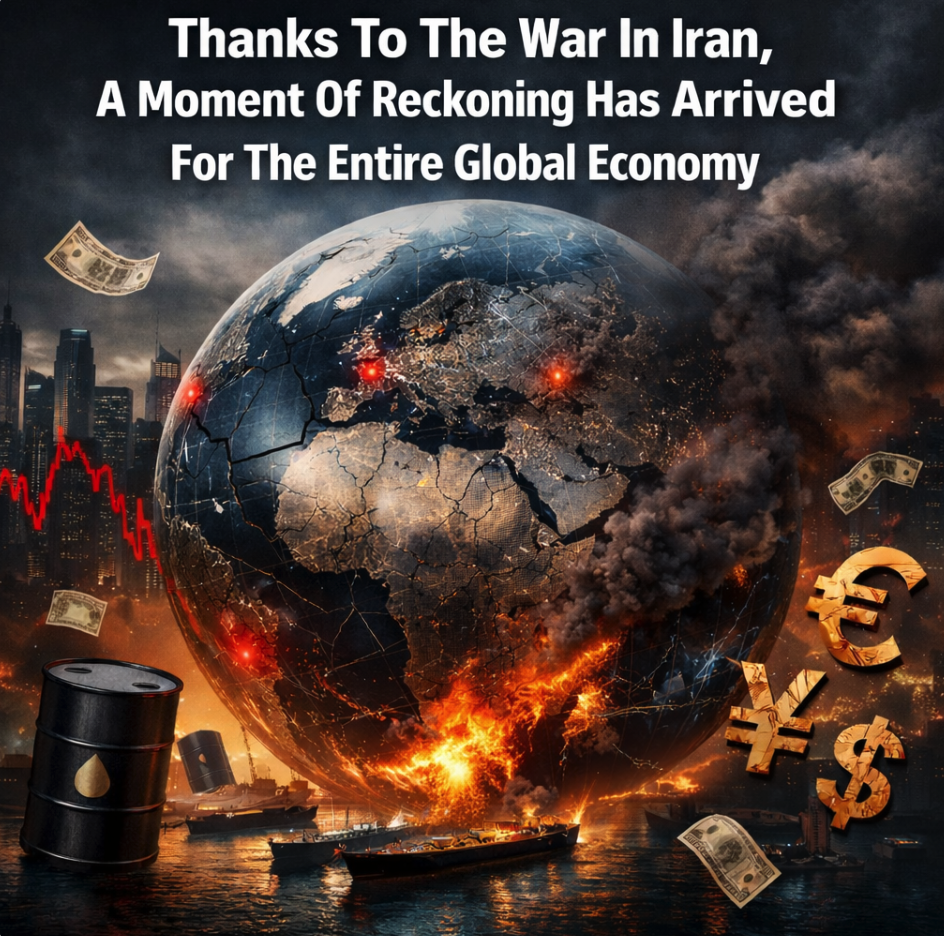
 Global financial markets are starting to shake, and it is because of what is happening in the Middle East. At this stage, every day is a rollercoaster ride for investors, and that is not likely to change any time soon. The Iranians have paralyzed traffic through the Strait of Hormuz, and trying to reopen it by force is going to be exceptionally difficult to do. As you will see below, this is going to have enormous implications for every nation on the entire planet. We are in the early chapters of a major global crisis, and a tremendous amount of pain is ahead.
On Thursday, Mojtaba Khamenei issued a statement in which he boldly declared that the Strait of Hormuz must remain closed in order to “pressure the enemy”…
Iran’s new supreme leader, Mojtaba Khamenei, said Thursday that the closure of the Strait of Hormuz maritime passage should be continued as a “tool to pressure the enemy,” in his first public statement since being appointed.
Khamenei also said all U.S. military bases in the Middle East should close immediately and “those bases will be attacked,” in televised comments translated by Reuters.
Oil prices extended gains following the statement, read out by a state TV broadcaster. The shipping of oil through the Strait of Hormuz has effectively stopped since the war began, causing global oil prices to soar. Iran warned on Wednesday that the price per barrel could climb to $200.
Needless to say, the Iranians are fully capable of carrying out Khamenei’s threats.
Several more vessels have been attacked within the past 48 hours, and that includes a U.S.-owned oil tanker that was completely destroyed…
Iran’s semi-official Tasnim news agency also released a dramatic video apparently showing a missile strike on a U.S.-owned tanker in the Persian Gulf. The video shows a massive explosion on a vessel that is then engulfed in flames as people aboard what appears to be an IRGC attack boat celebrate. CBS News Confirmed identified the vessel as the Safesea Vishnu, a crude oil tanker sailing under a Marshall Islands flag, but owned by the New Jersey-based company Safesea Group LLC.
Now that Iran has officially closed the Strait of Hormuz, it will be up to the U.S. military to try to reopen it.
This will not be an easy task.
In fact, some military experts are warning that it could take months to accomplish that goal…
Unblocking the Strait of Hormuz is shaping up as a remarkably complex and time-consuming task.
The fate of the global oil markets—and the global economy—rests on whether ships can traverse the 22-mile-wide waterway from the Persian Gulf to the Gulf of Oman. More than 10 days after the U.S. and Israel attacked Iran, there is no clear plan for reopening it. Military experts say the effort is so daunting it could take months to achieve, absent a fast and full cease-fire.
So exactly why will it be so difficult to reopen the Strait of Hormuz?
As one expert has aptly noted, the Iranians are able to block traffic through the Strait in a multitude of different ways…
The problem is that the strait can’t be cleared solely through a bombing campaign, or an attack by destroyers. Iran’s navy has been severely depleted by the U.S., but the country doesn’t need large attack ships to scare commercial vessels away. Its weapons include mines, fast attack boats, missiles and drones. Layered on top of each other, they become exceptionally difficult to remove.
“They’ve created an integrated, vertical stack of threats that can cover the strait from undersea all the way to above the surface,” said Jonathan Schroden, chief research officer at the Center for Naval Analyses, a federally funded nonprofit that does research for the Navy.
If you take out all of their missiles, they would still have thousands of drones.
If you could somehow locate and eliminate all of the drones, they would still have their fast attack boats.
And even if you could eliminate all of their fast attack boats, they would still have thousands of naval mines.
My point is that this crisis is not going to be resolved easily.
And that is really, really bad news for the global economy.
Right now, approximately half of the available global fleet of liquified natural gas carriers is trapped in the Persian Gulf…
According to the WSJ, at least 20 LNG carriers about half the available global fleet – are trapped in the Persian Gulf, with daily freight costs soaring as demand from Asia surges, according to ship brokers.
This is a nightmare.
Liquified natural gas prices have already soared in Europe and in Asia, and this is probably only just the beginning…
Ship brokers said the 20 ships trapped in the Persian Gulf make up nearly half of all LNG ships currently available for charter, with daily rates rising to more than $200,000 from less than $98,000 before the start of the Iran hostilities.
Energy traders expect LNG prices to rise by early next week, adding to this week’s 40% rise in Asia and Europe. “The effect on LNG shipping will outlast the conflict for a few months,” Karathanos said.
Amid the scramble to procure LNG, more shipments bound for Europe are diverting to Asia. At least nine cargoes initially headed to Europe have changed course to Asia since the start of the fighting, according to ship-tracking data compiled by Bloomberg, with the trend accelerating in recent days. A buffer of spare supply is quickly drying up, threatening more competition and higher prices for both regions.
Meanwhile, a very large percentage of the nitrogen fertilizer that famers in the northern hemisphere are counting on is also stuck in the Persian Gulf region…
Nearly half the world’s traded urea — the most widely used nitrogen fertilizer — comes from the Gulf region, with Qatar accounting for one-tenth of the global supply, according to Bloomberg Intelligence.
When QatarEnergy last week halted production after Iranian strikes on Ras Laffan, the world’s biggest LNG and fertilizer hub, hundreds of thousands of tons of key fertilizer nutrients and precursors were sidelined.
The compounding effects of the Iran war threaten the third major risk to global food security in six years, after the COVID-19 pandemic and Moscow’s seizure of farmland and ports used to export Ukrainian grain at the start of Russia’s war in Ukraine in 2022.
If we can’t get that fertilizer into the hands of the farmers that need it, we are going to have a massive problem on our hands.
Approximately half of the entire population of the world eats food that is grown using nitrogen fertilizer…
About 4 billion people on the planet eat food grown with synthetic nitrogen fertilizers. Roughly half of the global population, in other words, is alive because of these chemicals converted into nutrients for plants, said Lorenzo Rosa, who researches sustainable energy, water, and food systems at the Carnegie Institution for Science at Stanford University.
If this war persists for an extended period of time, famine will become a major global theme.
Of course the war with Iran has also caused the greatest oil supply disruption in human history…
The war in the Middle East is creating the largest supply disruption in the history of the global oil market, the International Energy Agency said in a report on Thursday slashing its annual supply outlook, shortly after the group announced its biggest-ever oil stock release.
It is now being projected that the price of oil could soon hit $150 a barrel, and that would absolutely crush the global economy…
If it remains fully closed for weeks, analysts see oil prices climbing to $150—a level that could send the U.S. and other economies into recession. Countries are going to great lengths—from emptying their strategic oil stockpiles to rerouting supplies through underutilized pipelines—to find other ways to replace the shortage. None of those ideas will come close to replacing all the lost supplies.
Meanwhile, trouble is brewing in the financial markets.
In fact, George Noble is warning that a major crisis is emerging in the private credit market…
George Noble, a longtime Fidelity fund manager and Wall Street veteran, sees big problems brewing in the booming private credit market.
The former director of Fidelity Overseas Fund recently wrote that he sees the makings of a financial crisis in the sector, echoing others who have worried about a spate of negative headlines in recent months.
So what is it specifically that has him so spooked?
Well, it is the fact that so many big players are starting to block investors from withdrawing their money…
“We’re watching a financial crisis unfold in real time,” he said in a post on X. “The last time funds started blocking investors from getting their money back, Bear Stearns collapsed six months later.”
The collapse of the investment bank is often seen as one of the first dominoes of the 2008 financial crisis. Noble pointed to recent news of redemptions at major firms, including BlackRock, Blackstone, and Blue Owl.
Noble is right.
We haven’t seen anything like this since 2008.
And now we can add Morgan Stanley to the list…
Morgan Stanley’s investment management arm became the latest asset manager to cap withdrawals from a private credit fund, telling investors in a letter Wednesday evening that it saw a wave of redemption requests this quarter.
The company’s North Haven Private Income Fund, which has $7.6 billion in total investments, received investor requests to buy back around 10.9% of outstanding shares in its quarterly tender offer. The fund capped repurchases at 5%, its previously disclosed threshold.
“By maintaining appropriate limits on the quarterly repurchase offer, the [fund] seeks to avoid asset sales during periods of market dislocation and provide for conservative capital structure management through evolving market conditions,” the letter said.
This is it guys.
What we have been waiting for has officially begun.
I hope that you are ready for what is coming next, because the months ahead are going to be absolutely filled with chaos.
Michael’s new book entitled “10 Prophetic Events That Are Coming Next” is available in paperback and for the Kindle on Amazon.com, and you can subscribe to his Substack newsletter at michaeltsnyder.substack.com.

About the Author: Michael Snyder’s new book entitled “10 Prophetic Events That Are Coming Next” is available in paperback and for the Kindle on Amazon.com. He has also written nine other books that are available on Amazon.com including “Chaos”, “End Times”, “7 Year Apocalypse”, “Lost Prophecies Of The Future Of America”, “The Beginning Of The End”, and “Living A Life That Really Matters”. When you purchase any of Michael’s books you help to support the work that he is doing. You can also get his articles by email as soon as he publishes them by subscribing to his Substack newsletter. Michael has published thousands of articles on The Economic Collapse Blog, End Of The American Dream and The Most Important News, and he always freely and happily allows others to republish those articles on their own websites. These are such troubled times, and people need hope. John 3:16 tells us about the hope that God has given us through Jesus Christ: “For God so loved the world, that he gave his only begotten Son, that whosoever believeth in him should not perish, but have everlasting life.” If you have not already done so, we strongly urge you to invite Jesus Christ to be your Lord and Savior today.