Financial Armageddon Approaches: U.S. Banks Have 247 Trillion Dollars Of Exposure To Derivatives

Nuclear War - Public DomainDid you know that there are 5 “too big to fail” banks in the United States that each have exposure to derivatives contracts that is in excess of 30 trillion dollars?  Overall, the biggest U.S. banks collectively have more than 247 trillion dollars of exposure to derivatives contracts.  That is an amount of money that is more than 13 times the size of the U.S. national debt, and it is a ticking time bomb that could set off financial Armageddon at any moment.  Globally, the notional value of all outstanding derivatives contracts is a staggering 552.9 trillion dollars according to the Bank for International Settlements.  The bankers assure us that these financial instruments are far less risky than they sound, and that they have spread the risk around enough so that there is no way they could bring the entire system down.  But that is the thing about risk – you can try to spread it around as many ways as you can, but you can never eliminate it.  And when this derivatives bubble finally implodes, there won’t be enough money on the entire planet to fix it.

A lot of readers may be tempted to quit reading right now, because “derivatives” is a term that sounds quite complicated.  And yes, the details of these arrangements can be immensely complicated, but the concept is quite simple.  Here is a good definition of “derivatives” that comes from Investopedia

A derivative is a security with a price that is dependent upon or derived from one or more underlying assets. The derivative itself is a contract between two or more parties based upon the asset or assets. Its value is determined by fluctuations in the underlying asset. The most common underlying assets include stocks, bonds, commodities, currencies, interest rates and market indexes.

I like to refer to the derivatives marketplace as a form of “legalized gambling”.  Those that are engaged in derivatives trading are simply betting that something either will or will not happen in the future.  Derivatives played a critical role in the financial crisis of 2008, and I am fully convinced that they will take on a starring role in this new financial crisis.

And I am certainly not the only one that is concerned about the potentially destructive nature of these financial instruments.  In a letter that he once wrote to shareholders of Berkshire Hathaway, Warren Buffett referred to derivatives as “financial weapons of mass destruction”…

The derivatives genie is now well out of the bottle, and these instruments will almost certainly multiply in variety and number until some event makes their toxicity clear. Central banks and governments have so far found no effective way to control, or even monitor, the risks posed by these contracts. In my view, derivatives are financial weapons of mass destruction, carrying dangers that, while now latent, are potentially lethal.

Since the last financial crisis, the big banks in this country have become even more reckless.  And that is a huge problem, because our economy is even more dependent on them than we were the last time around.  At this point, the four largest banks in the U.S. are approximately 40 percent larger than they were back in 2008.  The five largest banks account for approximately 42 percent of all loans in this country, and the six largest banks account for approximately 67 percent of all assets in our financial system.

So the problem of “too big to fail” is now bigger than ever.

If those banks go under, we are all in for a world of hurt.

Yesterday, I wrote about how the Federal Reserve has implemented new rules that would limit the ability of the Fed to loan money to these big banks during the next crisis.  So if the survival of these big banks is threatened by a derivatives crisis, the money to bail them out would probably have to come from somewhere else.

In such a scenario, could we see European-style “bail-ins” in this country?

Ellen Brown, one of the most fierce critics of our current financial system and the author of Web of Debt, seems to think so…

Dodd-Frank states in its preamble that it will “protect the American taxpayer by ending bailouts.” But it does this under Title II by imposing the losses of insolvent financial companies on their common and preferred stockholders, debtholders, and other unsecured creditors. That includes depositors, the largest class of unsecured creditor of any bank.

Title II is aimed at “ensuring that payout to claimants is at least as much as the claimants would have received under bankruptcy liquidation.” But here’s the catch: under both the Dodd Frank Act and the 2005 Bankruptcy Act, derivative claims have super-priority over all other claimssecured and unsecured, insured and uninsured.

The over-the-counter (OTC) derivative market (the largest market for derivatives) is made up of banks and other highly sophisticated players such as hedge funds. OTC derivatives are the bets of these financial players against each other. Derivative claims are considered “secured” because collateral is posted by the parties.

For some inexplicable reason, the hard-earned money you deposit in the bank is not considered “security” or “collateral.” It is just a loan to the bank, and you must stand in line along with the other creditors in hopes of getting it back.

As I mentioned yesterday, the FDIC guarantees the safety of deposits in member banks up to a certain amount.  But as Brown has pointed out, the FDIC only has somewhere around 70 billion dollars sitting around to cover bank failures.

If hundreds of billions or even trillions of dollars are ultimately needed to bail out the banking system, where is that money going to come from?

It would be difficult to overstate the threat that derivatives pose to our “too big to fail” banks.  The following numbers come directly from the OCC’s most recent quarterly report (see Table 2), and they reveal a recklessness that is on a level that is difficult to put into words…

Citigroup

Total Assets: $1,808,356,000,000 (more than 1.8 trillion dollars)

Total Exposure To Derivatives: $53,042,993,000,000 (more than 53 trillion dollars)

JPMorgan Chase

Total Assets: $2,417,121,000,000 (about 2.4 trillion dollars)

Total Exposure To Derivatives: $51,352,846,000,000 (more than 51 trillion dollars)

Goldman Sachs

Total Assets: $880,607,000,000 (less than a trillion dollars)

Total Exposure To Derivatives: $51,148,095,000,000 (more than 51 trillion dollars)

Bank Of America

Total Assets: $2,154,342,000,000 (a little bit more than 2.1 trillion dollars)

Total Exposure To Derivatives: $45,243,755,000,000 (more than 45 trillion dollars)

Morgan Stanley

Total Assets: $834,113,000,000 (less than a trillion dollars)

Total Exposure To Derivatives: $31,054,323,000,000 (more than 31 trillion dollars)

Wells Fargo

Total Assets: $1,751,265,000,000 (more than 1.7 trillion dollars)

Total Exposure To Derivatives: $6,074,262,000,000 (more than 6 trillion dollars)

As the “real economy” crumbles, major hedge funds continue to drop like flies, and we head into a new recession, there seems to very little alarm among the general population about what is happening.

The mainstream media is assuring us that everything is under control, and they are running front page headlines such as this one during the holiday season: “Kylie Jenner shows off her red-hot, new tattoo“.

But underneath the surface, trouble is brewing.

A new financial crisis has already begun, and it is going to intensify as we head into 2016.

And as this new crisis unfolds, one word that you are going to want to listen for is “derivatives”, because they are going to play a major role in the “financial Armageddon” that is rapidly approaching.
The Rate Hike Stock Market Crash Has Thrown Gasoline Onto An Already Raging Global Financial Inferno

Inferno - Public DomainIf the stock market crash of last Thursday and Friday had all happened on one day, it would have been the 7th largest single day decline in U.S. history.  On Friday, the Dow Jones Industrial Average was down 367 points after finishing down 253 points on Thursday.  The overall decline of 620 points between the two days would have been the 7th largest single day stock market crash ever experienced in the United States if it had happened within just one trading day.  If you will remember, this is precisely what I warned would happen if the Federal Reserve raised interest rates.  But when news of the rate hike first came out on Wednesday, stocks initially jumped.  This didn’t make any sense at all, and personally I was absolutely stunned that the markets had behaved so irrationally.  But then we saw that on Thursday and Friday the markets did exactly what we thought they would do.  The chief economist at Gluskin Sheff, David Rosenberg, is calling the brief rally on Wednesday “a head-fake of enormous proportions“, and analysts all over Wall Street are bracing for what could be another very challenging week ahead.

When the Federal Reserve decided to lift interest rates, they made a colossal error.  You don’t raise interest rates when a global financial crisis has already started.  That is absolutely suicidal.  It is the kind of thing that you would do if you were trying to bring down the global financial system on purpose.

Surely the “experts” at the Federal Reserve can see what is happening.  Junk bonds have already crashed, just like they did in 2008.  The price of oil has crashed, just like it did in 2008.  Commodity prices have crashed, just like they did in 2008.  And more than half of all major global stock market indexes are already down at least 10 percent for the year so far.

You don’t raise interest rates in that kind of an environment.

You would have to be utterly insane to do so.

The Federal Reserve has thrown fuel onto a global financial inferno that is already raging, and things could spiral out of control very rapidly.

As far as this upcoming week is concerned, we have now entered “liquidation season”.  Investors are going to be pulling their money out of poorly performing hedge funds before the end of the calendar year, and as CNBC has pointed out, more hedge funds have already failed in 2015 than at any point since the last financial crisis…

Liquidation season occurs when clients of poorly performing hedge funds ask for their money back. It tends to occur at the end of a quarter or year. In response, hedge funds must sell stocks in the open market to raise the money that needs to be returned to investors.

That means if a hedge fund performed poorly this year; it is probably flooded with liquidation requests right now. In fact, there have been more failed hedge funds this year than any time since 2008.

The dominoes are starting to fall.  We have already seen funds run by Third Avenue Management, Stone Lion Capital Partners and Lucidus Capital Partners collapse.  Amazingly, there are some people out there that are still attempting to claim that “nothing is happening” even in the midst of all of this chaos.

As they say, “denial” is not just a river in Egypt.

And this crisis is going to get even worse as we head into 2016.  Egon von Greyerz, the founder of Matterhorn Asset Management, is convinced that we will soon see “one disaster after another”

Greyerz predicts, “I think we will have one disaster after another, first in the junk bond market, then in emerging markets and, after that, the subprime markets. Subprime car loans and student loans I see as another massive problem area. It is going to be one thing after another that will unravel. Since 2008, when the world almost went under, we have printed or increased credit by 50% or by $70 trillion, and the world economy is still struggling to survive. I think the real change in confidence will come down when markets come down. . . . I think things will come down very quickly.”

And I think that he is right on target.  The global financial system is more interconnected today than ever before, and when one financial institution fails, it inevitably affects dozens of others.  And the failures that we have already seen are already spreading a wave of fear and panic that may be difficult to stop.  The following comes from Business Insider, and I think that it is a pretty good explanation of what we could see next…

  • Funds such as Third Avenue and Lucidus close, liquidating their portfolios.
  • Investors, spooked by the closures and the risk that they might not be able to get their money out of these funds, make a rush for the exits while they still can.
  • That creates even more selling pressure.
  • Funds sell the assets that are easiest to sell as they look to reduce risk, which pushes the selling pressure from the risky parts of the market to the higher-quality part of the market.
  • Things evolve from there.

If you have been waiting for the next financial crisis to arrive, you can stop, because it is already unfolding right in front of our eyes.

The only question is how bad it is going to become.

In the final analysis, I find myself agreeing quite a bit with Charles Hugh Smith, the author of “A Radically Beneficial World: Automation, Technology and Creating Jobs for All“.  He believes that the ridiculous monetary policies of the Federal Reserve have played a primary role in setting the stage for this new crisis, and that now this giant financial “Death Star” that they have created “is about to blow up”

By slashing rates to zero, the Fed ruthlessly eliminating safe returns for savers, pension funds, insurers and the millions of people with 401K retirement nesteggs. In effect, the Fed-Farce has pushed everyone into risk assets–and then played another Dark Side mind-trick by masking the true dangers of these risky assets.

As oil-sector debt blows up, as junk bonds blow up, and emerging markets blow up, we are finally starting to see the real costs of going over to the Dark Side of endless credit expansion and throwing the gasoline of near-zero interest rates on the speculative fires of financialization.

The Fed’s hubris has led it to the Dark Side, and now its Death Star of impaired debt, phantom collateral, speculative frenzy and bogus mind-tricks is about to blow up.

Personally, instead of saying that it “is about to blow up”, I would have said that it is already blowing up.

We have already seen trillions upon trillions of dollars of wealth wiped out around the world.

Energy companies are failing, giant hedge funds are going under, and the 7th largest economy on the entire planet has already plunged into “an outright depression“.

Everyone that warned of financial disaster in the second half of 2015 has been proven right, but this is just the beginning.  Now that the Federal Reserve has thrown gasoline onto the fire, our problems are only going to accelerate as we head into 2016.

So for the upcoming year, let us hope for the best, but let us also prepare for the worst.

This Is What A Financial Crisis Looks Like

Financial Crisis 2015 - Public DomainJust within the past few days, three major high yield funds have completely imploded, and panic is spreading rapidly on Wall Street.  Funds run by Third Avenue Management and Stone Lion Capital Partners have suspended payments to investors, and a fund run by Lucidus Capital Partners has liquidated its entire portfolio.  We are witnessing a race for the exits unlike anything that we have seen since the great financial crash of 2008, and many of those that choose to hesitate are going to end up getting totally wiped out.  In case you are wondering, this is what a financial crisis looks like.  In 2008, other global stock markets started to tumble, then junk bonds began to crash, and finally U.S. stocks followed.  The exact same pattern is playing out again, and the carnage that we have seen so far is just the tip of the iceberg.

Since the end of 2009, a high yield bond ETF that I watch very closely known as JNK has been trading in a range between 36 and 42.  I have been waiting all this time for it to dip below 35, because I knew that would be a sign that the next major financial crisis was imminent.

In September, it closed as low as 35.33 at one point, but that was not the signal that I was looking for.  Finally, early last week JNK broke below 35 for the very first time since the last financial crisis, and since then it has just kept on falling.  As I write this, JNK has plummeted all the way to 33.42, and Bloomberg is reporting that many bond managers “are predicting more carnage for high-yield investors”…

Top bond managers are predicting more carnage for high-yield investors amid a market rout that forced at least three credit funds in the past week to wind down.

Lucidus Capital Partners, a high-yield fund founded in 2009 by former employees of Bruce Kovner’s Caxton Associates, said Monday it has liquidated its entire portfolio and plans to return the $900 million it has under management to investors next month. Funds run by Third Avenue Management and Stone Lion Capital Partners have stopped returning cash to investors, after clients sought to pull too much money.

When it says that those firms “have stopped returning cash to investors”, what that means is that many of those investors will be lucky to get pennies on the dollar when it is all said and done.

Like I said, now that the crisis has started, the ones that are going to lose the most are those that hesitate.

And just check out some of the very big names that are “warning of more high-yield trouble ahead”

Scott Minerd, global chief investment officer at Guggenheim Partners, predicts 10 percent to 15 percent of junk bond funds may face high withdrawals as more investors worry about getting their money back. He joins money managers Jeffrey GundlachCarl Icahn, Bill Gross and Wilbur Ross in warning of more high-yield trouble ahead.

In this type of environment, the Federal Reserve would have to be completely insane to raise interest rates.

Unfortunately, that appears to be exactly what is going to happen.

If the Fed raises rates, that is going to make corporate debt defaults even more likely and will almost certainly drive high-yield bonds down even further…

Higher rates could make corporate bond defaults more likely and investors are already bailing out of the sector, pulling $3.8 billion out of high-yield funds in the week ended December 9, the biggest move in 15 weeks. The effective yield on U.S. junk bonds is now 17 percent, the highest level in five years, according to Bank of America Merrill Lynch data.

A whole host of prominent names are warning that the Fed is about to make a tragic mistake.  One of them is James Rickards

“The Fed should have raised interest rates in 2010 and 2011 and if they did that they would actually be in a position to cut them today,” said James Rickards, a central bank critic and chief global strategist at West Shore Funds. “The Fed is on the brink of committing a historic blunder that may rank with the mistakes it made in 1927 and 1929. By raising into weakness, they will likely cause a recession.”

In 2015, we have already seen stocks crash all over the globe.  Coming into December, more than half of the 93 largest stock market indexes in the world were down more than 10 percent year to date, and some of them were down by as much as 30 or 40 percent.  At this point, conditions are absolutely perfect for a frightening collapse of U.S. markets, and the Federal Reserve is about to pour gasoline on to the fire.

Anyone that says that “nothing is happening” is either completely misinformed or is totally crazy.

I like how James Howard Kunstler summarized what we are currently facing…

Equities barfed nearly four percent just last week, credit is crumbling (nobody wants to lend), junk bonds are tanking (as defaults loom), currencies all around the world are crashing, hedge funds can’t give investors their money back, “liquidity” is AWOL (no buyers for janky securities), commodities are in freefall, oil is going so deep into the sub-basement of value that the industry may never recover, international trade is evaporating, the president is doing everything possible in Syria to start World War Three, and the monster called globalism is lying in its coffin with a stake pointed over its heart.

The financial markets held together far longer than many people thought that they would, but now they are finally coming apart at the seams.

Moving forward, the “winners” are going to be the people that pull their money out the fastest.  This is especially true for high risk funds like the three that just imploded.  If you hesitate, you could end up losing everything.

And as this rush for the exits accelerates, sellers are going to greatly outnumber buyers, and this is going to push prices down at a very rapid pace.  We are going to hear a lot about a “lack of liquidity” in the days ahead, but the truth is that what we will really be looking at is a good old-fashioned panic.

December 14th To 18th: A Week Of Reckoning For Global Stocks If The Fed Hikes Interest Rates?

Time Of Reckoning - Public DomainAre we about to witness widespread panic in the global financial marketplace?  This week is shaping up to be an absolutely critical week for global stocks.  Coming into December, more than half of the 93 largest stock market indexes in the world were down more than 10 percent year to date, and last week stocks really started to slide all over the world.  Here in the United States, the Dow Jones Industrial Average is down about 600 points over the past week or so, and at this point it is down more than 1000 points from the peak of the market.  That brings us to this week, during which the Federal Reserve is expected to raise interest rates for the very first time since the last financial crisis.  If that happens, that could potentially be enough to accelerate this “slide” into a full-blown crash.

And just look at what is already happening.  Trading for stocks in the Middle East has opened for the week, and we are already witnessing tremendous carnage

Following Friday’s further freefall in crude oil prices, The Middle East is opening down notably. Abu Dhabi, Saudi, and Kuwait are lower; Israel is weak and UAE and Qatar are tumbling, but Dubai is worst for now.  Dubai is down for the 6th day in a row (dropping over 3% – the most in a month) extending the opening losses to 2-year lows. The 11% drop in the last 6 days is the largest since the post-China-devaluation global stock collapse. Leading the losses are financial and property firms.

Things in Asia look very troubling as well.  As I write this, the Japanese market has just opened, and the Nikkei is already down 508 points.

In recent days I have been explaining to my readers how everything is lining up in textbook fashion for another major market crash.  In particular, the implosion of junk bonds is a major red flag.  Late last week, Third Avenue Management shocked Wall Street by freezing withdrawals from a 788 million dollar credit mutual fund.  The following comes from Bloomberg

A day after a prominent Wall Street firm shocked investors by freezing withdrawals from a credit mutual fund, things only got nastier in the junk-bond market. Prices on the high-risk securities sank to levels not seen in six years and, to add to the growing sense of alarm, billionaire investor Carl Icahn said the selloff is only starting.

The meltdown in High Yield is just beginning,” Icahn, who’s been betting against the high-yield market, wrote on his verified Twitter account Friday.

Icahn’s comments come as junk-bond investors, already stung by the worst losses since 2008, are the most nervous they’ve been in three years after Third Avenue Management took the rare step of freezing withdrawals from a $788 million credit mutual fund.

What Third Avenue Management just did was absolutely huge.  Now investors that have money in any similar funds are going to be racing to get it out.  We could be on the verge of a run on bond funds that is absolutely unprecedented.  This is so obvious that even CNBC’s Jim Cramer is sounding the alarm…

Friday was a day where Cramer’s ears were burning with concern because of the troubles discovered with a high yield bond fund run by Third Avenue Management. It decided to bar investors from getting their money out of its Focused Credit Fund, because it could not meet demands to get cash back to them in an orderly way.

This was significant because when it tries to sell the bonds needed to satisfy these orders for redemptions, it could destroy the high yield bond market because there are no buyers anywhere near the amount that they want to sell.

I cannot emphasize enough just how disconcerting this move is,” Cramer said.

I know that for the ordinary person on the street, all of this sounds very complicated.

But it basically comes down to this – anyone that has a lot of money invested in these bond funds is in danger of getting totally wiped out.

In a situation like this, it is those that are “first out the door” that come out as the winners.  I like how Wolf Richter explained what we are currently facing…

It works like this: When an “open-end” bond fund starts losing money, investors begin to sell it. Fund managers first use all available cash to pay investors. When the cash is gone, they sell the most liquid securities that haven’t lost much money yet, such as Treasuries. When they’re gone, they sell the most liquid corporate paper. As they go down the line, they sell bonds that have already lost a lot of value. By now the smart money is betting against the fund, having figured out what’s happening. They’re shorting the very bonds these folks are trying to sell.

The longer this goes on, the more money investors lose and the more spooked they get. It turns into a run. And people who still have that fund in their retirement account are getting cleaned out.

Bond funds can be treacherous – especially if they hold dubious paper, which is never dubious until it suddenly is. And when they get in trouble, you want to be among the first out the door.

I would anticipate that we will see more junk bond carnage this week – especially if the Fed raises rates.

And as I have discussed previously, a stock crash almost always follows a junk bond crash.  If the Fed does raise rates this week and stocks do start falling significantly, one key day to watch will be Friday.  JPM’s head quant Marko Kolanovic has warned that “the largest option expiry in many years” will happen on that day…

This important event falls at a peculiar time—less than 48 hours before the largest option expiry in many years. There are $1.1 trillion of S&P 500 options expiring on Friday morning. $670Bn of these are puts, of which $215Bn are struck relatively close below the market level, between 1900 and 2050. Clients are net long these puts and will likely hold onto them through the event and until expiry. At the time of the Fed announcement, these put options will essentially look like a massive stop loss order under the market.

A perfect storm for stocks is brewing, and this week could potentially be one of the most chaotic that we have seen in a very long time.

But of course the Federal Reserve could decide to surprise us all by not raising rates, and that would change things substantially.

So what do you think will happen this week?

Please feel free to share your thoughts by posting a comment below…

The Global Commodity Crash Tells Us That A Major Deflationary Financial Crisis Is Imminent

Global - Public DomainIf we really are plunging into a deflationary global financial crisis, we would expect to see commodity prices crash hard.  That happened just before the great stock market crash of 2008, and that is precisely what is happening once again right now.  On Thursday, the Bloomberg Commodity Index closed at 79.1544.  The last time that it closed this low was 16 years ago.  Not even during the worst moments of the last recession did it ever get so low.  Overall, the Bloomberg Commodity Index is down more than 28 percent over the past 12 months, and it has plummeted by more than half since mid-2011.  As a result of this stunning commodity collapse, extremely large mining companies such as Anglo American are imploding, giant commodity trading firms such as Glencore and Trafigura are in full-blown crisis mode, and huge portions of the global financial system are in danger of utterly collapsing.

In recent days, I have been trying to stress that many of the exact same patterns that we witnessed just prior to the great stock market crash of 2008 are happening once again.  This includes the staggering crash of commodity prices that we are currently witnessing, and even CNN acknowledges that there are parallels to what we experienced seven years ago…

The last time raw materials like copper and oil were this cheap, an economic depression loomed just around the corner.

It’s no secret that commodities in general have had a horrendous 2015. A nasty combination of overflowing supply and soft demand has wreaked havoc on the industry.

But prices for everything from crude oil to industrial metals like aluminum, steel, copper, platinum, and palladium have collapsed even further in recent days.

As I mentioned above, this crash in prices is hitting mining companies really hard.  Just this week, the fifth largest mining company in the entire world announced a massive restructuring and will be laying off tens of thousands of workers…

In the latest example of just how bad things have gotten, Anglo American–the world’s fifth largest miner–just kitchen sink-ed it, announcing a sweeping restructuring, a massive round of layoffs, and a dividend cut. The company will reduce its assets by some 60% while headcount will be cut by a whopping 85,000 or, nearly two-thirds. 

Overall, the U.S. has lost approximately 123,000 good paying jobs from the mining sector since the end of 2014.  And if commodity prices stay low, this sector is going to continue to bleed good paying jobs.

Meanwhile, investors have been dumping the debt of any companies that have anything to do with commodities.  This has significantly contributed to the emerging junk bond crisis that I discussed in my last article.  As I write this, a high yield bond ETF known as JNK has fallen all the way down to 34.31, which is the lowest that it has been since the last recession.  For much more on the junk bond implosion, I would encourage you to read an article that Wolf Richter just put out entitled “Bond King Gets Antsy as Junk Bonds, Which Lead Stocks, Spiral to Heck“.

So why are commodity prices falling so rapidly?

Many analysts are pointing to the economic slowdown in China as the primary reason.  For years, the Chinese economy voraciously gobbled up commodities from sources all over the planet, but now things are changing.  The Chinese economy is really, really slowing down, and some recently released numbers give us some clues as to the true extent of that slowdown…

-Chinese exports fell 6.8 percent in November on a year over year basis after being down 6.9 percent on a year over year basis in October.

-Chinese imports were down 8.7 percent in November on a year over year basis.

-Chinese manufacturing activity has been contracting for nine months in a row.

-Last week, the China Containerized Freight Index plummeted to 718.58 – the lowest level ever recorded.

And of course it isn’t just China.  Goldman Sachs says that the seventh largest economy on the entire planet, Brazil, has plunged into a “depression“.  And as I pointed out the other day, of the 93 largest stock market indexes in the entire world, an astonishing 47 of them (more than half) are down at least 10 percent year to date.

Even though stocks slid in the U.S. this week, the major indexes still seem somewhat stable.  But this is a bit of an illusion.  Yes, the biggest names on Wall Street are still flying high for the moment, but shares of a multitude of smaller and mid-size firms have been plummeting.  At this point, nearly 70 percent of all U.S. stocks are already below their 200 day moving averages.  This is yet another thing that we would expect to see just before the bottom falls out for stocks.

Everything that I have been writing about this week (see here and here) is perfectly consistent with all of my warnings from earlier this year.

We are plunging into a deflationary financial crisis in textbook fashion.  And if the Federal Reserve actually does decide to go ahead with an interest rate hike next week that is just going to make things even worse.

But most people are not patient enough to watch a process play out.  Most people that write about “the coming economic collapse” hype it up like it is going to be some sort of big Hollywood blockbuster that is going to happen over a week or a month and then be over.  That is definitely not the way that I see things.

To me, “the economic collapse” is something that has been happening for decades, that is still in the process of happening right now, and that will continue to happen as we move forward into the future.  The long-term trends that are ripping our economy to shreds continue to intensify, and our leaders are not doing anything to fix our underlying fundamental problems.

And the financial crisis that I warned would start during 2015 and accelerate in 2016 has already begun.  More than half of all major global stock market indexes are down by at least 10 percent year to date, and some of them have plummeted by more than 30 or 40 percent.  Trillions of dollars of wealth has been wiped out around the globe, and this is just the beginning.

All of the numbers tell us the same thing.

Big trouble is ahead.

My job is to inform you of these things.  What you choose to do with this information is up to you.

Guess What Happened The Last Time Junk Bonds Started Crashing Like This? Hint: Think 2008

Thumbs Down - Public Domain
The extreme carnage that we are witnessing in the junk bond market right now is one of the clearest signals yet that a major U.S. stock market crash is imminent.  For those that are not familiar with “junk bonds”, please don’t get put off by the name.  They aren’t really “junk”.  They simply have a higher risk and thus a higher return than other bonds of the same type.  And yesterday, I explained why I watch them so closely.  If stocks are going to crash, you would expect to see a junk bond crash first.  This happened in 2008, and it is happening again right now.  On Monday, a high yield bond ETF known as JNK crashed through the psychologically important 35.00 barrier for the very first time since the last financial crisis.  On Tuesday, high yield bonds had their worst day in three months, and JNK plummeted all the way down to 34.44.  When I saw this I was absolutely stunned.  This is precisely the kind of junk bond crash that I have been anticipating that we would soon witness.

Normally, stocks and junk bonds track one another very closely, but just like before the 2008 crash, they have become decoupled in recent months.  Anyone that even has an elementary understanding of the financial world knows that this cannot continue indefinitely.  And when they start converging once again, the movement could be quite violent.

When I chose to use the word “carnage” to open this article, I was not exaggerating what is going on in the junk bond market one bit.  On Tuesday evening, Jeffrey Gundlach used the exact same word to describe what is happening…

Jeffrey Gundlach, the widely followed investor who runs DoubleLine Capital, said on a webcast on Tuesday that the junk bond market has come under severe selling pressure ahead of the Federal Reserve’s policy meeting next week.

We are looking at real carnage in the junk bond market,” Gundlach said. Gundlach also said it was too early to buy high-yield junk bonds and energy debt securities. “I don’t like things when they go down every single day.”

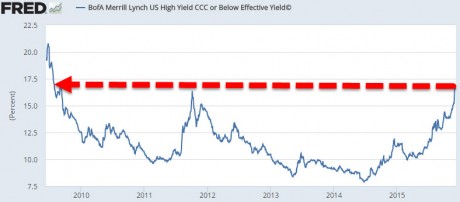
Sometimes a chart can be extremely helpful in understanding what is going on.  The following chart was posted by Zero Hedge on Tuesday, and it shows that yields on the riskiest junk bonds are heading into the stratosphere…

High Yield Debt - from Zero Hedge

And for those that are not familiar, it is important to note that when yields go up, bond prices go down.  So the chart above is what a “crash” looks like.

Another “leading indicator” that I watch is the behavior of Dow Transports.

Dow Transports started crashing before the Dow Jones Industrial Average did back in August, and now it is happening again

Dow Transports are in reverse. Down over 3% today, the biggest drop since the Black Monday collapse, Trannies are now below the lows of the Bullard bounce from October 2014 and down a shocking 16% in 2015. This would be the first four-quarters-in-a-row drop in Transports since 1994 and the worst year since 2008…

In addition, we are also seeing trouble signs erupt at major financial institutions just like we did during the run up to the 2008 crash.  For example, I have been concerned about Morgan Stanley for quite a while, and on Tuesday we learned that they have just laid off more than a thousand workers

Struggling Morgan Stanley slashed 1,200 jobs around the world in recent days, a person familiar with the matter told CNNMoney.

The cuts were broad-based and eliminated 25% of the positions within the fixed income and commodities businesses, the person said. Those divisions are grappling with tumbling trading revenue and shrinking fees.

Morgan Stanley also eliminated about 730 back-office jobs like human-resources and IT positions.

Virtually all of the things that we would expect to see just prior to a 2008-style stock market crash are happening right now.

If just two or three leading indicators were flashing red, we could have a really good debate about what they might mean.

But the fact that virtually all of the numbers are screaming a warning at us should mean that the debate is over.  Anyone with an open mind should be able to very clearly see what is coming next.

Very quickly, let me give you just 10 signs that indicate that we are right on the precipice of a major recession and a very substantial financial downturn…

1. Global GDP growth has gone negative for the first time since 2009.

2. Corporate earnings growth has turned negative.

3. S&P 500 net profit margins are steeply declining.  According to Tony Sagami, “since 1973, there has been only one 60 bps decline in S&P 500 net profit margin that didn’t lead to a recession.”

4. In October, U.S. imports of goods declined by 6.6 percent on a year over year basis.

5. In October, U.S. exports of goods declined by 10.4 percent on a year over year basis.

6. U.S. manufacturing is contracting at the fastest pace that we have seen since the last recession.

7. Corporate debt defaults have risen to the highest level that we have seen since the last recession.

8. Credit card numbers that were recently released show that holiday sales have gone negative for the first time since the last recession.

9. The velocity of money in the United States has dropped to the lowest level ever recorded.

10. Of the 93 largest stock market indexes in the entire world, 47 of them (slightly more than half) have already plunged at least 10 percent year to date.

Just like in 2008, other global financial markets are imploding ahead of a U.S. collapse.

On Tuesday, the Dow Jones Industrial Average was down another 162 points, but we are still within 1000 points of the market peak that was set earlier this year.  We are still in far better shape than most of the rest of the world, but that will soon change.

I can’t think of a single leading indicator that is telling us that everything is going to be okay.  All of the numbers are pointing to major trouble ahead.  So I hope that you are being smart and doing what you can to get prepared while there is still time.

27 Major Global Stocks Markets That Have Already Crashed By Double Digit Percentages In 2015

Earth Globe - Public DomainAnyone that tries to tell you that a global financial crisis is not happening is not being honest with you.  Right now, there are 27 major global stock markets that have declined by double digit percentages from their peaks earlier this year.  And this is truly a global phenomenon – we have seen stock market crashes in Asia, Europe, South America, Africa and the Middle East.  But because U.S. stocks are only down less than a thousand points from the peak earlier this year, most Americans seem to think that everything is just fine.

The truth, of course, is that everything is not fine.  We are witnessing a pattern similar to what we saw back in 2008.  Back then, Chinese stocks and other major stock markets started crashing first, and then U.S. stocks followed later.

And it appears that we may have entered the next leg down for markets in the western world this week.  The Dow was down another 252 points on Thursday, and all of the major stock indexes in the U.S. are now negative for the year except for the NASDAQ.  Unless there is a major turnaround in the coming weeks, the six year winning streak for U.S. stocks is likely over.

But when you step back and look at what has been happening globally, a much more ominous picture emerges.  I spent much of the afternoon looking at stock market charts for the largest economies all over the globe.  What I discovered was financial carnage that was much worse than I anticipated.

It turns out that there are 27 major global stock markets that have fallen by more than 10 percent from peaks that were set earlier this year.  If you want to verify this information for yourself, just go to Trading Economics.  As you can see, many of these stock market declines have been quite impressive…

1. China: down more than 30 percent

2. Saudi Arabia: down 26 percent

3. Germany: down about 13 percent

4. United Kingdom: down close to 12 percent

5. Spain: down 15 percent

6. Brazil: down more than 22 percent (13,000 points overall)

7. Kuwait: down 14 percent

8. Turkey: down 16 percent

9. India: down close to 12 percent

10. Chile: down 11 percent

11. Columbia: down about 30 percent

12. Peru: down more than 40 percent

13. Bulgaria: down more than 20 percent

14. Greece: down more than 30 percent

15. Poland: down about 19 percent

16. Malaysia: down 10 percent

17. Egypt: down 32 percent

18. Indonesia: down 18 percent

19. Canada: down 12 percent

20. Ukraine: down 45 percent

21. Morocco: down 13 percent

22. Ghana: down 17 percent

23. Kenya: down 27 percent

24. Australia: down 13 percent

25. Nigeria: down more than 30 percent

26. Taiwan: down 15 percent

27. Thailand: down 20 percent

We have not seen numbers like these since 2008, and trillions of dollars of stock market wealth has been wiped out globally.  So the “nothing is happening” crowd is simply dead wrong.  Stocks are already crashing all over the planet.  Just because the big U.S. stock market crash has not happened quite yet does not mean that a major global financial crisis is not happening.

But do you know what is crashing here in this country?

Junk bonds.

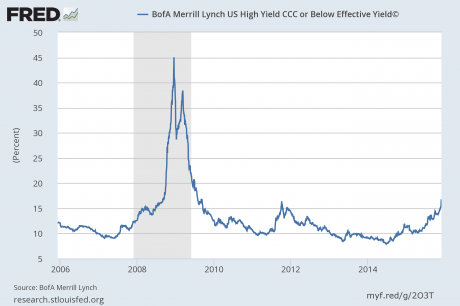
At this point, yields on the riskiest junk bonds have risen to levels that we have not seen since the last financial crisis.  As I have discussed repeatedly, yields on junk bonds spiked dramatically just before the stock market crash of 2008, and now it is happening again…

Yield On CCC Bonds - Chart from Federal Reserve

This is precisely the kind of behavior that we would expect to see if a major U.S. stock market crash was imminent.  Personally, I watch the junk bond market very, very closely because it is such a key leading indicator.  And according to Jeffrey Snider, it appears that “something” is starting to cause junk bonds to sell off at an alarming pace…

There isn’t much as far as confirmation, but it increasingly appears as if “something” just hit the triple hooks (CCC) in the junk bond bubble. At least as far as one view of it, Bank of America ML’s CCC implied yield, there was a huge selloff that brought the yield to a new cycle high (low in price) above even the 2011 crisis peak.

But just like in 2008, a lot of people will not heed the warnings because they don’t have the patience to watch long-term trends play out.

We live in a society where we expect constant instant gratification.  We have instant coffee, video on demand and 48 hour news cycles.  If something does not happen immediately, most of us quickly lose patience.

On my other website, I include a lot more stories about things that are trending in the news.  For example, earlier today I wrote about the horrible shootings in San Bernardino, California and I explained why I believe that Islamic terror is now more of a threat to the American people than ever before.

But on this website I like to take a broader view of things.  For months, I have been warning that conditions were perfect for another major global financial crisis, and since that time events have been unfolding in textbook fashion.

And as you can see from the numbers above, we have already entered a new global financial crisis.  If you tried to tell someone in China, Brazil or Saudi Arabia that a financial crisis was not happening, they would just laugh at you.  We need to start learning that the world doesn’t revolve around the United States.

Of course the U.S. is heading for tremendous difficulties as well.  This is something that I covered yesterday.  All of the fundamental economic numbers are absolutely screaming “recession”, and yet most of the “experts” are still forecasting good things for the coming year.

Those that do not learn from history are doomed to repeat it.  None of the problems that caused the crisis the last time around have been fixed, and most of our “leaders” seem blind to what is happening at this moment even though the exact same patterns that played out in 2008 are playing out once again right in front of our eyes.

If you have been waiting for the next global financial crisis, you can stop, because it is already here.

As we move toward the end of 2015, let us hope for the best, but let us also get prepared for the worst.

Alarm Bells Go Off As 11 Critical Indicators Scream The Global Economic Crisis Is Getting Deeper

Alarm Clock - Public DomainEconomic activity is slowing down all over the planet, and a whole host of signs are indicating that we are essentially exactly where we were just prior to the great stock market crash of 2008.  Yesterday, I explained that the economies of Japan, Brazil, Canada and Russia are all in recession.  Today, I am mainly going to focus on the United States.  We are seeing so many things happen right now that we have not seen since 2008 and 2009.  In so many ways, it is almost as if we are watching an eerie replay of what happened the last time around, and yet most of the “experts” still appear to be oblivious to what is going on.  If you were to make up a checklist of all of the things that you would expect to see just before a major stock market crash, virtually all of them are happening right now.  The following are 11 critical indicators that are absolutely screaming that the global economic crisis is getting deeper…

#1 On Tuesday, the price of oil closed below 40 dollars a barrel.  Back in 2008, the price of oil crashed below 40 dollars a barrel just before the stock market collapsed, and now it has happened again.

#2 The price of copper has plunged all the way down to $2.04.  The last time it was this low was just before the stock market crash of 2008.

#3 The Business Roundtable’s forecast for business investment in 2016 has dropped to the lowest level that we have seen since the last recession.

#4 Corporate debt defaults have risen to the highest level that we have seen since the last recession.  This is a huge problem because corporate debt in the U.S. has approximately doubled since just before the last financial crisis.

#5 The Bloomberg U.S. economic surprise index is more negative right now than it was at any point during the last recession.

#6 Credit card data that was just released shows that holiday sales have gone negative for the first time since the last recession.

#7 As I mentioned yesterday, U.S. manufacturing is contracting at the fastest pace that we have seen since the last recession.

#8 The velocity of money in the United States has dropped to the lowest level ever recorded.  Not even during the depths of the last recession was it ever this low.

#9 In 2008, commodity prices crashed just before the stock market did, and late last month the Bloomberg Commodity Index hit a 16 year low.

#10 In the past, stocks have tended to crash about 12-18 months after a peak in corporate profit margins.  At this point, we are 15 months after the most recent peak.

#11 If you look back at 2008, you will see that junk bonds crashed horribly.  Why this is important is because junk bonds started crashing before stocks did, and right now they have dropped to the lowest point that they have been since the last financial crisis.

If just one or two of these indicators were flashing red, that would be bad enough.

The fact that all of them seem to be saying the exact same thing tells us that big trouble is ahead.

And I am not the only one saying this.  Just today, a Reuters article discussed the fact that Citigroup analysts are projecting that there is a 65 percent chance that the U.S. economy will plunge into recession in 2016…

The outlook for the global economy next year is darkening, with a U.S. recession and China becoming the first major emerging market to slash interest rates to zero both potential scenarios, according to Citi.

As the U.S. economy enters its seventh year of expansion following the 2008-09 crisis, the probability of recession will reach 65 percent, Citi’s rates strategists wrote in their 2016 outlook published late on Tuesday. A rapid flattening of the bond yield curve towards inversion would be an key warning sign.

Personally, I am convinced that we are already in a recession.  There is a lag in the official numbers, so often we don’t know that we are officially in one until it is well underway.  For example, we now know that a recession started in early 2008, but in the summer of 2008 Ben Bernanke and our top politicians were still insisting that there was not going to be a recession.  They were denying what was actually happening right in front of their eyes, and the same thing is happening now.

And of course if the government was actually using honest numbers, we would all be talking about the recession that never seems to end.  According to John Williams of shadowstats.com, honest numbers would show that the U.S. economy has continually been in recession since 2005.

But just like in 2008, the “experts” at the Federal Reserve are assuring all of us that everything is going to be just fine.  In fact, Janet Yellen is convinced that things are so rosy that she seems quite confident that the Fed will raise interest rates in December

Federal Reserve Chair Janet Yellen signaled Wednesday that the Fed is all but certain to raise interest rates this month for the first time in nearly a decade, saying that gains in the economy and labor market have met the central bank’s goals.

Her comments at the Economic Club of Washington amount to the strongest indication the Fed has provided so far that it will take action at a December 15-16 meeting.

This is the exact same kind of mistake that the Federal Reserve made back in the late 1930s.  They thought that the U.S. economy was finally recovering, and so interest rates were raised.  That turned out to be a tragic mistake.

But this time around, any mistake that the Fed makes will have global consequences.  The rising U.S. dollar is already crippling emerging markets all around the globe, and an interest rate hike will just push the U.S. dollar even higher.  For much more on this, please see my previous article entitled “The U.S. Dollar Has Already Caused A Global Recession And Now The Fed Is Going To Make It Worse“.

Many people are waiting for “the big crash”, but the truth is that almost everything has crashed already.

Oil has crashed.

Commodities have crashed.

Gold and silver have crashed.

Junk bonds have crashed.

Chinese stocks have crashed.

Dozens of other stock markets around the world have already crashed.

But the “big event” that many are waiting for is the crash of U.S. stocks.  And just like in 2008, it is inevitable that a U.S. stock crash will follow all of the other crashes that I just mentioned.

Sometimes I get criticized for issuing these kinds of alarms.  But just think of how many people could have been helped if they would have known that the financial crisis of 2008 was going to happen ahead of time.

The exact same patterns that we experienced back then are playing out once again right in front of our eyes, and the more people that we can warn in advance the better.