Commodities Collapsed Just Before The Last Stock Market Crash – So Guess What Is Happening Right Now?

Grid Stock Exchange Economy Finance - Public DomainIf we were going to see a stock market crash in the United States in the fall of 2015 (to use a hypothetical example), we would expect to see commodity prices begin to crash a few months ahead of time.  This is precisely what happened just before the great financial crisis of 2008, and we are watching the exact same thing happen again right now.  On Wednesday, commodities got absolutely pummeled, and at this point the Bloomberg Commodity Index is down a whopping 26 percent over the past twelve months.  When global economic activity slows down, demand for raw materials sinks and prices drop.  So important global commodities such as copper, iron ore, aluminum, zinc, nickel, lead, tin and lumber are all considered to be key “leading indicators” that can tell us a lot about where things are heading next.  And what they are telling us right now is that we are rapidly approaching a global economic meltdown.

If the global economy was actually healthy and expanding, the demand for commodities would be increasing and that would tend to drive prices up.  But instead, prices continue to go down.

The Bloomberg Commodity Index just hit a brand new 13-year low.  That means that global commodity prices are already lower than they were during the worst moments of the last financial crisis

The commodities rout that’s pushed prices to a 13-year low pulled some of the biggest mining and energy companies below levels seen during the financial crisis.

The FTSE 350 Mining Index plunged as much as 4.9 percent to the lowest since 2009 on Wednesday, with BHP Billiton Ltd. and Anglo American Plc leading declines. Gold and copper are near the lowest in at least five years, while crude oil retreated to $50 a barrel.

This commodity bear market is like a train wreck in slow motion,” said Andy Pfaff, the chief investment officer for commodities at MitonOptimal in Cape Town. “It has a lot of momentum and doesn’t come to a sudden stop.”

Commodity prices have not been this low since April 2002.  According to Bloomberg, some of the commodities being hit the hardest include soybean oil, copper, zinc and gasoline.  And this commodity crash is already having a dramatic impact on some of the biggest commodity-producing nations on the globe.  Just consider what Gerald Celente recently told Eric King

We now see that the Australian dollar is at a six-year low against the U.S. dollar. What are Australia’s biggest exports? How about iron-ore and other metals.

If we look at Canada, their currency is also now at a six-year low vs the U.S. dollar. Well, Canada is a big oil exporter, particularly some tar sands oil, which is expensive to produce.

We also now have the Brazilian real at a 10-year low vs the U.S. dollar. Why? Because it’s a natural resource rich country and they don’t have a strong market to sell their natural resources to.

Meanwhile, the Indian rupee is at a 17-year low vs the U.S. dollar. This is because manufacturing is slowing down and there is less development. If the Americans aren’t buying, the Indians, the Chinese, the Vietnamese — they’re not making things.

All of this is so, so similar to what we experienced in the run up to the financial crisis of 2008.  Just a couple of days ago, I talked about how the U.S. dollar got really strong just prior to the last stock market crash.  The same patterns keep playing out over and over, and yet most in the mainstream media refuse to see what is happening.

Something else that happened just a few months before the last stock market crash was a collapse of the junk bond market.

Guess what?

That is starting to happen again too.  Just check out this chart.

I know that I must sound like a broken record.  But I think that it is extremely important to document these things.  When the next financial collapse takes place, virtually everyone in the mainstream media will be talking about what a “surprise” it is.

But for those that have been paying attention, it won’t be much of a “surprise” at all.

When the stock market does crash, how far might it fall?

During a recent appearance on CNBC, Marc Faber suggested that it could decline by up to 40 percent

The U.S. stock market could “easily” drop 20 percent to 40 percent, closely followed contrarian Marc Faber said Wednesday—citing a host of factors including the growing list of companies trading below their 200-day moving average.

In recent days, “there were [also] more declining than advancing stocks, and the list of 12-month new lows was very high on Friday,” the publisher of The Gloom, Boom & Doom Report told CNBC’s “Squawk Box.”

“It shows you a lot of stocks are already declining.”

Others, including myself, believe that what we are going to experience is going to be even worse than that.

We live in such a fast-paced world, and most of us don’t have the patience to wait for long-term trends to play out.

If the stock market is not crashing today, to most people that means that everything must be fine.

But once it has crashed, everyone is going to be complaining that they weren’t warned in advance about what was coming and everyone will be complaining that nobody ever fixed the things that caused the exact same problems the last time around.

Personally, I am trying very hard to make sure that nobody can accuse me of not sounding the alarm about the storm that is on the horizon.

The world has never been in more debt, our “too big to fail” banks have never been more reckless, and global financial markets have never been more primed for a collapse.

Amazingly, there are still a lot of “experts” out there that insist that everything is going to be okay somehow.

Of course many of those exact same “experts” were telling us the same thing just before the stock market crashed in 2008 too.

A great financial shaking has already begun around the world, and it will hit U.S. financial markets very soon.

I hope that you are getting ready while you still can.

4 Things That Are Happening Today That Indicate That A Deflationary Financial Collapse Is Imminent

four asphalt - public domain
When financial markets crash, they do not do so in a vacuum.  There are always patterns, signs and indicators that tell us that something is about to happen.  In this article, I am going to share with you four patterns that are happening right now that also happened just prior to the great financial crisis of 2008.  These four signs are very strong evidence that a deflationary financial collapse is right around the corner.  Instead of the hyperinflationary crisis that so many have warned about, what we are about to experience is a collapse in asset prices, a massive credit crunch and a brief period of absolutely crippling deflation.  The response by national governments and global central banks to this horrific financial crisis will cause tremendous inflation down the road, but that comes later.  What comes first is a crisis that will initially look a lot like 2008, but will ultimately prove to be much worse.  The following are 4 things that are happening right now that indicate that a deflationary financial collapse is imminent…

#1 Commodities Are Crashing

In mid-2008, just before the U.S. stock market crashed in the fall, commodities started crashing hard.  Well, now it is happening again.  In fact, the Bloomberg Commodity Index just hit a 13 year low, which means that it is already lower than it was at any point during the last financial crisis…

#2 Oil Is Crashing

On Monday, the price of oil dipped back below $50 a barrel.  This has surprised many analysts, because a lot of them thought that the price of oil would start to rebound by now.

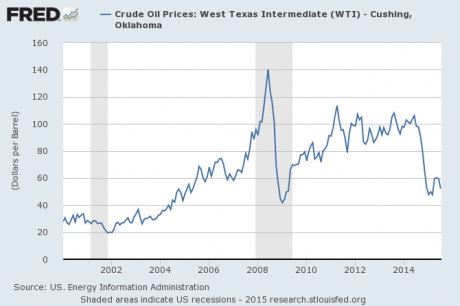
In early 2014, the price of a barrel of oil was sitting above $100 a barrel and the future of the industry looked very bright.  Since that time, the price of oil has fallen by more than 50 percent.

There is only one other time in all of history when the price of oil has fallen by more than $50 a barrel in such a short period of time.  That was in 2008, just before the great financial crisis that erupted later that year.  In the chart posted below, you can see how similar that last oil crash was to what we are experiencing right now…

Oil Price 2015

#3 Gold Is Crashing

Most people don’t remember that the price of gold took a very serious tumble in the run up to the financial crisis of 2008.  In early 2008, the price of gold almost reached $1000 an ounce, but by October it had fallen to nearly $700 an ounce.  Of course once the stock market finally crashed it ultimately propelled gold to unprecedented heights, but what we are concerned about for this article is what happens before a crisis arrives.

Just like in 2008, the price of gold has been hit hard in recent months.  And on Monday, the price of gold absolutely got slammed.  The following comes from USA Today

The yellow metal has tumbled to a five-year low amid a combination of diminishing investor fears related to foreign headwinds in Greece and China, and stronger growth in the U.S. which is leading to a stronger dollar and coming interest rate hikes from the Federal Reserve. Investors have been dumping shares of gold-related investments as other bearish signs, such as less demand from China and the breaking of key price support levels, add up.

Earlier today, an ounce of gold fell below $1,100 an ounce to $1,080, its lowest level since February 2010. Gold peaked around $1,900 an ounce back in 2011.

For years, I have been telling people that we were going to see wild swings in the prices of gold and silver.

And to be honest, the party is just getting started.  Personally, I particularly love silver for the long-term.  But you have got to be able to handle the roller coaster ride if you are going to get into precious metals.  It is not for the faint of heart.

#4 The U.S. Dollar Index Is Surging

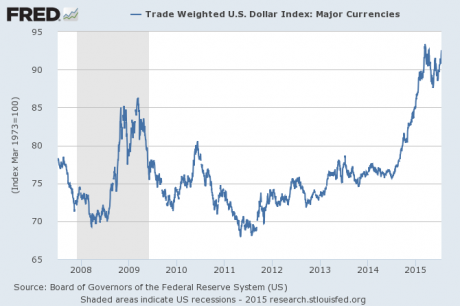
Before the U.S. stock market crashed in the fall of 2008, the U.S. dollar went on a very impressive run.  This is something that you can see in the chart posted below.  Now, the U.S. dollar is experiencing a similar rise.  For a while there it looked like the rally might fizzle out, but in recent days the dollar has started to skyrocket once again.  That may sound like good news to most Americans, but the truth is that a strong dollar is highly deflationary for the global financial system as a whole for a variety of reasons.  So just like in 2008, this is not the kind of chart that we should want to see…

Dollar Index 2015

If a 2008-style financial crisis was imminent, these are the kinds of things that we would expect to see happen.  And of course these are not the only signs that are pointing to big problems in our immediate future.  For example, the last time there was a major stock market crash in China, it came just before the great U.S. stock market crash in the fall of 2008.  This is something that I covered in my previous article entitled “Guess What Happened The Last Time The Chinese Stock Market Crashed Like This?

As an attorney, I was trained to follow the evidence and to only come to conclusions that were warranted by the facts.  And right now, it seems abundantly clear that things are lining up in textbook fashion for another major financial crisis.

But even though what is happening right in front of our eyes is so similar to what happened back in 2008, most people do not see it.

And the reason why they do not see it is because they do not want to see it.

Just like with most things in life, most people end up believing exactly what they want to believe.

Yes, there is a segment of the population that are actually honest truth seekers.  If you have felt drawn to this website, you are probably one of them.  But overall, most people in our society are far more concerned with making themselves happy than they are about pursuing the truth.

So even though the signs are obvious, most people will never see what is coming in advance.

I hope that does not happen to you.

What In The World Just Happened To The New York Stock Exchange?

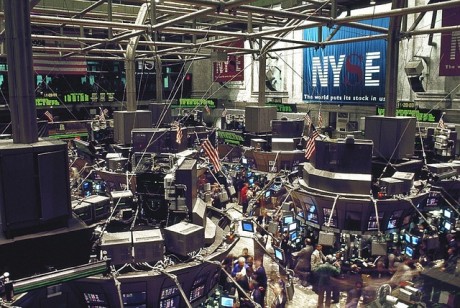
New York Stock Exchange - Public DomainDo you believe that the New York Stock Exchange shut down because of a “technical glitch” on Wednesday?  At 11:32 AM on Wednesday morning, trading on the New York Stock Exchange was halted due to “internal technical issues”, and it did not resume until 3:10 PM.  Officials insist that there is no evidence that a cyberattack caused the technical problems even though hactivists had hinted that something may happen the night before.  Adding to the suspicion is the fact that United Airlines and the Wall Street Journal also experienced very serious “technical glitches” on Wednesday.  Others found it very curious that trading on the NYSE was halted just after Chinese stocks had absolutely plummeted the night before.  In fact, Hong Kong’s Hang Seng Index experienced the largest one day decline that we have witnessed since November 2008.  So is there more going on here than meets the eye?

Overall, the Dow was down 261 points on Wednesday, and the Dow and the S&P 500 both closed below their 200 day moving averages.  Iron ore had its biggest daily price drop ever, and the price of oil continued to decline.  But it was the stunning shut down of the New York Stock Exchange that made headlines all over the world

The New York Stock Exchange, United Airlines and the Wall Street Journal have all fallen victim to a series of massive technical glitches within hours of each other.

NYSE halted all trading for ‘technical reasons’ at 11:32am and only reopened at 3:10pm – but says the problem is an internal one and not the result of a cyberattack.

It comes as tens of thousands of United Airlines passengers were stranded at U.S. airports on Wednesday morning after all of the carrier’s flights were grounded nationwide due to a computer system glitch.

The Wall Street Journal was also left unable to publish after its systems came under attack and has been forced to switch to an alternative site design.

In response to the shut down, the following photo began circulating on Twitter…

But was it really just a “technical glitch”?

Of course they probably would never admit it publicly if it was a cyberattack.  We live at a time when the authorities are much more concerned with keeping everyone calm than they are about telling us the truth.  So in the end all we can really do is speculate about what really happened.

But what we do know is that the stock market crash in China got even worse the night before this shutdown.  The Shanghai Composite Index and the Hang Seng Index both declined by almost six percent overnight.  Overall, the Shanghai Composite Index is now down by more than 30 percent in less than a month, and the Chinese version of the NASDAQ is down by more than 40 percent

In just three weeks, stocks listed on mainland China’s most prominent exchange have fallen by more than 30% from their seven-year highs. The even more speculative ChiNext Index has lost 42% of its value over the 21 days.

Government regulators have now banned, for six months, Chinese executives from selling stock in their own companies. This is only one of a number moves made by panicked officials.

At this point, trading for approximately 45 percent of all stocks on the Shanghai and Shenzhen exchanges has been suspended.  So as a result the selling has bled over to the Hang Seng Index in Hong Kong, and this has caused tremendous chaos

Hong Kong’s benchmark stock gauge plunged the most since the global financial crisis as an equity rout in mainland China rippled across Asia.

The Hang Seng Index fell 5.8 percent to 23,516.56 at the close today, the biggest drop since November 2008, after slumping as much as 8.6 percent.

Even though the Chinese have been trying all sorts of crazy things to stop the crash, nothing has worked.  Instead, the selling restrictions have only seemed to fuel the panic even more…

Investors are disappointed and afraid that the Chinese policy makers lost control of the market,” said Mari Oshidari, a Hong Kong-based strategist at Okasan Securities Group Inc. “With no end in sight to the plunge, sentiment has turned cold. With liquidity drying up in the mainland, the Hong Kong market is being sold instead –- the only thing it can do is just quietly take the storm.”

Meanwhile, things over in Europe have become more ominous as well.  As I wrote about yesterday, EU officials have declared this week to be “the final deadline” for making a deal with Greece.  On Wednesday, Greece applied for a new three year emergency loan, and European officials have said that they will consider it

A race to save Greece from bankruptcy and keep it in the euro gathered pace on Wednesday when Athens formally applied for a three-year loan and European authorities launched an accelerated review of the request.

Greek Prime Minister Alexis Tsipras called in a speech to the European Parliament for a fair deal, acknowledging Greece’s historic responsibility for its plight, after EU leaders gave him five days to come up with convincing reforms.

The government submitted a request to the European Stability Mechanism bailout fund to lend an unspecified amount “to meet Greece’s debt obligations and to ensure stability of the financial system”. It promised to begin implementing tax and pension measures sought by creditors as early as Monday.

But there is still a tremendous amount of skepticism about whether a deal can be reached.  The Greeks want debt relief, but the Germans have completely ruled out any sort of a debt haircut.  Most of the rest of the EU nations are siding with the Germans, and unless the Greek government caves in at the last moment it appears that a “Grexit” is quite likely.

For most people, the events of 2008 have long since faded from their memories.  After years of soaring stock prices, many in the financial world have become extremely comfortable.  But as we are seeing in China, what goes up must eventually come down.

And the shut down of the New York Stock Exchange today should be a huge wake up call for all of us.  We have become extraordinarily dependent on computers and technology, and this makes us exceedingly vulnerable.  Someday, we might just experience a cyberattack that causes a tremendous amount of permanent damage that cannot be undone.

What will we do then?

Our world is becoming increasingly unstable, and events are beginning to accelerate as we enter the second half of 2015.

So what comes next?  Please feel free to share what you think by posting a comment below…

European Stocks, Chinese Stocks And Commodities Are All Crashing – Are U.S. Stocks Next?

European Stock Market Crash - Public DomainA global stock market crash has begun.  European stocks are crashing, Chinese stocks are crashing, and commodities are crashing.  And guess what?  All of those things happened before U.S. stocks crashed in the fall of 2008 too.  In so many ways, it seems like we are watching a replay of the financial crisis of 2008, but this time around the world is in far worse shape financially.  Global debt levels are at an all-time high, the 75 trillion dollar global shadow banking system could implode at any time, and there are hundreds of trillions of dollars in derivatives that threaten to wipe out major banks all over the planet.  The last major worldwide financial crash was almost seven years ago, and very little has been done since that time to prepare for the next one.  If global markets do not calm down, we could see carnage in the months ahead that is absolutely unprecedented.

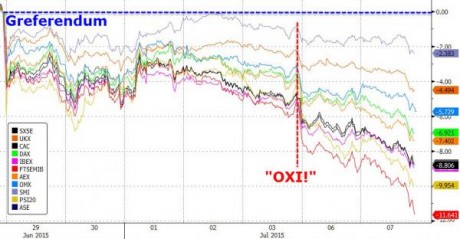
For months, European authorities have been promising us that a “Grexit” is already “priced in” to the markets and that any “contagion” from the Greek crisis will be “contained”.  Of course everyone knew that was just a smokescreen.  Just in the past couple of days since the Greek “no” vote, European stocks have already been crashing.  The following comes from Zero Hedge

Does this look contained to you?

Portugal, Spain, and Italy all collapsing…

European Stocks Crashing - Zero Hedge

As I mentioned at the top of this article, European stocks started crashing well before U.S. stocks started crashing during the last financial crisis.  If you doubt this, just look at this chart, and this chart and this chart.

Will the same thing happen again this time?

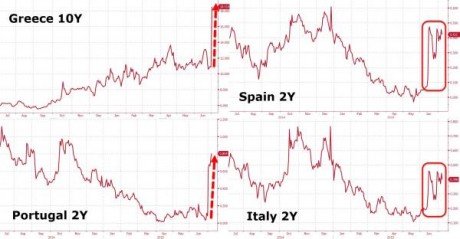
And just like I have warned repeatedly, European bond yields have started to soar.  When bond yields go up, bond prices go down, so many bond investors are losing a tremendous amount of money right now.  Here is more from Zero Hedge

Who’s next?

European bond risk is anything but “contained” as GGB 10Y Yields top 18%…

European Bond Yields - Zero Hedge

If there is not a last minute deal between Greece and her creditors, what we have witnessed so far in the bond markets will just be the tip of the iceberg.  In the months ahead, we could witness a bond crash unlike anything that we have ever seen in all of history.  Just consider what Egon von Greyerz recently told Eric King…

There is no liquidity in this market and this is where we will soon see a problem. We will see the bond market totally seizing up in the next few months. Eric, people simply don’t understand that this is a much bigger problem than Greece.

So we are talking about a worldwide problem, not just a Greek problem. The majority of the $100 trillion bond market is worthless, and of course a ticking time-bomb of over $1 quadrillion worth of derivatives is linked to that. This means that, sadly, we are heading into a major contagion that will lead to financial catastrophe for the world. This will also lead to an implosion of all bubble assets across the globe.

Hmm – there is that word “derivatives” again.

It is funny how that keeps popping up.

As things unravel over in Europe, a lot of desperate Europeans are feverishly purchasing physical gold.  The following comes from Bloomberg

European investors are increasing purchases of gold as Greece’s turmoil boosts the appeal for an alternative to the euro.

Demand from Greek customers for Sovereign gold coins was double the five-month average in June, the U.K. Royal Mint said in an e-mailed statement. CoinInvest.com, an online retailer, said sales on Saturday and Sunday were the highest since Cyprus limited cash withdrawals in 2013, driven by a jump in German, French and Greek buyers.

Investors are searching for a safe haven after Greece imposed capital controls, closed banks and stopped selling gold coins to the public until at least July 6.

Meanwhile, Chinese stocks have continued to fall.  Overall, Chinese stocks have fallen 27 percent since the peak, and a whopping 3.2 trillion dollars of “paper wealth” has been wiped out in China in just the last three weeks.

At this point things are so bad that about one-fourth of all stocks in China have already suspended trading according to CNN

The turmoil in China’s stock market is so bad that some companies are calling it quits.

Over 700 Chinese companies have halted trading to “self preserve,” according to the state media. That means about a quarter of the companies listed on China’s two big exchanges — the Shanghai and Shenzhen — are no longer trading.

Desperate measures are being employed to try to stop the stock market crash in China.  For example, over the weekend an alliance of securities brokerages pledged to invest “at least 120 billion yuan” in order to stabilize stock prices

China’s top 21 securities brokerages said on Saturday they would collectively invest at least 120 billion yuan ($19.3 billion) to help stabilize the country’s stock markets after a slump of nearly 30 percent since mid-June. In addition, 57 Chinese mutual funds are reportedly investing 2.2 billion yuan in stock funds.

The Chinese central bank has gotten involved as well.  In fact, the People’s Bank of China has taken the dramatic step of actually directly loaning money to brokerages

In an extraordinary move, the People’s Bank of China has begun lending money to investors to buy shares in the flailing market. The Wall Street Journal reports this “liquidity assistance” will be provided to the regulator-owned China Securities Finance Corp, which will lend the money to brokerages, which will in turn lend to investors.

The dramatic intervention marks the first time funds from the central bank have been directed anywhere other than the banks, signalling serious concern from authorities about the crisis.

In addition, the Chinese government has taken the following steps to intervene…

-All short selling of stocks has been banned.

-China’s national social security fund has been banned from selling stocks, but they can continue to buy stocks.

-Local media has been banned from using the terms “equity disaster” and “rescue the market” in their news reports.

But despite everything that you just read, Chinese stocks have still been falling.

Meanwhile, global commodity prices are crashing.  Just check out this chart.  This is also something that happened before U.S. stocks crashed back in 2008.

Thankfully, U.S. stocks have not started crashing yet.  But it should be noted that the “smart money” in the United States has been selling stocks like crazy since the “no” vote in the Greek referendum.  And if the patterns that we witnessed seven years ago hold up, it is just a matter of time before we experience a stock market crash too.

Incredibly, there are a lot of people out there that very strongly believe that everything is going to be just fine.  They have tremendous faith in the central bankers and in our political leaders, and they are assuring all the rest of us that there is no possible way that the global financial system could be brought down again.

I truly wish that they were right.  If everything was going to be just fine, instead of writing about the coming economic collapse I could write about sports or do a blog dedicated to LOLcats.  But of course the truth is that the “hopetimists” are dead wrong.

A great shaking is coming to our world, and life as we know it is about to change in a major way.

Greece Votes NO – Let The Chaos Begin…

No - Public DomainThe result of the referendum in Greece is a great victory for freedom, but it is also threatens to unleash unprecedented economic chaos all across Europe.  With almost all of the votes counted, it is being reported that approximately 61 percent of Greeks have voted “no” and only about 39 percent of Greeks have voted “yes”.  This is a much larger margin of victory for the “no” side than almost everyone was anticipating, and it represents a stunning rejection of European austerity.  Massive celebrations have erupted on the streets of Athens and other major Greek cities, but the euphoria may not last long.  Greek Prime Minister Alexis Tsipras is promising that Greece will be able to stay in the euro, but that gives EU bureaucrats and the IMF a tremendous amount of power, because at this point the Greek government is flat broke.  Without more money from the EU and the IMF, the Greek government will not be able to pay its bills and virtually all Greek banks will inevitably collapse.  Meanwhile, the rest of Europe is about to experience a tremendous amount of pain as financial markets respond to the results of this referendum.  The euro is already plummeting, and most analysts expect European bond yields to soar and European stocks to drop substantially when trading opens on Monday morning.

Personally, I love the fact that the Greek people decided not to buckle under the pressure being imposed on them by the EU and the IMF.  But amidst all of the celebration, the cold, hard reality of the matter is that your options are extremely limited when you are out of money.

How is the Greek government going to pay its bills without any money?

How are the insolvent Greek banks going to operate without any money?

How is the Greek economy going to function without any money?

Now that the Greek people have overwhelmingly rejected the demands of the creditors, it will be very interesting to see what the EU and the IMF do.  Prior to the referendum, European leaders were insisting that a “no” vote would put an end to negotiations and would force Greece to leave the euro.

Now that the results are in, are they going to change their tune?  Because the ball is definitely in their court

“This does two things: it legitimises the stance of the Greek government and it leaves the ball in Europe’s court,” ANZ Bank analysts said in a note.

Europe either folds or Greece goes bankrupt; over to you Merkel.”

So would they actually let Greece go bankrupt?

It is going to be fascinating to watch what happens over the next few days.  Right now, Greek banks are on life support.  If the European Central Bank decides to pull the plug, they would essentially destroy the entire Greek banking system.  The only thing that can keep Greek banks alive and kicking is more intervention from the ECB.  The following comes from the New York Times

Now that Greek voters have said no to the economic demands of its international creditors, the fate of the country’s struggling banks is in the hands of the European Central Bank.

Greece’s banks, closed since last Monday because they are perilously low on cash, have been kept alive in recent weeks by emergency loans from the European Central Bank. On Monday, the central bank’s policy makers plan to convene to determine how much longer they are willing to prop up the Greek banks, now that the country has essentially said no to the unpopular dictates of the other eurozone countries.

Of much greater concern to the rest of the world is how financial markets are going to respond to all of this.  As I write this article, things already appear to be unraveling.  The following comes from CNBC

Germany’s Dax is indicated sharply lower from Friday’s close at around 4 percent, while the euro was down 2 percent against the yen as the news emerged. U.S. stocks are expected to open around 1 percent lower Monday, according to recent stock futures data.

What could be most important for those worried about contagion from the Greek crisis is how Portuguese, Spanish and Italian government bonds perform in Monday morning trade.

If these peripheral euro zone countries, often lumped in with Greece, suffer a sharp spike in yields, this could cause alarm about whether Greece leaving the currency might cause further contagion to other weaker euro zone economies.

This could potentially become a “trigger event” that unleashes a wave of financial panic all over Europe.  And once financial panic begins, it is very difficult to end.

If the EU and the IMF want to avoid a crisis, they could just give in to the new Greek government.  But that would be politically risky for certain high profile European leaders.  For instance, Angela Merkel would face a huge backlash back home if she conceded to the new Greek government now.  And other German leaders are already calling the referendum result a “disaster”

German politicians branded the result a ‘disaster’, with the country’s economy minister Sigmar Gabriel Sigmar accusing Tsipras of ‘tearing down the last bridges on which Greece and Europe could have moved towards a compromise’.

He added: ‘Tsipras and his government are leading the Greek people on a path of bitter abandonment and hopelessness.’

And the president of the European Parliament, a German, told a German radio station over the weekend that a “no” vote would almost certainly mean that the Greeks will be forced out of the euro

If after the referendum, the majority is a ‘no,’ they will have to introduce another currency because the euro will no longer be available for a means of payment,” Martin Schulz, European Parliament president, said on German radio.

That is pretty strong language, eh?

Here is yet another quote from Schulz

Without new money, salaries won’t be paid, the health system will stop functioning, the power network and public transport will break down, and they won’t be able to import vital goods because nobody can pay,” he said.

So at this point it is all up to the EU and the IMF, and in particular the focus will be on the Germans.

What will they decide to do?

Will they give in, or will they force the Greeks to leave the euro?

If the Greeks do transition from the euro to a new currency, it will be a process that takes months (if not longer).  You just can’t change ATMs, computer systems, cash registers, etc. overnight.  So a move to the drachma  would not be as simple as many are suggesting…

British firms like De La Rue, which prints 150 currencies worldwide, are believed to have been contacted with a view to providing such services.

It’s done in great secrecy to prevent currency speculation. The other big problem is the logistical challenges of switching a currency. All ATMs, computers and other machinery of commerce that bears the euro symbol will have to be adjusted. It could, and would, take months.

And if Greece does leave, it will be a massive shock for global financial markets.  Faith in the European project will be shattered, the euro will drop like a rock, bond yields all over the continent will rise to unsustainable levels and major banks all over Europe will fail.

I think that the following quote from Romano Prodi sums things up quite well

Romano Prodi, former chief of the European Commission and Italy’s ex-premier, said it is the EU’s own survival that is now at stake as the botched handling of the Greek crisis escalates into a catastrophe. “If the EU cannot resolve a small problem the size of Greece, what is the point of Europe?

Meanwhile, we should all keep in mind that a financial crisis has already erupted over in Asia as well.  Chinese stocks have lost 30 percent of their value in just the last three weeks.  In fact, the amount of “paper wealth” wiped out in China over the past three weeks is approximately equivalent to “10 times Greece’s gross domestic product”

A dizzying three-week plunge in Chinese equities has wiped out $2.36 trillion in market value — equivalent to about 10 times Greece’s gross domestic product last year.

The great financial collapse of 2015 is well underway, and it should be a very interesting week for global markets.

But no matter what happens this week, we all need to keep in mind that this is just the tip of the iceberg.

A “perfect storm” is on the way, and we all need to get prepared for it while we still can.

Guess What Happened The Last Time The Chinese Stock Market Crashed Like This?

Question Button - Public DomainThe second largest stock market in the entire world is collapsing right in front of our eyes.  Since hitting a peak in June, the most important Chinese stock market index has plummeted by well over 20 percent, and more than 3 trillion dollars of “paper wealth” has been wiped out.  Of course the Shanghai Composite Index is still way above the level it was sitting at exactly one year ago, but what is so disturbing about this current crash is that it is so similar to what we witnessed just prior to the great financial crisis of 2008 in the United States.  From October 2006 to October 2007, the Shanghai Composite Index more than tripled in value.  It was the greatest stock market surge in Chinese history.  But after hitting a peak, it began to fall dramatically.  From October 2007 to October 2008, the Shanghai Composite Index absolutely crashed.  In the end, more than two-thirds of all wealth in the market was completely wiped out.  You can see all of this on a chart that you can find right here.  What makes this so important to U.S. investors is the fact that Chinese stocks started crashing well before U.S. stocks started crashing during the last financial crisis, and now it is happening again.  Is this yet another sign that a U.S. stock market crash is imminent?

Over the past several months, I have been trying to hammer home the comparisons between what we are experiencing right now and the lead up to the U.S. financial crisis in the second half of 2008.  Today, I want to share with you an excerpt from a New York Times article that was published in April 2008.  At that time, the Chinese stock market crash was already well underway, but U.S. stocks were still in great shape…

The Shanghai composite index has plunged 45 percent from its high, reached last October. The first quarter of this year, which ended Monday with a huge sell-off, was the worst ever for the market.

Suddenly, millions of small investors who were crowding into brokerage houses, spending the entire day there playing cards, trading stocks, eating noodles and cheering on the markets with other day traders and retirees, are feeling depressed and angry.

This sounds almost exactly like what is happening in China right now.  First we witnessed a ridiculous Chinese stock market bubble form, and now we are watching a nightmarish sell off take place.  This next excerpt is from a Reuters article that was just published…

Shanghai’s benchmark share index crashed below 4,000 points for the first time since April – a key support level that analysts said had been seen as a line in the sand that Beijing had to defend, below which more conservative investors would start ejecting from their leveraged positions, widening the rout.

Chinese markets, which had risen as much as 110 percent from November to a peak in June, have collapsed at an incredibly rapid pace in since June 12, losing more than 20 percent in jaw-dropping volatility as money surges in and out of the market.

That drop has wiped out nearly $3 trillion in market capitalization, more than the GDP of Brazil.

Did you catch that last part?

The amount of wealth that has been wiped out during this Chinese stock market crash is already greater than the entire yearly GDP of Brazil.

To me, that is absolutely incredible.

And now that the global financial system is more interconnected than ever, what goes on over in China has a greater impact on the rest of the globe than ever before.  Today, China has the largest economy on the planet on a purchasing power basis, and the Chinese stock market “is the second largest in the world in terms of market capitalization”

Just as in 1929, flighty retail investors make up the bulk of China’s stock market and, just as in 1929 in the U.S., they have heavily margined their accounts. The Financial Times puts the number of retail investors in the Chinese stock market at 80 to 90 percent of the total market. Retail investors, unlike sophisticated institutional investors, are prone to panic selling, which explains the wild intraday swings in the Shanghai Composite over the past week.

Last night, the Shanghai Composite broke a key technical support level, closing below 4,000 at 3,912.77. The index is now down 24 percent since it peaked earlier this month and has wiped out more than $2.4 trillion in value. China’s stock market is the second largest in the world in terms of market capitalization, with the U.S. ranking number one.

Making world markets even more worried about the situation in China, its regulators are showing a similar brand of leadership as Mario Draghi. After previously pledging to trim back risky margin lending, they have now done a complete flip flop and are permitting individual brokerage firms to avoid selling out accounts that miss margin calls by setting their own guidelines on the amount of collateral needed.

I know that a lot of Americans don’t really care about what happens over in Asia, but when the second largest stock market in the entire world crashes, it is a very big deal.

The great financial crisis of 2015 has now begun, and it is just going to get much, much worse.  On Thursday, Ron Paul declared that “the day of reckoning is at hand“, and I agree with him.

So what comes next?

The following is what Phoenix Capital Research is anticipating…

By the time it’s all over, I expect:

1)   Numerous emerging market countries to default and most emerging market stocks to lose 50% of their value.

2)   The Euro to break below parity before the Eurozone is broken up (eventually some new version of the Euro to be introduced and remain below parity with the US Dollar).

3)   Japan to have defaulted and very likely enter hyperinflation.

4)   US stocks to lose at least 50% of their value and possibly fall as far as 400 on the S&P 500.

5)   Numerous “bail-ins” in which deposits are frozen and used to prop up insolvent banks.

I tend to agree with most of that. I don’t agree that the euro is going to go away, but I do agree that the eurozone is going to break up and be reconstituted in a new form eventually.  And yes, we are going to see tremendous inflation all over the world down the road, but I wouldn’t say that it is imminent in Japan or anywhere else.  But overall, I think that is a pretty good list.

So what do you think is coming?  Please feel free to join the discussion by posting a comment below…

Why The Puerto Rico Debt Crisis Is Such A Huge Threat To The U.S. Financial System

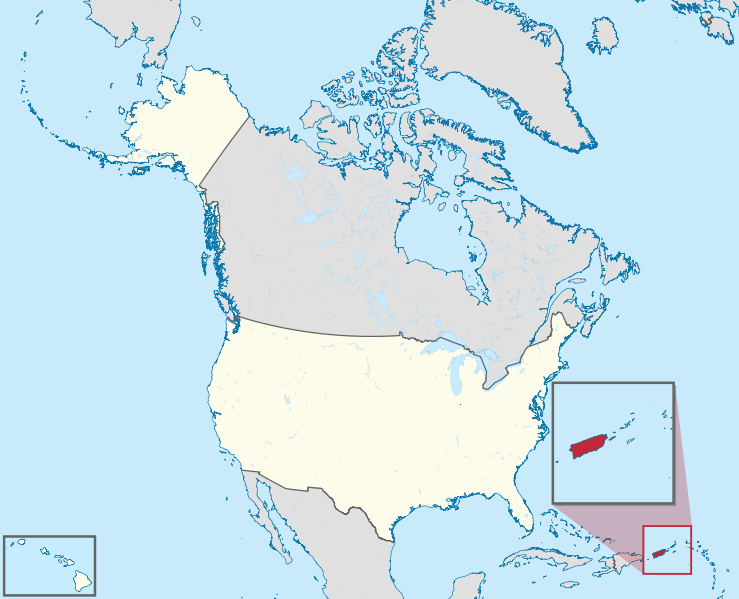
Puerto Rico Map On A Globe - Photo by TUBSThe debt crisis in Puerto Rico could potentially cost financial institutions in the United States tens of billions of dollars in losses.  This week, Puerto Rico Governor Alejandro Garcia Padilla publicly announced that Puerto Rico’s  73 billion dollar debt is “not payable,” and a special adviser that was recently appointed to help straighten out the island’s finances said that it is “insolvent” and will totally run out of cash very shortly.  At this point, Puerto Rico’s debt is approximately 15 times larger than the per capita median debt of the 50 U.S. states.  Yes, the Greek debt crisis is larger, as Greece currently owes about $350 billion to the rest of the planet.  But only about $14 billion of that total is owed to U.S. financial institutions.  But with Puerto Rico, things are very different.  Just about the entire 73 billion dollar debt is owed to U.S. financial institutions, and this could potentially cause massive problems for some extremely leveraged Wall Street firms.

There is a reason why Puerto Rico is called “America’s Greece”.  In Puerto Rico today, more than 40 percent of the population is living in poverty, the unemployment rate is over 12 percent, and the economy of the small island nation has continually been in recession since 2006.

Yet all this time Puerto Rico has continued to pile up even more debt.  Finally, it has gotten to the point where all of this debt is simply unpayable

Steven Rhodes, the retired U.S. bankruptcy judge who oversaw Detroit’s historic bankruptcy and has now been retained by Puerto Rico to help solve its problems, gave a blunt assessment on Monday.

Puerto Rico “urgently needs our help,” Rhodes said. “It can no longer pay its debts, it will soon run out of cash to operate, its residents and businesses will suffer,” he added.

This is why I hammer on the danger of U.S. government debt so often.  As we see with the examples of Greece and Puerto Rico, eventually a day of reckoning always arrives.  And when the day of reckoning arrives, power shifts into the hands of those that you owe the money too.

It would be hard to understate just how severe the debt crisis in Puerto Rico has become.  Former IMF economist Anne Krueger has gone so far as to say that it is “really dire”

The situation is dire, and I mean really dire,” said former IMF economist Anne Krueger, co-author of the report commissioned by the U.S. territory, which recommended debt restructuring, tax hikes and spending cuts. “The needed measures may face political resistance but failure to address the issues would affect even more the people of Puerto Rico.”

So who is going to get left holding the bag?

As I mentioned at the top of this article, major U.S. financial institutions are very heavily exposed.  Income from Puerto Rican bonds is exempt from state and federal taxation, and so that made them very attractive to many U.S. investors.  According to USA Today, there are 180 mutual funds that have “at least 5% of their portfolios in Puerto Rican bonds”…

The inability of the U.S. territory to repay its debt, combined with the financial crisis in Greece, would have far-reaching implications for financial markets and unsuspecting American investors. Morningstar, an investment research firm based in Chicago, estimated in 2013 that 180 mutual funds in the United States and elsewhere have at least 5% of their portfolios in Puerto Rican bonds.

It is important to keep in mind that many of these financial institutions are very highly leveraged.  So just a “couple of percentage points” could mean the different between life and death for some of these firms.

And unlike what is happening with Greece, the private financial institutions that hold Puerto Rican bonds are not likely to be very eager to “negotiate”.  In fact, the largest holder of Puerto Rican debt has already stated that it is very much against any kind of restructuring

U.S. fund manager OppenheimerFunds, the largest holder of Puerto Rico debt among U.S. municipal bond funds, warned the island it stands ready to defend the terms of bonds it holds, a day after the governor said he wanted to restructure debt and postpone bond payments.

What Oppenheimer is essentially saying is that it does not plan to give Puerto Rico any slack at all.  Here is more from the article that I just quoted above

OppenheimerFunds, with about $4.5 billion exposure to Puerto Rico according to Morningstar, said it believed the island could repay bondholders while providing essential services to citizens and growing the economy. It said it stood ready “to defend the previously agreed to terms in each and every bond indenture.”

“We are disheartened that Governor Padilla, in a public forum, has called for negotiations with other creditors, representing and including the millions of individual Americans that hold Puerto Rico municipal bonds,” a spokesman for Oppenheimer said in a statement.

But Puerto Rico simply does not have the money to meet all of their debt obligations.

So somebody is not going to get paid at some point.

When that happens, those that insure Puerto Rican bonds are also going to take tremendous losses.  The following comes from a recent piece by Stephen Flood

Now, bondholders are at risk as are the funds which hold Puerto Rican bonds and, more importantly, those who insure them in the derivatives market.

Dave Kranzler, from Investment Research Dynamics has warned that there are signs that the Puerto Rico situation may not remain a local crisis for much longer.

He points out that share prices of MBIA, the bond insurers, have been plummeting. MBIA are valued at $3.9 billion whereas their exposure to Puerto Rican debt is around $4.5 billion. Kranzler reckons their exposure could even be multiples of that figure. A default could wipe them out.

He also points out that the firm’s largest shareholders are Warburg Pincus, the firm to which Timothy Geithner went after his stint as Treasury Secretary, when he helped paper over the chasms opening up in the financial system.

Did you notice the word “derivatives” in that quote?

Hmmm – who has been writing endless articles warning about the danger of derivatives for years?

Who has been warning that “this gigantic time bomb is going to go off and absolutely cripple the entire global financial system“?

When Puerto Rico defaults, bond insurers are going to be expected to step up and make huge debt service payments to investors.

But this just might bankrupt some of these big bond insurers.  In fact, we have already started to see the stock prices of some of these bond insurers begin to plummet.  The following comes from the Wall Street Journal

Bond insurers MBIA Inc. and Ambac Financial Group Inc. are down again Tuesday as concerns over Puerto Rico’s ability to repay its debt multiply.

Investors fear that both firms face the potential for steep losses on their promises to backstop billions of Puerto Rico’s $72 billion of debt.

MBIA’s stock closed down 23% Monday, and fell more than 10% before rebounding Tuesday. By late afternoon, the stock was down 6%. Ambac’s stock fell 12% Monday and was off 14% Tuesday.

Of course Puerto Rico is just the tip of the iceberg of the coming debt crisis in the western hemisphere, just like Greece is just the tip of the iceberg of the coming debt crisis in Europe.

So stay tuned, because the second half of 2015 has now begun, and the remainder of this calendar year promises to be extremely “interesting”.

The 75 Trillion Dollar Shadow Banking System Is In Danger Of Collapsing

Shadow Banking System - Public DomainKeep an eye on the shadow banking system – it is about to be shaken to the core.  According to the Financial Stability Board, the size of the global shadow banking system has reached an astounding 75 trillion dollars.  It has approximately tripled in size since 2002.  In the U.S. alone, the size of the shadow banking system is approximately 24 trillion dollars.  At this point, shadow banking assets in the United States are even greater than those of conventional banks.  These shadow banks are largely unregulated, but governments around the world have been extremely hesitant to crack down on them because these nonbank lenders have helped fuel economic growth.  But in the end, we will all likely pay a very great price for allowing these exceedingly reckless financial institutions to run wild.

If you are not familiar with the “shadow banking system”, the following is a pretty good definition from investing answers.com

The shadow banking system (or shadow financial system) is a network of financial institutions comprised of non-depository banks — e.g., investment banks, structured investment vehicles (SIVs), conduits, hedge funds, non-bank financial institutions and money market funds.

How it works/Example:

Shadow banking institutions generally serve as intermediaries between investors and borrowers, providing credit and capital for investors, institutional investors, and corporations, and profiting from fees and/or from the arbitrage in interest rates.

Because shadow banking institutions don’t receive traditional deposits like a depository bank, they have escaped most regulatory limits and laws imposed on the traditional banking system. Members are able to operate without being subject to regulatory oversight for unregulated activities. An example of an unregulated activity is a credit default swap (CDS).

These institutions are extremely dangerous because they are highly leveraged and they are behaving very recklessly.  They played a major role during the financial crisis of 2008, and even the New York Fed admits that shadow banking has “increased the fragility of the entire financial system”…

The current financial crisis has highlighted the growing importance of the “shadow banking system,” which grew out of the securitization of assets and the integration of banking with capital market developments. This trend has been most pronounced in the United States, but it has had a profound influence on the global financial system. In a market-based financial system, banking and capital market developments are inseparable: Funding conditions are closely tied to fluctuations in the leverage of market-based financial intermediaries. Growth in the balance sheets of these intermediaries provides a sense of the availability of credit, while contractions of their balance sheets have tended to precede the onset of financial crises. Securitization was intended as a way to transfer credit risk to those better able to absorb losses, but instead it increased the fragility of the entire financial system by allowing banks and other intermediaries to “leverage up” by buying one another’s securities.

Over the past decade, shadow banking has become a truly worldwide phenomenon, and thus it is a major threat to the entire global financial system.  In China, shadow banking has been growing by leaps and bounds, but this has the authorities deeply concerned.  In fact, according to Bloomberg one top Chinese regulator has referred to shadow banking as a “Ponzi scheme”…

Their growth had caused the man who is now China’s top securities regulator to label the off-balance-sheet products a “Ponzi scheme,” because banks have to sell more each month to pay off those that are maturing.

And what happens to all Ponzi schemes eventually?

In the end, they always collapse.

And when this 75 trillion dollar Ponzi scheme collapses, the global devastation that it will cause will be absolutely unprecedented.

Bond expert Bill Gross, who is intimately familiar with the shadow banking system, has just come out with a major warning about the lack of liquidity in the shadow banking system…

Mutual funds, hedge funds, and ETFs, are part of the “shadow banking system” where these modern “banks” are not required to maintain reserves or even emergency levels of cash. Since they in effect now are the market, a rush for liquidity on the part of the investing public, whether they be individuals in 401Ks or institutional pension funds and insurance companies, would find the “market” selling to itself with the Federal Reserve severely limited in its ability to provide assistance.

As far as shadow banking is concerned, everything is just fine as long as markets just keep going up and up and up.

But once they start falling, the whole system can start falling apart very rapidly.  Here is more from Bill Gross on what might cause a “run on the shadow banks” in the near future…

Long used to the inevitability of capital gains, investors and markets have not been tested during a stretch of time when prices go down and policymakers’ hands are tied to perform their historical function of buyer of last resort. It’s then that liquidity will be tested.

And what might precipitate such a “run on the shadow banks”?

1) A central bank mistake leading to lower bond prices and a stronger dollar.

2) Greece, and if so, the inevitable aftermath of default/restructuring leading to additional concerns for Eurozone peripherals.

3) China – “a riddle wrapped in a mystery, inside an enigma”. It is the “mystery meat” of economic sandwiches – you never know what’s in there. Credit has expanded more rapidly in recent years than any major economy in history, a sure warning sign.

4) Emerging market crisis – dollar denominated debt/overinvestment/commodity orientation – take your pick of potential culprits.

5) Geopolitical risks – too numerous to mention and too sensitive to print.

6) A butterfly’s wing – chaos theory suggests that a small change in “non-linear systems” could result in large changes elsewhere. Call this kooky, but in a levered financial system, small changes can upset the status quo. Keep that butterfly net handy.

Should that moment occur, a cold rather than a hot shower may be an investor’s reward and the view will be something less than “gorgeous”. So what to do? Hold an appropriate amount of cash so that panic selling for you is off the table.

In order to avoid a shadow banking crisis, what we need is for global financial markets to stabilize and to resume their upward trends.

If stocks and bonds start crashing, which is precisely what I have projected will happen during the last half of 2015, the shadow banking system is going to come under an extreme amount of stress.  If the coming global financial crisis is even half as bad as I believe it is going to be, there is no way that the shadow banking system is going to hold up.

So let’s hope that the financial devastation that we have seen so far this week is not a preview of things to come.  The global financial system has been transformed into a delicately balanced pyramid of glass that is not designed to handle turbulent times.  We should have never allowed the shadow banks to run wild like this, but we did, and now in just a short while we are going to get to witness a financial implosion unlike anything the world has ever seen before.