Investors Start To Panic As A Global Bond Market Crash Begins

Panic Keyboard - Public DomainIs the financial collapse that so many are expecting in the second half of 2015 already starting?  Many have believed that we would see bonds crash before the stock market crashes, and that is precisely what is happening right now.  Since mid-April, the yield on 10 year German bonds has shot up from 0.05 percent to 0.89 percent.  But much of that jump has come this week.  Just a couple of days ago, the yield on 10 year German bonds was sitting at just 0.54 percent.  And it isn’t just Germany – bond yields are going crazy all over Europe.  So far, it is being estimated that global investors have lost more than half a trillion dollars, and there is much more room for these bonds to fall.  In the end, the overall losses could be well into the trillions even before the stock market collapses.

I know that for most average Americans, talk about “bond yields” is rather boring.  But it is important to understand these things, because we could very well be looking at the beginning of the next great financial crisis.  The following is an excerpt from an article by Wolf Richter in which he details the unprecedented carnage that we have witnessed over the past few days…

On Tuesday, ahead of the ECB’s policy announcement today, German Bunds sagged, and the 10-year yield soared from 0.54% to 0.72%, drawing a squiggly diagonal line across the chart. In just one day, yield increased by one-third!

Makes you wonder to which well-connected hedge funds the ECB had once again leaked its policy statement and the all-important speech by ECB President Mario Draghi that the rest of us got see today.

And today, the German 10-year yield jump to 0.89%, the highest since October last year. From the low in mid-April of 0.05% to today’s 0.89% in just seven weeks! Bond prices, in turn, have plunged!  This is the definition of a “rout.”

Other euro sovereign bonds have gone through a similar rout, with the Spanish 10-year yield soaring from 1.05% in March to 2.07% today, and the Italian 10-year yields jumping from a low in March of 1.03% to 2.17% now.

What this means is that the central banks are losing control.

In particular, the European Central Bank has been trying very hard to force yields down, and now the exact opposite is happening.

This is very bad news for a global financial system that is absolutely teeming with red ink.  Since the last financial crisis, our planet has been on the greatest debt binge of all time.  If we are moving into a time of higher interest rates, that is going to cause enormous problems.  Unfortunately, CNBC says that is precisely where things are headed…

The wild breakout in German yields is rocking global debt markets, and giving investors an early glimpse of the uneasy future for bonds in a world of higher interest rates.

The shakeout also carries a message for corporate bond investors, who have snapped up a record level of new issuance this year, and are now seeing negative total returns in the secondary market for the first time this year.

So why is this happening?

Why are bond yields going crazy?

According to the Wall Street Journal, financial regulators in Europe are blaming the ECB’s quantitative easing program…

A recent surge in government bond market volatility can be blamed on the quantitative easing program of the European Central Bank, according to one of Europe’s top financial regulators.

EIOPA, the body responsible for regulating insurers and pension funds in the European Union, has warned that the ECB’s decision to buy billions of euros’ worth of sovereign bonds, to kick-start the region’s economy, has caused markets to become choppier.

And actually this is what should be happening.  When central banks start creating money out of thin air and pumping it into the markets, investors should rationally demand a higher return on their money.  This didn’t really happen when the Federal Reserve tried quantitative easing, so the Europeans thought that they might as well try to get away with it too.  Unfortunately for them, investors are starting to catch up with the scam.

So what happens next?

Well, European bond yields are probably going to keep heading higher over the coming weeks and months.  This will especially be true if the Greek crisis continues to escalate.  And unfortunately for Europe, that appears to be exactly what is happening

Greece will not make a June 5 repayment to the International Monetary Fund if there is no prospect of an aid-for-reforms deal with its international creditors soon, the spokesman for the ruling Syriza party’s lawmakers said on Wednesday.

The payment of 300 million euros ($335 million) is the first of four this month totaling 1.6 billion euros from a country that depends on foreign aid to stay afloat.

Greece owes a total of about 320 billion euros, of which about 65 percent to euro zone governments and the IMF, and about 8.7 percent to the European Central Bank.

On Tuesday, Greece’s creditors drafted the broad outlines of an agreement to put to the leftist government in Athens in a bid to conclude four months of negotiations and release aid before the country runs out of money.

“If there is no prospect of a deal by Friday or Monday, I don’t know by when exactly, we will not pay,” Nikos Filis told Mega TV.

In fact, there are reports that both the ECB and the Greek government are talking about Greece going to a “parallel domestic currency”

Biagio Bossone and Marco Cattaneo write that according to several recent media reports, both the Greek government and the ECB are taking into consideration the possibility (for Greece) to issue a parallel domestic currency to pay for government expenditures, including civil servant salaries, pensions, etc. This could happen in the coming weeks as Greece faces a severe shortage of euros. A new domestic currency would help make payments to public employees and pensioners while freeing up the euros needed to pay out creditors.

If Greece defaults and starts using another currency, the value of the euro is going to absolutely plummet and bond yields all over the continent are going to start heading into the stratosphere.

That is why it is so important to keep an eye on what is going on in Greece.

But no matter what happens in Greece, it appears that we are moving into a time when there will be higher interest rates around the world.  And since 505 trillion dollars in derivatives are directly tied to interest rate levels, that could lead to a financial unraveling unlike anything that we have ever seen before in the history of our planet.

As I have warned about so many times before, 2008 was just the warm up act.

The main event is still coming, and it is going to be extraordinarily painful.
Is The Stock Market Overvalued?

Stock Market Overvalued - Public DomainAre stocks overvalued?  By just about any measure that you could possibly name, stocks are at historically high prices right now.  From a technical standpoint, the stock market is more overvalued today than it was just prior to the last financial crisis.  The only two moments in U.S. history that even compare to our current state of affairs are the run up to the stock market crash of 1929 and the peak of the hysteria just before the dotcom bubble burst.  It is so obvious that stocks are in a bubble that even Janet Yellen has talked about it, but of course she will never admit that the Federal Reserve has played a key role in creating this bubble.  They say that hindsight is 20/20, but what is happening right in front of our eyes in 2015 is so obvious that everyone should be able to see it.  Just like with all other financial bubbles throughout our history, someday people will look back and talk about how stupid we all were.

Why can’t we ever learn from history?  We just keep on making the same mistakes over and over again.  And without a doubt, some of the smartest members of our society are trying to warn us about what is coming.  For example, Yale economics professor Robert Shiller has repeatedly tried to warn us that stocks are overvalued

I think that compared with history, US stocks are overvalued. One way to assess this is by looking at the CAPE (cyclically adjusted P/E) ratio that I created with John Campbell, now at Harvard, 25 years ago. The ratio is defined as the real stock price (using the S&P Composite Stock Price Index deflated by the CPI) divided by the ten-year average of real earnings per share. We have found this ratio to be a good predictor of subsequent stock market returns, especially over the long run. The CAPE ratio has recently been around 27, which is quite high by US historical standards. The only other times it has been that high or higher were in 1929, 2000, and 2007—all moments before market crashes.

But the CAPE ratio is not the only metric I watch. In my book Irrational Exuberance (3rd Ed., Princeton 2015) I discuss several metrics that help judge what’s going on in the market. These include my stock market confidence indices. One of the indicators in that series is based on a single question that I have asked individual and institutional investors over the years along the lines of, “Do you think the stock market is overvalued, undervalued, or about right?” Lately, what I call “valuation confidence” captured by this question has been on a downward trend, and for individual investors recently reached its lowest point since the stock market peak in 2000.

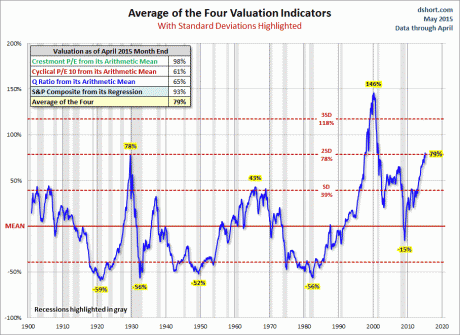
Other analysts prefer to use different valuation indicators than Shiller does.  But no matter which indicators you use, they all show that stocks are tremendously overvalued in mid-2015.  For instance, just consider the following chart.  It comes from Doug Short, and it shows the average of four of his favorite valuation indicators.  As you can see, there is only one other time in all of our history when stocks have been more overvalued than they are today according to the average of these four indicators…

Four Valuation Indicators - Doug Short

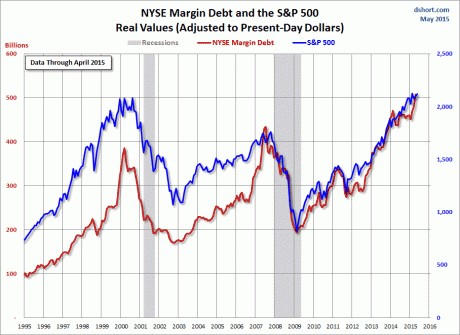
Another danger sign that many analysts are pointing to is the dramatic rise in margin debt that we have seen in recent years.  Investors are borrowing tremendous amounts of money to fund purchases of stock.  This is something that we witnessed during the dotcom bubble, it was something that we witnessed just prior to the financial collapse of 2008, and now it is happening again.  In fact, margin debt just surged to a brand new all-time record high.  Once again, the following chart comes from Doug Short

NYSE Margin Debt - Chart by Doug Short

All of this margin debt has helped drive stocks to ridiculous highs, but it can also serve to drive stock prices down very rapidly when the market turns.  This was noted by Henry Blodget of Business Insider in a recent editorial…

What is “margin debt”?

It’s the amount of money stock investors have collectively borrowed via traditional margin accounts to fund stock purchases.

In a bull market, the growth of margin debt serves as a turbocharger that helps drive stock prices higher.

As with a home mortgage, the more investors borrow, the more house or stock they can buy. So as margin debt grows, collective buying power grows. The borrowed money gets used to fund new stock purchases, which helps drives the prices of those stocks higher. The higher prices, in turn, allow traders to borrow more money to fund additional purchases. And so on.

It’s a self-reinforcing cycle.

The trouble is that it’s a self-reinforcing cycle on the way down, too.

If the overall U.S. economy was absolutely booming, these ultra-high stock prices would not be as much of a concern.  But the truth is that the financial markets have become completely divorced from economic reality.  Right now, corporate profits are actually falling and our exports are way down.  U.S. GDP shrunk during the first quarter, and there are a whole host of economic trouble signs on the horizon.  I am calling this a “recession within a recession“, and I believe that we are heading into another major economic downturn.

Unfortunately, our “leaders” are absolutely clueless about what is coming.  They assure us that everything is going to be just fine – just like they did back in 2008 before everything fell apart.  But the truth is that things are already so bad that even the big banks are sounding the alarm.  For instance, just consider the following words from Deutsche Bank

At issue is whether or not the Fed in particular but the market in general has properly understood the nature of the economic problem. The more we dig into this, the more we are afraid that they do not. So aside from a data revision tsunami, we would suggest that the Fed has the outlook not just horribly wrong, but completely misunderstood.

Ultimately, most people believe what they want to believe.

Our politicians want to believe that the economy is going to get better, and so do the bureaucrats over at the Federal Reserve.  The mainstream media wants to put a happy face on things, and they want all of us to continue to have faith in the system.

Unfortunately for them, the system is failing.  I truly do hope that this bubble can last for a few more months, but I don’t see it going on for much longer than that.

The greatest financial crisis in U.S. history is fast approaching, and it is going to be extraordinarily painful.

When it arrives, it is not just going to destroy faith in the system.  In the end, it is going to destroy the system altogether.

Stocks Began Falling Right At This Time Of The Year Just Prior To The Last Financial Crisis

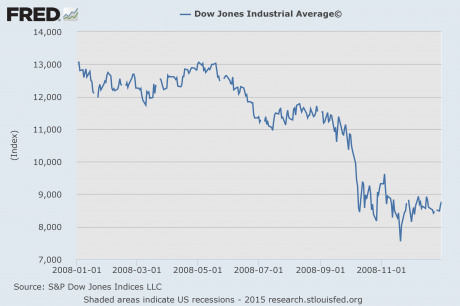
Stock Market Crash Bear - Public DomainHave you heard of the saying “sell in May and go away”?  Traditionally, the period from May through October has been a time of weakness for stocks.  In fact, on average stocks hit their lowest point of the year on October 27th.  And most people don’t remember this, but the Dow Jones Industrial Average actually began plunging right at this time of the year just prior to the financial crisis of 2008.  Most people do remember the huge stock crash that happened in the fall of that year, but the market actually started to slide in May.  Throughout the first four and a half months of 2008, stocks moved up and down in a fairly narrow range, and the Dow closed at a short-term peak of 13,028.16 on May 19th.  From there it was all downhill for the rest of the year.  So will a similar thing happen in 2015 as we approach the next great financial crisis?  Since March 20th, the Dow Jones Transportation Average has already fallen by almost 800 points.  So will the Dow Jones Industrial Average soon follow?  Well, only time will tell, but the Dow was down 190 points on Tuesday.  Signs of trouble are popping up all over the place, and the “smart money” is getting out while the getting is good.

The chart that I have posted below shows how the Dow Jones Industrial Average performed during 2008.  As you can see, stocks began plummeting long before the financial crisis in the fall.  From May 19th through early July, the Dow fell by about 2,000 points.  Should we expect to see a similar pattern this summer?…

Dow Jones Industrial Average 2008

Like I stated earlier in this article, red flags and warning signs are starting to pop up all over the place.  The following are just a few of the trouble signs that we have seen this week…

-On Tuesday, the VIX (a closely watched measure of market volatility) jumped by the highest percentage that we have seen so far in 2015.  As I have explained so often before, markets tend to go up in calm markets and they tend to go down in volatile markets.  So the fact that volatility is on the rise is not a good sign.

-The U.S. dollar index is surging again.  In fact, we just witnessed the largest seven day rise in the U.S. dollar index since the collapse of Lehman Brothers.  This is another indication that big trouble is ahead.  For much more on this, please see my previous article entitled “Guess What Happened The Last Time The U.S. Dollar Skyrocketed In Value Like This?…

-Thanks to the ongoing Greek crisis, the euro is falling again.  It just hit a fresh one-month low, and if I am right it is going to go quite a bit lower as the European financial crisis intensifies.

-In the U.S., orders for durable goods have fallen year over year for four months in a row.  When orders for durable goods start going negative for a few months, it is usually a signal that we are entering a recession.

-After rebounding a little bit, the price of crude oil is falling again.  It just hit a new one-month low, and the number of oil rigs in operation has declined for 24 weeks in a row.  Once again, this is highly reminiscent of what happened back in 2008.

-Unfortunately, it isn’t just oil that is declining.  A whole host of other commodity prices are going down right now as well.  This happened just prior to the financial crisis of 2008, and it is a sign that we are heading into a deflationary economic slowdown.

The reason why I talk so much about what happened the last time around is that we should be able to learn from it.

Looking back, there were so many warning signs leading up to the financial crisis of 2008 but most people totally missed them.  Now, so many of those exact same signs are appearing once again, but they are being ignored.

Only this time the global financial system is in far worse shape than it was back in 2008.  Debt levels all over the planet have absolutely exploded over the past seven years, and the debt to GDP ratio for the entire world is now up to a mind blowing 286 percent.  In the United States, our national debt has approximately doubled since just prior to the last recession, and at this point it is mathematically impossible to pay it off.  We are in the midst of the greatest stock market bubble of all time, the greatest bond bubble of all time (76 trillion dollars) and the greatest derivatives bubble of all time.  Anyone that cannot see the trouble that is approaching is willingly blind.

In the western world, we have extremely short attention spans and we suffer deeply from something called “normalcy bias”.  The following is how “normalcy bias” is defined by Wikipedia

The normalcy bias, or normality bias, is a mental state people enter when facing a disaster. It causes people to underestimate both the possibility of a disaster and its possible effects. This may result in situations where people fail to adequately prepare for a disaster, and on a larger scale, the failure of governments to include the populace in its disaster preparations.

The assumption that is made in the case of the normalcy bias is that since a disaster never has occurred then it never will occur. It can result in the inability of people to cope with a disaster once it occurs. People with a normalcy bias have difficulties reacting to something they have not experienced before. People also tend to interpret warnings in the most optimistic way possible, seizing on any ambiguities to infer a less serious situation.

That is such a perfect description of what is happening in the western world today.  But just because things have always been a certain way in our past does not mean that they will continue to be that way in the future.  A great economic storm is rapidly approaching, and the signs of the times are all around us.

Hopefully more people will start listening to the warnings, because we have almost run out of time to prepare.

Is The 505 Trillion Dollar Interest Rate Derivatives Bubble In Imminent Jeopardy?

Bubble In Hands - Public DomainAll over the planet, large banks are massively overexposed to derivatives contracts.  Interest rate derivatives account for the biggest chunk of these derivatives contracts.  According to the Bank for International Settlements, the notional value of all interest rate derivatives contracts outstanding around the globe is a staggering 505 trillion dollars.  Considering the fact that the U.S. national debt is only 18 trillion dollars, that is an amount of money that is almost incomprehensible.  When this derivatives bubble finally bursts, there won’t be enough money in the entire world to bail everyone out.  The key to making sure that all of these interest rate bets do not start going bad is for interest rates to remain stable.  That is why what is going on in Greece right now is so important.  The Greek government has announced that it will default on a loan payment that it owes to the IMF on June 5th.  If that default does indeed happen, Greek bond yields will soar into the stratosphere as panicked investors flee for the exits.  But it won’t just be Greece.  If Greece defaults despite years of intervention by the EU and the IMF, that will be a clear signal to the financial world that no nation in Europe is truly safe.  Bond yields will start spiking in Italy, Spain, Portugal, Ireland and all over the rest of the continent.  By the end of it, we could be faced with the greatest interest rate derivatives crisis that any of us have ever seen.

The number one thing that bond investors want is to get their money back.  If a nation like Greece is actually allowed to default after so much time and so much effort has been expended to prop them up, that is really going to spook those that invest in bonds.

At this point, Greece has not gotten any new cash from the EU or the IMF since last August.  The Greek government is essentially flat broke at this point, and once again over the weekend a Greek government official warned that the loan payment that is scheduled to be made to the IMF on June 5th simply will not happen

Greece cannot make debt repayments to the International Monetary Fund next month unless it achieves a deal with creditors, its Interior Minister said on Sunday, the most explicit remarks yet from Athens about the likelihood of default if talks fail.

Shut out of bond markets and with bailout aid locked, cash-strapped Athens has been scraping state coffers to meet debt obligations and to pay wages and pensions. With its future as a member of the 19-nation euro zone potentially at stake, a second government minister accused its international lenders of subjecting it to slow and calculated torture.

After four months of talks with its eurozone partners and the IMF, the leftist-led government is still scrambling for a deal that could release up to 7.2 billion euros ($7.9 billion) in aid to avert bankruptcy.

And it isn’t just the payment on June 5th that won’t happen.  There are three other huge payments due later in June, and without a deal the Greek government will not be making any of those payments either.

It isn’t that Greece is holding back any money.  As the Greek interior minister recently explained during a television interview, the money for the payments just isn’t there

The money won’t be given . . . It isn’t there to be given,” Nikos Voutsis, the interior minister, told the Greek television station Mega.

This crisis can still be avoided if a deal is reached.  But after months of wrangling, things are not looking promising at the moment.  The following comes from CNBC

People who have spoken to Mr Tsipras say he is in dour mood and willing to acknowledge the serious risk of an accident in coming weeks.

“The negotiations are going badly,” said one official in contact with the prime minister. “Germany is playing hard. Even Merkel isn’t as open to helping as before.”

And even if a deal is reached, various national parliaments around Europe are going to have to give it their approval.  According to Business Insider, that may also be difficult…

The finance ministers that make up the Eurogroup will have to get approval from their own national parliaments for any deal, and politicians in the rest of Europe seem less inclined than ever to be lenient.

So what happens if there is no deal by June 5th?

Well, Greece will default and the fun will begin.

In the end, Greece may be forced out of the eurozone entirely and would have to go back to using the drachma.  At this point, even Greek government officials are warning that such a development would be “catastrophic” for Greece…

One possible alternative if talks do not progress is that Greece would leave the common currency and return to the drachma. This would be “catastrophic”, Mr Varoufakis warned, and not just for Greece itself.

“It would be a disaster for everyone involved, it would be a disaster primarily for the Greek social economy, but it would also be the beginning of the end for the common currency project in Europe,” he said.

“Whatever some analysts are saying about firewalls, these firewalls won’t last long once you put and infuse into people’s minds, into investors’ minds, that the eurozone is not indivisible,” he added.

But the bigger story is what it would mean for the rest of Europe.

If Greece is allowed to fail, it would tell bond investors that their money is not truly safe anywhere in Europe and bond yields would start spiking like crazy.  The 505 trillion dollar interest rate derivatives scam is based on the assumption that interest rates will remain fairly stable, and so if interest rates begin flying around all over the place that could rapidly create some gigantic problems in the financial world.

In addition, a Greek default would send the value of the euro absolutely plummeting.  As I have warned so many times before, the euro is headed for parity with the U.S. dollar, and then it is going to go below parity.  And since there are 75 trillion dollars of derivatives that are directly tied to the value of the U.S. dollar, the euro and other major global currencies, that could also create a crisis of unprecedented proportions.

Over the past six years I have written more than 2,000 articles, I have authored two books and I have produced two DVDs.  One of the things that I have really tried to get across to people is that our financial system has been transformed into the largest casino in the history of the world.  Big banks all over the planet have become exceedingly reckless, and it is only a matter of time until all of this gambling backfires on them in a massive way.

It isn’t going to take much to topple the current financial order.  It could be a Greek debt default in June or it may be something else.  But when it does collapse, it is going to usher in the greatest economic crisis that any of us have ever seen.

So keep watching Europe.

Things are about to get extremely interesting, and if I am right, this is the start of something big.

The Debt To GDP Ratio For The Entire World: 286 Percent

Global Debt - Public DomainDid you know that there is more than $28,000 of debt for every man, woman and child on the entire planet?  And since close to 3 billion of those people survive on less than 2 dollars a day, your share of that debt is going to be much larger than that.  If we took everything that the global economy produced this year and everything that the global economy produced next year and used it to pay all of this debt, it still would not be enough.  According to a recent report put out by the McKinsey Global Institute entitled “Debt and (not much) deleveraging“, the total amount of debt on our planet has grown from 142 trillion dollars at the end of 2007 to 199 trillion dollars today.  This is the largest mountain of debt in the history of the world, and those numbers mean that we are in substantially worse condition than we were just prior to the last financial crisis.

When it comes to debt, a lot of fingers get pointed at the United States, and rightly so.  Just prior to the last recession, the U.S. national debt was sitting at about 9 trillion dollars.  Today, it has crossed the 18 trillion dollar mark.  But of course the U.S. is not the only one that is guilty.  In fact, the McKinsey Global Institute says that debt levels have grown in all major economies since 2007.  The following is an excerpt from the report

Seven years after the bursting of a global credit bubble resulted in the worst financial crisis since the Great Depression, debt continues to grow. In fact, rather than reducing indebtedness, or deleveraging, all major economies today have higher levels of borrowing relative to GDP than they did in 2007. Global debt in these years has grown by $57 trillion, raising the ratio of debt to GDP by 17 percentage points (Exhibit 1). That poses new risks to financial stability and may undermine global economic growth.

What is surprising is that debt has actually grown the most in China.  If you can believe it, total Chinese debt has grown from 7 trillion dollars in 2007 to 28 trillion dollars today.  Needless to say, that is absolutely insane…

China’s debt has quadrupled since 2007. Fueled by real estate and shadow banking, China’s total debt has nearly quadrupled, rising to $28 trillion by mid-2014, from $7 trillion in 2007. At 282 percent of GDP, China’s debt as a share of GDP, while manageable, is larger than that of the United States or Germany. Three developments are potentially worrisome: half of all loans are linked, directly or indirectly, to China’s overheated real-estate market; unregulated shadow banking accounts for nearly half of new lending; and the debt of many local governments is probably unsustainable. However, MGI calculates that China’s government has the capacity to bail out the financial sector should a property-related debt crisis develop. The challenge will be to contain future debt increases and reduce the risks of such a crisis, without putting the brakes on economic growth.

What all of this means is that our long-term global economic problems have gotten much, much worse.  This short-lived period of relative stability that we have been enjoying has been fueled by unprecedented amounts of debt and voracious money printing.  Anyone with half a brain should be able to see that this is a giant financial bubble, and in the end it is going to unwind very, very painfully.  The following comes from a Canadian news source

At the beginning of 2008, government accounted for a smaller portion of the debt pie than corporate, household or financial debt. It now exceeds each of those other categories.

The current situation is much worse than in 2000 or 2007, and with interest rates near or at zero, the central banks have already used up their ammunition. Plus, the total indebtedness, especially the indebtedness of governments, is much higher than ever before,” said Claus Vogt, a Berlin-based analyst and co-author of a 2011 book titled The Global Debt Trap.

“Every speculative bubble rests on some kind of a fairy tale, a story the bubble participants believe in and use as rationalization to buy extremely overvalued stocks or bonds or real estate,” Mr. Vogt argued. “And now it is the faith in the central-planning capabilities of global central bankers. When the loss of confidence in the Fed, the ECB etc. begins, the stampede out of stocks and bonds will start. I think we are very close to this pivotal moment in financial history.”

But for the moment, the ridiculous stock market bubble continues.

Internet companies that didn’t even exist a decade ago are now supposedly worth billions upon billions of dollars even though some of them don’t make any money at all.  There is even a name for this phenomenon.  Internet companies that have gigantic valuations without gigantic revenue streams are being called “unicorns”

A dizzying mix of bold ideas and lavish investments has catapulted dozens of privately held start-ups to unicorn status, defined as having market valuations of at least $1 billion often without soaring revenues to match. Social-sharing site Pinterest has soared to $11 billion. Ride-hailing company Uber is now worth a staggering $50 billion.

How long can the party last?

And these days, Wall Street even rewards companies that lose huge amounts of money quarter after quarter.  For example, just check out what happened when JC Penney announced that it only lost 167 million dollars during the first quarter of 2015…

Yippee!!! JC Penney ONLY lost $167 million in the first quarter. The Wall Street shysters are ecstatic because they BEAT expectations. Buy Buy Buy.

This loss now brings JC Penney’s cumulative loss since 2011 to, drum roll please, $3.5 BILLION. They haven’t had a profitable quarter in over four years. But, they are always on the verge of that turnaround just over the horizon.

Wall Street has told you to buy this stock from $42 in 2012 to it’s current pitiful level of $9. They tout the wonderful 3.4% increase in comparable sales. They fail to mention that first quarter 2016 sales are only 30% below first quarter sales in 2011.

They fail to mention that JC Penney burned through another $274 million of cash in the first quarter. Their equity has dropped by $1 billion in the last year, while their long term debt has gone up by $500 million.

This is how irrational Wall Street has become.  JC Penney is ultimately going to zero, and yet there are still people out there that are pouring huge amounts of money into that financial black hole.

Sadly, the truth is that Wall Street is headed for a very painful awakening.

What we are experiencing right now is the greatest financial bubble of all time.

What comes after that is going to be the greatest financial crash of all time.

199,000,000,000,000 dollars of debt is about to come crashing down, and the pain of this disaster will be felt by every man, woman and child on the entire planet.


Why Are Exchange-Traded Funds Preparing For A ‘Liquidity Crisis’ And A ‘Market Meltdown’?

Financial Crisis 2015 - Public DomainSome really weird things are happening in the financial world right now.  If you go back to 2008, there was lots of turmoil bubbling just underneath the surface during the months leading up to the great stock market crash in the second half of that year.  When Lehman Brothers finally did collapse, it was a total shock to most of the planet, but we later learned that their problems had been growing for a long time.  I believe that we are in a similar period right now, and the second half of this year promises to be quite chaotic.  Apparently, those that run some of the largest exchange-traded funds in the entire world agree with me, because as you will see below they are quietly preparing for a “liquidity crisis” and a “market meltdown”.  About a month ago, I warned of an emerging “liquidity squeeze“, and now analysts all over the financial industry are talking about it.  Could it be possible that the next great financial crisis is right around the corner?

According to Reuters, the companies that run some of the largest exchange-traded funds in existence are deeply concerned about what a lack of liquidity would mean for them during the next financial crash.  So right now they are quietly “bolstering bank credit lines” so that they will be better positioned for “a market meltdown”…

The biggest providers of exchange-traded funds, which have been funneling billions of investor dollars into some little-traded corners of the bond market, are bolstering bank credit lines for cash to tap in the event of a market meltdown.

Vanguard Group, Guggenheim Investments and First Trust are among U.S. fund companies that have lined up new bank guarantees or expanded ones they already had, recent company filings show.

The measures come as the Federal Reserve and other U.S. regulators express concern about the ability of fund managers to withstand a wave of investor redemptions in the event of another financial crisis. They have pointed particularly to fixed-income ETFs, which tend to track less liquid markets such as high yield corporate bonds or bank loans.

So why are Vanguard Group, Guggenheim Investments and First Trust all making these kinds of preparations right now?

Do they know something that the rest of us do not?

Over recent months, I have been writing about how so many of the exact same patterns that we witnessed just prior to previous financial crashes seem to be repeating once again in 2015.

One of the things that we would expect to see happen just before a major event would be for the “smart money” to rush out of long-term bonds and into short-term bonds and other more liquid assets.  This is something that had not been happening, but during the past couple of weeks there has been a major change.  All of a sudden, long-term yields have been spiking dramatically.  The following comes from Martin Armstrong

The amount of cash rushing around on the short-end is stunning. Yields are collapsing into negative territory and this is the same flight to quality we began to see at the peak in the crisis back in 2009. The big money is selling the 10 year or greater paper and everyone is rushing into the short-term. There is not enough paper around to satisfy the demands. Capital is unwilling to hold long-term even the 10 year maturities of governments including Germany. This is illustrating the crisis that is unfolding and there is a collapse in liquidity.

There is that word “liquidity” once again.  It is funny how that keeps popping up.

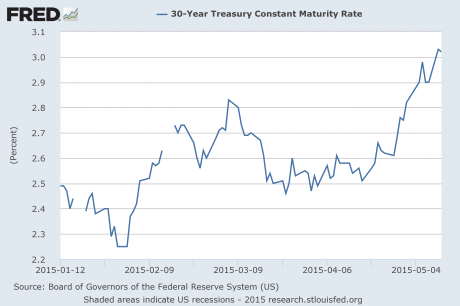
Here is a chart that shows what has been happening to the yield on 30 year U.S. Treasuries in 2015.  As you can see, there has been a big move recently…

30 Year Yield

And what this chart doesn’t show is that the yield on 30 year Treasuries shot up to about 3.08% on Wednesday.

Of course it isn’t just yields in the U.S. that are skyrocketing.  This is happening all over the globe, and many analysts are now openly wondering if the 76 trillion dollar global bond bubble is finally imploding.  For instance, just consider what Deutsche Bank strategist Jim Reid recently told the Telegraph

Financial regulations introduced since the crisis have required banks to hold more bonds, as quantitative easing schemes have meant central banks hold many on their own balance sheets, reducing the number available to trade on the open market.

Simultaneously, central banks have attempted to boost so-called “high money liquidity” with quantitative easing schemes and their close to zero interest rates. “What has become increasingly clear over the last couple of years is that the combination of high money liquidity and low trading liquidity creates air pockets,” said Mr Reid.

He continued: “It’s a worry that these events are occurring in relatively upbeat markets. I can’t helping thinking that when the next downturn hits the lack of liquidity in various markets is going to be chaotic. These increasingly regular liquidity issues we’re seeing might be a mild dress rehearsal.”

Those are sobering words.

And without a doubt, we are in the midst of a massive stock market bubble as well.  The chaos that is coming is not just going to affect bonds.  In fact, I believe that the greatest stock market crash in U.S. history is coming.

So when will it happen?

Well, Phoenix Capital Research seems to think that we have reached an extremely important turning point…

This is something of a last hurrah for stocks. We are now officially in May. And historically the period from May to November has been one of the worst periods for stocks from a seasonal perspective.

Moreover, the fundamentals are worsening dramatically for the markets. By the look of things, 2014 represented the first year in which corporate sales FELL since 2009. Sales track actual economic activity much more closely than earnings: either the money comes in or it isn’t. The fact that sales are falling indicates the economy is rolling over and the “recovery” has ended.

Having cut costs to the bone and issued debt to buyback shares, we are likely at peak earnings as well. Thus far 90% of companies in the S&P 500 have reported earnings. Year over year earnings are down 11.9%.

So sales are falling and earnings are falling… at a time when stocks are so overvalued that even the Fed admits it. This has all the makings of a serious market collapse. And smart investors are preparing now BEFORE it hits.

Personally, I have a really bad feeling about the second half of 2015.  Everything seems to be gearing up for a repeat of 2008 (or even worse).  Let’s hope that does not happen, but let’s not be willingly blind to the great storm on the horizon either.

And once the next great crisis does hit us, governments around the world will have a lot less “ammunition” to fight it than the last time around.  For example, the U.S. national debt has approximately doubled since the beginning of the last recession, and the Federal Reserve has already pushed interest rates down as far as they can.  Similar things could also be said about other governments all over the planet.  This is something that HSBC chief economist Stephen King recently pointed out in a 17 page report entitled “The world economy’s titanic problem”.  The following is a brief excerpt from that report

“Whereas previous recoveries have enabled monetary and fiscal policymakers to replenish their ammunition, this recovery — both in the US and elsewhere — has been distinguished by a persistent munitions shortage. This is a major problem. In all recessions since the 1970s, the US Fed funds rate has fallen by a minimum of 5 percentage points. That kind of traditional stimulus is now completely ruled out.”

For a long time, I have had a practice of ending my articles by urging people to get prepared.  But now time for preparing is rapidly running out.  My new book entitled “Get Prepared Now” was just released, but honestly my co-author and I should have had it out last year.  In the very small amount of time that we have left before the financial markets crash, the amount of “prepping” that people are going to be able to do will be fairly limited.

I am not just pointing to a single event.  Once the financial markets crash this time, I believe that there is not going to be any sort of a “recovery” like we experienced after 2008.  I believe that the long-term economic collapse that we have been experiencing will accelerate very greatly, and it will usher in a horrible period of time for the United States unlike anything that we have ever seen before.

So what do you think?

Could I be wrong?

Please feel free to share your thoughts by posting a comment below…

Experts Are Warning That The 76 Trillion Dollar Global Bond Bubble Is About To Explode

Bubble World - Public DomainWarren Buffett believes “that bonds are very overvalued“, and a recent survey of fund managers found that 80 percent of them are convinced that bonds have become “badly overvalued“.  The most famous bond expert on the planet, Bill Gross, recently confessed that he has a sense that the 35 year bull market in bonds is “ending” and he admitted that he is feeling “great unrest”.  Nobel Prize–winning economist Robert Shiller has added a new chapter to his bestselling book in which he argues that bond prices are “irrationally high”.  The global bond bubble has ballooned to more than 76 trillion dollars, and interest rates have never been lower in modern history.  In fact, 25 percent of all government bonds in Europe actually have a negative rate of return at this point.  There is literally nowhere for the bond market to go except for the other direction, and when this bull market turns into a bear it will create chaos and financial devastation all over the planet.

In a recent piece entitled “A Sense Of Ending“, bond guru Bill Gross admitted that the 35 year bull market in bonds that has made him and those that have invested with him so wealthy is now coming to an end…

Stanley Druckenmiller, George Soros, Ray Dalio, Jeremy Grantham, among others warn investors that our 35 year investment supercycle may be exhausted. They don’t necessarily counsel heading for the hills, or liquidating assets for cash, but they do speak to low future returns and the increasingly fat tail possibilities of a “bang” at some future date. To them, (and myself) the current bull market is not 35 years old, but twice that in human terms. Surely they and other gurus are looking through their research papers to help predict future financial “obits”, although uncertain of the announcement date. Savor this Bull market moment, they seem to be saying in unison. It will not come again for any of us; unrest lies ahead and low asset returns. Perhaps great unrest, if there is a bubble popping.

And the way that he ended his piece sounds rather ominous

I wish to still be active in say 2020 to see how this ends. As it is, in 2015, I merely have a sense of an ending, a secular bull market ending with a whimper, not a bang. But if so, like death, only the timing is in doubt. Because of this sense, however, I have unrest, increasingly a great unrest. You should as well.

Bill Gross is someone that knows what he is talking about.  I would consider his words very carefully.

Another renowned financial expert, Yale professor Robert Shiller, warned us about the stock bubble in 2000 and about the real estate bubble in 2005.  Now, he is warning about the danger posed by this bond bubble

In the first edition of his landmark book “Irrational Exuberance,” published in 2000, the Yale professor of economics and 2013 Nobel Laureate presciently warned that stocks looked especially expensive. In the second edition, published in 2005 shortly before the real estate bubble crashed, he added a chapter about real estate valuations. And in the new edition, due out later this month, Shiller adds a fresh chapter called “The Bond Market in Historical Perspective,” in which he worries that bond prices might be irrationally high.

For years, ultra-low interest rates have enabled governments around the world to go on a debt binge unlike anything the world has ever seen.  Showing very little restraint since the last financial crisis, they have piled up debts that are exceedingly dangerous.  If interest rates were to return to historical norms, it would instantly create the greatest government debt crisis in history.

A recent letter from IceCap Asset Management summarized where we basically stand today…

Considering:

1) governments are unable to eliminate deficits

2) global government debt is increasing exponentially

3) 0% interest rates are allowing governments to borrow more to pay off old loans and fund deficits

4) Global growth is declining despite money printing and bailouts And, we’ve saved the latest and greatest fact for last: as stunning as 0% interest rates sound, the mathematically-challenged-fantasyland called Europe has just one upped everyone by introducing NEGATIVE INTEREST RATES.

As of writing, over 25% of all bonds issued by European governments has a guaranteed negative return for investors.

Germany can borrow money for 5 years at an interest rate of NEGATIVE 0.10%. Yes, instead of Germany paying you interest when you lend them money, you have to pay them interest.

These same negative interest rate conditions exist across many of the Eurozone countries, as well as Denmark, Sweden and Switzerland.

Negative interest rates are by nature irrational.

Why in the world would you pay someone to borrow money from you?

It doesn’t make any sense at all, and this irrational state of affairs will not last for too much longer.

At some point, investors are going to come to the realization that the 35 year bull market for bonds is finished, and then there will be a massive rush for the exits.  This rush for the exits will be unlike anything the bond market has ever seen before.  Robert Wenzel of the Economic Policy Journal says that this coming rush for the exits will set off a “death spiral”…

Anyone who holds the view that the Fed will not soon raise interest rates,and soon, fails to understand the nature of the developing crisis. It will be led by a collapse of the bond market.

Market forces, somewhat misleadingly called bond-vigilantes, will lead the charge.

I am not as bearish in the short-term on the stock market. The equity markets will be volatile because of the climb in rates and look scary at times but the death spiral will be in the bond market.

As this death spiral accelerates, we are going to see global interest rates rise dramatically.  And considering the fact that more than 400 trillion dollars in derivatives are directly tied to interest rates, that is a very scary thing.

And in case you are wondering, the stock market will be deeply affected by all of this as well.  I believe that we are going to witness a stock market crash even greater than what we experienced in 2008, and other experts are projecting similar things.  For example, just consider what Marc Faber recently told CNBC

“For the last two years, I’ve been thinking that U.S. stocks are due for a correction,” Faber said Wednesday on CNBC’s “Trading Nation.” “But I always say a bubble is a bubble, and if there’s no correction, the market will go up, and one day it will go down, big time.”

“The market is in a position where it’s not just going to be a 10 percent correction. Maybe it first goes up a bit further, but when it comes, it will be 30 percent or 40 percent minimum!” Faber asserted.

Where we are right now is at the end of the party.  There are some that want to keep on dancing to the music for as long as possible, but most can see that things are winding down and people are starting to head for the exits.

The irrational global financial bubble that investors have been enjoying for the past few years has stretched on far longer than it should have.  But that is the way irrational bubbles work – they just keep going even when everyone can see that they have become absolutely absurd.  However, eventually something always comes along and bursts them, and once that happens markets can crash very, very rapidly.

11 Signs That We Are Entering The Next Phase Of The Global Economic Crisis

Earth Puzzle - Public DomainWell, the Nasdaq finally did it.  It has climbed all the way back to where it was at the peak of the dotcom bubble.  Back in March 2000, the Nasdaq set an all-time record high of 5,048.62.  On Thursday, after all these years, that all-time record was finally eclipsed.  The Nasdaq closed at 5056.06, and Wall Street greatly rejoiced.  So if you invested in the Nasdaq at the peak of the dotcom bubble, you are just finally breaking even 15 years later.  Unfortunately, the truth is that stocks have not been soaring because the U.S. economy is fundamentally strong.  Just like the last two times, what we are witnessing is an irrational financial bubble.  Sometimes these irrational bubbles can last for a surprisingly long time, but in the end they always burst.  And even now there are signs of economic trouble bubbling to the surface all around us.  The following are 11 signs that we are entering the next phase of the global economic crisis…

#1 It is being projected that half of all fracking companies in the United States will be “dead or sold” by the end of this year.

#2 The rig count just continues to fall as the U.S. oil industry implodes.  Incredibly, the number of rigs in operation in the United States has fallen for 19 weeks in a row.

#3 McDonald’s has announced that it will be closing 700 “poor performing” restaurants in 2015.  Why would McDonald’s be doing this if the economy was actually getting better?

#4 As I wrote about the other day, we could be right on the verge of a Greek debt default.  In fact, we learned on Thursday that the Greek government has been “running on empty” for months…

Greece warned it will go bankrupt next week after failing to stump up enough cash to pay millions of public sector workers and its international debts.

Deputy finance minister Dimitras Mardas set alarm bells ringing yesterday when he declared the country had been ‘running on empty’ since February.

With a debt repayment deadline looming on May 1, Greece faces the deeply damaging prospect of having to snub its own employees to make a €200m payment to the International Monetary Fund.

#5 Coal accounts for approximately 40 percent of all electrical generation on the entire planet.  When the price of coal starts to drop, that is a sign that economic activity is slowing down.  Just prior to the last financial crisis in 2008, the price of coal shot up dramatically and then crashed really hard.  Well, guess what?  The price of coal has been crashing again, and it is already lower than it was at any point during the last recession.

#6 The price of iron ore has been crashing as well.  It is down 35 percent in the last nine months, and David Stockman believes that this is because of a major deflationary crisis that is brewing in China…

There is no better measure of the true contraction underway in China than the price of iron ore. The Wall Street stock peddlers will tell you not to be troubled by the 70% plunge from the 2012 highs and the 35% drop just in the last nine months. According to them, its all the fault of the big global miners who went overboard opening up massive new iron ore pits and mining infrastructure.

#7 At this point, China accounts for more total global trade than anyone else in the world.  That is why it is so alarming that Chinese imports and exports are both absolutely collapsing

China’s monthly trade data shows exports fell in March from a year ago by 14.6% in yuan terms, compared to expectations for a rise of more than 8%.

Imports meanwhile fell 12.3% in yuan terms compared to forecasts for a fall of more than 11%.

#8 The number of publicly traded companies in the United States that filed for bankruptcy during the first quarter of 2015 was more than double the number that filed for bankruptcy during the first quarter of 2014.

#9 New home sales in the United States just declined at their fastest pace in almost two years.

#10 U.S. manufacturing data has been shockingly weak lately…

On the heels of weak PMIs from Europe and Asia, Markit’s US Manufacturing PMI plunged to 54.2 in April (from 55.7). Against expectations of a rise to 55.6, this is the biggest miss on record. Of course, this is ‘post-weather’ so talking-heads will need to find another excuse as New Orders declined for the first time since Nov 2014.

#11 When priced according to “the average blue-collar hourly wage“, U.S. stocks are the most expensive that they have ever been in history right now.  To say that this financial bubble is overdue to burst is a massive understatement.

For a long time, I have been pointing to 2015 as a major “turning point” for the global financial system, and I still feel that way.

But for the first four months of this year, things have been surprisingly quiet – at least on the surface.

So what is going on?

Well, I believe that what we are experiencing right now is the proverbial “calm before the storm”.  There is all sorts of turmoil brewing just beneath the surface, but for the moment things seem like they are running along just fine to most people.  Unfortunately, this period of quiet is not going to last much longer.

And those that are “in the know” are already moving their money in anticipation of what is coming.  For example, consider the words of  Snapchat founder and CEO Evan Spiegel

Fed has created abnormal market conditions by printing money and keeping interest rates low. Investors are looking for growth anywhere they can find it and tech companies are good targets – at these values, however, all tech stocks are expensive – even looking at 5+ years of revenue growth down the road. This means that most value-driven investors have left the market and the remaining 5-10%+ increase in market value will be driven by momentum investors. At some point there won’t be any momentum investors left buying at higher prices, and the market begins to tumble. May be 10-20% correction or something more significant, especially in tech stocks.

It may not happen next week, or even next month, but big financial trouble is coming.

And when it finally arrives, it is going to shock the world, even though anyone with any sense can see the coming crisis approaching from a mile away.