7 Signs That A Stock Market Peak Is Happening Right Now

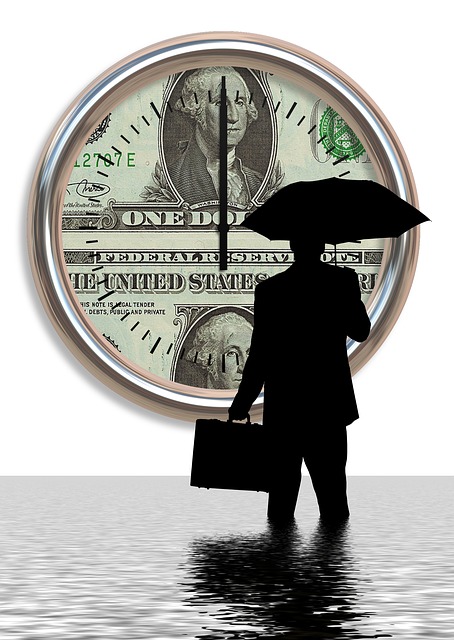
Stock Market Crash - Public DomainIs this the end of the last great run for the U.S. stock market?  Are we witnessing classic “peaking behavior” that is similar to what occurred just before other major stock market crashes?  Throughout 2014 and for the early stages of 2015, stocks have been on quite a tear.  Even though the overall U.S. economy continues to be deeply troubled, we have seen the Dow, the S&P 500 and the Nasdaq set record after record.  But no bull market lasts forever – particularly one that has no relation to economic reality whatsoever.  This false bubble of financial prosperity has been enjoyable, and even I wish that it could last much longer.  But there comes a time when we all must face reality, and the cold, hard facts are telling us that this party is about to end.  The following are 7 signs that a stock market peak is happening right now…

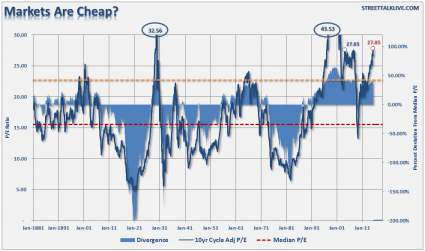
#1 Just before a stock market crash, price/earnings ratios tend to spike, and that is precisely what we are witnessing.  The following commentary and chart come from Lance Roberts

The chart below shows Dr. Robert Shiller’s cyclically adjusted P/E ratio. The problem is that current valuations only appear cheap when compared to the peak in 2000. In order to put valuations into perspective, I have capped P/E’s at 30x trailing earnings. The dashed orange line measures 23x earnings which has been the level where secular bull markets have previously ended. I have noted the peak valuations in periods that have exceeded that 30x earnings.

markets are cheap - StreetTalkLive

At 27.85x current earning the markets are currently at valuation levels where previous bull markets have ended rather than continued. Furthermore, the markets have exceeded the pre-financial crisis peak of 27.65x earnings. If earnings continue to deteriorate, market valuations could rise rapidly even if prices remain stagnant.
#2 The average bull market lasts for approximately 3.8 years. The current bull market has already lasted for six years.

#3 The median total gain during a bull market is 101.5 percent.  For this bull market, it has been 213 percent.

#4 Usually before a stock market crash we see a divergence between the relative strength index and the stock market itself.  This happened prior to the bursting of the dotcom bubble, it happened prior to the crash of 2008, and it is happening again right now

The first technical warning sign that we should heed is marked by a significant divergence between the relative strength index (RSI) and the market itself. This is noted by a declining pattern of lower highs in the RSI as stocks continue to make higher highs, a sign that the market is “topping out”. In the late ‘90s this divergence persisted for many years as the tech bubble reached epic valuation levels. In 2007 this divergence lasted over a much shorter period (6 months) before the market finally peaked and succumbed to massive selling. With last month’s strong rally to new records, we now have a confirmed divergence between the long-term relative strength index and the market’s price action.

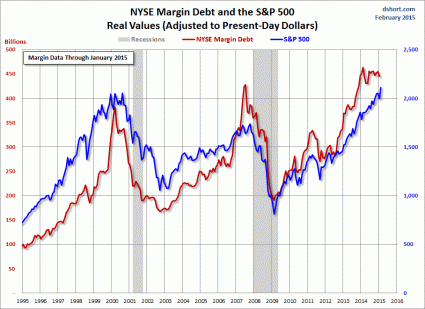
#5 In the past, peaks in margin debt have been very closely associated with stock market peaks.  The following chart comes from Doug Short, and I included it in a previous article

Margin Debt

#6 As I have discussed previously, we usually witness a spike in 10 year Treasury yields just about the time that the stock market is peaking right before a crash.

Well, according to Business Insider, we just saw the largest 5 week rate rally in two decades…

Lots of guys and gals went home this past weekend thinking about the implications of the recent rise in the 10-year Treasury bond’s yield.

Chris Kimble notes it was the biggest 5-week rate rally in twenty years!

#7 A lot of momentum indicators seem to be telling us that we are rapidly approaching a turning point for stocks.  For example, James Stack, the editor of InvesTech Research, says that the Coppock Guide is warning us of “an impending bear market on the not-too-distant horizon”

A momentum indicator dubbed the Coppock Guide, which serves as “a barometer of the market’s emotional state,” has also peaked, Stack says. The indicator, which, “tracks the ebb and flow of equity markets from one psychological extreme to another,” is also flashing a warning flag.

The Coppock Guide’s chart pattern is flashing a “double top,”  which suggests that “psychological excesses are present” and that “secondary momentum has peaked” in this bull market, according to Stack.

“All of this is just another reason for concern about an impending bear market on the not-too-distant horizon,” Stack writes.

So if we are to see a stock market crash soon, when will it happen?

Well, the truth is that nobody knows for certain.

It could happen this week, or it could be six months from now.

In fact, a whole lot of people are starting to point to the second half of 2015 as a danger zone.  For example, just consider the words of David Morgan

“Momentum is one indicator and the money supply. Also, when I made my forecast, there is a big seasonality, and part of it is strict analytical detail and part of it is being in this market for 40 years. I got a pretty good idea of what is going on out there and the feedback I get. . . . I’m in Europe, I’m in Asia, I’m in South America, I’m in Mexico, I’m in Canada; and so, I get a global feel, if you will, for what people are really thinking and really dealing with. It’s like a barometer reading, and I feel there are more and more tensions all the time and less and less solutions. It’s a fundamental take on how fed up people are on a global basis. Based on that, it seems to me as I said in the January issue of the Morgan Report, September is going to be the point where people have had it.”

Time will tell if Morgan was right.

But without a doubt, lots of economic warning signs are starting to pop up.

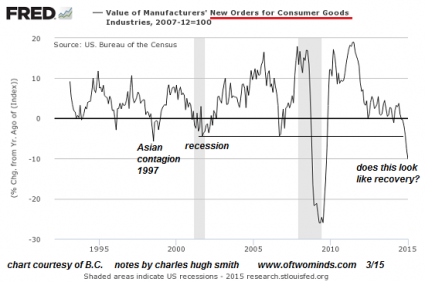
One that is particularly troubling is the decline in new orders for consumer goods.  This is something that Charles Hugh-Smith pointed out in one of his recent articles…

The financial news is astonishingly rosy: record trade surpluses in China, positive surprises in Europe, the best run of new jobs added to the U.S. economy since the go-go 1990s, and the gift that keeps on giving to consumers everywhere, low oil prices.

So if everything is so fantastic, why are new orders cratering? New orders are a snapshot of future demand, as opposed to current retail sales or orders that have been delivered.

Posted below is a chart that he included with his recent article.  As you can see, the only time things have been worse in recent decades was during the depths of the last financial crisis…
Charles Hugh-Smith New Orders

To me, it very much appears that time is running out for this bubble of false prosperity that we have been living in.

But what do you think?  Please feel free to contribute to the discussion by posting a comment below…

Stock Market Bubble: Wall Street Is Ecstatic As The NASDAQ Closes Above 5000

Bubble In Hands - Public DomainAre we at the tail end of the stock market bubble to end all stock market bubbles?  Wall Street was full of glee Monday when the Nasdaq closed above 5000 for the first time since the peak of the dotcom bubble in March 2000.  And almost everyone in the financial world seems convinced that things are somehow “different” this time around.  Even though by almost every objective measure stocks are wildly overpriced right now, and even though there are a whole host of signs that economic trouble is on the horizon, the overwhelming consensus is that this bull market is just going to keep charging ahead.  But of course that is what they thought just before the last two stock market crashes in 2001 and 2008 as well.  No matter how many times history repeats, we never seem to learn from it.

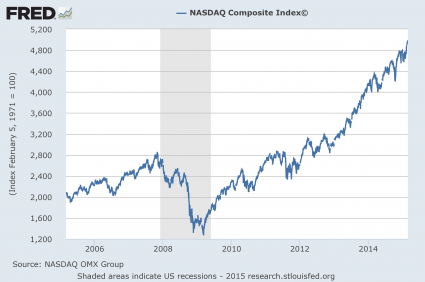
Back in October 2002, the Nasdaq hit a post-dotcom bubble low of 1108.  From there, it went on an impressive run.  In late 2007, it briefly moved above 2800 before losing more than half of its value during the stock market crash of 2008.

So the fact that the Nasdaq has now closed above 5000 is a really big deal.  The following is how USA Today described what happened on Monday…

The Nasdaq Composite capped its long march back to 5000 Monday, eclipsing, then closing above the long-hallowed mark for the first time since March 2000.

The arduous climb came on the heels of a 10-day winning streak that ended last week, Nasdaq’s longest since July 2009. That helped fuel the technology-heavy market index to a 7% gain in February, the sixth-largest monthly climb since its 1971 launch.

The chart below shows how the Nasdaq has performed over the past decade.  As you can see, we are coming dangerously close to doubling the peak that was hit just before the last stock market collapse…

NASDAQ since 2005

By looking at that chart, you would be tempted to think that the overall U.S. economy must be doing great.

But of course that is not the case at all.

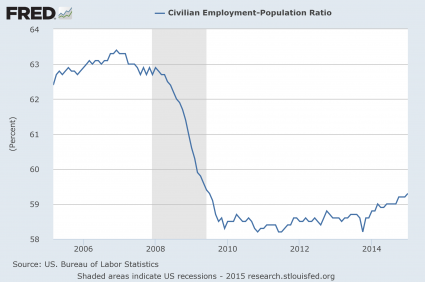
For example, just take a look at what has happened to the employment-population ratio over the past decade.  The percentage of the working age U.S. population that is currently employed is actually far lower than it used to be…

Employment Population Ratio Since 2005

So why is the stock market doing so well if the overall economy is not?

Well, the truth is that stocks have become completely divorced from economic reality at this point.  Wall Street has been transformed into a giant casino, and trading stocks has been transformed into a high stakes poker game.

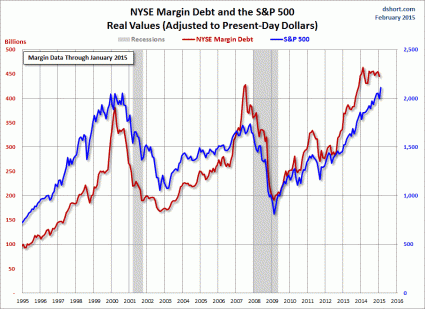
And one of the ways that we can tell that a stock market bubble has formed is when people start borrowing massive amounts of money to invest in stocks.  As you can see from the commentary and chart from Doug Short below, margin debt is peaking again just like it did just prior to the last two stock market crashes…

Unfortunately, the NYSE margin debt data is a month old when it is published. Real (inflation-adjusted) debt hit its all-time high in February 2014, after which it margin declined sharply for two months, but by June it had risen to a level about two percent below its high and then oscillated in a relatively narrow range. The latest data point for January is four percent off its real high eleven month ago.

Margin Debt - Doug Short

So why can’t more people see this?

We are in the midst of a monumental stock market bubble and most on Wall Street seem willingly blind to it.

Fortunately, there are a few sober voices in the crowd.  One of them is John Hussman.  He is warning that now is the time to get out of stocks

Unless we observe a rather swift improvement in market internals and a further, material easing in credit spreads – neither which would relieve the present overvaluation of the market, but both which would defer our immediate concerns about downside risk – the present moment likely represents the best opportunity to reduce exposure to stock market risk that investors are likely to encounter in the coming 8 years.

Last week, the cyclically-adjusted P/E of the S&P 500 Index surpassed 27, versus a historical norm of just 15 prior to the late-1990’s market bubble. The S&P 500 price/revenue ratio surpassed 1.8, versus a pre-bubble norm of just 0.8. On a wide range of historically reliable measures (having a nearly 90% correlation with actual subsequent S&P 500 total returns), we estimate current valuations to be fully 118% above levels associated with historically normal subsequent returns in stocks. Advisory bullishness (Investors Intelligence) shot to 59.5%, compared with only 14.1% bears – one of the most lopsided sentiment extremes on record. The S&P 500 registered a record high after an advancing half-cycle since 2009 that is historically long-in-the-tooth and already exceeds the valuation peaks set at every cyclical extreme in history but 2000 on the S&P 500 (across all stocks, current median price/earnings, price/revenue and enterprise value/EBITDA multiples already exceed the 2000 extreme). Equally important, our measures of market internals and credit spreads, despite moderate improvement in recent weeks, continue to suggest a shift toward risk-aversion among investors. An environment of compressed risk premiums coupled with increasing risk-aversion is without question the most hostile set of features one can identify in the historical record.

Everyone knows that the stock market cannot stay detached from economic reality forever.

At some point the bubble is going to burst.

If you want to know what the real economy is like, just ask Alison Norris of Detroit, Michigan

When Alison Norris couldn’t find work in Detroit, she searched past city limits, ending up with a part-time restaurant job 20 miles away, which takes at least two hours to get to using public transportation.

Norris has to take two buses to her job at a suburban mall in Troy, Michigan, using separate city and suburban bus systems.

For many city residents with limited skills and education, Detroit is an employment desert, having lost tens of thousands of blue-collar jobs in manufacturing cutbacks and service jobs as the population dwindled.

Sadly, her story is not an anomaly.  I get emails from readers all the time that are out of work and just can’t seem to find a decent job no matter how hard they try.

It would be one thing if the stock market was soaring because the U.S. economy was thriving.

But we all know that is not true.

So that means the current stock market mania that we are witnessing is artificial.

How long will it last?

Give us your opinion by posting a comment below…
Two More Harbingers Of Financial Doom That Mirror The Crisis Of 2008

Harbingers - Public DomainThe stock market continues to flirt with new record highs, but the signs that we could be on the precipice of the next major financial crisis continue to mount.  A couple of days ago, I discussed the fact that the U.S. dollar is experiencing a tremendous surge in value just like it did in the months prior to the financial crisis of 2008.  And previously, I have detailed how the price of oil has collapsed, prices for industrial commodities are tanking and market behavior is becoming extremely choppy.  All of these are things that we witnessed just before the last market crash as well.  It is also important to note that orders for durable goods are declining and the Baltic Dry Index has dropped to the lowest level on record.  So does all of this mean that the stock market is guaranteed to crash in 2015?  No, of course not.  But what we are looking for are probabilities.  We are looking for patterns.  There are multiple warning signs that have popped up repeatedly just prior to previous financial crashes, and many of those same warning signs are now appearing once again.

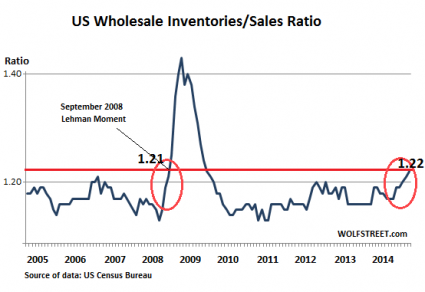
One of these warning signs that I have not discussed previously is the wholesale inventories to sales ratio.  When economic activity starts to slow down, inventory tends to get backed up.  And that is precisely what is happening right now.  In fact, as Wolf Richter recently wrote about, the wholesale inventories to sales ratio has now hit a level that we have not seen since the last recession…

In December, the wholesale inventory/sales ratio reached 1.22, after rising consistently since July last year, when it was 1.17. It is now at the highest – and worst – level since September 2009, as the financial crisis was winding down:

Wolf Richter

Rising sales gives merchants the optimism to stock more. But because sales are rising in that rosy scenario, the inventory/sales ratio, depicting rising inventories and rising sales, would not suddenly jump. But in the current scenario, sales are not keeping up with inventory growth.

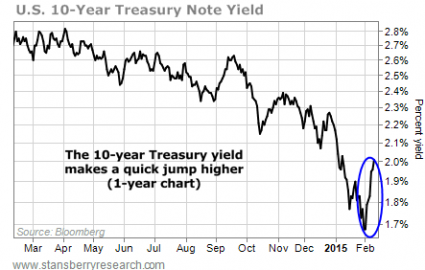
Another sign that I find extremely interesting is the behavior of the yield on 10 year U.S. Treasury notes.  As Jeff Clark recently explained, we usually see a spike in the 10 year Treasury yield about the time the market is peaking before a crash…

The 10-year Treasury note yield bottomed on January 30 at 1.65%. Today, it’s at 2%. That’s a 35-basis-point spike – a jump of 21% – in less than two weeks.

And it’s the first sign of an impending stock market crash.

10 Year Yield - Stansberry

As I explained last September, the 10-year Treasury note yield has ALWAYS spiked higher prior to an important top in the stock market.

For example, the 10-year yield was just 4.5% in January 1999. One year later, it was 6.75% – a spike of 50%. The dot-com bubble popped two months later.

In 2007, rates bottomed in March at 4.5%. By July, they had risen to 5.5% – a 22% increase. The stock market peaked in September.

Let’s be clear… not every spike in Treasury rates leads to an important top in the stock market. But there has always been a sharp spike in rates a few months before the top.

Once again, just because something has happened in the past does not mean that it will happen in the future.

But the fact that so many red flags are appearing all at once has got to give any rational person reason for concern.

Yes, the Dow gained more than 100 points on Thursday.  But on Thursday we also learned that retail sales dropped again in January.  Overall, this has been the worst two month drop in retail sales since 2009

Following last month’s narrative-crushing drop in retail sales, despite all that low interest rate low gas price stimulus, January was more of the same as hopeful expectations for a modest rebound were denied. Falling 0.8% (against a 0.9% drop in Dec), missing expectations of -0.4%, this is the worst back-to-back drop in retail sales since Oct 2009. Retail sales declined in 6 of the 13 categories.

And economic activity is rapidly slowing down on the other side of the planet as well.

For example, Chinese imports and exports both fell dramatically in January…

Chinese imports collapsed 19.9% YoY in January, missing expectations of a modest 3.2% drop by the most since Lehman. This is the biggest YoY drop since May 2009 and worst January since the peak of the financial crisis. Exports tumbled 3.3% YoY (missing expectations of 5.9% surge) for the worst January since 2009. Combined this led to a $60.03 billion trade surplus in January – the largest ever. But apart from these massive imbalances, everything is awesome in the global economy (oh apart from The Baltic Dry at record lows, Iron Ore near record lows, oil prices crashed, and the other engine of the world economy – USA USA USA – imploding).

In light of so much bad economic data, it boggles my mind that stocks have been doing so well.

But this is typical bubble behavior.  Financial bubbles tend to be very irrational and they tend to go on a lot longer than most people think they will.  When they do finally burst, the consequences are often quite horrifying.

It may not seem like it to most people, but we are right on track for a major financial catastrophe.  It is playing out right in front of our eyes in textbook fashion.  But it is going to take a little while to unfold.

Unfortunately, most people these days do not have the patience to watch long-term trends develop.  Instead, we have been trained by the mainstream media to have the attention spans of toddlers.  We bounce from one 48-hour news cycle to the next, eagerly looking forward to the next “scandal” that is going to break.

And when the next financial crash does strike, the mainstream media is going to talk about what a “surprise” it is.  But for those that are watching the long-term trends, it is not going to be a surprise at all.  We will have seen it coming a mile away.


Guess What Happened The Last Time The U.S. Dollar Skyrocketed In Value Like This?…

Question Ball - Public DomainOver the past decade, there has been only one other time when the value of the U.S. dollar has increased by so much in such a short period of time.  That was in mid-2008 – just before the greatest financial crash since the Great Depression.  A surging U.S. dollar also greatly contributed to the Latin American debt crisis of the early 1980s and the Asian financial crisis of 1997.  Today, the globe is more interconnected than ever.  Most global trade is conducted in U.S. dollars, and much of the borrowing done by emerging markets all over the planet is denominated in U.S. dollars.  When the U.S. dollar goes up dramatically, this can put a tremendous amount of financial stress on economies all around the world.  It also has the potential to greatly threaten the stability of the 65 trillion dollars in derivatives that are directly tied to the value of the U.S. dollar.  The global financial system is more vulnerable to currency movements than ever before, and history tells us that when the U.S. dollar soars the global economy tends to experience a contraction.  So the fact that the U.S. dollar has been skyrocketing lately is a very, very bad sign.

Most of the people that write about the coming economic collapse love to talk about the coming collapse of the U.S. dollar as well.

But in the initial deflationary stage of the coming financial crisis, we are likely to see the U.S. dollar actually strengthen considerably.

As I have discussed so many times before, we are going to experience deflation first, and after that deflationary phase the desperate responses by the Federal Reserve and the U.S. government to that deflation will cause the inflationary panic that so many have written about.

Yes, someday the U.S. dollar will essentially be toilet paper.  But that is not in our immediate future.  What is in our immediate future is a “flight to safety” that will push the surging U.S. dollar even higher.

This is what we witnessed in 2008, and this is happening once again right now.

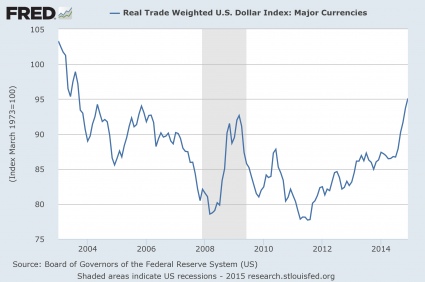
Just look at the chart that I have posted below.  You can see the the U.S. dollar moved upward dramatically relative to other currencies starting in mid-2008.  And toward the end of the chart you can see that the U.S. dollar is now experiencing a similar spike…

Dollar Index 2015

At the moment, almost every major currency in the world is falling relative to the U.S. dollar.

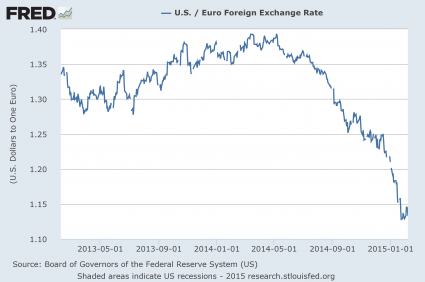
For example, this next chart shows what the euro is doing relative to the dollar.  As you can see, the euro is in the midst of a stunning decline…

Euro U.S. Dollar

Instead of focusing on the U.S. dollar, those that are looking for a harbinger of the coming financial crisis should be watching the euro.  As I discussed yesterday, analysts are telling us that if Greece leaves the eurozone the EUR/USD could fall all the way down to 0.90.  If that happens, the chart above will soon resemble a waterfall.

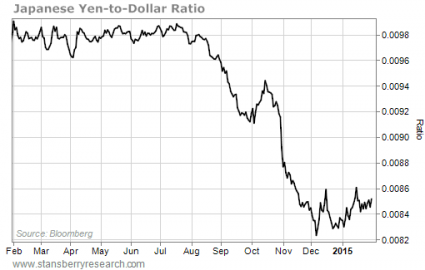
And of course it isn’t just the euro that is plummeting.  The yen has been crashing as well.  The following chart was recently posted on the Crux

Yen Dollar from the Crux

Unfortunately, most Americans have absolutely no idea how important all of this is.  In recent years, growing economies all over the world have borrowed gigantic piles of very cheap U.S. dollars.  But now they are faced with the prospect of repaying those debts and making interest payments using much more expensive U.S. dollars.

Investors are starting to get nervous.  At one time, investors couldn’t wait to pour money into emerging markets, but now this process is beginning to reverse.  If this turns into a panic, we are going to have one giant financial mess on our hands.

The truth is that the value of the U.S. dollar is of great importance to every nation on the face of the Earth.  The following comes from U.S. News & World Report

In the early ’80s, a bullish U.S. dollar contributed to the Latin American debt crisis, and also impacted the Asian Tiger crisis in the late ’90s. Emerging markets typically have higher growth, but carry much higher risk to investors. When the economies are doing well, foreign investors will lend money to emerging market countries by purchasing their bonds.

They also deposit money in foreign banks, which facilitates higher lending. The reason for this is simple: Bond payments and interest rates in emerging markets are much higher than in the U.S. Why deposit cash in the U.S. and earn 0.25 percent, when you could earn 6 percent in Indonesia? With the dollar strengthening, the interest payments on any bond denominated in U.S. dollars becomes more expensive.

Additionally, the deposit in the Indonesian bank may still be earning 6 percent, but that is on Indonesian rupiahs. After converting the rupiahs to U.S. dollars, the extra interest doesn’t offset the loss from the exchange. As investors get nervous, the higher interest on emerging market debt and deposits becomes less alluring, and they flee to safety. It may start slowly, but history tells us it can quickly spiral out of control.

Over the past few months, I have been repeatedly stressing that so many of the signs that we witnessed just prior to previous financial crashes are happening again.

Now you can add the skyrocketing U.S. dollar to that list.

If you have not seen my previous articles where I have discussed these things, here are some places to get started…

Guess What Happened The Last Time The Price Of Oil Crashed Like This?…

Not Just Oil: Guess What Happened The Last Time Commodity Prices Crashed Like This?…

10 Key Events That Preceded The Last Financial Crisis That Are Happening Again RIGHT NOW

The warnings signs are really starting to pile up.

When we look back at past financial crashes, there are recognizable patterns that can be identified.

Anyone with half a brain should be able to see that a large number of those patterns are unfolding once again right before our eyes.

Unfortunately, most people in this world end up believing exactly what they want to believe.

No matter how much evidence you show them, they will not accept the truth until it is too late.

A Day Of Reckoning For The Euro Has Arrived – 26 TRILLION In Currency Derivatives At Risk

Yanis Varoufakis - posted to Twitter by Utopian FiremanThis is the month when the future of the eurozone will be decided.  This week, Greek leaders will meet with European officials to discuss what comes next for Greece.  The new prime minister of Greece, Alexis Tsipras, has already stated that he will not accept an extension of the current bailout.  Officials from other eurozone countries have already said that they expect Greece to fully honor the terms of the current agreement.  So basically we are watching a giant game of financial “chicken” play out over in Europe, and a showdown is looming.  Adding to the drama is the fact that the Greek government is rapidly running out of money.  According to the Wall Street Journal, Greece is “on course to run out of money within weeks if it doesn’t gain access to additional funds, effectively daring Germany and its other European creditors to let it fail and stumble out of the euro.”  We have witnessed other moments of crisis for Greece before, but things are very different this time because the new Greek government is being run by radical leftists that based their entire campaign on ending the austerity that has been imposed on Greece by the rest of Europe.  If they buckle under the demands of the European financial lords, their credibility will be gone and Syriza will essentially be finished in Greek politics.  But if they don’t compromise, Greece could be forced to leave the eurozone and we could potentially be facing the equivalent of “financial armageddon” in Europe.  If nobody flinches, the eurozone will fall to pieces, the euro will collapse and trillions upon trillions of dollars in derivatives will be in jeopardy.

According to the Bank for International Settlements, 26.45 trillion dollars in currency derivatives are directly tied to the value of the euro.

Let that number sink in for a moment.

To give you some perspective, keep in mind that the U.S. government spends a total of less than 4 trillion dollars a year.

The entire U.S. national debt is just a bit above 18 trillion dollars.

So 26 trillion dollars is an amount of money that is almost unimaginable.  And of course those are just the derivatives that are directly tied to the euro.  Overall, the total global derivatives bubble is more than 700 trillion dollars in size.

Over the past couple of decades, the global financial system has been transformed into the biggest casino in the history of the planet.  And when things are stable, the computer algorithms used by the big banks work quite well and they make enormous amounts of money.  But when unexpected things happen and markets go haywire, the financial institutions that gamble on derivatives can lose massive quantities of money very rapidly.  We saw this in 2008, and we could be on the verge of seeing this happen again.

If no agreement can be reached and Greece does leave the eurozone, the euro is going to fall off a cliff.

When that happens, someone out there is going to lose an extraordinary amount of money.

And just like in 2008, when the big financial institutions start to fail that will plunge the entire planet into another major financial crisis.

So at the moment, it is absolutely imperative that Greece and the rest of the eurozone find some common ground.

Unfortunately, that may not happen.  The new prime minister of Greece certainly does not sound like he is in a compromising mood

Greece’s new leftist prime minister, Alexis Tsipras, said on Sunday he would not accept an extension to Greece’s current bailout, setting up a clash with EU leaders – who want him to do just that – at a summit on Thursday.

Tsipras also pledged his government would heal the “wounds” of austerity, sticking to campaign pledges of giving free food and electricity to those who had suffered, and reinstating civil servants who had been fired as part of bailout austerity conditions.

Prior to the summit on Thursday, eurozone finance ministers are going to get together on Wednesday to discuss what they should do.  If these two meetings don’t go well this week, we could be looking at big trouble right around the corner.  In fact, Greece is being warned that they only have until February 16th to apply for an extension of the current bailout…

Euro zone finance ministers will discuss how to proceed with financial support for Athens at a special session next Wednesday ahead of the first summit of EU leaders with the new Greek prime minister, Alexis Tsipras, the following day.

However, the chairman of the finance ministers said the following meeting of the Eurogroup on Feb. 16 would be Greece’s last chance to apply for a bailout extension because some euro zone countries would need to consult their parliaments.

“Time will become very short if they (Greece) don’t ask for an extension (by then),” said Jeroen Dijsselbloem.

The current bailout for Greece expires on Feb 28. Without it the country will not get financing or debt relief from its lenders and has little hope of financing itself in the markets.

And as I mentioned above, the Greek government is quickly running out of money.

Most analysts believe that because of the enormous stakes that one side or the other will give in at some point.

But what if that does not happen?

Personally, I believe that the eurozone is doomed in the configuration that we see it today, and that it is just a matter of time before it breaks up.

And I am far from alone.  For example, just check out what former Fed chairman Alan Greenspan is saying

Mr Greenspan, chairman of the Federal Reserve from 1987 to 2006, said: “I believe [Greece] will eventually leave. I don’t think it helps them or the rest of the eurozone – it is just a matter of time before everyone recognizes that parting is the best strategy.

The problem is that there there is no way that I can conceive of the euro of continuing, unless and until all of the members of eurozone become politically integrated – actually even just fiscally integrated won’t do it.”

The Greeks are using all of this to their advantage.  They know that if they leave it could break apart the entire monetary union.  So this gives them a tremendous amount of leverage.  Greek Finance Minister Yanis Varoufakis has even gone so far as to compare the eurozone to a house of cards

The euro is fragile, it’s like building a castle of cards, if you take out the Greek card the others will collapse.” Varoufakis said according to an Italian transcript of the interview released by RAI ahead of broadcast.

The euro zone faces a risk of fragmentation and “de-construction” unless it faces up to the fact that Greece, and not only Greece, is unable to pay back its debt under the current terms, Varoufakis said.

“I would warn anyone who is considering strategically amputating Greece from Europe because this is very dangerous,” he said. “Who will be next after us? Portugal? What will happen when Italy discovers it is impossible to remain inside the straitjacket of austerity?”

After all this time and after so many bailouts, we have finally reached a day of reckoning.

There is a very real possibility that Greece could leave the eurozone in just a matter of months, and the elite know this.

That is why they are getting prepared for that eventuality.  The following is from a recent Wall Street Journal report

The U.K. government is stepping up contingency planning to prepare for a possible Greek exit from the eurozone and the market instability such a move would create, U.K. Treasury chief George Osborne said on Sunday.

A spokeswoman for the Treasury declined comment on the details of the contingency planning.

The U.K. government has said the standoff between Greece’s new anti-austerity government and the eurozone is increasing the risks to the global and U.K. economy.

“That’s why I’m going tomorrow to the G-20 [Group of 20] to encourage our partners to resolve this crisis. It’s why we’re stepping up the contingency planning here at home,” Mr. Osborne told the BBC in an interview. “We have got to make sure we don’t, at this critical time when Britain is also facing a critical choice, add to the instability abroad with instability at home.”

And if Greece does leave, it will cause panic throughout global financial markets as everyone wonders who is next.

Italy, Spain and Portugal are all in a similar position.  Every one of them could rapidly become “the next Greece”.

But of even greater concern is what a “Grexit” would do to the euro.  If the euro falls below parity with the U.S. dollar, the derivatives losses are going to be absolutely mind blowing.  And coupled with the collapse of the price of oil, we could be looking at some extreme financial instability in the not too distant future.

When big banks collapse, they don’t do it overnight.  But we often learn about it in a single moment.

Just remember Lehman Brothers.  Their problems developed over an extended period of time, but we only learned the full extent of their difficulties on one very disturbing day in 2008, and that day changed the world.

As you read this, big financial troubles are brewing in the background.  At some point, they are going to come to the surface.  When they do, the entire planet is going to be shocked.


It Is About To Get Ugly: Oil Is Crashing And So Is Greece

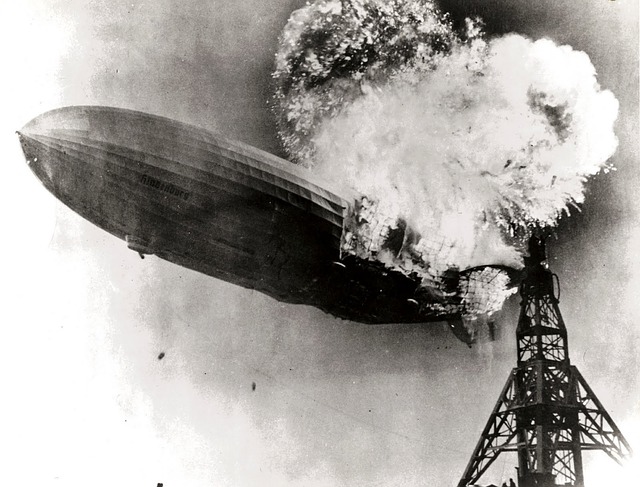
Hindenburg Disaster - Public DomainThe price of oil collapsed by more than 8 percent on Wednesday, and a decision by the European Central Bank has Greece at the precipice of a complete and total financial meltdown.  What a difference 24 hours can make.  On Tuesday, things really seemed like they were actually starting to get better.  The price of oil had rallied by more than 20 percent since last Thursday, things in Europe seemed like they were settling down, and there appeared to be a good deal of optimism about how global financial markets would perform this month.  But now fear is back in a big way.  Of course nobody should get too caught up in how the markets behave on any single day.  The key is to take a longer term point of view.  And the fact that the markets have been on such a roller coaster ride over the past few months is a really, really bad sign.  When things are calm, markets tend to steadily go up.  But when the waters start really getting choppy, that is usually a sign that a big move down in on the horizon.  So the huge ups and the huge downs that we have witnessed in recent days are likely an indicator that rough seas are ahead.

A stunning decision that the European Central Bank has just made has set the stage for a major showdown in Europe.  The ECB has decided that it will no longer accept Greek government bonds as collateral from Greek banks.  This gives the European Union a tremendous amount of leverage in negotiations with the new Greek government.  But in the short-term, this could mean some significant pain for the Greek financial system.  The following is how a CNBC article described what just happened…

“The European Central Bank is telling the Greek banking system that it will no longer accept Greek bonds as collateral for any repurchase agreement the Greek banks want to conduct,” said Peter Boockvar, chief market analyst at The Lindsey Group, said in a note.

“This is because the ECB only accepts investment grade paper and up until today gave Greece a waiver to this clause. That waiver has now been taken away and Greek banks now have to go to the Greek Central Bank and tap their Emergency Liquidity Assistance facility for funding,” he said.

And it certainly didn’t take long for global financial markets to respond to this news

The Greek stock market closed hours ago, but the exchange-traded fund that tracks Greek stocks, GREK, crashed during the final minutes of trading in the US markets.

The euro is also getting walloped, falling 1.3% against the US dollar.

The EUR/USD, which had recovered to almost 1.15, fell to nearly 1.13 on news of the action taken by the ECB.

But this is just the beginning.

In coming months, I fully expect the euro to head toward parity with the U.S. dollar.

And if the new Greek government will not submit to the demands of the EU, and Greece ultimately ends up leaving the common currency, it could potentially mean the end of the eurozone in the configuration that we see it today.

Meanwhile, the oil crash has taken a dangerous new turn.

Over the past week, we have seen the price of oil go from $43.58 to $54.24 to less than 48 dollars before rebounding just a bit at the end of the day on Wednesday.

This kind of erratic behavior is the exact opposite of what a healthy market would look like.

What we really need is a slow, steady climb which would take the price of oil back to at least the $80 level.  In the current range in which it has been fluctuating, the price of oil is going to be absolutely catastrophic for the global economy, and the longer it stays in this current range the more damage that it is going to do.

But of course the problems that we are facing are not just limited to the oil price crash and the crisis in Greece.  The truth is that there are birth pangs of the next great financial collapse all over the place.  We just have to be honest with ourselves and realize what all of these signs are telling us.

And it isn’t just in the western world where people are sounding the alarm.  All over the world, highly educated professionals are warning that a great storm is on the horizon.  The other day, I had an economist in Germany write to me with his concerns.  And in China, the head of the Dagong Rating Agency is declaring that we are going to have to face “a new world financial crisis in the next few years”

The world economy may slip into a new global financial crisis in the next few years, China’s Dagong Rating Agency Head Guan Jianzhong said in an interview with TASS news agency on Wednesday.

“I believe we’ll have to face a new world financial crisis in the next few years. It is difficult to give the exact time but all the signs are present, such as the growing volume of debts and the unsteady development of the economies of the US, the EU, China and some other developing countries,” he said, adding the situation is even worse than ahead of 2008.

For a long time, I have been pointing at the year 2015.  But this year is not going to be the end of anything.  Rather, it is just going to be the beginning of the end.

During the past few years, we have experienced a temporary bubble of false stability fueled by reckless money printing and an unprecedented accumulation of debt.  But instead of fixing anything, those measures have just made the eventual crash even worse.

Now a day of reckoning is fast approaching.

Life as we know it is about to change dramatically, and most people are completely and totally unprepared for it.

Why The Damage To The Economy Caused By The Oil Crash Is Going To Get Progressively Worse

Oil Price Crash - Public DomainWe are really starting to see the price of oil weigh very heavily on the economy and on the stock market.  On Tuesday, the Dow was down 291 points, and the primary reason for the decline was disappointing corporate sales numbers.  For example, heavy equipment manufacturer Caterpillar is blaming the “dramatic decline in the price of oil” for much lower than anticipated sales during the fourth quarter of 2014.  Even though Caterpillar is not an “energy company”, the price of oil is critical to their success.  And the same could be said about thousands of other companies.  That is why I have repeatedly stated that anyone who believes that collapsing oil prices are good for the U.S. economy is crazy.  The key to how much damage this oil collapse is going to do to our economy is not how low prices ultimately go.  Rather, the key is how long they stay at these low levels.  If the price of oil went back to $80 a barrel next week, the damage would be fairly minimal.  But if the price of oil stays at this current level for the remainder of 2015, the damage will be absolutely catastrophic.  Just think of the price of oil like a hot iron.  If you touch it for just a fraction of a second, it won’t do too much damage.  But if you press it against your skin for an hour, you will be severely damaged for the rest of your life at the very least.

So the damage that we are witnessing right now is just the very beginning unless the price of oil goes back up substantially.

When the price of oil first started crashing, most analysts focused on the impact that it would have on energy companies.  And without a doubt, quite a few of them are likely to be wiped out if things don’t change soon.

But of even greater importance is the ripple effects that the price of oil will have throughout our entire economy.  The oil price crash is not that many months old at this point, and yet big companies are already blaming it for causing significant problems.  The following is how Caterpillar explained their disappointing sales numbers on Tuesday

The recent dramatic decline in the price of oil is the most significant reason for the year-over-year decline in our sales and revenues outlook.  Current oil prices are a significant headwind for Energy & Transportation and negative for our construction business in the oil producing regions of the world.  In addition, with lower prices for copper, coal and iron ore, we’ve reduced our expectations for sales of mining equipment.  We’ve also lowered our expectations for construction equipment sales in China.  While our market position in China has improved, 2015 expectations for the construction industry in China are lower”

We also learned on Tuesday that orders for durable goods were extremely disappointing.  Many analysts believe that this is another area where the oil price crash is having an impact

Orders for business equipment unexpectedly fell in December for a fourth month, signaling a global growth slowdown is weighing on American companies. Bookings for non-military capital goods excluding aircraft dropped 0.6 percent for a second month, data from the Commerce Department showed. Demand for all durable goods − items meant to last at least three years − declined 3.4 percent, the worst performance since August.

Let’s keep an eye on the durable goods numbers in coming months.  Usually, when the economy is heading into a recession durable goods numbers start declining.

Meanwhile, a bunch of other big companies reported disappointing sales numbers on Tuesday as well.  The following summary comes from the Crux

Microsoft lost 9.9 percent as software-license sales to businesses were below forecasts. Caterpillar plunged 7.3 percent after forecasting 2015 results that trailed estimates as plunging oil prices signal lower demand from energy companies. DuPont Co. dropped 2.8 percent as a stronger dollar cuts into the chemical maker’s profit. Procter & Gamble Co. and United Technologies Corp. declined at least 2 percent after saying the surging greenback will lower full-year earnings.

What the economy could really use right now is a huge rebound in the price of oil.

Unfortunately, as I wrote about the other day, that is not likely to happen any time soon.

In fact, a top executive for Goldman Sachs recently told CNBC that he believes that the price of oil could ultimately go as low as 30 dollars a barrel.

And hedge fund managers are backing up their belief that oil is heading even lower with big money

Hedge funds boosted bearish wagers on oil to a four-year high as US supplies grew the most since 2001.

Money managers increased short positions in West Texas Intermediate crude to the highest level since September 2010 in the week ended January 20, US Commodity Futures Trading Commission data show. Net-long positions slipped for the first time in three weeks.

US crude supplies rose by 10.1 million barrels to 397.9 million in the week ended January 16 and the country will pump the most oil since 1972 this year, the Energy Information Administration says. Saudi Arabia’s King Salman, the new ruler of the world’s biggest oil exporter, said he will maintain the production policy of his predecessor despite a 58 percent drop in prices since June.

Sadly, the truth is that anyone that thought that the stock market would go up forever and that the U.S. economy would be able to avoid a major downturn indefinitely was just being delusional.

Our economy goes through cycles, and every financial bubble eventually bursts.

For example, did you know that the S&P 500 has never had seven up years in a row?  The following comes from a CNBC article that was posted on Tuesday…

Doubleline Capital founder Jeff Gundlach, more known for his bond prowess than as an equity market expert, pointed out that the S&P 500 has never had seven consecutive up years.

Of course, records are made to be broken, and each year is supposed to stand on its own.

But in a market that faces an uncertain future regarding monetary policy, the specter of a global economic slowdown, and an oil price plunge that is dampening capital investment, Gundlach’s little factoid sparked a lot of chatter at ETF.com’s InsideETFs conference in Hollywood, Florida.

Hmm – that reminds me of the seven year cycles that I discussed in my article yesterday.

If the price of oil stays this low for the rest of 2015, there is no way that we are going to avoid a recession.

If the price of oil stays this low for the rest of 2015, there is no way that we are going to avoid a stock market crash.

So let’s hope that the price of oil starts going back up.

If it doesn’t, the damage that is inflicted on our economy is going to get progressively worse.

The Shemitah: The Biblical Pattern Which Indicates That A Financial Collapse May Be Coming In 2015

The Shemitah- Financial Collapse In 2015Does a mystery that is 3,500 years old hold the key to what is going to happen to global financial markets in 2015?  Could it be possible that the timing of major financial crashes is not just a matter of coincidence?  In previous articles on my website, I have discussed some of the major economic and financial cycle theories and their proponents.  For example, in an article entitled “If Economic Cycle Theorists Are Correct, 2015 To 2020 Will Be Pure Hell For The United States“, I examined a number of economic cycle theories that seem to indicate that the second half of this decade is going to be a nightmare economically.  But the cycle that I am going to discuss in this article is a lot more controversial than any of those.  In his most recent book, Jonathan Cahn has demonstrated that almost all of the major financial crashes in U.S. history are very closely tied to a seven year pattern that we find in the Bible known as “the Shemitah”.  Since that book was released, I have been asked about this repeatedly during radio appearances.  So in this article I am going to attempt to explain what the Shemitah is, and what this Biblical pattern seems to indicate may happen in 2015.  If you are an atheist, an agnostic, or are generally skeptical by nature, this article might prove quite challenging for you.  I would ask that you withhold judgment until you have examined the evidence.  When I first heard about these things, I had to go verify the facts for myself, because they are truly extraordinary.

So precisely what is “the Shemitah”?

In the Bible, the people of Israel were commanded to let the land lie fallow every seven years.  There would be no sowing and no reaping, and this is something that God took very seriously.  In fact, the failure to observe these Sabbath years was one of the main reasons cited in the Scriptures for why the Jewish people were exiled to Babylon in 586 BC.

But there was more to the Shemitah year than just letting the land lie fallow.

On the last day of the Shemitah year, the people of Israel were instructed to perform a releasing of debts.  We find the following in Deuteronomy chapter 15

At the end of every seven years you shall grant a relinquishing of debtsThis is the manner of the relinquishing: Every creditor that has loaned anything to his neighbor shall relinquish it. He shall not exact it of his neighbor, or of his brother, because it is called the Lord’s relinquishment.

This happened at the end of every seven years on Elul 29 – the day right before Rosh Hashanah on the Biblical calendar.

So what does this have to do with us today?

Well, if you go back to the last day of the Shemitah year in 2001, you will find that there was an absolutely horrifying stock market crash.

On September 17th, 2001 (which was Elul 29 on the Jewish calendar), we witnessed the greatest one day stock market crash in U.S. history up to that time.  The Dow fell an astounding 684 points, and it was a record that held for precisely seven years until the end of the next Shemitah year.

At the end of the next Shemitah year in 2008, another horrifying stock market crash took place.  On September 29th, 2008 the Dow plummeted 777 points, which still today remains the greatest one day stock market crash of all time.  It turns out that September 29th, 2008 corresponded with Elul 29 on the Jewish calendar – the precise day when the Bible calls for a releasing of debts.

So on the very last day of the last two Shemitah years, the stock market crashed so badly that it set a brand new all-time record.

And now we are in another Shemitah year.  It began last fall, and it will end next September.

Could it be possible that we will see another historic market crash?

Author Jonathan Cahn has correctly pointed out that we should never put God in a box.  Just because something has happened in the past does not mean that it will happen again.  But we should not rule anything out either.

Perhaps God is using His calendar to make a point.  Cahn believes that if we are going to see something happen, it will probably occur as the Shemitah year comes to an end

Cahn has pointed that, according to his research, the worst of the worst usually happens at the end of the Shemitah year, not at the beginning. In fact, the last day of the year, Elul 29 on the Hebrew calendar, which will occur on Sept. 13, 2015, is the most dreaded day.

The pattern revealed in “The Mystery of the Shemitah” is that the beginning of the Shemitah’s impact is often subtle, but leads to a dramatic climax.

“The beginning may mark a change in direction, even a foreshadow of what will come to a crescendo at the Shemitah’s end,” he said.

And this time around, far more people are paying attention.  Back in 2001 and 2008, most Americans had absolutely no idea what a “Shemitah year” was.  But now it is being talked about on some of the most prominent alternative news websites on the Internet.  For example, the following is what Joseph Farah of WND has to say about the Shemitah year…

Farah believes the date Sept. 13, 2015 bears close watching – though he is quick to admit he has no idea what, if anything, will happen in America.

“A clear pattern has been established,” he says. “I don’t believe it’s a coincidence what happened in America on Elul 29 in 2001 and 2008. It would be foolish to ignore the possibility that a greater judgment might be in the works – especially if America continues to move away from God and His Word.”

The Shemitah year that we are in now does end on September 13th, 2015 – and that falls on a Sunday so the markets will be closed.

But what it comes to the Shemitah, we aren’t just looking at one particular day.

And it is very interesting to note that there will also be a solar eclipse on September 13th, 2015.  Over the past century, there have only been two other times when a solar eclipse has corresponded with the end of a Shemitah year.  Those two times were in 1931 and 1987, and as Jonathan Cahn has told WND, those solar eclipses foreshadowed major financial disasters…

In 1931, a solar eclipse took place on Sept. 12 – the end of a “Shemitah” year. Eight days later, England abandoned the gold standard, setting off market crashes and bank failures around the world. It also ushered in the greatest monthlong stock market percentage crash in Wall Street history.

In 1987, a solar eclipse took place Sept. 23 – again the end of a “Shemitah” year. Less than 30 days later came “Black Monday” the greatest percentage crash in Wall Street history.

Is Cahn predicting doom and gloom on Sept. 13, 2015? He’s careful to avoid a prediction, saying, “In the past, this ushered in the worst collapses in Wall Street history. What will it bring this time? Again, as before, the phenomenon does not have to manifest at the next convergence. But, at the same time, and again, it is wise to take note.”

So what is going to happen this time?

We will just have to wait and see.

But without a doubt so many of the same patterns that we witnessed just prior to the financial crash of 2008 are happening again right before our very eyes.

It has been said that those that do not learn from history are doomed to repeat it.

Perhaps you believe that there is something to “the Shemitah”, or perhaps you think that it is all a bunch of nonsense.

But at least now you know what everyone is talking about.  What you choose to do with this information is up to you.