 Our planet is drying out at a pace that is unlike anything we have ever seen before. Once massive lakes are rapidly shrinking, once mighty rivers are steadily dwindling, and colossal underground aquifers are being pumped dry all over the world. This is an absolutely enormous problem, because very soon we simply will not have enough fresh water to support 8 billion people. In fact, drought conditions are severely affecting global crop production in 2026. If current trends continue, it will become increasingly difficult to grow food. In other words, if the land on our planet doesn’t stop drying out there is no way that we will be able to avoid an era of widespread global famines.
This isn’t something that just started happening recently.
Over the last several decades, the world has been losing fresh water “at an unprecedented rate”…
The world is losing fresh water at an unprecedented rate, two decades’ worth of satellite data has revealed.
Measurements from NASA’s twin GRACE satellites and GRACE follow-on missions have shown that since 2002, the amount of land suffering from water loss has been increasing year on year by twice the area of the state of California. That includes the loss of water from surface reservoirs such as lakes and rivers and underground aquifers, which are an important source of drinking water around the globe.
Mega-drying regions have emerged across the Northern Hemisphere with the worst-hit areas extending across the western coast of North America, Southwestern North America and Central America, the Middle East and Southeast Asia.
Just look at what has been happening to the Great Salt Lake.
Once upon a time it was absolutely gigantic.
But now it has lost approximately 73 percent of its water and approximately 60 percent of its surface area.
Of course this isn’t just happening in the United States.
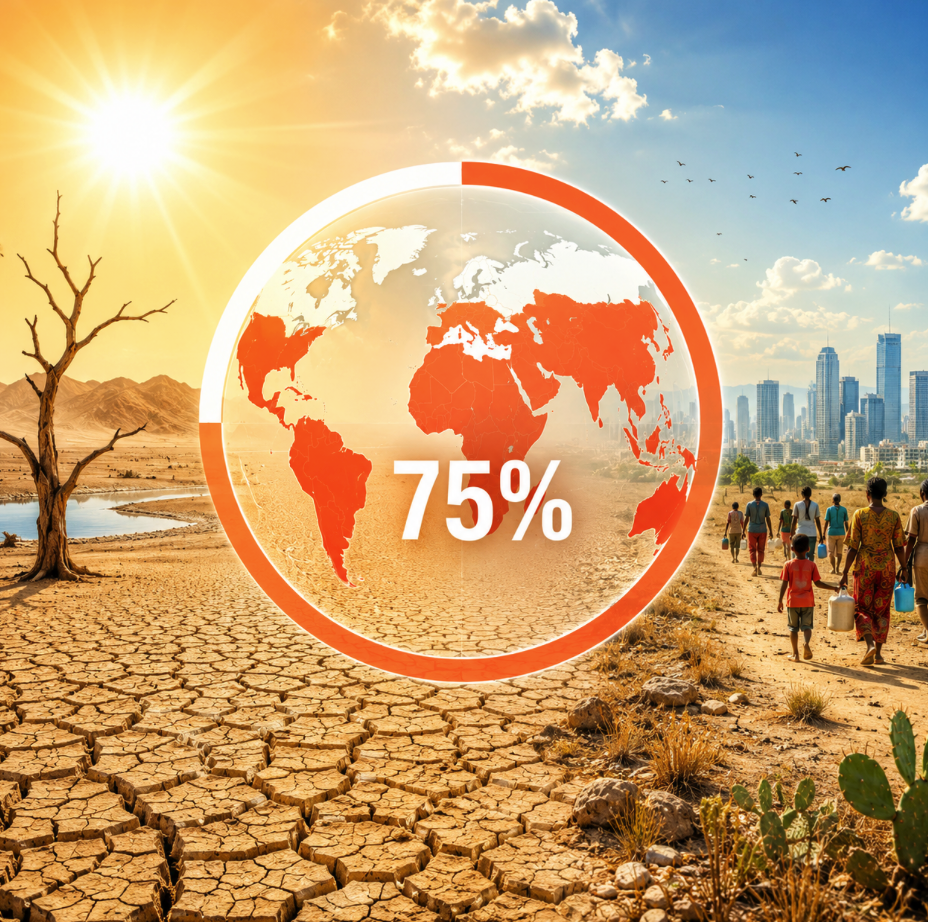
One study found that 75 percent of the population of the world currently lives in a country that is being affected by “continental drying”…
Much of the Earth is suffering a pandemic of “continental drying,” affecting the countries containing 75% of the world’s population, the new research shows.
The study, published in the journal Science Advances, examined changes to Earth’s total supply of fresh water and found that nearly 6 billion people live in the 101 countries facing a net decline in water supply, posing a “critical, emerging threat to humanity.”
I was stunned when I first read that.
If 6 billion people live in nations that are steadily drying out, what does that mean for the future of humanity?
We aren’t just talking about a few isolated deserts.
The United Nations is telling us that excluding Antarctica, drylands now account for more than 40 percent of all the land on this planet.
And more than three-quarters of all the land on this planet has been getting drier over the past 30 years…
As Earth continues to warm, more and more of the planet is becoming dry. A 2024 UN report found that in the last three decades, over three-fourths of all the world’s land became drier than it had been in the previous 30 years.
Drylands now comprise 40.6% of all global land (excluding Antarctica). In addition, the number of people living in drylands doubled over the last 30 years to 2.3 billion, which represents over 25% of the global population. In a worst-case climate change scenario, this number could climb to 5 billion by 2100.
Many of us have just come to accept that drought is a normal part of life.
If you look at the latest U.S. Drought Monitor map, it is a nightmare.
Right now, more than 60 percent of the continental United States is experiencing at least some level of drought…
As of May 26, 2026, 50.77% of the United States and Puerto Rico and 60.77% of the Lower 48 states are in drought.
Some of the areas that are being hit the hardest are where we grow our food.
In particular, wheat farmers in the U.S. are having a very challenging time this year…
It’s a perfect storm of terrible conditions for wheat farmers this year. Drought, dramatic swings in temperature, the skyrocketing price of fertilizer and diesel, plus multiple viruses affecting wheat have all led to one of the most challenging years for farmers in decades.
There are different classes of winter wheat, but they’re all down when compared to last year’s crop, explained Todd Hubbs, a crop marketing specialist at Oklahoma State University Extension.
What are they supposed to do?
If it doesn’t rain, it doesn’t rain.
Unfortunately, it is being projected that the winter wheat harvest in the U.S. will be down by 21 percent compared to last year…
The most widely produced class of wheat in the U.S., Hard Red Winter wheat, has a current production forecast of 515 million bushels. That may sound like a lot, but it would end up being the lowest since 1957, Hubbs said.
Soft red winter and white wheat varieties are also having tough years, with the lowest production volume in 6 to 10 years.
In all, growers will see their smallest wheat crop in terms of production since 1972, according to the U.S. Department of Agriculture; 1.56 billion bushels this year, down 21% from 2025.
Are you going to eat 21 percent less wheat this year?
I don’t think that anyone is planning to make that kind of sacrifice.
But there simply won’t be as much wheat as normal in 2026.
Kansas is a key wheat producing state, and a lack of rain has created nightmare conditions in much of the state…
The latest U.S. Drought Monitor (USDM) data, published May 28, shows 57% of Kansas suffering from drought, Sittel said.
“For the 26-year history of the USDM, the median coverage of drought in Kansas is 22%, which is another way to look at our current conditions against a historical time series,” Sittel said.
Typically, the winter wheat crop receives a few inches of rainfall in the spring, but that didn’t happen this year.
“The majority of the crop didn’t get that extra rainfall, and where we didn’t get any of that rainfall, a lot of times the crop already got terminated and insurance was called upon,” Lollato said. “Or we’re looking at very, very limited yield potentials, like 15–20 bushels per acre.”
We just experienced the driest first three months of a year ever recorded in the United States.
That is really saying something.
In addition to a seemingly endless drought, U.S. farmers are also facing much higher prices for diesel fuel and fertilizer.
On top of everything else, now a “Super El Niño” is coming, and that means that drought conditions will greatly intensify in many parts of the world.
This may be a good time to remind my readers that the “Super El Niño” of 1877-1878 caused horrifying droughts that killed more than 50 million people all over the globe.
Unfortunately, scientists are warning that the “Super El Niño” that will start later this year could be even more powerful.
Yes, we really are facing a catastrophic scenario.
But for now most of the population is still pretending that everything is going to be just fine, and so they continue to party as things rapidly get worse all around them.
Michael’s new book entitled “10 Prophetic Events That Are Coming Next” is available in paperback and for the Kindle on Amazon.com, and you can subscribe to his Substack newsletter at michaeltsnyder.substack.com.

About the Author: Michael Snyder’s new book entitled “10 Prophetic Events That Are Coming Next” is available in paperback and for the Kindle on Amazon.com. He has also written nine other books that are available on Amazon.com including “Chaos”, “End Times”, “7 Year Apocalypse”, “Lost Prophecies Of The Future Of America”, “The Beginning Of The End”, and “Living A Life That Really Matters”. When you purchase any of Michael’s books you help to support the work that he is doing. You can also get his articles by email as soon as he publishes them by subscribing to his Substack newsletter. Michael has published thousands of articles on The Economic Collapse Blog, End Of The American Dream and The Most Important News, and he always freely and happily allows others to republish those articles on their own websites. These are such troubled times, and people need hope. John 3:16 tells us about the hope that God has given us through Jesus Christ: “For God so loved the world, that he gave his only begotten Son, that whosoever believeth in him should not perish, but have everlasting life.” If you have not already done so, we strongly urge you to invite Jesus Christ to be your Lord and Savior today.