16 Facts About The Tremendous Financial Devastation That We Are Seeing All Over The World

Fireball - Devastation - Public DomainAs we enter the second half of 2015, financial panic has gripped most of the globe.  Stock prices are crashing in China, in Europe and in the United States.  Greece is on the verge of a historic default, and now Puerto Rico and Ukraine are both threatening to default on their debts if they do not receive concessions from their creditors.  Not since the financial crisis of 2008 has so much financial chaos been unleashed all at once.  Could it be possible that the great financial crisis of 2015 has begun?  The following are 16 facts about the tremendous financial devastation that is happening all over the world right now…

1. On Monday, the Dow fell by 350 points.  That was the biggest one day decline that we have seen in two years.

2. In Europe, stocks got absolutely smashed.  Germany’s DAX index dropped 3.6 percent, and France’s CAC 40 was down 3.7 percent.

3. After Greece, Italy is considered to be the most financially troubled nation in the eurozone, and on Monday Italian stocks were down more than 5 percent.

4. Greek stocks were down an astounding 18 percent on Monday.

5. As the week began, we witnessed the largest one day increase in European bond spreads that we have seen in seven years.

6. Chinese stocks have already met the official definition of being in a “bear market” – the Shanghai Composite is already down more than 20 percent from the high earlier this year.

7. Overall, this Chinese stock market crash is the worst that we have witnessed in 19 years.

8. On Monday, Standard & Poor’s slashed Greece’s credit rating once again and publicly stated that it believes that Greece now has a 50 percent chance of leaving the euro.

9. On Tuesday, Greece is scheduled to make a 1.6 billion euro loan repayment.  One Greek official has already stated that this is not going to happen.

10. Greek banks have been totally shut down, and a daily cash withdrawal limit of 60 euros has been established.  Nobody knows when this limit will be lifted.

11. Yields on 10 year Greek government bonds have shot past 15 percent.

12. U.S. investors are far more exposed to Greece than most people realize.  The New York Times explains…

But the question of what happens when the markets do open is particularly acute for the hedge fund investors — including luminaries like David Einhorn and John Paulson — who have collectively poured more than 10 billion euros, or $11 billion, into Greek government bonds, bank stocks and a slew of other investments.

Through the weekend, Nicholas L. Papapolitis, a corporate lawyer here, was working round the clock comforting and cajoling his frantic hedge fund clients.

“People are freaking out,” said Mr. Papapolitis, 32, his eyes red and his voice hoarse. “They have made some really big bets on Greece.”

13. The Governor of Puerto Rico has announced that the debts that the small island has accumulated are “not payable“.

14. Overall, the government of Puerto Rico owes approximately 72 billion dollars to the rest of the world.  Without debt restructuring, it is inevitable that Puerto Rico will default.  In fact, CNN says that it could happen by the end of this summer.

15. Ukraine has just announced that it may “suspend debt payments” if their creditors do not agree to take a 40 percent “haircut”.

16. This week the Bank for International Settlements has just come out with a new report that says that central banks around the world are “defenseless” to stop the next major global financial crisis.

Without a doubt, we are overdue for another major financial crisis.  All over the planet, stocks are massively overvalued, and financial markets have become completely disconnected from economic reality.  And when the next crash happens, many believe that it will be even worse than what we experienced back in 2008.  For example, just consider the words of Jim Rogers

“In the United States, we have had economic slowdowns every four to seven years since the beginning of the Republic. It’s now been six or seven years since our last stock market problem. We’re overdue for another problem.”

In Rogers’ view, low interest rates caused stock prices to increase significantly. He believes many assets are priced beyond their fundamentals thanks to the ultra-easy monetary policies by the Federal Reserve. Fed supporters argue such measures are good for investors, but Rogers takes a different view.

The Fed might tell us we don’t have to worry and that a correction or crash will never happen again. That’s balderdash! When this artificial sea of liquidity ends, we’re going to pay a terrible price. When the next economic problem occurs, it will be much worse because the debt is so much higher.”

Of course Rogers is far from alone.  A recent article by Paul B. Farrell expressed similar sentiments…

America’s 95 million investors are at huge risk. Remember the $10 trillion losses in the crash and recession of 2007-2009? The $8 trillion lost after the dot-com technology crash and recession of 2000-2003? This is the third big recession of the century. Yes, America will lose trillions again.

Especially with dead-ahead predictions like Mark Cook’s 4,000-point Dow correction. And Jeremy Grantham’s warning of a 50% crash around election time, with negative stock returns through the first term of the next president, beyond 2020. Starting soon.

Why is America so vulnerable when the next recession hits? Simple: The Fed’s cheap-money giveaway is killing America. When the downturn, correction, crash hits, it will compare to the 2008 crash. The Economist warns: “the world will be in a rotten position to do much about it. Rarely have so many large economies been so ill-equipped to manage a recession,” whatever the trigger.

Things have been relatively quiet in the financial world for so long that many have been sucked into a false sense of security.

But the underlying imbalances were always there, and they have been getting worse over time.

I believe that we are heading into a global financial collapse that will make what happened in 2008 look like a Sunday picnic by the time it is all said and done.

Global debt levels are at all-time highs, big banks all over the planet have been behaving more recklessly than ever, and financial markets are absolutely primed for a huge crash.

Hopefully things will calm down a bit as the rest of this week unfolds, but I wouldn’t count on it.

We have entered uncharted territory, and what comes next is going to shock the world.

And So It Begins – Greek Banks Get Shut Down For A Week And A ‘Grexit’ Is Now Probable

Greece Financial MeltdownIs this the beginning of the end for the eurozone?  For years, European officials have been trying to “fix Greece”, but nothing has worked.  Now a worst case scenario is rapidly unfolding, and a “Grexit” has become more likely than not.  On Sunday, the European Central Bank announced that it was not going to provide any more emergency support for Greek banks.  But that was the only thing keeping them alive.  In order to prevent total chaos, Greek banks have been shut down for at least a week.  ATMs are still open, but it is being reported that daily withdrawals will be limited to 60 euros.  Of course nobody knows for sure if or when the banks will reopen after this “bank holiday” is over, so needless to say average Greek citizens are pretty freaked out right about now.  In addition, the stock market in Greece is not going to open on Monday either.  This is what a national financial meltdown looks like, and the nightmare that has been unleashed in Greece will soon start spreading to much of the rest of Europe.

This reminds me so much of what happened in Cyprus.  Up until the very last minute, politicians were promising everyone that their money was perfectly safe, and then the hammer was brought down.

The exact same pattern is playing out in Greece.  For example, just check out what one very prominent Greek politician said on television on Saturday

“Citizens should not be scared, there is no blackmail,” Panos Kammenos, head of the government’s coalition ally, told local television. “The banks won’t shut, the ATMs will (have cash). All this is exaggeration,” he said.

One day later, the banks did get shut down and ATMs all over the country started running out of cash.  The following comes from CNBC

Despite a tweet from Greek Finance Minister Yanis Varoufakis that his government “opposed the very concept” of any controls, Greek Prime Minister Alexis Tsipras said later Sunday that he had forced the country’s central bank to recommend a bank holiday and capital controls.

The Athens stock exchange will also be closed as the government tries to manage the financial fallout of the disagreement with the European Union and the International Monetary Fund. Greece’s banks, kept afloat by emergency funding from the European Central Bank, are on the front line as Athens moves towards defaulting on a 1.6 billion euros payment due to the International Monetary Fund on Tuesday.

So what is the moral of this story?

Never trust politicians – especially when a major financial crisis is looming.

All over Greece, people are taking photos of very long lines at the ATMs that actually do still have some cash.  Here are just a couple of examples…

—–

Of course those that were smart enough to see this coming took their money out of the banks long ago.  And even as late as last week, people were pulling more than a billion euros out of the banks every single day.  Without direct intervention by the European Central Bank, most Greek banks would have totally collapsed by now

Customers have been withdrawing money in vast quantities ever since Syriza came to power, fearing that if Greece is thrown out of the single currency their euro savings will be converted into drachma – likely to be worth far less.

In the last week, the sums being taken out have risen to well over one billion euros a day, moved either to foreign banks or stashed in notes under mattresses.

It has been a slow and steady run on Greece’s banks which is now speeding up – for the finish line may well be in sight. Until now, the country’s banks have been kept afloat by €88 billion in loans from the European Central Bank.

So now that the banks are shut down, what happens next?

Needless to say, economic activity in Greece is going to come to a grinding halt.  In addition, very few foreigners are going to want to travel to Greece or deal with Greece financially until this crisis is resolved somehow

An extended bank shutdown and tough capital controls will likely wreak further havoc on the Greek economy by scaring away tourists and chilling commercial activity.

And with Greece unable to borrow from financial markets, and apparently unwilling to strike a deal with the only institutions prepared to lend it money, it will find itself sliding rapidly towards exit from the euro.

When the Greek banks finally do reopen, which of them will still be solvent?

Will some of them need “bail-ins”?

Will account holders be forced to take “haircuts” like we saw in Cyprus?

For the moment, what we do know is that the banks will all be shut down until at least July 6th.  Greek Prime Minister Alexis Tsipras has called for a national referendum to be held on July 5th.  The Greek people will get a chance to vote on whether or not the latest creditor proposals should be accepted.  But the funny thing is that Tsipras and the rest of Syriza are already encouraging the Greek people to vote no

Greece’s parliament has voted in favor of Prime Minister Alexis Tsipras’ motion to hold a referendum on the country’s creditor proposals for reforms in exchange for loans, the Associated Press reported. Tsipras and his coalition government have urged people to vote against the deal, throwing into question the country’s financial future.

The vote is to be held next Sunday, July 5. It has raised the question of whether Greece can remain in Europe’s joint currency, the euro.

So why hold a referendum if you just want everyone to vote no?

It is because Tsipras does not want to solely shoulder the blame for what comes next.  A “no vote” would essentially be a vote to leave the euro and go back to the drachma.  The following comes from the Daily Mail

Should Greeks vote against the new bailout, most economists believe Greece will be forced to quit the single currency and return to the drachma. The country could even eventually be forced out of the EU, though Greek politicians have long argued a Grexit would not be the automatic result of default.

However, next week’s referendum is likely to be billed as, in effect, an in-out vote on the euro.

If Greece does default and ends up leaving the euro, the short-term economic consequences for Greece will be catastrophic.

But the rest of Europe will feel a tremendous amount of pain as well.  In fact, we are already getting a sneak peek at coming attractions.  As we approach Monday morning in Europe, Asian stocks are crashing big time, and European futures are absolutely cratering.  It should be very interesting to see how Monday plays out.

In addition, the euro is already way down in early trading.  If Greece does ultimately leave the euro, the value of the euro is going to plunge like a rock.  As I have warned repeatedly, the euro is heading for parity with the U.S. dollar, and at some point it will drop below parity.

And once Greece is out, everyone is going to be speculating who the “next Greece” will be.  Expect bond yields for Italy, Spain, Portugal and France to go skyrocketing.

Just a couple of days ago, I issued a red alert for the second half of 2016.  We are entering a period of time when the global financial system is beginning to unravel.  Most people still have a tremendous amount of faith in the system and assume that those running it are fully capable of keeping it from collapsing.  In fact, many have accused me of being crazy for suggesting that the global financial system is in imminent danger of imploding.

A very wise man once said that “pride goeth before destruction”.  Our arrogance and our blind faith in the fundamentally flawed systems that we have established will contribute greatly to our undoing.

Events are starting to accelerate greatly now, and it is just a matter of time before we see who was right and who was wrong.


The Liquidity Crisis Intensifies: ‘Prepare For A Bear Market In Bonds’

Bear Market - Public DomainAre we about to witness trillions of dollars of “paper wealth” vaporize into thin air?  During the next financial crisis, a lot of “wealthy” investors are going to be in for a very rude awakening.  The truth is that securities are only worth what someone else is willing to pay for them, and that is why liquidity is so important.  Back on April 17th, I published an article entitled “The Global Liquidity Squeeze Has Begun“, but it didn’t get nearly as much attention as many of my other articles do.  But now that the liquidity crisis is intensifying, hopefully people will start to grasp the implications of what is happening.  The 76 trillion dollar global bond bubble is threatening to implode, and if it does, the amount of “paper wealth” that could potentially be lost during the months ahead is almost unimaginable.

For those that do not consider the emerging liquidity crisis to be important, I would suggest that they check out what the financial experts are saying.  For instance, the following comes from a recent Bloomberg report

There are three things that matter in the bond market these days: liquidity, liquidity and liquidity.

How — or whether — investors can trade without having prices move against them has become a major worry as bonds globally tanked in the past few months. As a result, liquidity, or the lack of it, is skewing markets in new and surprising ways.

Things have already gotten so bad that Zero Hedge says that some fund managers “are starting to panic” about the lack of liquidity in the marketplace…

Fund managers who together control trillions in assets are starting to panic in the face of an acute bond market liquidity shortage.

Dealer inventories have collapsed in the post-crisis regulatory regime, eliminating the traditional source of liquidity in secondary corporate credit markets, while HFTs and central banks have combined to create the conditions under which USTs and German Bunds can, at any given time, trade like penny stocks (October’s Treasury flash crash and May’s dramatic Bund rout are the quintessential examples).

For a moment, just imagine what would happen if someone yelled “fire” in a very crowded movie theater, and the only exit was a very small doggie door that only one person at a time could squeeze through.  According to experts, that is what the bond market could soon look like

When the unwind comes, like we’ve seen in the past few months, it comes abruptly and sharply as the exit door is tiny,” said Ryan Myerberg, a London-based fund manager at Janus Capital Group Inc., which oversees about $190 billion.

Are you starting to get the picture?

In the end, I believe that those that “squeezed through the door” during this time period are going to be very glad that they got out while they still could.

For much more on the coming bond collapse, check out this YouTube video from Ron Paul in which he explains why we should “prepare for a bear market in bonds”…

Another very prominent voice that is deeply concerned about bonds is Carl Icahn.  The following is what he told CNBC on Wednesday…

Carl Icahn warned investors on Wednesday that he believes the market is “extremely overheated—especially high-yield bonds.”

I think the public is walking into a trap again as they did in 2007,” the activist investor told CNBC’s “Fast Money Halftime Report.” “I think it’s almost the duty of well-respected investors, like myself I hope, to warn people, to tell people, that really you are making errors.”

Icahn compared the current market situation to the prerecession days, when mortgage-backed securities were being widely sold. “It’s almost deja vu,” he said.

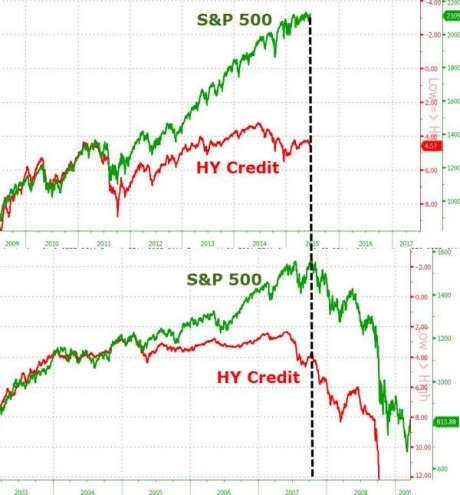
Let’s talk about high-yield bonds for a moment.  Prior to the last financial crisis, they started crashing way before stocks did, and now we see the exact same pattern repeating once again.

Normally high yield credit tracks stocks very closely.  When there is a disconnect, that can be a huge sign of trouble.  The following chart comes from Zero Hedge, and it brilliantly demonstrates how similar things are today to the period just before the stock market crash of 2008…

S&P 500 HY Credit

It is glaringly apparent that we are due for a “correction”.  And even though stocks have recently hit brand new record highs, there are rumblings under the surface that a big move down is right around the corner.

For example, USA Today is reporting that mutual fund investors have pulled more money out of stocks than they have put in for 16 weeks in a row….

In a sign of stock market nervousness on Main Street, mutual fund investors have yanked more money out of U.S. stock funds than they put in for 16 straight weeks.

The last time domestic stock funds had positive net cash inflows was in the week ending Feb. 25, according to data from the Investment Company Institute, a mutual fund trade group.

In the week ended June 17, the most recent data available, mutual funds that invest in U.S. stocks suffered net outflows of $3.45 billion, according to the ICI.

Since late February, U.S. stock funds have suffered estimated outflows of nearly $55 billion. Those net withdrawals come despite the fact the benchmark Standard & Poor’s 500 hit a fresh record high of 2130.82 on May 21 and the Dow Jones industrial average notched a fresh record on May 19.

Those that are smart are getting out while the getting is good.

In all the time that I have been publishing The Economic Collapse Blog, I have never seen stocks so primed for a crash.  If you were writing up a scenario for a textbook that imagined what a lead up to a major stock market crash would look like, you could very easily use the last six months as a model.

For a long time, many people out there (including some of my readers) have been very impatiently waiting for the financial markets to crash.  But this is not something that any of us should want to see.  When this next great financial crisis comes, it is going to be absolutely horrible.  Millions upon millions of workers will lose their jobs, and there will be tremendous economic suffering all over the planet.

Tomorrow I plan to share something that is going to shock a lot of people.

It is going to be something that I have never done before, but the time has come.

Stay tuned…

Warren Buffett: Derivatives Are Still Weapons Of Mass Destruction And ‘Are Likely To Cause Big Trouble’

Nuclear War - Public DomainAfter all these years, the most famous investor in the world still believes that derivatives are financial weapons of mass destruction.  And you know what?  He is exactly right.  The next great global financial collapse that so many are warning about is nearly upon us, and when it arrives derivatives are going to play a starring role.  When many people hear the word “derivatives”, they tend to tune out because it is a word that sounds very complicated.  And without a doubt, derivatives can be enormously complex.  But what I try to do is to take complex subjects and break them down into simple terms.  At their core, derivatives represent nothing more than a legalized form of gambling.  A derivative is essentially a bet that something either will or will not happen in the future.  Ultimately, someone will win money and someone will lose money.  There are hundreds of trillions of dollars worth of these bets floating around out there, and one of these days this gigantic time bomb is going to go off and absolutely cripple the entire global financial system.

Back in 2002, legendary investor Warren Buffett shared the following thoughts about derivatives with shareholders of Berkshire Hathaway

The derivatives genie is now well out of the bottle, and these instruments will almost certainly multiply in variety and number until some event makes their toxicity clear. Central banks and governments have so
far found no effective way to control, or even monitor, the risks posed by these contracts. In my view, derivatives are financial weapons of mass destruction, carrying dangers that, while now latent, are potentially lethal.

Those words turned out to be quite prophetic.  Derivatives have definitely multiplied in variety and number since that time, and it has become abundantly clear how toxic they are.  Derivatives played a substantial role in the financial meltdown of 2008, but we still haven’t learned our lessons.  Today, the derivatives bubble is even larger than it was just before the last financial crisis, and it could absolutely devastate the global financial system at any time.

During one recent interview, Buffett was asked if he is still convinced that derivatives are “weapons of mass destruction”.  He told the interviewer that he believes that they are, and that “at some point they are likely to cause big trouble”

Thirteen years after describing derivatives as “weapons of mass destruction” Warren Buffett has reaffirmed his view that they pose a threat to the global economy and financial markets.

In an interview with Chanticleer this week, Buffett said that “at some point they are likely to cause big trouble“.

“Derivatives, lend themselves to huge amounts of speculation,” he said.

Most of the time, the big banks that do most of the trading in these derivatives do very well.  They use extremely sophisticated computer algorithms that help them come out on the winning end of these bets most of the time.

But when there is some sort of unforeseen event that suddenly causes a massive shift in the marketplace, that can cause tremendous problems.  This is something that Buffett discussed during his recent interview

“The problem arises when there is a discontinuity in the market for some reason or another.

“When the markets closed like it was for a few days after 9/11 or in World War I the market was closed for four or five months – anything that disrupts the continuity of the market when you have trillions of dollars of nominal amounts outstanding and no ability to settle up and who knows what happens when the market reopens,” he said.

So if the markets behave fairly calmly and predictably, the derivatives bubble probably will not burst.

But no balancing act of this nature ever lasts forever.  Just remember what happened in 2008.  Lehman Brothers collapsed and then the financial system virtually froze up.  According to Forbes, at that time almost everyone was afraid to deal with the big banks because nobody was quite sure how much exposure they had to these risky derivatives…

Fast forward to the financial meltdown of 2008 and what do we see? America again was celebrating. The economy was booming. Everyone seemed to be getting wealthier, even though the warning signs were everywhere: too much borrowing, foolish investments, greedy banks, regulators asleep at the wheel, politicians eager to promote home-ownership for those who couldn’t afford it, and distinguished analysts openly predicting this could only end badly. And then, when Lehman Bros fell, the financial system froze and world economy almost collapsed. Why?

The root cause wasn’t just the reckless lending and the excessive risk taking. The problem at the core was a lack of transparency. After Lehman’s collapse, no one could understand any particular bank’s risks from derivative trading and so no bank wanted to lend to or trade with any other bank. Because all the big banks’ had been involved to an unknown degree in risky derivative trading, no one could tell whether any particular financial institution might suddenly implode.

After the crisis, we were promised that something would be done about the “too big to fail” problem.

But instead, the problem of “too big to fail” is now larger than ever.

Since the last financial crisis, the four largest banks in the country have gotten approximately 40 percent larger.  Today, the five largest banks account for approximately 42 percent of all loans in the United States, and the six largest banks account for approximately 67 percent of all assets in our financial system.  Without those banks, we would not have much of an economy left at all.

Meanwhile, smaller banks have been going out of business or have been swallowed up by the big banks at a staggering rate.  Incredibly, there are 1,400 fewer small banks in operation today than there were when the last financial crisis erupted.

So we cannot afford for these “too big to fail” banks to actually fail.  Even the failure of a single one would cause a national financial nightmare.  The “too big to fail” banks that I am talking about are JPMorgan Chase, Citibank, Goldman Sachs, Bank of America, Morgan Stanley and Wells Fargo.  When you total up the exposure to derivatives that all of them currently have, it comes to a grand total of more than 278 trillion dollars.  But when you total up all of the assets of all six banks combined, it only comes to a grand total of about 9.8 trillion dollars.  In other words, the “too big to fail” banks have exposure to derivatives that is more than 28 times the size of their total assets.

I have shared the following numbers with my readers before, but it is absolutely crucial that we all understand how exceedingly vulnerable our financial system really is.  These numbers come directly from the OCC’s most recent quarterly report (see Table 2), and they reveal a recklessness that is almost beyond words…

JPMorgan Chase

Total Assets: $2,573,126,000,000 (about 2.6 trillion dollars)

Total Exposure To Derivatives: $63,600,246,000,000 (more than 63 trillion dollars)

Citibank

Total Assets: $1,842,530,000,000 (more than 1.8 trillion dollars)

Total Exposure To Derivatives: $59,951,603,000,000 (more than 59 trillion dollars)

Goldman Sachs

Total Assets: $856,301,000,000 (less than a trillion dollars)

Total Exposure To Derivatives: $57,312,558,000,000 (more than 57 trillion dollars)

Bank Of America

Total Assets: $2,106,796,000,000 (a little bit more than 2.1 trillion dollars)

Total Exposure To Derivatives: $54,224,084,000,000 (more than 54 trillion dollars)

Morgan Stanley

Total Assets: $801,382,000,000 (less than a trillion dollars)

Total Exposure To Derivatives: $38,546,879,000,000 (more than 38 trillion dollars)

Wells Fargo

Total Assets: $1,687,155,000,000 (about 1.7 trillion dollars)

Total Exposure To Derivatives: $5,302,422,000,000 (more than 5 trillion dollars)

Since the United States was first established, the U.S. government has run up a total debt of a bit more than 18 trillion dollars.  It is the biggest mountain of debt in the history of the planet, and it has grown so large that it is literally impossible for us to pay it off at this point.

But the top five banks in the list above each have exposure to derivatives that is more than twice the size of the national debt, and several of them have exposure to derivatives that is more than three times the size of the national debt.

That is why I keep saying that there will not be enough money in the entire world to bail everyone out when this derivatives bubble finally implodes.

Warren Buffett is entirely correct about derivatives – they truly are weapons of mass destruction that could destroy the entire global financial system at any time.

So as we move into the second half of this year and beyond, you will want to watch for terms like “derivatives crisis” or “derivatives crash” in news reports.  When derivatives start making front page news, that will be a really, really bad sign.

Our financial system has been transformed into the largest casino in the history of the planet.  For the moment, the roulette wheels are still spinning and everyone is happy.  But sooner or later, a “black swan event” will happen that nobody expected, and then all hell will break loose.

Lindsey Williams, Martin Armstrong And Alex Jones All Warn About What Is Coming In The Fall Of 2015

Warnings - Public DomainNot since the financial crash of 2008 have so many prominent people issued such urgent warnings about a specific time period.  Almost daily now, really big names are coming out with chilling predictions about what they believe is going to happen during the second half of 2015.  But it isn’t just that these people have a “bad feeling” about things.  The truth is that we are witnessing a confluence of circumstances and events in the second half of this year that is unprecedented.  This is something that I covered in a previous article that went mega-viral all over the Internet entitled “7 Key Events That Are Going To Happen By The End Of September“.  Personally, I have never been more concerned about any period of time than I am about the second half of 2015.  And as you will see below, I am definitely not alone.

Just a few days ago, I received an email that contained a chilling message from Lindsey Williams.  You can view the same message that came to my email right here.  According to Lindsey Williams, the elite insider that he is in contact with told him that there will be a global financial collapse between September and December of this year…

WARNING!

From Lindsey Williams: I just received an email from my Elite friend.

My Elite friend indicated that they have a World Wide Financial Collapse scheduled between September and the end of December 2015

You may have just THREE (3) months to prepare!

I have a ton of respect for Lindsey Williams, and I would listen to what he has to say very carefully.  Back in 2008, an elite insider told him that the price of oil would drop from $140 a barrel to $40 a barrel, and it happened.  This time around, Williams has been telling us throughout 2013 and 2014 that a global financial collapse was not going to happen during those years, and he was right about that.

But now he is sounding the alarm that one is going to come by the end of this calendar year.

Martin Armstrong is someone else that has been sounding the alarm about the second half of this year.

In fact, Armstrong says that he has “warned that the Big Bang was coming 2015.75” since 1985.

In the past, I have written entire articles about economic cycle theories and what they indicate is coming in our future.

Armstrong has developed one of his own, and he calls it the Economic Confidence Model.  According to the ECM, the “sovereign debt Big Bang” is scheduled to happen by the end of 2015.  And it turns out that the time period that Armstrong has been pointing to lines up with a whole bunch of other significant events as well

There are many aspects that are lining up with the turn in the ECM (Economic Confidence Model) from the Blood Moon and the Jewish Year for forgiving the debts, to France imposing restrictions on cash in September, and even in Germany the laws that protected about half a million people so-called dachas there in East Germany expire. To date, a law protecting the tenant against dismissal by the municipality will also expire October 3, 2015. Everywhere we look, there are changes coming to a head, right down to the U.S. Federal budget with 2015.75.

In case you are tempted to dismiss this as nonsense, Armstrong has pointed out that his ECM has been accurate “to the day” in the past

Of course the 1987 crash bottomed to the day with the ECM confirming that was the low. The same took place in 1994 where the U.S. share market bottomed right to the day, once again confirming this was an important low.

So will the ECM be right again this time?

Only time will tell, but it should be noted that the global bond market is already starting to crash.  If Armstrong ultimately turns out to be correct, we could be on the verge of a major turning point

This next turning point should be the peak in the concentration of capital and confidence in government. From there on out, 2015.75 should mark the change in trend where people will start to disbelieve government on a grand scale. The debt markets that peak precisely with the target are going to get the worst of it.

Other financial experts are issuing similar warnings, even if they aren’t being quite as specific.

For example, just consider what Jim Rogers had to say recently…

I suspect in the next year or two we will see some kind of major, major problems in the world financial markets.

I would suspect when we have this correction, it’s going to cause central banks to panic. There’s going to come a time when there is not much the central banks can do when they have lost all credibility. When governments have lost all credibility. They will print and spend and borrow, but there comes a time when people are just going to say We don’t want to play this game anymore. And at that point, the world has serious, serious problems because there’s nothing to rescue us.

Perhaps the most sobering warning of all that I have come across in recent days is from Alex Jones.

In the video posted below, he explains that he recently received “two different calls” from “extremely prominent wealthy people” warning him about what is coming by the end of this year and asking him why he isn’t leaving the United States “before October”.

In other words, these individuals believe that something really big is going to happen by the end of September.  This dovetails perfectly with what I have already been warning about.

In this video, Alex also explains that large numbers of insiders are now quietly leaving the country.  I have never seen him quite like this.  I think that so many of us are just in shock that the things that we have been warning about for so long are now actually happening.  Watch this video for yourself and see what you think…

In the financial markets, we are also seeing signals that many people believe that big trouble is right around the corner.  For instance, according to Dana Lyons we haven’t seen bets that the VIX will rise at this level since just before the financial crash of 2008…

As most observers are aware, the VIX tends to rise as the stock market declines. Thus a rising VIX is associated with bad markets. The interesting thing about present conditions in VIX options is that the Put/Call Ratio (using a 21-day average) is at the lowest level since the summer of 2008. That means that there are more bets on a rising VIX versus bets on a falling VIX than we have seen in 7 years. And again, a rising VIX is associated with bad markets.

In other words, investors are betting a tremendous amount of money that we are going to see a rise in volatility in the financial markets in the months ahead.  And as I have explained so many times before, during times of high volatility markets tend to go down very rapidly.  So these bets will pay off very handsomely if there is a financial crash this fall.

Meanwhile, the manager of one of the largest bond funds in the UK is warning that a “systemic event” could soon hit global financial markets and that it is wise to have some “physical cash” at home just in case there is some sort of major emergency.  The following comes from Zero Hedge

The manager of one of Britain’s biggest bond funds has urged investors to keep cash under the mattress.

Ian Spreadbury, who invests more than £4bn of investors’ money across a handful of bond funds for Fidelity, including the flagship Moneybuilder Income fund, is concerned that a “systemic event” could rock markets, possibly similar in magnitude to the financial crisis of 2008, which began in Britain with a run on Northern Rock.

“Systemic risk is in the system and as an investor you have to be aware of that,” he told Telegraph Money.

The best strategy to deal with this, he said, was for investors to spread their money widely into different assets, including gold and silver, as well as cash in savings accounts. But he went further, suggesting it was wise to hold some “physical cash”, an unusual suggestion from a mainstream fund manager.

This sounds like what I have been saying for years.  I am a big believer in not having all of your financial eggs in one basket, and I do believe that it is wise to have at least some emergency cash at home.

But to hear it from a member of Britain’s financial elite is definitely unusual to say the least.

Sadly, just like last time, most people are not listening to the warnings.  Back in the summer of 2008, my wife and I went up to visit her parents.  I sat on their sofa and told them that a great financial collapse was about to unfold and that it would shake the entire world.  Of course just a few months later that is exactly what happened.

Now we are on the verge of an even greater financial collapse, and still I find that there are a lot of people out there that are doubters.  Most of these doubters have an immense amount of faith in the system, and they are confident that this debt-fueled bubble of false prosperity that we are currently enjoying can somehow last indefinitely.

I truly wish that the hopeless optimists were right.

I truly wish that I could live out my days in peace and quiet in a world that was safe and stable.

Unfortunately for all of us, things are about to change in a major way.  When it starts happening, don’t forget that there have been people that have been warning you that this would happen all along.

Signs Of Financial Turmoil In Europe, China And The United States

Earth In Peril - Public DomainAs we move toward the second half of 2015, signs of financial turmoil are appearing all over the globe.  In Greece, a full blown bank run is happening right now.  Approximately 2 billion euros were pulled out of Greek banks in just the past three days, Barclays says that capital controls are “imminent” unless a debt deal is struck, and there are reports that preparations are being made for a “bank holiday” in Greece.  Meanwhile, Chinese stocks are absolutely crashing.  The Shanghai Composite Index was down more than 13 percent this week alone.  That was the largest one week decline since the collapse of Lehman Brothers.  In the U.S., stocks aren’t crashing yet, but we just witnessed one of the largest one week outflows of capital from the bond markets that we have ever witnessed.  Slowly but surely, we are starting to see the smart money head for the exits.  As one Swedish fund manager put it recently, everyone wants “to avoid being caught on the wrong side of markets once the herd realizes stocks are over-valued“.

I don’t think that most people understand how serious things have gotten already.  In Greece, so much money has been pulled out of the banks that the European Central Bank admits that Greek banks may not be able to open on Monday

The European Central Bank told a meeting of euro zone finance ministers on Thursday that it was not sure if Greek banks, which have been suffering large daily deposit outflows, would be able to open on Monday, officials with knowledge of the talks said.

Greek savers have withdrawn about 2 billion euros from banks over the past three days, with outflows accelerating rapidly since talks between the government and its creditors collapsed at the weekend, banking sources told Reuters.

All over social media, people are sharing photos of long lines at Greek ATMs as ordinary citizens rush to get their cash out of the troubled banks.  Here is one example

And if there is no debt deal by the end of this month, the Greek debt crisis is going to totally spin out of control and financial chaos will begin to erupt all over Europe.  But instead of trying to be reasonable, EU president Donald Tusk “has delivered an ultimatum to Greece”, and it almost appears as if EU officials are more concerned about winning a power struggle than they are about averting financial catastrophe…

EU president Donald Tusk has delivered an ultimatum to Greece, claiming the country must ‘accept an offer or default’ at an emergency summit set for Monday – in a last-ditch effort to stop the debt-stricken nation crashing out of the euro.

‘We are close to the point where the Greek government will have to choose between accepting what I believe is a good offer of continued support or to head towards default,’ Mr Tusk said today.

His comments come as Greek Prime Minister Alexis Tsipras warned that his country’s exit from the eurozone would trigger the collapse of the single currency.

‘The famous Grexit cannot be an option either for the Greeks or the European Union,’ he said in an Austrian newspaper interview.

‘This would be an irreversible step, it would be the beginning of the end of the eurozone.’

While all of this has been going on, the obscene stock market bubble in China has started to implode.  Just check out the following numbers from Zero Hedge

As the carnage began last night in China we noted the extreme levels of volatility the major indices had experienced in recent weeks. By the close, things were ugly with the broad Shanghai Composite down a stunning 13.3% on the week – the most since Lehman in 2008 (with Shenzhen slightly better at down 12.8% and CHINEXT down a record-breaking 14.99%).

Under normal circumstances, numbers like these would be reason for a full-blown financial panic over in Asia.  But these are not normal times.  Even with these losses, stock prices in China are still massively overinflated.  For example, USA Today is reporting that the median stock over in China is “trading at 95 times earnings”…

Margin debt in China has soared to a record $363 billion, according to Bloomberg, and the median stock in mainland China is now trading at 95 times earnings, which even tops the price-to-earnings multiple of 68 back at the 2007 peak.

That is absolutely ridiculous.  When a stock is trading at 25 or 30 times earnings it is overpriced.  So these numbers that are coming out of China are beyond crazy, and what this means is that Chinese stocks have much, much farther to fall before they get back to any semblance of reality.

Meanwhile, in the U.S. money is flowing out of bonds at a staggering pace.  The following quote originally comes from Bank of America

“High grade credit funds suffered their biggest outflow this year, and double the previous week (and also the biggest since June 2013). High yield outflows also jumped to $1.1bn, the biggest since the start of the year. However, government bond funds suffered the most amid the recent spike in volatility, with outflows surging to the highest weekly number on record ($2.7bn). This brings the total outflow from fixed income funds to almost $6bn over the last week, the highest since the Taper Tantrum and the third highest outflow ever.”

What this means is that big trouble is brewing in the bond markets.  This is something that I warned about in my previous article entitled “Experts Are Warning That The 76 Trillion Dollar Global Bond Bubble Is About To Explode“.

For the moment, U.S. stocks are doing fine.  But just about everyone can see that we in a massive financial bubble that could burst at any time.  Presidential candidate Donald Trump says that what we are witnessing is a “big fat economic and financial bubble like you’ve never seen before”

Yesterday during an interview on MSNBC, presidential candidate Donald Trump said he has some big names in mind for the Treasury secretary if he wins the White House. “I’d like guys like Jack Welch. I like guys like Henry Kravis. I’d love to bring my friend Carl Icahn.” He also opined on the economy and the stock market, admitting that the Fed has benefited people like him but that the economy and is in a “big fat economic and financial bubble like you’ve never seen before.

Ron Paul also believes that this financial bubble is going to end very badly.  Just check out what he told CNBC earlier this week

Despite record highs in the market, former Rep. Ron Paul says the Fed’s easy money policies have left stocks and bonds are on the verge of a massive collapse.

“I am utterly amazed at how the Federal Reserve can play havoc with the market,” Paul said on CNBC’s “Futures Now” referring to Thursday’s surge in stocks. The S&P 500 closed less than 1 percent off its all-time high. “I look at it as being very unstable.”

In Paul’s eyes, “the fallacy of economic planning” has created such a “horrendous bubble” in the bond market that it’s only a matter of time before the bottom falls out. And when it does, it will lead to “stock market chaos.”

Yes, this financial bubble has persisted far longer than many believed possible, but all irrational bubbles eventually burst.

And you know what they say – the bigger they come the harder they fall.

When this gigantic financial bubble finally implodes, it is going to be absolutely horrifying, and the entire planet is going to be shocked by the carnage.

The Next Great European Financial Crisis Has Begun

European Financial CrisisThe Greek financial system is in the process of totally imploding, and the rest of Europe will soon follow.  Neither the Greeks nor the Germans are willing to give in, and that means that there is very little chance that a debt deal is going to happen by the end of June.  So that means that we will likely see a major Greek debt default and potentially even a Greek exit from the eurozone.  At this point, credit default swaps on Greek debt have risen 456 percent in price since the beginning of this year, and the market has priced in a 75 percent chance that a Greek debt default will happen.  Over the past month, the yield on two year Greek bonds has skyrocketed from 20 percent to more than 30 percent, and the Greek stock market has fallen by a total of 13 percent during the last three trading days alone.  This is what a financial collapse looks like, and if Greece does leave the euro, we are going to see this kind of carnage happen all over Europe.

Officials over in Europe are now openly speaking of the need to prepare for a “state of emergency” now that negotiations have totally collapsed.  At one time, it would have been unthinkable for Greece to leave the euro, but now it appears  that this is precisely what will happen unless a miracle happens…

Greece is heading for a state of emergency and an exit from the euro following the collapse of talks to agree a bailout deal, senior EU officials warned last night.

Europe must be prepared to step in otherwise Greek society would face an unprecedented crisis with power blackouts, medicine shortages and no money to pay for police, they said.

In the past, the Greeks have always buckled under pressure.  But this new Greek government was elected with a mandate to end austerity, and so far they have shown a remarkable amount of resolve.  In order for a debt deal to happen, one side is going to have to blink, and at this point it does not look like it will be the Greeks

The world’s financial markets are facing up to the possibility that Greece could soon become the first country to crash out of Europe’s single currency. Talks between Athens and its eurozone creditors have collapsed in acrimony just days before a final deadline for Greece to unlock the €7.2bn (£5.2bn) in bailout funds it needs to avoid a catastrophic debt default.

The Greek Prime Minister, Alexis Tsipras, accused the creditor powers of hidden “political motives” in their demands that Greece make further cuts to public pension payments in return for the financial aid. “We are shouldering the dignity of our people, as well as the hopes of the people of Europe,” Mr Tsipras said in a defiant statement. “We cannot ignore this responsibility. This is not a matter of ideological stubbornness. This is about democracy.”

As we approach the point of no return, both sides are preparing for the endgame.

In Greece, members of parliament have been studying what happened in Iceland a few years ago.  Many of them believe that a Greek debt default combined with a nationalization of Greek banks and a Greek exit from the euro could set the nation back on the path to prosperity fairly rapidly.  The following comes from the Telegraph

The radical wing of Greece’s Syriza party is to table plans over coming days for an Icelandic-style default and a nationalisation of the Greek banking system, deeming it pointless to continue talks with Europe’s creditor powers.

Syriza sources say measures being drafted include capital controls and the establishment of a sovereign central bank able to stand behind a new financial system. While some form of dual currency might be possible in theory, such a structure would be incompatible with euro membership and would imply a rapid return to the drachma.

The confidential plans were circulating over the weekend and have the backing of 30 MPs from the Aristeri Platforma or ‘Left Platform’, as well as other hard-line groupings in Syriza’s spectrum. It is understood that the nationalist ANEL party in the ruling coalition is also willing to force a rupture with creditors, if need be.

Meanwhile, in a desperate attempt to get the Greeks to give in at the last moment, Greek’s creditors are preparing to pull out all the stops in order to put as much financial pressure on Greece as possible

Germany’s Suddeutsche Zeitung reported that the creditors are drawing an ultimatum to the Greeks, threatening to cut off Greek access to the European payments system and forcing capital controls on the country as soon as this weekend. The plan would lead to the temporary closure of the banks, followed by a rationing of cash withdrawals.

For a long time, most in the financial world assumed that a debt deal would eventually happen.  But now reality is setting in.  As I mentioned at the top of this article, the cost to insure Greek debt has risen by an astounding 456 percent since the beginning of this year

Given these dramatic stakes, the risk of a Greek default has gone way up. One way to measure that risk is by looking at the skyrocketing price of insurance policies that would pay out if Greek bonds go bust. The cost to insure Greek debt for one year against the risk of default has skyrocketed 456% since the start of the 2015, according to FactSet data.

These insurance-like contracts, known as credit default swaps, imply there is a 75% to 80% probability of Greece defaulting on its debt, according to Jigar Patel, a credit strategist at Barclays.

The probability of a Greek default soars to a whopping 95% for five-year CDS, Patel said.

“Default is looking more and more likely,” Peter Boockvar, chief market analyst at The Lindsey Group, wrote in a note to clients on Tuesday.

And in recent days, we have also seen Greek stocks and Greek bonds totally crash.  The following comes from CNN

The Greek stock market has plummeted 13% over the past three trading days, including a 3% drop on Tuesday alone.

In the bond market, the yield on Greek two-year debt has skyrocketed to 30.2%. A month ago, the yield was only 20%. Yields rise as bond prices fall.

Of course if there is a Greek debt default and Greece does leave the euro, it won’t just be Greece that pays the price.

As I have written about previously, there are tens of trillions of dollars in derivatives that are directly tied to currency exchange rates and 505 trillion dollars in derivatives that are directly tied to interest rates.  A “Grexit” would cause the euro to drop like a rock and interest rates all over the continent would start to go crazy.  The financial chaos that a “Grexit” would cause should not be underestimated.

And there are signs that some of Europe’s biggest banks are already on the verge of collapse.  For example, just consider what has been going on at the biggest bank in Germany.  Both of the co-CEOs at Deutsche Bank recently resigned, and it is increasingly looking as if it could soon become Europe’s version of Lehman Brothers.  The following summary of the recent troubles at Deutsche Bank comes from an article that was posted on NotQuant

Here’s a re-cap of what’s happened at Deutsche Bank over the past 15 months:

  • In April of 2014,  Deutsche Bank was forced to raise an additional 1.5 Billion of Tier 1 capital to support it’s capital structure.  Why?
  • 1 month later in May of 2014, the scramble for liquidity continued as DB announced the selling of 8 billion euros worth of stock – at up to a 30% discount.   Why again?  It was a move which raised eyebrows across the financial media.  The calm outward image of Deutsche Bank did not seem to reflect their rushed efforts to raise liquidity.  Something was decidedly rotten behind the curtain.
  • Fast forwarding to March of this year:   Deutsche Bank fails the banking industry’s “stress tests” and is given a stern warning to shore up it’s capital structure.
  • In April,  Deutsche Bank confirms it’s agreement to a joint settlement with the US and UK regarding the manipulation of LIBOR.   The bank is saddled with a massive $2.1 billion payment to the DOJ.  (Still, a small fraction of their winnings from the crime). 
  • In May,  one of Deutsche Bank’s CEOs, Anshu Jain is given an enormous amount of new authority by the board of directors.  We guess that this is a “crisis move”.  In times of crisis the power of the executive is often increased.
  • June 5:  Greece misses it’s payment to the IMF.   The risk of default across all of it’s debt is now considered acute.   This has massive implications for Deutsche Bank.
  • June 6/7:  (A Saturday/Sunday, and immediately following Greece’s missed payment to the IMF) Deutsche Bank’s two CEO’s announce their surprise departure from the company.  (Just one month after Jain is given his new expanded powers).   Anshu Jain will step down first at the end of June.  Jürgen Fitschen will step down next May.
  • June 9: S&P lowers the rating of Deutsche Bank to BBB+  Just three notches above “junk”.  (Incidentally,  BBB+ is even lower than Lehman’s downgrade – which preceded it’s collapse by just 3 months)

And that’s where we are now.  How bad is it?  We don’t know because we won’t be permitted to know.  But these are not the moves of a healthy company.

For a very long time, I have been warning that a major financial crisis was coming to Europe, and for a very long time the authorities in Europe have been able to successfully kick the can down the road.

But now it looks like we have reached the end of the road, and a day of reckoning is finally here.

Nobody is quite sure what is going to happen next, but almost everyone agrees that it isn’t going to be pretty.

So you better buckle up, because it looks like we are all in for a wild ride as we enter the second half of this year.

The Central Banks Are Losing Control Of The Financial Markets

Dollars And Euros - Public DomainEvery great con game eventually comes to an end.  For years, global central banks have been manipulating the financial marketplace with their monetary voodoo.  Somehow, they have convinced investors around the world to invest tens of trillions of dollars into bonds that provide a return that is way under the real rate of inflation.  For quite a long time I have been insisting that this is highly irrational.  Why would any rational investor want to put money into investments that will make them poorer on a purchasing power basis in the long run?  And when any central bank initiates a policy of “quantitative easing”, any rational investor should immediately start demanding a higher rate of return on the bonds of that nation.  Creating money out of thin air and pumping into the financial system devalues all existing money and creates inflation.  Therefore, rational investors should respond by driving interest rates up.  Instead, central banks told everyone that interest rates would be forced down, and that is precisely what happened.  But now things have shifted.  Investors are starting to behave more rationally and the central banks are starting to lose control of the financial markets, and that is a very bad sign for the rest of 2015.

And of course it isn’t just bond yields that are out of control.  No matter how hard they try, financial authorities in Europe can’t seem to fix the problems in Greece, and the problems in Italy, Spain, Portugal and France just continue to escalate as well.  This week, Greece became the very first nation to miss a payment to the IMF since the 1980s.  We’ll discuss that some more in a moment.

Over in Asia, stocks are fluctuating very wildly.  The Shanghai Composite Index plunged by 5.4 percent on Thursday before regaining all of those losses and actually closing with a gain of 0.8 percent.  When we see this kind of extreme volatility, it is a very bad sign.  It is during times of extreme volatility that markets crash.

Remember, stocks generally tend to go up during calm markets, and they generally tend to go down during choppy markets.  So most investors do not want to see lots of volatility.  Unfortunately, that is precisely what we are witnessing all over the world right now.  The following comes from the Wall Street Journal

Volatility over the last days has been breathtaking, especially in bond markets,” said Wouter Sturkenboom, senior investment strategist at Russell Investments. He said that it rippled through equity and currency markets, which overreacted.

The yield on the benchmark German 10-year bond touched 0.99%, its highest level since September, before erasing the day’s rise and falling back to 0.84%. The 10-year U.S. Treasury yield, which hit a fresh 2015 high of 2.42% earlier Thursday, recently fell back to 2.33%. Yields rise as prices fall.

Sometimes when bond yields go up, it is because investors are taking money out of bonds and putting it into stocks because they are feeling really good about where the stock market is heading.  This is not one of those times.  As Peter Tchir has noted, the huge moves in the bond market that we are now seeing are the result of “sheer panic in the market”

In a morning note before the open, Brean Capital’s Peter Tchir wrote: “It is time to reduce US equity holdings for the near term and look for a 3% to 5% move lower. The Treasury weakness is NOT a ‘risk on’ trade it is a ‘risk off’ trade, where low yields are viewed as a risk asset and not a safe haven.” And Tom di Galoma, head of fixed-income rates and credit at ED&F Man Capital Markets, told Bloomberg, “This is sheer panic in the market from the standpoint of what’s been happening in Europe … Most of Wall Street is guarded here as far as taking on new positions.”

But this wasn’t supposed to happen.

After watching the Federal Reserve be able to successfully use quantitative easing to drive down interest rates, the European Central Bank decided to try the same thing.  Unfortunately for them, investors are starting to behave more rationally.  The central banks are starting to lose control of the financial markets, and bond yields are soaring.  I think that Peter Boockvar summarized where we are currently at very well when he stated the following…

I’ve said this before but I’m sorry, I need to say it again. What we are witnessing in global markets is the inherent contradiction writ large that is modern day monetary policy where dangerously ZIRP, NIRP and QE are considered conventional policies. The contradiction is simply this: the desire for higher inflation if fulfilled will result in higher interest rates that central banks are trying so hard and desperately to suppress.

Outside of the short end of the curve, markets will always win for better or worse and that is clearly evident now. The ECB is getting their first taste of the market talking back and in quite the violent way. In the US, the bond market is watching the Fed drag its feet (its never-ending) with wanting to raise interest rates and finally said enough is enough. The US Treasury market is tightening for them. Since mid April, the 5 yr note yield is higher by 40 bps, the 10 yr is up by 55 bps and the 30 yr yield is up by 65 bps.

And if global investors continue to move in a rational direction, this is just the beginning.  Bond yields all over the planet should be much, much higher than they are right now.  What that means is that bond prices potentially have a tremendous amount of room to go down.

One thing that could accelerate the global bond crash is the crisis in Greece. Negotiations between the Greeks and their creditors have been dragging on for four months, and no agreement has been reached.  Now, Greece has missed the loan payment that was due to the IMF on June 5th, and it is asking the IMF to bundle all of the payments that are due this month into one giant payment at the end of June

Greece has asked to bundle its four debt payments to the International Monetary Fund that fall due in June so that it can pay them in one batch at the end of the month, Greek newspaper Kathimerini reported on Thursday.

The request is expected to be approved by the IMF, the newspaper said. That would mean Greece does not have to pay the first tranche of 300 million euros that falls due on Friday.

Greece faces a total bill of 1.5 billion euros owed to the IMF over four installments this month.

Of course that payment will not be made either if a deal does not happen by then.  And with each passing day, a deal seems less and less likely.  At this point, the package of “economic reforms” that the creditors are demanding from Greece is completely unacceptable to Syriza.  The following comes from an article in the Guardian

Fresh from talks in Brussels, Tsipras faced outrage on Thursday from highly skeptical members of his own Syriza party. A five-page ultimatum from creditors, presented by the European commission president, Jean-Claude Juncker, was variously described as shocking, provocative, disgraceful and dishonourable.

It will never pass,” said Greece’s deputy social security minister, Dimitris Stratoulis. “If they don’t back down, the country won’t be lost … there are alternatives that would cost less than our signing a disgraceful and dishonourable agreement.”

Ultimately, I don’t believe that we are going to see an agreement.

Why?

Well, I tend to agree with this bit of analysis from Andrew Lilico

The Eurozone does not want to make any compromise with the current Greek government because (a) they don’t believe they need to because Greek threats to leave the euro are empty both because internal polling suggests Greeks don’t want to leave and because if they did leave that doesn’t really constitute any threat to the euro; (b) because they (particularly perhaps Angela Merkel) believe that under enough pressure the Greek government might collapse and be replaced by a more cooperative government, as has happened repeatedly before in the Eurozone crisis including in Italy and Greece itself; and (c) because any deal with Greece that is seen to involve or be presentable as any victory for the Greek government would threaten the political positions of governments in several Eurozone states including Spain, Portugal, Italy, Finland and perhaps even the Netherlands and Germany.

Furthermore, it’s not clear to me that the Eurozone creditors at this stage would have much interest in any deal based upon promises, regardless of how much the Greek had verbally surrendered.  Things have gone too far now for mere words to work.  They would need to see the Greeks deliver actions — tangible economic reforms and tangible, credible primary surplus targets and a sustainable change in the long-term political mood within Greece that meant other Eurozone states might eventually get their money back.  That is almost certainly not doable at all with the current Greek government.  The only deal possible would be with some replacement Greek government that had come in precisely on the basis that it did want to do a deal and did want to pay the creditors back.

On the Syriza side, I see no more appetite for a deal.  They believe that austerity has been ruinous for the lives of Greeks and that decades more austerity would mean decades more Greek economic misery.  From their point of view, default or even exit from the euro, even if economically painful in the short term, would be better than continuing with austerity now.

You can read the rest of his excellent article right here.

Without a deal, the value of the euro is going to absolutely plummet and bond yields over in Europe will go through the roof.  I am fully convinced that this is the beginning of the end for the eurozone as it is currently constituted, and that we stand on the verge of a great European financial crisis.

And of course the financial crisis that is coming won’t just be in Europe.  The global financial system is more interconnected than ever, and there are tens of trillions of dollars in derivatives that are tied to foreign exchange rates and 505 trillion dollars in derivatives that are tied to interest rates.  When this giant house of cards collapses, the central banks won’t be able to stop it.

In the end, could we eventually see the entire central banking system itself totally collapse?

That is what Phoenix Capital Research believes is about to happen…

Last year (2014) will likely go down in history as the “beginning of the end” for the current global Central Banking system.

What will follow will be a gradual unfolding of the next crisis and very likely the collapse of the Central Banking system as we know it.

However, this process will not be fast by any means.

Central Banks and the political elite will fight tooth and nail to maintain the status quo, even if this means breaking the law (freezing bank accounts or funds to stop withdrawals) or closing down the markets (the Dow was closed for four and a half months during World War 1).

There will be Crashes and sharp drops in asset prices (20%-30%) here and there. However, history has shown us that when a financial system goes down, the overall process takes take several years, if not longer.

We stand at the precipice of the greatest economic transition that any of us have ever seen.

Even though things may seem very “normal” to most people right now, the truth is that the global financial system is fundamentally flawed, and cracks in the system are starting to appear all over the place.

When this system does collapse, it will take most people entirely by surprise.

But it shouldn’t.

All con games eventually fall apart in the end, and we are about to learn that lesson the hard way.