Computer Models Tell Us That This Ebola Pandemic Could Soon Kill Millions

Ebola Is Coming - Public DomainWe could potentially be on the verge of the greatest health crisis that any of us have ever seen.  The number of Ebola cases in Africa has approximately doubled over the past three weeks, and scientific computer models tell us that this Ebola pandemic could ultimately end up killing millions of us – especially if it starts spreading on other continents.  At first, many assumed that this Ebola outbreak would be just like all the others – that it would flare up for a little while and then it would completely fade away.  But that has not happened this time.  Instead, this epidemic has seemed to pick up momentum with each passing week.  Despite extraordinary precautions, hundreds of health workers have gotten the virus, and the head of the CDC says that the spread of Ebola is “spiraling out of control” and that it is “going to get worse in the very near future.”  For those that have thought that all of this talk about Ebola was just “fearmongering”, it is time for you to wake up.

Right now, the World Health Organization says that we could see the total number of Ebola cases reach 20,000 nine months from now.  But computer models created for the National Institutes of Health and the Department of Defense are projecting that Ebola could soon be growing at a rate of 20,000 cases per month

The Ebola epidemic affecting West Africa is predicted to last a further 12 to 18 months, according to U.S. scientists.

Epidemiologists have been creating computer models of the Ebola epidemic for the National Institutes of Health and the Defense Department.

The model they have created is a far less optimistic estimate than that of the World Health Organization (WHO), which last month said it hoped to contain the outbreak within nine months and 20,000 total cases.

The New York Times reports that various researchers have said the virus could grow at a rate that could be closer to 20,000 per month.

The WHO is sticking to its estimates, a spokesman said Friday.

Other scientists are even more pessimistic.

For example, a model created jointly by a researcher at the University of Tokyo and a researcher at Arizona State University has produced a “worst-case scenario” of 277,124 Ebola cases by the end of this year

The Eurosurveillance paper, by two researchers from the University of Tokyo and Arizona State University, attempts to derive what the reproductive rate has been in Guinea, Liberia and Sierra Leone. (Note for actual epidemiology geeks: The calculation is for the effective reproductive number, pegged to a point in time, hence actually Rt.) They come up with an R of at least 1, and in some cases 2; that is, at certain points, sick persons have caused disease in two others.

You can see how that could quickly get out of hand, and in fact, that is what the researchers predict. Here is their stop-you-in-your-tracks assessment:

In a worst-case hypothetical scenario, should the outbreak continue with recent trends, the case burden could gain an additional 77,181 to 277,124 cases by the end of 2014.

That is a jaw-dropping number.

If we do see an explosion like that, how many millions of cases will we see by the time 2015 is through?

A different model has produced an even more jaw-dropping number.

An “econometric simulation model” created by Francis Smart at Michigan State University is predicting that a whopping 1.2 million people will die from Ebola in the next six months

An econometric simulation model based on the assumption the World Health Organization and others will be unable to control the Ebola outbreak in West Africa predicts 1.2 million people will die from the disease in the next six months.

Six months is the minimum time the WHO projects will be necessary to contain the epidemic.

In his analysis, econometrics research assistant Francis Smart at Michigan State University took seriously the conclusions of Canadian researchers who proved the strain of Ebola in the current West African epidemic could go airborne.

The Ebola virus could be transmitted between humans through breathing, Smart says.

In developing the model, Smart began with WHO’s Aug. 28 statement that the Ebola epidemic in West Africa could afflict more than 20,000 people before it is brought under control.

That has got to be the worst possible number, right?

Wrong.

The other day a prominent German virologist came forward and declared that “it is too late” to stop Ebola and that five million people will die in Sierra Leone and Liberia alone…

A top German virologist has caused shockwaves by asserting that it’s too late to halt the spread of Ebola in Sierra Leone and Liberia and that five million people will die, noting that efforts should now be focused on stopping the transmission of the virus to other countries.

Jonas Schmidt-Chanasit of the Bernhard Nocht Institute for Tropical Medicine in Hamburg told Germany’s Deutsche Welle that hope is all but lost for the inhabitants of Sierra Leone and Liberia and that the virus will only “burn itself out” when it has infected the entire population and killed five million people.

“The right time to get this epidemic under control in these countries has been missed,” said Schmidt-Chanasit. “That time was May and June. “Now it is too late.”

So which of the numbers discussed above are accurate?

Only time will tell.

Meanwhile, the U.S. federal government is feverishly preparing for the worst.

This week we learned that Barack Obama is going to ask Congress for 88 million dollars for the purpose of conducting “a major Ebola offensive” in Africa.

Granted, Obama will ask Congress for money at the drop of a hat these days.  He wants 500 million dollars to arm the allies of ISIS and his reckless spending has been one of the primary factors why the U.S. national debt has risen by more than a trillion dollars over the past 12 months.

But it is still noteworthy.

Even more noteworthy is the fact that the U.S. State Department has just ordered 160,000 Hazmat suits

The U.S. State Department has ordered 160,000 Hazmat suits for Ebola, prompting concerns that the federal government is anticipating the rapid spread of a virus that has already claimed an unprecedented number of lives.

In a press release posted by Market Watch, Lakeland Industries, a manufacturer of industrial protective clothing for first responders, announced that it had signaled its intention “to join the fight against the spread of Ebola” by encouraging other suppliers to meet the huge demand created by the U.S. State Department’s order of 160,000 hazmat suits.

“With the U.S. State Department alone putting out a bid for 160,000 suits, we encourage all protective apparel companies to increase their manufacturing capacity for sealed seam garments so that our industry can do its part in addressing this threat to global health,” states the press release.

The huge bulk order of hazmat suits for Ebola has stoked concerns that the U.S. government expects the virus to continue to ravage countries in west Africa and may also be concerned about an outbreak inside the United States.

You don’t order that many Hazmat suits unless you are anticipating an outbreak of apocalyptic proportions.

And the CDC has just issued a six page Ebola checklist to hospitals to help them spot potential Ebola patients in America…

The Centers for Disease Control and Prevention, warning hospitals and doctors that “now is the time to prepare,” has issued a six-page Ebola “checklist” to help healthcare workers quickly determine if patients are infected.

While the CDC does not believe that there are new cases of Ebola in the United States, the assumption in the checklist is that it is only a matter of time before the virus hits home.

Let us hope and pray that these precautions do not become necessary.

Because if Ebola starts spreading like wildfire in this country, we are going to see pain and suffering beyond anything that most of us have ever imagined.

Just consider what a health worker on the front lines is seeing on a day to day basis…

I wake up each morning – if I have managed to sleep – wondering if this is really happening, or if it is a horror movie. In decades of humanitarian work I have never witnessed such relentless suffering of fellow human beings or felt so completely paralysed and utterly overwhelmed at our inability to provide anything but the most basic, and sometimes less than adequate, care.

I am supervising the suspect tent, which has room for 25 patients who are likely to have Ebola – 80-90% of those we test have the virus. We administer treatment for malaria, start patients on antibiotics, paracetamol, multivitamins, rehydration supplements, food, water and juice while they wait for their results. Sometimes people have arrived too late and die shortly after arriving.

In one afternoon last week I watched five seemingly fit, healthy, young men die. I gave the first a bottle of oral rehydration solution and came back with another for the second. In the half a minute or so in which I had been away the first man died, his bottle of water spilt across the floor. The four others followed in quick succession.

Ebola is truly a terrible, terrible disease.

The moment that cases start popping up in the United States, all of our lives will instantly change.

I hope that you are getting prepared for that.

Vote YES On Scottish Independence – Scotland Finally Has A Chance To Get Free From The British

Scottish FlagScottish voters finally have the opportunity to fulfill William Wallace’s dream of a Scotland that is free and independent of England forever.  All they have to do is vote yes next week.  Without a doubt, a divorce from the British would be quite messy, and life would probably be more comfortable in the short-term if Scotland remains part of the United Kingdom.  But hopefully the people of Scotland are looking beyond short-term concerns.  Today, the United Kingdom is a horribly repressive Big Brother police state that is dominated by bureaucratic control freaks.  You can hardly even sneeze without violating some kind of law, rule or regulation.  And the London banking establishment is at the very heart of the debt-based global financial system which is enslaving so much of the planet.  Scotland finally has a chance to get free from all of this.  All it is going to take is a yes vote on Scottish independence.

It looks like it is going to be an incredibly close vote.  Recent polls show that the result could go either way.  Needless to say, this is causing the British establishment to freak out quite a bit.

For example, a couple of large banks have attempted to sway the vote during this past week by publicly declaring that they will have to move to England if the vote for Scottish independence is successful…

The Royal Bank of Scotland announced Thursday that it is making contingency plans to move its legal incorporation to England in the event of a “yes” vote. In addition, Lloyds Banking Group said it had made arrangements to establish “new legal entities” in England should voters in Scotland decide to sever ties with Britain.

And there have been lots of other warnings of “economic disaster” for Scotland if it does not remain part of the United Kingdom

Standard Life, the pensions company, disclosed that it was planning to move part of its business to England to protect its customers, while BP and Shell backed expert predictions that North Sea oil will have all but run out by 2050. It also emerged that nearly $2-billion has flowed out of U.K. equity funds in the past two months amid heightened uncertainty over what separation would mean for the economy.

Honestly, it is probably true that there would be some short-term economic disruptions for Scotland.

But in the long run the Scottish would probably be in quite good shape considering how much of the North Sea oil they would own.  Just check out the following excerpt from a recent Bloomberg article

The discovery of North Sea riches in the 1970s planted the seed of modern-day Scottish nationalism as supporters of independence cried “It’s our oil!”

Four decades later, nothing will be more important to the economic future of Scotland than the oil industry should the country vote to end the 307-year union with the rest of the U.K.

Reserves of oil and gas would be split, possibly along the so-called median line, already used to allocate fishing rights. The division would hand the Scots about 96 percent of annual oil production and 47 percent of the gas, according to estimates for 2012 by the University of Aberdeen’s Alex Kemp and Linda Stephen cited by the Scottish government.

What most British politicians won’t tell you is that it would probably be the British that would suffer the most economically in the short-term and in the long-term.

In fact, if there is a yes vote for Scottish independence it is being projected that the value of the British pound will fall substantially and we could see a “negative shock” in British financial markets…

Adam Memon, the head of economic research at the Centre for Policy Studies, said: “The principal immediate threat would be to sterling and the stability of the financial markets. The recent selloff is a mere warning of what may come if the Scots actually do vote for independence.”

Threadneedle Investments said: “Given the constitutional and economic uncertainties attached to a potential break-up of the UK, a vote for independence would be likely to deliver a negative shock to UK financial assets and lead to meaningful currency weakness.”

And actually, the Scottish are not going nearly far enough with this vote for independence.  For example, according to Yes Scotland a newly-independent Scottish government would continue to have allegiance to the Queen…

The Scottish Government’s proposal is that the Queen remains Head of State in Scotland, in the same way as she is currently Head of State in independent nations such as Canada, Australia and New Zealand.

This would be the position for as long as the people of Scotland wished our country to remain a monarchy.

Speaking as an American, let me say that getting rid of the British monarchy has worked out exceptionally well for us.

Hopefully the Scottish people will make a similar decision sooner rather than later.

If Scotland does indeed end up voting for independence, it could give momentum to similar movements all over Europe.

Just this week, hundreds of thousands of Catalans took to the streets in Barcelona to demand the right to vote on independence from Spain…

Thousands of Catalans have rallied in Barcelona, Spain, demanding the right to hold a referendum on independence.

Participants, waving Catalan flags and wearing the flag’s red and yellow colours, stood in a V-shape formation, indicating their desire for a vote.

Protesters were energised by Scotland’s forthcoming independence referendum – and many also waved the Scottish flag.

The regional government has called a referendum for 9 November. The Spanish government says the vote is illegal.

Could we end up seeing a number of new nations emerging from the chaos that is about to engulf Europe?

This is clearly not what the establishment wants.  In fact, George Soros says that “this is the worst possible time” for Scottish independence.

That alone is a really good reason to vote yes.

Personally, I am rooting for the Scottish people on this one.  I truly hope that they are finally able to win their freedom.

The people of Scotland have been pushed around by the British for centuries.

Now they finally have a chance to stand up to the tyranny of London.

They finally have a chance to get free.

Let us hope that they take it.

Once Again Obama Shows That He Is Clueless About What Is Going On In The Middle East

Barack Obama Discusses Strategy With National Security Staff - Public DomainWhy would Barack Obama want to give hundreds of millions of dollars of weapons to groups inside Syria that are selling weapons to ISIS and regularly fighting alongside them?  Is he really that clueless about what is going on in the Middle East?  The FSA and other groups of “moderate” fighters inside Syria do not consider ISIS to be an enemy.  Rather, they consider ISIS to be an important ally in the struggle to overthrow the Syrian government.  In fact, many “moderate” units have actually joined ISIS in recent months.  If Obama gives more weapons to the “moderate” fighters in Syria, it is inevitable that a lot of them will end up in the hands of ISIS.  In a previous article, I already discussed how ISIS is talking over vast stretches of Syria and Iraq using mostly American weapons.  If the Obama administration goes ahead with this plan to arm “moderates” in Syria, it is just going to make ISIS even stronger.

Without a doubt, ISIS is an organization that is absolutely seething with evil.  They have been running around beheading journalists, crucifying their enemies in public and even cutting children in half.  ISIS has promised to drown America “in blood“, and the only way to appease them would be for every single one of us to convert to their version of Islam.

But Obama’s strategy to “defeat ISIS” makes absolutely no sense at all.

First of all, if you want to defeat someone you don’t give weapons to their friends.

According to Fox News, the White House actually believes that the FSA and other “moderate” groups inside Syria will act as “ground troops” in our fight against ISIS…

According to one White House aide, the president is escalating the call for more aid to the rebels so they could act as the ground troops to support potential U.S. airstrikes against ISIS.

Can you imagine the laughter that will ensue when ISIS leaders read this?

Secondly, if you want to conduct air strikes against ISIS, you have got to get permission from the nation where you will be conducting those air strikes.

The Obama administration has permission from the Iraqi government to conduct air strikes against ISIS targets inside Iraq, and the Pentagon says that those air strikes have been effective.

However, it is being reported that Obama now wants to bomb ISIS targets inside Syria

President Barack Obama, who will set out a broad long-term strategy to defeat the Islamic State in a speech to Americans on Wednesday evening, is prepared to authorize air strikes against the group in Syria, U.S. officials said.

Pursuing the Islamist radicals inside Syria would complement an expanded military campaign to back government forces in Iraq following the formation of a more inclusive government in Baghdad.

But Obama does not have permission from the Syrian government to do that.  In fact, the Syrian government is warning that any U.S. air strikes within their borders will be considered an act of war.

Do we really want to declare war on Syria on top of everything else?

Sadly, Obama doesn’t seem to think that he needs permission to do much of anything.

In fact, he insists that he doesn’t even need the permission of Congress to start conducting air strikes inside Syria…

President Obama is prepared to use U.S. military airstrikes in Syria as part of an expanded campaign to defeat the Islamic State and does not believe he needs formal congressional approval to take that action, according to people who have spoken with the president in recent days.

We have a man occupying the White House running around doing whatever he wants without even having an elementary understanding about what is going on over in the Middle East.

And he has the audacity to stand up in front of the American people and “explain” to us why we need to spend hundreds of millions of taxpayer dollars to arm groups that are clearly aligned with ISIS.

Below, I want to share an extended excerpt from a recent article by Paul Joseph Watson.  In his article, Watson lists numerous examples that show that the “moderate” rebels and ISIS are still very much working together…

The lunacy of such a policy is illustrated by the fact that Bassel Idriss, commander of an FSA-run rebel brigade, recently admitted that Washington-backed “moderate” rebels are still collaborating with ISIS.

“We are collaborating with the Islamic State and the Nusra Front by attacking the Syrian Army’s gatherings in … Qalamoun,” Idriss told Lebanon’s Daily Star. “Let’s face it: The Nusra Front is the biggest power present right now in Qalamoun and we as FSA would collaborate on any mission they launch as long as it coincides with our values.”

A July report in Stars and Stripes also documented how the 1,000 strong Dawud Brigade, which had previously fought alongside the FSA against the Assad regime, defected in its entirety to join ISIS.

Also in July it emerged that “several factions within the FSA, including Ahl Al Athar, Ibin al-Qa’im” had “handed over its weapons to the Islamic State in large numbers” and pledged allegiance to ISIS.

Islamic State fighter Abu Atheer also told Al-Jazeera, “We are buying weapons from the FSA. we bought 200 anti-aircraft missiles and Koncourse anti tank weapons. We have good relations with our brothers in the FSA. For us, the infidels are those who cooperate with the West to fight Islam.”

The Obama administration has spent weeks working on a “strategy” to deal with ISIS, and this is what they have come up with?

Rather than “defeating ISIS”, this strategy is likely to make ISIS even stronger and have the added bonus of potentially starting a war with Syria.

Exactly what is Obama trying to accomplish in the Middle East anyway?

But in the end, the real fault lies with the American people.  Despite relentless warnings, the American people willingly chose to elect this con man to the highest office in the land two times in a row, and as a result we all get to suffer the consequences of those very foolish decisions.

16 Apocalyptic Quotes From Global Health Officials About This Horrific Ebola Epidemic

Gustave Doré - Death on the Pale HorseEbola continues to spread an an exponential rate.  According to the World Health Organization, 40 percent of all Ebola cases have happened in just the last three weeks.  At this point, the official numbers tell us that approximately 3,500 people have gotten the virus in Africa and more than 1,900 people have died.  That is quite alarming, but the real problem will arise if this disease continues to spread at an exponential pace.  One team of researchers has used computer modeling to project that the number of Ebola cases will reach 10,000 by September 24th if current trends continue.  And if the spread of Ebola does not slow down, we could be dealing with 100,000 cases by December.  Even the WHO is admitting that the number of cases is likely to grow to 20,000 before too much longer, and global health officials are now starting to use apocalyptic language to describe this outbreak.

For people in the western world that have never seen anything like this other than in the movies, it can be difficult to grasp just how horrible this epidemic truly is.  In the areas of west Africa where Ebola is spreading, fear and panic are everywhere, food shortages are becoming a serious problem and there have been reports of dead bodies rotting in the streets.  People are avoiding hospitals and clinics because of paranoia about the fact that so many health workers have contracted the disease.  According to the World Health Organization, more than 240 health workers have gotten the virus so far and more than 120 of them have perished.

We have never seen anything like this in any of our lifetimes, and the scary part is that this might only be just the beginning.

The following are 16 apocalyptic quotes from global health officials about this horrific Ebola epidemic…

#1 Dr. Tom Frieden, the Director of the Centers for Disease Control and Prevention: “It is the world’s first Ebola epidemic, and it’s spiraling out of control. It’s bad now, and it’s going to get worse in the very near future. There is still a window of opportunity to tamp it down, but that window is closing. We really have to act now.”

#2 Dr. Joanne Liu, the international president of Doctors Without Borders: “Riots are breaking out. Isolation centres are overwhelmed. Health workers on the frontline are becoming infected and are dying in shocking numbers.”

#3 David Nabarro, senior United Nations system coordinator for Ebola disease: “This outbreak is moving ahead of efforts to control it.”

#4 Dr. Bruce Aylward, WHO’s assistant director-general for emergency operations: “This far outstrips any historic Ebola outbreak in numbers. The largest outbreak in the past was about 400 cases.”

#5 Margaret Chan, the head of the World Health Organization: “…we hope to stop the transmission in six to nine months”.

#6 Dr. Daniel Bausch, associate professor in the department of Tropical Medicine at Tulane University: “You have a very dangerous virus in three of the countries in the world that are least equipped to deal with it. The scale of this outbreak has just outstripped the resources. That’s why it’s become so big.”

#7 Gayle Smith, senior director at the National Security Council: “This is not an African disease. This is a virus that is a threat to all humanity.”

#8 Dr. Tom Frieden, the Director of the Centers for Disease Control and Prevention: “The level of outbreak is beyond anything we’ve seen—or even imagined.”

#9 Vincent Martin, head of an FAO unit in Dakar:  “This is different than every other Ebola situation we’ve ever had. It’s spreading widely, throughout entire countries, through multiple countries, in cities and very fast.”

#10 Dr. Richard Besser, health and medical editor for ABC News: “Emergency rooms are closed, many hospital wards are as well leaving people who are sick with heart disease, trauma, pregnancy complications, pneumonia, malaria and all the everyday health emergencies with nowhere to go.”

#11 Bukar Tijani, the UN Food and Agricultural Organization regional representative for Africa: “Access to food has become a pressing concern for many people in the three affected countries and their neighbours.”

#12 Keiji Fukuda, the WHO’s assistant director-general for health security: “People are hungry in these communities. They don’t know how they are going to get food.”

#13 Dr. Daniel Bausch, associate professor in the department of Tropical Medicine at Tulane University: “This is for sure the worst situation I’ve ever seen.”

#14 Dr. Tom Frieden, the Director of the Centers for Disease Control and Prevention: “I could not possibly overstate the need for an urgent response.”

#15 Official WHO statement: “Staff at the outbreak sites see evidence that the numbers of reported cases and deaths vastly underestimate the magnitude of the outbreak.”

#16 Dr. Joanne Liu, the international president of Doctors Without Borders: “It is impossible to keep up with the sheer number of infected people pouring into facilities. In Sierra Leone, infectious bodies are rotting in the streets.”

Despite all of these warnings, a lot of people in the western world are not too concerned about this epidemic because they have faith that our advanced technology will prevent a widespread Ebola outbreak in the United States and Europe.

But I wouldn’t be so certain about that.

So far, the most promising experimental Ebola drug seems to be ZMapp.  In clinical trials, it has been doing very well on monkeys.

However, it hasn’t turned out to be a silver bullet for humans so far.  Two out of the seven people that have received ZMapp have died, and as CBS News recently explained, current supplies are exhausted and it takes a really long time to make more of this stuff…

ZMapp’s maker, Mapp Biopharmaceutical Inc., of San Diego, has said the small supply of the drug is now exhausted and that it will take several months to make more. The drug is grown in tobacco plants and was developed with U.S. government support.

Kobinger said it takes about a month to make 20 to 40 doses at a Kentucky plant where the drug is being produced. Officials have said they are looking at other facilities and other ways to ramp up production, and Kobinger said there were plans for a clinical trial to test ZMapp in people early next year.

The cold, hard truth is that Ebola is a brutally efficient killer for which we do not have a cure at the moment.

And what makes things even more complicated is that a different strain of Ebola is now spreading in the Democratic Republic of Congo.  A treatment that works for one strain of Ebola may not work on another strain.

So let us hope and pray that Ebola does not reach the United States.

If it does, it could potentially spread like wildfire.

The Road To World War 3: Russia And Ukraine Are Now Engaged In A Shooting War

Russian Tanks - Photo by Yana AmelinaRussian soldiers and Ukrainian soldiers are now shooting at each other in eastern Ukraine.  Could this conflict ultimately lead us down the road to World War 3?  This week, a very robust force of “tanks, artillery and infantry” has opened up a “third front” in the Ukrainian civil war in a part of southeastern Ukraine that had not seen much fighting yet.  Exhausted Ukrainian forces are suddenly being pushed back rapidly and many outsiders are wondering how the nearly defeated rebels were able to muster such impressive military strength all of a sudden.  But it really isn’t much of a mystery.  The tanks, artillery and infantry came from inside Russia.  In recent days, Ukrainian units have captured ten Russian paratroopers and there have even been funerals for Russian paratroopers that have been killed in action back home in Russia.  Even though it has become exceedingly obvious that Russia is now conducting a stealth invasion of Ukraine, Vladimir Putin is still choosing to deny it.  But if he did publicly admit it, that would be even more dangerous.  Barack Obama would be forced into a position of either having to do something about the Russian invasion or look weak in the eyes of the public.  And as the Russians have already shown, they are more than willing to match any move that the Obama administration makes.

There has already been much written about who is to blame for all of this, and I am sure that much more will be written about who is to blame in the future.  The western world is blaming “Russian aggression” for the mess in Ukraine.    In return, the Russians point out that it was westerners that funded and organized the groups that violently overthrew the democratically-elected government of Ukraine.  To the Russians, the current government of Ukraine is made up of neo-Nazi terrorist usurpers that are attempting to brutally oppress millions of ethnic Russians in eastern Ukraine.

So the Russians seem themselves as “the good guys” in this conflict and so does the western world.  But that is how most wars start.  Both sides usually feel morally justified at the start of a conflict.

In the final analysis, however, is it really going to matter very much who was “right” and who was “wrong” if the end result is World War 3?

If the rebels in eastern Ukraine had been able to defeat the Kiev government forces on their own, Putin probably would have been content to let them do that.  But instead, they had been pushed back to two major cities and seemed on the verge of defeat.

But now it is the Ukrainian forces that are experiencing “panic and wholesale retreat”

Tanks, artillery and infantry have crossed from Russia into an unbreached part of eastern Ukraine in recent days, attacking Ukrainian forces and causing panic and wholesale retreat not only in this small border town but a wide swath of territory, in what Ukrainian and Western military officials are calling a stealth invasion.

The attacks outside this city and in an area to the north essentially have opened a new, third front in the war in eastern Ukraine between Ukrainian forces and pro-Russian separatists, along with the fighting outside the cities of Donetsk and Luhansk.

How is this happening?

It is the Russians of course.

In fact, if you talk to Ukrainian soldiers, they are very clear on who they are fighting now…

“I tell you they are Russians, but this is what proof I have,” said Sgt. Aleksei Panko, holding up his thumb and index finger to form a zero. Sergeant Panko estimated about 60 armored vehicles crossed near Novoazovsk. “This is what happened: they crossed the border, took up positions and started shooting.”

The Ukrainian Vinnytsia brigade met the cross-border advance over the six miles of countryside separating Novoazovsk from the Russian border, but later retreated to the western edge of town along the Rostov-Mariupol highway, where soldiers were collapsed in exhaustion on the roadside. “This is now a war with Russia,” Sergeant Panko said.

And as I mentioned above, Ukrainian forces have even captured ten Russian paratroopers.  Rather than denying who they are, the Russian government is claiming that they wandered into Ukraine by mistake

Ten Russian soldiers were detained in the Donetsk region of eastern Ukraine, that country’s Security Service said Tuesday, as tensions simmered over the conflict between Ukrainian forces and pro-Russian rebels.

The Russian soldiers were captured with documents and weapons on them, the Security Service said.

Moscow has repeatedly denied claims by Kiev that it has sent troops and weapons over the border into Ukraine, where the Ukrainian military is fighting pro-Russian rebels.

Russia’s state-run RIA Novosti news agency cited a source in the Russian Defense Ministry as saying the soldiers had been patrolling the border and “most likely crossed by accident” at an unmarked point.

The denials that Russian forces are actively operating inside eastern Ukraine have become so absurd that even some in the Russian press are openly questioning them.  For example, just check out this excerpt from a USA Today article that was posted on Wednesday…

Vedomosti, a liberal business daily, published an editorial Wednesday on events in Ukraine under the headline, “Are We Fighting?”

It noted the recent capture of the Russian soldiers on Ukrainian territory and reports of “mysterious funerals” of Russian soldiers, some of whom are officially counted dying during training exercises.

“The number of questions that hang in the air of the dead and detained Russian troops on the territory of Ukraine has reached a critical number. Does Russia fight in Ukraine and, if so, on what grounds? If not, then who is in those freshly dug graves or giving testimony at SBU (Russian Security service) interrogations?”

A Bloomberg editorial contained some more details about the “mystery funerals” that have been taking place inside Russia…

One such burial, of two soldiers, took place in the village of Vybuty near Pskov in northwestern Russia, where an airborne division is based. Efforts to conceal the deaths produced a fiasco. Though the wife of one paratrooper had reported his death on the Vkontakte social network, when a reporter, Ilya Vasyunin of the Russian Planet website, called the wife’s phone number, a woman who answered stated that the paratrooper was alive and well. Two reporters, from Russian Planet and TV Dozhd, who visited the cemetery where the two fresh graves had been seen were immediately attacked by men in black tracksuits. Local journalists, however, succeeded in photographing the graves. According to the independent TV Dozhd, the soldiers’ names and wreaths have been removed from the graves.

There are other reports of paratrooper funerals, which are hard to conceal. Soldiers have grieving families who do not necessarily share the authorities’ desire for deception. In any case, Ukrainian troops have captured some Russian paratroopers. For the first time since the conflict began in March, they were able to record interviews with them.

Sadly, most Americans are not paying much attention to this conflict.

Most Americans are not really going to care much about a war on the other side of the planet that does not directly involve us.

But they should care.

Because things are about to escalate to a level that we rarely saw even during the darkest moments of the Cold War.  Relations between the United States and Russia are spiraling downhill, and that could end up having a huge impact on all of our lives.

For example, in my previous article entitled “Russia Is Doing It – Russia Is Actually Abandoning The Dollar“, I discussed how this tug of war over Ukraine was causing Russia to think about moving away from the petrodollar.  Well, it turns out that now the Russians are actually taking concrete steps toward abandoning the petrodollar for good…

The Russian oil company Gazprom Neft has agreed to export 80,000 tons of oil from Novoportovskoye field in the Arctic; it will accept payment in rubles, and will also deliver oil via the Eastern Siberia-Pacific Ocean pipeline (ESPO), accepting payment in Chinese yuan for the transfers, the Russian business daily Kommersant reported Wednesday.

The Russian government and several of the country’s largest exporters have widely discussed the possibility of accepting payments in rubles for oil exports.

Last week, Russia began to ship oil from the Novoportovskoye field to Europe by sea. Two oil tankers are expected to arrive in Europe in September. According to Kommersant, the payment for these shipments will be received in rubles.

That is huge news, but you probably haven’t heard a thing about it on the big mainstream news networks.

Meanwhile, one thing that you probably have heard about is how “Russian hackers” attacked JPMorgan Chase earlier this month

Russian hackers attacked the U.S. financial system in mid-August, infiltrating and stealing data from JPMorgan Chase & Co. and at least one other bank, an incident the FBI is investigating as a possible retaliation for government-sponsored sanctions, according to two people familiar with the probe.

The attack resulted in the loss of gigabytes of sensitive data, said the people, who asked not to be identified because the probe is still preliminary. Authorities are investigating whether recent infiltrations of major European banks using a similar vulnerability are also linked to the attack, one of the people said.

As relations between the United States and Russia continue to decline precipitously, both sides will be looking for ways to hurt one another.

And that won’t be good for any of us.

So let us hope that cooler heads prevail.

But ultimately, this current conflict could end up taking us to a destination that the Cold War never did.

World War 3 will probably not happen next week, next month or even next year, but right now we are on a road which could eventually lead to the unthinkable.

Let us pray that our politicians are able to find the exit ramp at some point.

Ebola Among Health Workers: More Than 240 Sick, More Than 120 Dead

Ebola ScareIf hundreds of doctors and nurses are becoming infected with Ebola, what chance is the general public going to have?  This is not just a question that many of us are asking.  As you will see below, this is a question that the World Health Organization is asking.  When dozens of health workers started getting Ebola, nobody could explain how it was happening.  More precautions were taken and health workers were even more careful than before.  Then the number of sick health workers rose to 170.  Even more measures were taken to keep doctors and nurses from getting the disease, but now just a couple of weeks later we have learned that a total of 240 health workers have contracted the virus and more than 120 of them have died.  Overall, more than 2,600 people have been infected with Ebola since this outbreak began and more than 1,400 people have died.  This virus continues to spread at an exponential rate, and now we have learned that there are confirmed cases of Ebola in the Democratic Republic of Congo.  When are people in the western world going to wake up and start taking this disease seriously?

The mainstream media has told us over and over again that Ebola “does not spread easily” and that we have nothing to be concerned about in the United States and Europe.

But if that is true, then how in the world have hundreds of doctors and nurses gotten sick?  They go to extraordinary lengths to avoid getting the virus.  The following is from an official World Health Organization statement that was released on Monday

The outbreak of Ebola virus disease in west Africa is unprecedented in many ways, including the high proportion of doctors, nurses, and other health care workers who have been infected.

To date, more than 240 health care workers have developed the disease in Guinea, Liberia, Nigeria, and Sierra Leone, and more than 120 have died.

During past outbreaks, a few health workers have contracted the virus.  But once the virus was identified and proper safety measures were put into place, “cases among medical staff dropped dramatically”.  Unfortunately, the WHO says that this outbreak is “different” and the virus continues to spread among medical personnel

In the past, some Ebola outbreaks became visible only after transmission was amplified in a health care setting and doctors and nurses fell ill. However, once the Ebola virus was identified and proper protective measures were put in place, cases among medical staff dropped dramatically.

Moreover, many of the most recent Ebola outbreaks have occurred in remote areas, in a part of Africa that is more familiar with this disease, and with chains of transmission that were easier to track and break.

The current outbreak is different. Capital cities as well as remote rural areas are affected, vastly increasing opportunities for undiagnosed cases to have contact with hospital staff. Neither doctors nor the public are familiar with the disease. Intense fear rules entire villages and cities.

Needless to say, the fact that so many doctors and nurses are getting sick has created a tremendous amount of panic in areas of Africa were Ebola is spreading.  Here is more from the WHO statement

The fact that so many medical staff have developed the disease increases the level of anxiety: if doctors and nurses are getting infected, what chance does the general public have? In some areas, hospitals are regarded as incubators of infection and are shunned by patients with any kind of ailment, again reducing access to general health care.

The loss of so many doctors and nurses has made it difficult for WHO to secure support from sufficient numbers of foreign medical staff.

I think that the WHO has brought up a legitimate question.

If hundreds of doctors and nurses are getting the virus even after using protective equipment, what chance is the general public going to have?

Of course one of the big problems is the misinformation that is being spread through the mainstream media.  We have been told over and over that Ebola can only be spread “through direct contact with infected body fluids”, but scientific studies have shown that this is simply not accurate.  Dr. Ronald R. Cherry believes that this bad information could be contributing to the spread of Ebola among medical personnel…

We know that airborne transmission of Ebola occurs from pigs to monkeys in experimental settings. We also know that healthcare workers like Dr. Kent Brantly are contracting Ebola in West Africa despite CDC-level barrier protection measures against physical contact with the bodies and body fluids of Ebola victims, so it only makes sense to conclude that some — possibly many — of these doctors, nurses, and ancillary healthcare workers are being infected via airborne transmission. It makes perfect sense that sick humans, as they vomit, have diarrhea, cough, and expectorate sputum, and as medical procedures are performed on them, have the ability to shed infectious Ebola particles into the air at a similar or higher level compared to Sus scrofa (wild boar) in the pig-to-monkey study.

There had been hope that a “miracle drug” known as ZMapp could be used to save the lives of at least some of these doctors and nurses, but there is a problem.  It turns out that some of the people that have gotten this drug have died anyway.  The following is from a news report about one of these individuals…

A Liberian doctor treated with experimental American anti-Ebola serum ZMapp has died, a minister in the west African nation said on Monday.

Abraham Borbor had been improving but died on Sunday night, Liberian Information Minister Lewis Brown told AFP.

“He was showing signs of progress but he finally died. The government regrets this loss and extends its condolences to the bereaved family,” Brown said.

Meanwhile, Ebola continues to spread.  As I mentioned above, cases of the disease have now been confirmed in Congo.  Not only that, it turns out that two different strains of Ebola were discovered by the medical tests…

Numbi said that one of the two cases that tested positive was for the Sudanese strain of the disease, while the other was a mixture between the Sudanese and the Zaire strain — the most lethal variety. The outbreak in West Africa that has killed at least 1,427 people in West Africa since March is the Zaire strain.

So now we have multiple strains of Ebola being spread around out there.

And the truth of the matter is that even the authorities admit that they have absolutely no idea how many people actually have Ebola.  As CNN recently reported, the WHO says that the official numbers “vastly underestimate” the scope of this pandemic…

“The outbreak is expected to continue for some time,” the WHO said in a statement Thursday. “Staff at the outbreak sites see evidence that the numbers of reported cases and deaths vastly underestimate the magnitude of the outbreak.”

We could potentially be on the verge of the greatest health crisis that any of us have ever seen.

But in the western world there is very little concern about this disease right now.  Most people seem to believe that it poses absolutely no threat to those of us living in the United States and Europe.

Hopefully they are right.

But what if they aren’t?

Why The Earthquake Near San Francisco Is Just The Start Of The Shaking In California

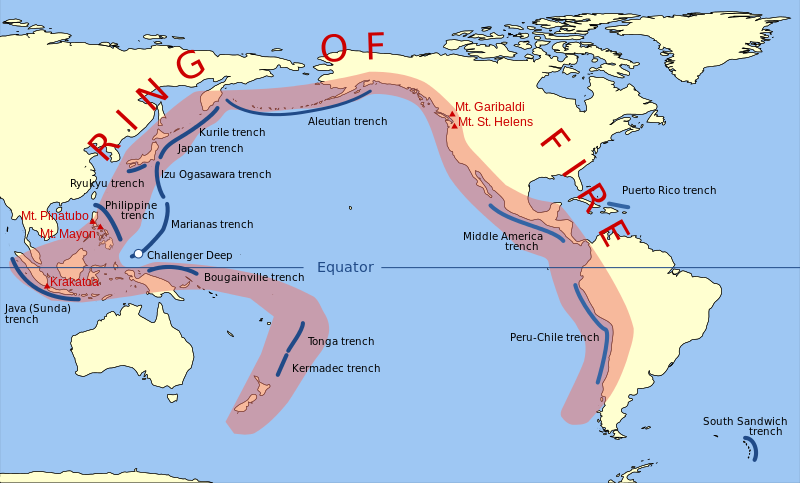
Tectonic Plates - WikipediaIf you thought that the earthquake that struck northern California on Sunday was something, just wait until you see what is coming in the years ahead.  As you will read about below, we live at a time when earthquake activity is dramatically increasing.  This is especially true of the “Ring of Fire” which runs roughly along the outer perimeter of the Pacific Ocean.  Approximately 81 percent of all big earthquakes occur along the Ring of Fire, and the entire west coast of the United States falls within the danger zone.  Over the past few years, we have seen huge earthquake after huge earthquake strike various areas along the Ring of Fire, but up until now the California coastline has mostly been spared.  However, there are indications that this may be about to change in a big way.

Early on Sunday, a 6.1 magnitude earthquake struck the heart of wine country.  It was the largest earthquake to hit northern California in 25 years.  More than 120 people were injured, scores of buildings were damaged and Governor Jerry Brown declared a state of emergency.

It is being projected that the economic loss from this earthquake will exceed a billion dollars.  Since the initial quake, there have been more than 60 aftershocks, and residents are very much hoping that the worst is over.  The following is how the damage caused by the earthquake was described by CNN

“Everything and everyone in Napa was affected by the quake. My house, along with everybody else’s, is a disaster. It looks like somebody broke in and ravaged the place, room by room.” said CNN iReporter Malissa Koven, who was awakened by the shaking at about 3:20 a.m.

“Anything and everything that could fall, did,” she said.

The damage in Napa is “fairly significant,” said Glenn Pomeroy, the CEO of the California Earthquake Authority, who surveyed the area Sunday afternoon.

“The downtown area is hardest hit, probably because of the age of construction down there,” Pomeroy said. In the residential areas, he is “seeing a lot of chimneys that’ve come crashing down.”

That sounds pretty bad, right?

But remember, this was only a 6.1 magnitude earthquake.  As Wikipedia explains, a 7.0 magnitude earthquake would be many times more powerful…

The Richter magnitude scale (also Richter scale) assigns a magnitude number to quantify the energy released by an earthquake. The Richter scale is a base-10 logarithmic scale, which defines magnitude as the logarithm of the ratio of the amplitude of the seismic waves to an arbitrary, minor amplitude.

As measured with a seismometer, an earthquake that registers 5.0 on the Richter scale has a shaking amplitude 10 times greater than that of an earthquake that registered 4.0, and thus corresponds to a release of energy 31.6 times greater than that released by the lesser earthquake.

And the earthquake that happened on Sunday would not even be worth comparing to an 8.0 or a 9.0 quake.  In fact, one study concluded that a 9.0 magnitude earthquake along the Cascadia fault could potentially produce a giant tsunami that would “wash away coastal towns”…

If a 9.0 earthquake were to strike along California’s sparsely populated North Coast, it would have a catastrophic ripple effect.

A giant tsunami created by the quake would wash away coastal towns, destroy U.S. 101 and cause $70 billion in damage over a large swath of the Pacific coast. More than 100 bridges would be lost, power lines toppled and coastal towns isolated. Residents would have as few as 15 minutes notice to flee to higher ground, and as many as 10,000 would perish.

Scientists last year published this grim scenario for a massive rupture along the Cascadia fault system, which runs 700 miles off shore from Northern California to Vancouver Island.

And when we think about “the Big One” hitting California, most of the time we think about southern California.  The most famous fault line in southern California is the San Andreas fault, but the truth is that many experts are far more concerned about the Puente Hills fault line.  According to one seismologist, that is the fault that would be most likely to “eat L.A.” and cause hundreds of billions of dollars in economic damage…

Video simulations of a rupture on the Puente Hills fault system show how energy from a quake could erupt and be funneled toward L.A.’s densest neighborhoods, with the strongest waves rippling to the west and south across the Los Angeles Basin.

According to estimates by the USGS and Southern California Earthquake Center, a massive quake on the Puente Hills fault could kill from 3,000 to 18,000 people and cause up to $250 billion in damage. Under this worst-case scenario, people in as many as three-quarters of a million households would be left homeless.

So don’t get too excited about what happened on Sunday.  Scientists assure us that it is only a matter of time before “the Big One” hits California.

In fact, the 6.1 magnitude earthquake that hit northern California on Sunday was not even the largest earthquake along the Ring of Fire this weekend.  According to the U.S. Geological Survey, a 6.4 magnitude earthquake shook the area around Valparaiso, Chile on Saturday and a 6.9 magnitude earthquake struck Peru on Sunday.

As I mentioned above, we have moved into a time when seismic activity is steadily rising.  It has gotten to the point where even the mainstream media cannot ignore it anymore.  For example, just check out the following excerpt from a recent CBS News report…

The average rate of big earthquakes — those larger than magnitude 7 — has been 10 per year since 1979, the study reports. That rate rose to 12.5 per year starting in 1992, and then jumped to 16.7 per year starting in 2010 — a 65 percent increase compared to the rate since 1979. This increase accelerated in the first three months of 2014 to more than double the average since 1979, the researchers report.

Something is happening that scientists don’t understand, and that is a little scary.

As I wrote about the other day, earthquake activity seems to particularly be increasing in the United States.  While the west has been relatively quiet, the number of earthquakes in the central and eastern portions of the nation has quintupled over the past 30 years…

According to the USGS, the frequency of earthquakes in the central and eastern U.S. has quintupled, to an average of 100 a year during the 2011-2013 period, up from only 20 per year during the 30-year period to 2000.

Most of these quakes were minor, but research published by the USGS earlier this year demonstrated that a relatively minor magnitude 5.0 quake caused by wastewater injection after conventional oil drilling triggered a much bigger, 5.7 magnitude quake in Prague, Okla.

“We know the hazard has increased for small and moderate size earthquakes. We don’t know as well how much the hazard has increased for large earthquakes. Our suspicion is it has but we are working on understanding this,” said William Ellsworth, a scientist with the USGS.

What in the world could be causing this to happen?

Oklahoma, which used to rarely ever have significant earthquakes, has experienced over 2,300 earthquakes so far in 2014.

That is absolutely staggering.

And of course volcanic activity has been rising all over the planet as well.  In 2013, the number of eruptions around the globe set a new all-time high, and right now persistent rumbling under Iceland’s Bardarbunga volcano has much of Europe on alert

For more than a week the earth has been rumbling beneath Iceland’s looming Bardarbunga volcano. The almost continuous small earthquakes led the government to activate its National Crisis Coordination Centre this week and block off access to the largely uninhabited region around the Bardarbunga caldera.

Major airlines are making contingency plans for a potential eruption that could throw dust into the atmosphere and disrupt flight paths between North America and Europe.

Some scientists are saying that if that volcano erupts, it “could trigger Britain’s coldest winter ever“.

Clearly something is happening.

All over the world seismic activity is on the rise.

That means that the shaking in California (and in much of the rest of the world) may soon get a whole lot worse.

So what do you think is causing all of this?  Please share what you think by posting a comment below…