Swiss Shocker Triggers Gigantic Losses For Banks, Hedge Funds And Currency Traders

Trading - Public DomainThe absolutely stunning decision by the Swiss National Bank to decouple from the euro has triggered billions of dollars worth of losses all over the globe.  Citigroup and Deutsche Bank both say that their losses were somewhere in the neighborhood of 150 million dollars, a major hedge fund that had 830 million dollars in assets at the end of December has been forced to shut down, and several major global currency trading firms have announced that they are now insolvent.   And these are just the losses that we know about so far.  It will be many months before the full scope of the financial devastation caused by the Swiss National Bank is fully revealed.  But of course the same thing could be said about the crash in the price of oil that we have witnessed in recent weeks.  These two “black swan events” have set financial dominoes in motion all over the globe.  At this point we can only guess how bad the financial devastation will ultimately be.

But everyone agrees that it will be bad.  For example, one financial expert at Boston University says that he believes the losses caused by the Swiss National Bank decision will be in the billions of dollars

The losses will be in the billions — they are still being tallied,” said Mark T. Williams, an executive-in-residence at Boston University specializing in risk management. “They will range from large banks, brokers, hedge funds, mutual funds to currency speculators. There will be ripple effects throughout the financial system.”

Citigroup, the world’s biggest currencies dealer, lost more than $150 million at its trading desks, a person with knowledge of the matter said last week. Deutsche Bank lost $150 million and Barclays less than $100 million, people familiar with the events said, after the Swiss National Bank scrapped a three-year-old policy of capping its currency against the euro and the franc soared as much as 41 percent that day versus the euro. Spokesmen for the three banks declined to comment.

And actually, if the total losses from this crisis are only limited to the “billions” I think that we will be extremely fortunate.

As I mentioned above, a hedge fund that had 830 million dollars in assets at the end of December just completely imploded.  Everest Capital’s Global Fund had heavily bet against the Swiss franc, and as a result it now has lost “virtually all its money”

Marko Dimitrijevic, the hedge fund manager who survived at least five emerging market debt crises, is closing his largest hedge fund after losing virtually all its money this week when the Swiss National Bank unexpectedly let the franc trade freely against the euro, according to a person familiar with the firm.

Everest Capital’s Global Fund had about $830 million in assets as of the end of December, according to a client report. The Miami-based firm, which specializes in emerging markets, still manages seven funds with about $2.2 billion in assets. The global fund, the firm’s oldest, was betting the Swiss franc would decline, said the person, who asked not to be named because the information is private.

This is how fast things can move in the financial marketplace when things start getting crazy.

It can seem like you are on top of the world one day, but just a short while later you can be filing for bankruptcy.

Consider what just happened to FXCM.  It is one of the largest retail currency trading firms on the entire planet, and the decision by the Swiss National Bank instantly created a 200 million dollar hole in the company that desperately needed to be filled…

The magnitude of the crisis for U.S. currency traders became clear Friday when New York-based FXCM, a publicly traded U.S. currency broker, and the largest so far to announce it was in financial trouble after suffering a 90-percent drop in the firm’s stock price, reported the firm would need a $200-$300 million bailout to prevent capital requirements from being breached. Highly leveraged currency traders, including retail customers, were unable to come up with sufficient capital to cover the losses suffered in their currency trading accounts when the Swiss franc surged.

Currency traders worldwide allowed to leverage their accounts 100:1, meaning the customer can bet $100 in the currency exchange markets for every $1.00 the customer has on deposit in its account, can result in huge gains from unexpected currency price fluctuations or massive and devastating losses, should the customer bet wrong.

Fortunately for FXCM, another company called Leucadia came riding to the rescue with a 300 million dollar loan.

But other currency trading firms were not so lucky.

For example, Alpari has already announced that it is going into insolvency

Retail broker Alpari UK filed for insolvency on Friday.

The move “caused by the SNB’s unexpected policy reversal of capping the Swiss franc against the euro has resulted in exceptional volatility and extreme lack of liquidity,” Alpari, the shirt sponsor of English Premier League soccer club West Ham, said in a statement.

“This has resulted in the majority of clients sustaining losses which exceeded their account equity. Where a client cannot cover this loss, it is passed on to us. This has forced Alpari (UK) Limited to confirm that it has entered into insolvency.”

And Alpari is far from alone.  Quite a few other smaller currency trading firms all over the world are in the exact same boat.

Unfortunately, this could potentially just be the beginning of the currency chaos.

All eyes are on the European Central Bank right now.  If a major round of quantitative easing is announced, that could unleash yet another wave of crippling losses for financial institutions.  The following is from a recent CNBC article

One of Europe’s most influential economists has warned that the quantitative easing measures seen being unveiled by the European Central Bank (ECB) this week could create deep market volatility, akin to what was seen after the Swiss National Bank abandoned its currency peg.

“There was so much capital flight in anticipation of the QE to Switzerland, that the Swiss central bank was unable to stem the tide, and there will be more effects of that sort,” the President of Germany’s Ifo Institute for Economic Research, Hans-Werner Sinn, told CNBC on Monday.

As I have written about previously, we are moving into a time of greatly increased financial volatility.  And when we start to see tremendous ups and downs in the financial world, that is a sign that a great crash is coming.  We witnessed this prior to the financial crisis of 2008, and now we are watching it happen again.

And this is not just happening in the United States.  Just check out what happened in China on Monday…

Chinese shares plunged about 8% Monday after the country’s securities regulator imposed margin trading curbs on several major brokerages, a sign that authorities are trying to rein in the market’s big gains. It was China’s largest drop in six years.

Sadly, most Americans have absolutely no idea what is coming.

They just trust that Barack Obama, Congress and the “experts” at the Federal Reserve have it all figured out.

So when the next great financial crisis does arrive, most people are going to be absolutely blindsided by it, even though anyone that is willing to look at the facts honestly should be able to see it steamrolling directly toward us.

Over the past couple of years, we have been blessed to experience a period of relative stability.

But that period of relative stability is now ending.

I hope that you are getting ready for what comes next.
What In The World Just Happened In Switzerland?

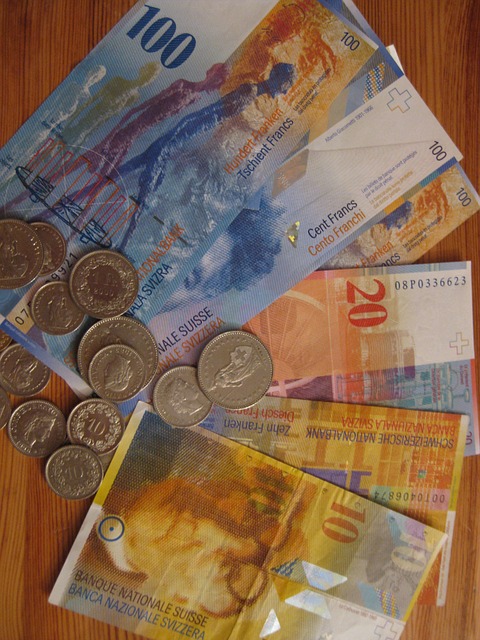
Swiss Francs - Public DomainCentral banks lie.  That is what they do.  Not too long ago, the Swiss National Bank promised that it would defend the euro/Swiss franc currency peg with the “utmost determination”.  But on Thursday, the central bank shocked the financial world by abruptly abandoning it.  More than three years ago, the Swiss National Bank announced that it would not allow the Swiss franc to fall below 1.20 to the euro, and it has spent a mountain of money defending that peg.  But now that it looks like the EU is going to launch a very robust quantitative easing program, the Swiss National Bank has thrown in the towel.  It was simply going to cost way too much to continue to defend the currency floor.  So now there is panic all over Europe.  On Thursday, the Swiss franc rose a staggering 30 percent against the euro, and the Swiss stock market plunged by 10 percent.  And all over the world, investors, hedge funds and central banks either lost or made gigantic piles of money as currency rates shifted at an unprecedented rate.  It is going to take months to really measure the damage that has been done.  Meanwhile, the euro is in greater danger than ever.  The euro has been declining for months, and now the number one buyer of euros (the Swiss National Bank) has been removed from the equation.  As things in Europe continue to get even worse, expect the euro to go to all-time record lows.  In addition, it is important to remember that the Asian financial crisis of the late 1990s began when Thailand abandoned its currency peg.  With this move by Switzerland set off a European financial crisis?

Of course this is hardly the first time that we have seen central banks lie.  In the United States, the Federal Reserve does it all the time.  The funny thing is that most people still seem to trust what central banks have to say.  But at some point they are going to start to lose all credibility.

Financial markets like predictability.  And gigantic amounts of money had been invested based on the repeated promises of the Swiss National Bank to use “unlimited amounts” of money to defend the currency floor.  Needless to say, there are a lot of people in the financial world that feel totally betrayed by the Swiss National Bank today.  The following comes from an analysis of the situation by Bruce Krasting

Thomas Jordan, the head of the SNB has repeated said that the Franc peg would last forever, and that he would be willing to intervene in “Unlimited Amounts” in support of the peg. Jordan has folded on his promise like a cheap suit in the rain. When push came to shove, Jordan failed to deliver.

The Swiss economy will rapidly fall into recession as a result of the SNB move. The Swiss stock market has been blasted, the currency is now nearly 20% higher than it was a day before. Someone will have to fall on the sword, the arrows are pointing at Jordan.

The dust has not settled on this development as of this morning. I will stick my neck out and say that the failure to hold the minimum rate will result in a one time loss for the SNB of close to $100B. That’s a huge amount of money. It comes to 20% of the Swiss GDP!

Most experts are calling this an extremely bad move by the Swiss National Bank.

But in the end, they may have had little choice.

The euro is falling apart, and the Swiss did not want to be married to it any longer.  Unfortunately, when any marriage ends the pain can be enormous.  The following comes from CNBC

How do you know you’re looking at a bad marriage?

Well if one or both of the spouses can’t wait to get out as soon as the smallest crack in the door opens, you have a pretty good clue.

Something like that just happened in Europe as we learned the real reason why so many traders were still invested in the euro: They had nowhere else to go.

As the Swiss National Bank unlocked the doors on its cap on trading euros for Swiss francs, the rush to exit the euro was faster than one of those French bullet trains.

But this move has not been bad for everyone.  In fact, for many of those that live in Switzerland but work in neighboring countries what happened on Thursday was very fortuitous

“I heard the news this morning. I’m so happy!” Vanessa, who refused to give her last name, told AFP outside of one of many mobbed exchange offices in Geneva.

She has reason to be extatic: she is one of some 280,000 people working in Switzerland but living and paying bills in eurozone countries France, Germany or Italy.

These so-called “frontaliers”, or border-crossers, are the biggest winners in Thursday’s Swiss franc surge, seeing their incomes jump 30 percent in the blink of an eye.

In normal times, things like this very rarely happen.

But in times of crisis, things can change very rapidly.  We are moving into a time of great volatility in global financial markets, and great volatility is often a sign that a great crash is coming.

This move by the Swiss National Bank is just the beginning.  Expect more desperate moves on the global economic chessboard in the days ahead.  But in the end, none of those moves is going to prevent what is coming.

And one of these days, another extremely important currency peg is going to end.  Right now, the Chinese have tied their currency very tightly to the U.S. dollar.  This has helped to artificially inflate the value of the dollar.  Unfortunately, as Robert Wenzel has noted, someday the Chinese could suddenly pull the rug out from under our currency, and that would be really bad news for us…

In other words, the SNB is no People’s Bank of China type patsy, where the PBOC has taken on massive amounts of dollar reserves to prop up the dollar.

Will the PBOC learn anything from SNB? If so, this will not be good for the US dollar.

So keep a close eye on what happens in Europe next.

It is going to be a preview of what is eventually coming to America.

This Is Exactly How Markets Behave Right Before They Crash

Roller Coaster - Photo by NeukolnWhen the stock market starts to behave like a roller coaster, that is a sign that a major move to the downside is right around the corner.  As I have stated repeatedly, when the market is very calm it tends to go up.  But when the waters start getting really choppy, that is a clear indication that stocks are about to plummet.  In early 2015, volatility has returned to Wall Street in a big way.  At one point on Tuesday, the Dow was up more than 300 points.  But then the bottom dropped out.  From the peak on Tuesday, the Dow plunged nearly 700 points in less than 30 hours before recovering more than 100 points at the end of the day.  The Dow has now experienced the longest losing streak that we have seen in 3 months, but that is not that big of a deal.  Of much greater concern is the huge price swings that we have been seeing. Remember, the three largest single day stock market increases in history were right in the middle of the financial crisis of 2008.  So if stocks go up 400 points tomorrow that is NOT a good sign.  What we really need is a string of days when stocks move less than 100 points in either direction.  If stocks keep making dramatic moves up and dramatic moves down, history tells us that it is only a matter of time before they collapse.  Any student of stock market history knows that what we are witnessing right now is exactly how markets behave right before they crash.

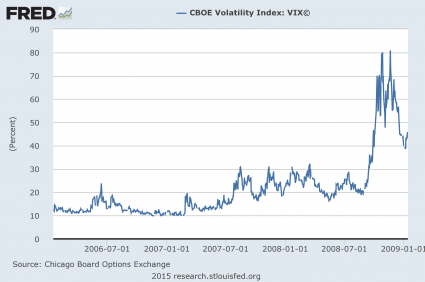
Examine the chart below very carefully.  It is a chart of the CBOE Volatility Index from 2006 to 2008.  As you can see, volatility was very low as stocks soared during 2006.  Then things started to get a bit choppy in 2007, and investors should have recognized this as a warning sign.  Finally, you can see that the VIX absolutely skyrocketed during the financial crisis of 2008…

VIX 2006 to 2008

Looking back, it seems so obvious.

So why aren’t more people alarmed this time around?

As CNN is reporting, the VIX is up almost 20 percent so far in 2015…

Volatility has returned with a vengeance this January. The Dow has been moving up or down by at least 100 points nearly every day this year.

CNNMoney’s Fear & Greed Index is showing signs of Extreme Fear again. And a volatility gauge known as the VIX, which is one of the components in our index, is up nearly 20% so far this year.

Meanwhile, there are lots of other signs of trouble on the horizon as well.

For example, the price of copper got absolutely hammered on Wednesday.  As I write this, it has fallen more than 5 percent and it has not been this low in more than five years.

In financial circles, it is referred to as “Dr. Copper” because it is such a valuable indicator regarding where the global economy is heading next.

For example, in 2008 the price of copper was close to $4.00 before plummeting to below $1.50 by the end of that year as the global financial system fell apart.

Now the price of copper is plunging again, and many analysts are becoming extremely concerned

One growing global worry is the steep decline in copper, which is used in many products and is often viewed as good gauge on how China is doing. The price of copper hit its lowest price since 2009 on Wednesday at $2.46. Copper is down nearly 7% this week alone.

Meanwhile, the recession (some call it a depression) in Europe continues to get even worse, and the euro continues to plunge.

On Wednesday, the euro declined to the lowest level that we have seen in nine years, and Goldman Sachs is now saying that the euro and the U.S. dollar could be at parity by the end of next year.

That is amazing considering the fact that it took $1.60 to get one euro back in July 2008.

Personally, I am fully convinced that Goldman Sachs is right on this one.  I believe that the euro is going to all-time lows that we have never seen before, and this is going to create massive problems for the eurozone.

With all of these signs of trouble out there, the smart money is rapidly pulling their money out of stocks and putting it into government bonds.  This usually happens when a crisis is looming.  It is called a “flight to safety”, and it pushes government bond yields down.

On Wednesday, the yield on 10 year U.S. Treasuries fell beneath the important 1.8 percent barrier.  We will probably see it go even lower in the months ahead.

As the rest of the world economy crumbles, the remainder of the globe is looking to America to be the rock in the storm.  For example, the following quote that I found today comes from a British news source

The global economy is running on a single engine… the American one,’ the World Bank’s chief economist, Kaushik Basu, said. ‘This does not make for a rosy outlook for the world.’

Well, they may not want to rely on us too much, because there are plenty of signs that our economy is slowing down too.  For example, we learned today that December retail sales were down 0.9% from a year ago, and this is being called “an unmitigated disaster“.  Americans were supposed to be taking the money that they were saving on gasoline and spending it, but that apparently is not happening.

Back on October 29th, I wrote an article entitled “From This Day Forward, We Will Watch How The Stock Market Performs Without The Fed’s Monetary Heroin“.  In that article, I warned that the end of quantitative easing could have dire consequences for the financial system as bubbles created by the Fed began to burst.

And that is precisely what is happening.  In fact, many analysts are now pinpointing the end of QE as the exact moment when our current troubles began.  For instance, check out this excerpt from a CNBC article that was published on Wednesday

Stuff happens when QE ends,” said Peter Boockvar, chief market analyst at The Lindsey Group. “It’s no coincidence that the market started going into a higher volatility mode, it’s no coincidence that the decline in commodity prices accelerated, it’s no coincidence that the yield curve started flattening when QE ended.”

Indeed, the increase in volatility and its effect on prices across the capital market spectrum was closely tied to the Fed ending the third round of QE in October.

We are moving into a time of great danger for Wall Street and for the global economy as a whole.

If we continue to see a tremendous amount of volatility, history tells us that it is only a matter of time before the markets implode.

Hopefully you will be ready when that happens.

Boom Goes The Dynamite: The Crashing Price Of Oil Is Going To Rip The Global Economy To Shreds

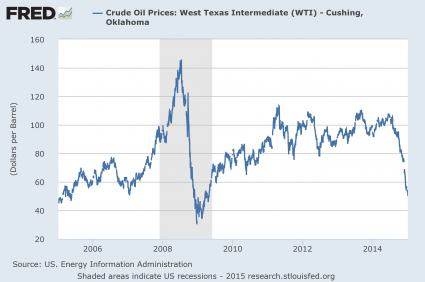
Boom Goes The Dynamite - Public DomainIf you were waiting for a “black swan event” to come along and devastate the global economy, you don’t have to wait any longer.  As I write this, the price of U.S. oil is sitting at $45.76 a barrel.  It has fallen by more than 60 dollars a barrel since June.  There is only one other time in history when we have seen anything like this happen before.  That was in 2008, just prior to the worst financial crisis since the Great Depression.  But following the financial crisis of 2008, the price of oil rebounded fairly rapidly.  As you will see below, there are very strong reasons to believe that it will not happen this time.  And the longer the price of oil stays this low, the worse our problems are going to get.  At a price of less than $50 a barrel, it is just a matter of time before we see a huge wave of energy company bankruptcies, massive job losses, a junk bond crash followed by a stock market crash, and a crisis in commodity derivatives unlike anything that we have ever seen before.  So let’s hope that a very unlikely miracle happens and the price of oil rebounds substantially in the months ahead.  Because if not, the price of oil is going to absolutely rip the global economy to shreds.

What amazes me is that there are still many economic “experts” in the mainstream media that are proclaiming that the collapse in the price of oil is going to be a good thing for the U.S. economy.

The only precedent that we can compare the current crash to is the oil price collapse of 2008.  You can see both crashes on the chart below…

Price Of Oil Since 2006

If rapidly falling oil prices are good economic news, that collapse should have pushed the U.S. economy into overdrive.

But that didn’t happen, did it?  Instead, we plunged into the deepest recession that we have seen since the Great Depression.

And unless there is a miracle rebound in the price of oil now, we are going to experience something similar this time.

Already, we are seeing oil rigs shut down at a staggering pace.  The following is from Bloomberg

U.S. oil drillers laid down the most rigs in the fourth quarter since 2009. And things are about to get much worse.

The rig count fell by 93 in the three months through Dec. 26, and lost another 17 last week, Baker Hughes Inc. data show. About 200 more will be idled over the next quarter as U.S. oil explorers make good on their promises to curb spending, according to Moody’s Corp.

But that was just the beginning of the carnage.  61 more oil rigs shut down last week alone, and hundreds more are being projected to shut down in the months ahead.

For those that cannot connect the dots, that is going to translate into the loss of large numbers of good paying jobs.  Just check out what is happening in Texas

A few days ago, Helmerich & Payne, announced that it would idle 50 more drilling rigs in February, after having already idled 11 rigs. Each rig accounts for about 100 jobs. This will cut its shale drilling activities by 20%. The other two large drillers, Nabors Industries and Patterson-UTI Energy are on a similar program. All three combined are “likely to cut approximately 15,000 jobs out of the 50,000 people they currently employ,” said Oilpro Managing Director Joseph Triepke.

Unfortunately, this crisis will not just be localized to states such as Texas.  There are tens of thousands of small and mid-size firms that will be affected.  The following is from a recent CNBC report

More than 20,000 small and midsize firms drive the “hydrocarbon revolution” in the U.S. that has helped the oil and gas industry thrive in recent years, and they produce more than 75 percent of the nation’s oil and gas output, according to the Manhattan Institute for Policy Research’s February 2014 Power & Growth Initiative Report. The Manhattan Institute is a conservative think tank in New York City.

A sustained decline in prices could lead to layoffs at these firms, say experts. “The energy industry has been one of the job-growth areas leading us out of the recession,” said Chad Mabry, a Houston-based analyst in the energy and natural resources research department of boutique investment bank MLV & Co. in New York City. “In 2015, that changes in this price environment,” he said. “We’re probably going to see some job losses on a fairy significant scale if this keeps up.”

If the price of oil makes a major comeback, the carnage will ultimately not be that bad.

But if it stays at this level or keeps going down for an extended period of time, it is inevitable that a whole bunch of those firms will go bankrupt and their debt will go bad.

That would mean a junk bond crash unlike anything that Wall Street has ever experienced.

And as I have written about previously, a stock market crash almost always follows a junk bond crash.

These are things that happened during the last financial crisis and that are repeating again right in front of our eyes.

Another thing that happened in 2008 that is happening again is a crash in industrial commodity prices.

At this point, industrial commodity prices have hit a 12 year low.  I am talking about industrial commodities such as copper, iron ore, steel and aluminum.  This is a huge sign that global economic activity is slowing down and that big trouble is on the way.

So what is driving this?  The following excerpt from a recent Zero Hedge article gives us a clue…

Globally there are over $9 trillion worth of borrowed US Dollars in the financial system. When you borrow in US Dollars, you are effectively SHORTING the US Dollar.

Which means that when the US Dollar rallies, your returns implode regardless of where you invested the borrowed money (another currency, stocks, oil, infrastructure projects, derivatives).

Take a look at commodities. Globally, there are over $22 TRILLION worth of derivatives trades involving commodities. ALL of these were at risk of blowing up if the US Dollar rallied.

Unfortunately, starting in mid-2014, it did in a big way.

This move in the US Dollar imploded those derivatives trades. If you want an explanation for why commodities are crashing (aside from the fact the global economy is slowing) this is it.

Once again, much of this could be avoided if the price of oil starts going back up substantially.

Unfortunately, that does not appear likely.  In fact, many of the big banks are projecting that it could go even lower

Goldman Sachs, CitiGroup, Societe General and Commerzbank are among the latest investment banks to reduce crude oil price estimates, and without production cuts, there appears to be more room for lower prices.

“We’re going to keep on going lower,” says industry analyst Brian Milne of energy manager Schneider Electric. “Even with fresher new lows, there’s still more downside.”

OPEC could stabilize global oil prices with a single announcement, but so far OPEC has refused to do this.  Many believe that the OPEC countries actually want the price of oil to fall for competitive reasons…

Representatives of Saudi Arabia, the United Arab Emirates and Kuwait stressed a dozen times in the past six weeks that the group won’t curb output to halt the biggest drop in crude since 2008. Qatar’s estimate for the global oversupply is among the biggest of any producing country. These countries actually want — and are achieving — further price declines as part of an attempt to hasten cutbacks by U.S. shale drillers, according to Barclays Plc and Commerzbank AG.

The oil producing countries in the Middle East seem to be settling in for the long haul.  In fact, one prominent Saudi prince made headlines all over the world this week when he said that “I’m sure we’re never going to see $100 anymore.”

Never is a very strong word.

Could there be such a massive worldwide oil glut going on right now that the price of oil will never get that high again?

Well, without a doubt there is a huge amount of unsold oil floating around out there at the moment.

It has gotten so bad that some big trading companies are actually hiring supertankers to store large quantities of unsold crude oil at sea…

Some of the world’s largest oil traders have this week hired supertankers to store crude at sea, marking a milestone in the build-up of the global glut.

Trading firms including Vitol, Trafiguraand energy major Shell have all booked crude tankers for up to 12 months, freight brokers and shipping sources told Reuters.

They said the flurry of long-term bookings was unusual and suggested traders could use the vessels to store excess crude at sea until prices rebound, repeating a popular 2009 trading gambit when prices last crashed.

The fundamentals for the price of oil are so much worse than they were back in 2008.

We could potentially be looking at sub-$50 oil for an extended period of time.

If that is indeed the case, there will be catastrophic damage to the global economy and to the global financial system.

So hold on to your hats, because it looks like we are going to be in for quite a bumpy ride in 2015.

10 Key Events That Preceded The Last Financial Crisis That Are Happening Again RIGHT NOW

10 Key Events That Preceded The Last Financial CrisisIf you do not believe that we are heading directly toward another major financial crisis, you need to read this article.  So many of the exact same patterns that preceded the great financial collapse of 2008 are happening again right before our very eyes.  History literally appears to be repeating, but most Americans seem absolutely oblivious to what is going on.  The mainstream media and our politicians are promising them that everything is going to be okay somehow, and that seems to be good enough for most people.  But the signs that another massive financial crisis is on the horizon are everywhere.  All you have to do is open up your eyes and look at them.

Bill Gross, considered by many to be the number one authority on government bonds on the entire planet, made headlines all over the world on Tuesday when he released his January Investment Outlook.  I don’t know if we have ever seen Gross be more negative about a new year than he is about 2015.  For example, just consider this statement

“When the year is done, there will be minus signs in front of returns for many asset classes. The good times are over.”

And this is how he ended the letter

And so that is why – at some future date – at some future Ides of March or May or November 2015, asset returns in many categories may turn negative. What to consider in such a strange new world? High-quality assets with stable cash flows. Those would include Treasury and high-quality corporate bonds, as well as equities of lightly levered corporations with attractive dividends and diversified revenues both operationally and geographically. With moments of liquidity having already been experienced in recent months, 2015 may see a continuing round of musical chairs as riskier asset categories become less and less desirable.

Debt supercycles in the process of reversal are not favorable events for future investment returns. Father Time in 2015 is not the babe with a top hat in our opening cartoon. He is the grumpy old codger looking forward to his almost inevitable “Ides” sometime during the next 12 months. Be cautious and content with low positive returns in 2015. The time for risk taking has passed.

So why are Gross and so many other financial experts being so “negative” right now?

It is because they can see what is happening.

They can see the same patterns that we saw in early 2008 unfolding again right in front of us.  I wanted to put these patterns in a single article so that they will be easy to share with people.  The following are 10 key events that preceded the last financial crisis that are happening again right now…

#1 A really bad start to the year for the stock market.  During the first three trading days of 2015, the S&P 500 was down a total of 2.73 percent.  There are only two times in history when it has declined by more than three percent during the first three trading days of a year.  Those years were 2000 and 2008, and in both years we witnessed enormous stock market declines.

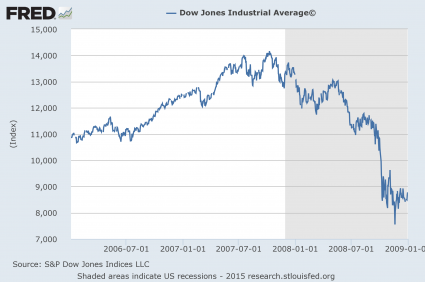
#2 Very choppy financial market behavior.  This is something that I discussed yesterday.  In general, calm markets tend to go up.  When markets get choppy, they tend to go down.  For example, the chart that I have posted below shows how the Dow Jones Industrial Average behaved from the beginning of 2006 to the end of 2008.  As you can see, the Dow was very calm as it rose throughout 2006 and most of 2007, but it got very choppy as 2008 played out…

The Dow 2006 to 2008

As I also mentioned yesterday, it is important not to get fooled if stocks soar on a particular day.  The three largest single day stock market gains in history were right in the middle of the financial crisis of 2008.  When you start to see big ups and big downs in the market, that is a sign of big trouble ahead.  That is why it is so alarming that global financial markets have begun to become quite choppy in recent weeks.

#3 A substantial decline for 10 year bond yields.  When investors get scared, there tends to be a “flight to safety” as investors move their money to safer investments.  We saw this happen in 2008, and that is happening again right now.

In fact, according to Bloomberg, global 10 year bond yields have already dropped to low levels that are absolutely unprecedented…

Taken together, the average 10-year bond yield of the U.S., Japan and Germany has dropped below 1 percent for the first time ever, according to Steven Englander, global head of G-10 foreign-exchange strategy at Citigroup Inc.

That’s not good news. The rock-bottom rates, which fall below zero when inflation is taken into account, show “that investors think we are going nowhere for a long time,” Englander wrote in a report yesterday.

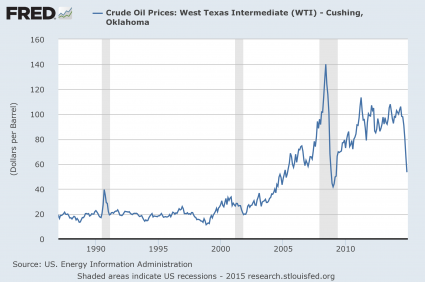
#4 The price of oil crashes.  As I write this, the price of U.S. oil has dipped below $48 a barrel.  But back in June, it was sitting at $106 at one point.  As the chart below demonstrates, there is only one other time in history when the price of oil has declined by more than $50 in less than a year…

Price Of Oil 2015

The only other time there has been an oil price collapse of this magnitude we experienced the greatest financial crisis since the Great Depression shortly thereafter.  Are we about to see history repeat?  For much more on this, please see my previous article entitled “Guess What Happened The Last Time The Price Of Oil Crashed Like This?

#5 A dramatic drop in the number of oil and gas rigs in operation.  Right now, oil and gas rigs are going out of operation at a frightening pace.  During the fourth quarter of 2014, 93 oil and gas rigs were idled, and it is being projected that another 200 will shut down this quarter.  As this Business Insider article demonstrates, this is also something that happened during the financial crisis of 2008 and it continued well into 2009.

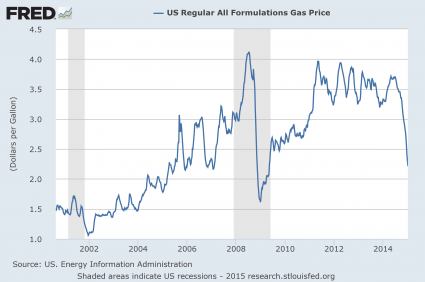
#6 The price of gasoline takes a huge tumble.  Millions of Americans are celebrating that the price of gasoline has plummeted in recent weeks.  But they were also celebrating when it happened back in 2008 as well.  But of course it turned out that there was really nothing to celebrate in 2008.  In short order, millions of Americans lost their jobs and their homes.  So the chart that I have posted below is definitely not “good news”…

Gas Price 2015

#7 A broad range of industrial commodities begin to decline in price.  When industrial commodities go down in price, that is a sign that economic activity is slowing down.  And just like in 2008, that is what we are watching unfold on the global stage right now.  The following is an excerpt from a recent CNBC article

From nickel to soybean oil, plywood to sugar, global commodity prices have been on a steady decline as the world’s economy has lost momentum.

For an extended discussion on this, please see my recent article entitled “Not Just Oil: Guess What Happened The Last Time Commodity Prices Crashed Like This?

#8 A junk bond crash.  Just like in 2008, we are witnessing the beginnings of a junk bond collapse.  High yield debt related to the energy industry is on the bleeding edge of this crash, but in recent weeks we have seen investors start to bail out of a broad range of junk bonds.  Check out this chart and this chart in addition to the chart that I have posted below…

High Yield Debt 2015

#9 Global inflation slows down significantly.  When economic activity slows down, so does inflation.  This is something that we witnessed in 2008, this is also something that is happening once again.  In fact, it is being projected that global inflation is about to fall to the lowest level that we have seen since World War II

Increases in the prices of goods and services in the world’s largest economies are slowing dramatically. Analysts are predicting that inflation will fall below 2pc in all of the countries that make up the G7 group of advanced nations this year – the first time that has happened since before the Second World War.

Indeed, Japan was the only G7 country whose inflation rate was above 2pc last year. And economists believe that was because its government increased sales tax which had the effect of artificially boosting prices.

#10 A crisis in investor confidence.  Just prior to the last financial crisis, the confidence that investors had that we would be able to avoid a stock market collapse in the next six months began to decline significantly.  And guess what?  That is something else that is happening once again…

Investor confidence that the US will avoid a stock-market crash in the next six months has dropped dramatically since last spring.

The Yale School of Management publishes a monthly Crash Confidence Index. The index shows the proportion of investors who believe we will avoid a stock-market crash in the next six months.

Yale points out that “crash confidence reached its all-time low, both for individual and institutional investors, in early 2009, just months after the Lehman crisis, reflecting the turmoil in the credit markets and the strong depression fears generated by that event, and is plausibly related to the very low stock market valuations then.”

Are you starting to get the picture?

And of course I am not the only one warning about these things.  As I wrote about earlier in the week, there are a whole host of prominent voices that are now warning of imminent financial danger.

Today, I would like to add one more name to the list.  He is respected author James Howard Kunstler, and what he predicts is coming in 2015 is absolutely chilling

*****

Here are my financial forecast particulars for 2015:

  • Early in 2015 the ECB proposes a lame QE program and is laughed out of the room. European markets tank.
  • Greek elections in January produce a government that stands up to the EU and ECB and causes a fatal slippage of faith in the ability of that project to continue.
  • Second half of 2015, the rest of the world gangs up and counter-attacks the US dollar.
  • Bond markets in Europe implode in first half and the contagion spreads to the US as fear and distrust rises about viability of US safe haven status.
  • Derivatives associated with currencies, interest rates, and junk bonds trigger a bloodbath in credit default swaps (CDS) and the appearance of countless black holes through which debt and “wealth” disappear forever.
  • US stock markets continue to bid upward in the first half of 2015, crater in Q3 as faith in paper and pixels erodes. DJA and S & P fall 30 to 40 percent in the initial crash, then further into 2016.
  • Gold and silver slide in the first half, then take off as debt and equity markets craters, faith in abstract instruments evaporates, faith in central bank omnipotence dissolves, and citizens all over the world desperately seek safety from currency war.
  • Goldman Sachs, Citicorp, Morgan Stanley, Bank of America, DeutscheBank, SocGen, all succumb to insolvency. American government and Federal Reserve officials don’t dare attempt to rescue them again.
  • By the end of 2015, central banks everywhere stand in general discredit. In the US, the Federal Reserve’s mandate is publically debated and revised back to its original mission as lender of last resort. It is forbidden to engage in further interventions and a new less-secretive mechanism is drawn up for regulating basic interest rates.
  • Oil prices creep back into the $65 – $70 range by May 2015. It is not enough to halt the destruction in the shale, tar sand, and deepwater sectors. As contraction in the failing global economy accelerates, oil sinks back to the $40 range in October…
  • …unless mischief in the Middle East (in particular, the Islamic State messing with Saudi Arabia) leads to gross and perhaps fatally permanent disruption in world oil markets — and then all bets are off for both the continuity of advanced economies and for peace between nations.

*****

Personally, I don’t agree with Kunstler on all of the particulars and the timing of certain events, but overall I think that we are going to look back when the year is done and say that he was a lot more right than he was wrong.

We are moving into a time of extreme danger for the global economy.  There has never been a time when I have been more concerned about a new year since I began The Economic Collapse Blog back in 2009.

Over the past couple of years, we have been very blessed to be able to enjoy a bubble of relative stability.  But this period of stability also fooled many people into thinking that our economic problems had been fixed, when in reality they have only gotten worse.

We consume far more wealth than we produce, our debt levels are at record highs and we are at the tail end of the largest Wall Street financial bubble in all of history.

It is inevitable that we are heading for a tragic conclusion to all of this.  It is just a matter of time.


Oil Falls Below 50 As Global Financial Markets Begin To Unravel

Crisis Silhouette - Public DomainOn Monday, the price of oil fell below $50 for the first time since April 2009, and the Dow dropped 331 points.  Meanwhile, the stock market declines over in Europe were even larger on a percentage basis, and the euro sank to a fresh nine year low on concerns that the anti-austerity Syriza party will be victorious in the upcoming election in Greece.  These are precisely the kinds of things that we would expect to see happen if a global financial crash was coming in 2015.  Just prior to the financial crisis of 2008, the price of oil collapsed, prices for industrial commodities got crushed and the U.S. dollar soared relative to other currencies.  All of those things are happening again.  And yet somehow many analysts are still convinced that things will be different this time.  And I agree that things will indeed be “different” this time.  When this crisis fully erupts, it will make 2008 look like a Sunday picnic.

Another thing that usually happens when financial markets begin to unravel is that they get really choppy.  There are big ups and big downs, and that is exactly what we have witnessed since October.

So don’t expect the markets just to go in one direction.  In fact, it would not be a surprise if the Dow went up by 300 or 400 points tomorrow.  During the initial stages of a financial crash, there are always certain days when the markets absolutely soar.

For example, did you know that the three largest single day stock market advances in history were right in the middle of the financial crash of 2008?  Here are the dates and the amount the Dow rose each of those days…

October 13th, 2008: +936 points

October 28th, 2008: +889 points

November 13th, 2008: +552 points

Just looking at those three days, you would assume that the fall of 2008 was the greatest time ever for stocks.  But instead, it was the worst financial crash that we have seen since the days of the Great Depression.

So don’t get fooled by the volatility.  Choppy markets are almost always a sign of big trouble ahead.  Calm waters usually mean that the markets are going up.

In order to avoid a major financial crisis in the near future, we desperately need the price of oil to rebound in a substantial way.

Unfortunately, it does not look like that is going to happen any time soon.  There is just way too much oil being produced right now.  The following is an excerpt from a recent CNBC article

The Morgan Stanley strategists say there are new reports of unsold West and North African cargoes, with much of the oil moving into storage. They also note that new supply has entered the global market with additional exports coming from Russia and Iraq, which is reportedly seeing production rising to new highs.

Since June, the price of oil has plummeted close to 55 percent.  If the price of oil stays where it is right now, we are going to see large numbers of small producers go out of business, the U.S. economy will lose millions of jobs, billions of dollars of junk bonds will go bad and trillions of dollars of derivatives will be in jeopardy.

And the lower the price of oil goes, the worse our problems are going to get.  That is why it is so alarming that some analysts are now predicting that the price of oil could hit $40 later this month

Some traders appeared certain that U.S. crude will hit the $40 region later in the week if weekly oil inventory numbers for the United States on Wednesday show another supply build.

‘We’re headed for a four-handle,’ said Tariq Zahir, managing member at Tyche Capital Advisors in Laurel Hollow in New York. ‘Maybe not today, but I’m sure when you get the inventory numbers that come out this week, we definitely will.’

Open interest for $40-$50 strike puts in U.S. crude have risen several fold since the start of December, while $20-$30 puts for June 2015 have traded, said Stephen Schork, editor of Pennsylvania-based The Schork Report.

The only way that the price of oil has a chance to move back up significantly is if global production slows down.  But instead, production just continues to increase in the short-term thanks to projects that were already in the works.  As a result, analysts from Morgan Stanley say that the oil glut is only going to intensify

Morgan Stanley analysts said new production will continue to ramp up at a number of fields in Brazil, West Africa, Canada and in the U.S. Gulf of Mexico as well as U.S. shale production. Also, the potential framework agreement with Iran could mean more Iranian oil on the market.

Yes, lower oil prices mean that we get to pay less for gasoline when we fill up our vehicles.

But as I have written about previously, anyone that believes that lower oil prices are good for the U.S. economy or for the global economy as a whole is crazy.  And these sentiments were echoed recently by Jeff Gundlach

Oil is incredibly important right now. If oil falls to around $40 a barrel then I think the yield on ten year treasury note is going to 1%. I hope it does not go to $40 because then something is very, very wrong with the world, not just the economy. The geopolitical consequences could be – to put it bluntly – terrifying.

If the price of oil does not recover, we are going to see massive financial problems all over the planet and the geopolitical stress that this will create will be unbelievable.

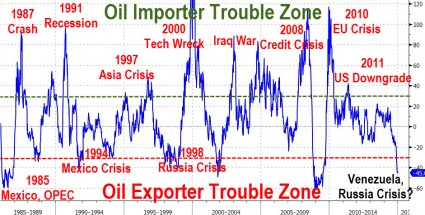
To expand on this point, I want to share an excerpt from a recent Zero Hedge article.  As you can see, a rapid rise or fall in the price of oil almost always correlates with a major global crisis of some sort…

Large and rapid rises and falls in the price of crude oil have correlated oddly strongly with major geopolitical and economic crisis across the globe. Whether driven by problems for oil exporters or oil importers, the ‘difference this time’ is that, thanks to central bank largesse, money flows faster than ever and everything is more tightly coupled with that flow.

Oil Crisis Chart - Zero Hedge

So is the 45% YoY drop in oil prices about to ’cause’ contagion risk concerns for the world?

And without a doubt, we are overdue for another stock market crisis.

Between December 31st, 1996 and March 24th, 2000 the S&P 500 rose 106 percent.

Then the dotcom bubble burst and it fell by 49 percent.

Between October 9th, 2002 and October 9th, 2007 the S&P 500 rose 101 percent.

But then that bubble burst and it fell by 57 percent.

Between March 9th, 2009 and December 31st, 2014 the S&P 500 rose an astounding 204 percent.

When this bubble bursts, how far will it fall this time?


11 Predictions Of Economic Disaster In 2015 From Top Experts All Over The Globe

2015 - Public DomainWill 2015 be a year of financial crashes, economic chaos and the start of the next great worldwide depression?  Over the past couple of years, we have all watched as global financial bubbles have gotten larger and larger.  Despite predictions that they could burst at any time, they have just continued to expand.  But just like we witnessed in 2001 and 2008, all financial bubbles come to an end at some point, and when they do implode the pain can be extreme.  Personally, I am entirely convinced that the financial markets are more primed for a financial collapse now than they have been at any other time since the last crisis happened nearly seven years ago.  And I am certainly not alone.  At this point, the warning cries have become a deafening roar as a whole host of prominent voices have stepped forward to sound the alarm.  The following are 11 predictions of economic disaster in 2015 from top experts all over the globe…

#1 Bill Fleckenstein: “They are trying to make the stock market go up and drag the economy along with it. It’s not going to work. There’s going to be a big accident. When people realize that it’s all a charade, the dollar will tank, the stock market will tank, and hopefully bond markets will tank. Gold will rally in that period of time because it’s done what it’s done because people have assumed complete infallibility on the part of the central bankers.”

#2 John Ficenec: “In the US, Professor Robert Shiller’s cyclically adjusted price earnings ratio – or Shiller CAPE – for the S&P 500 is currently at 27.2, some 64pc above the historic average of 16.6. On only three occasions since 1882 has it been higher – in 1929, 2000 and 2007.”

#3 Ambrose Evans-Pritchard, one of the most respected economic journalists on the entire planet: “The eurozone will be in deflation by February, forlornly trying to ignite its damp wood by rubbing stones. Real interest rates will ratchet higher. The debt load will continue to rise at a faster pace than nominal GDP across Club Med. The region will sink deeper into a compound interest trap.”

#4 The Jerome Levy Forecasting Center, which correctly predicted the bursting of the subprime mortgage bubble in 2007: “Clearly the direction of most of the recent global economic news suggests movement toward a 2015 downturn.”

#5 Paul Craig Roberts: “At any time the Western house of cards could collapse. It (the financial system) is a house of cards. There are no economic fundamentals that support stock prices — the Dow Jones. There are no economic fundamentals that support the strong dollar…”

#6 David Tice: “I have the same kind of feel in ’98 and ’99; also ’05 and ’06.  This is going to end badly. I have every confidence in the world.”

#7 Liz Capo McCormick and Susanne Walker: “Get ready for a disastrous year for U.S. government bonds. That’s the message forecasters on Wall Street are sending.”

#8 Phoenix Capital Research: “Just about everything will be hit as well. Most of the ‘recovery’ of the last five years has been fueled by cheap borrowed Dollars. Now that the US Dollar has broken out of a multi-year range, you’re going to see more and more ‘risk assets’ (read: projects or investments fueled by borrowed Dollars) blow up. Oil is just the beginning, not a standalone story.

If things really pick up steam, there’s over $9 TRILLION worth of potential explosions waiting in the wings. Imagine if the entire economies of both Germany and Japan exploded and you’ve got a decent idea of the size of the potential impact on the financial system.”

#9 Rob Kirby: “What this breakdown in the crude oil price is going to spawn another financial crisis.  It will be tied to the junk debt that has been issued to finance the shale oil plays in North America.  It is reported to be in the area of half a trillion dollars worth of junk debt that is held largely on the books of large financial institutions in the western world.  When these bonds start to fail, they will jeopardize the future of these financial institutions.  I do believe that will be the signal for the Fed to come riding to the rescue with QE4.  I also think QE4 is likely going to be accompanied by bank bail-ins because we all know all western world countries have adopted bail-in legislation in their most recent budgets.  The financial elites are engineering the excuse for their next round of money printing . . .  and they will be confiscating money out of savings accounts and pension accounts.  That’s what I think is coming in the very near future.”

#10 John Ing: “The 2008 collapse was just a dress rehearsal compared to what the world is going to face this time around. This time we have governments which are even more highly leveraged than the private sector was.

So this time the collapse will be on a scale that is many magnitudes greater than what the world witnessed in 2008.”

#11 Gerald Celente: “What does the word confidence mean? Break it down. In this case confidence = con men and con game. That’s all it is. So people will lose confidence in the con men because they have already shown their cards. It’s a Ponzi scheme. So the con game is running out and they don’t have any more cards to play.

What are they going to do? They can’t raise interest rates. We saw what happened in the beginning of December when the equity markets started to unravel. So it will be a loss of confidence in the con game and the con game is soon coming to an end. That is when you are going to see panic on Wall Street and around the world.”

If you have been following my website, you know that I have been pointing to 2015 for quite some time now.

For example, in my article entitled “The Seven Year Cycle Of Economic Crashes That Everyone Is Talking About“, I discussed the pattern of financial crashes that we have witnessed every seven years that goes all the way back to the Great Depression.  The last two major stock market crashes began in 2001 and 2008, and now here we are seven years later.

Will the same pattern hold up once again?

In addition, there are many other economic cycles that seem to indicate that we are due for a major economic downturn.  I discussed quite a few of these theories in my article entitled “If Economic Cycle Theorists Are Correct, 2015 To 2020 Will Be Pure Hell For The United States“.

But just like in 2000 and 2007, there are a whole host of doubters that are fully convinced that the party can continue indefinitely.  Even though our economic fundamentals continue to get worse, our debt levels continue to grow and every objective measurement shows that Wall Street is more reckless and more vulnerable to collapse than ever before, they mock the idea that a financial collapse is imminent.

So let’s see what happens in 2015.

I have a feeling that it is going to be an extremely “interesting” year.

Junk Bonds Are Going To Tell Us Where The Stock Market Is Heading In 2015

Dominoes - Public DomainDo you want to know if the stock market is going to crash next year?  Just keep an eye on junk bonds.  Prior to the horrific collapse of stocks in 2008, high yield debt collapsed first.  And as you will see below, high yield debt is starting to crash again.  The primary reason for this is the price of oil.  The energy sector accounts for approximately 15 to 20 percent of the entire junk bond market, and those energy bonds are taking a tremendous beating right now.  This panic in energy bonds is infecting the broader high yield debt market, and investors have been pulling money out at a frightening pace.  And as I have written about previously, almost every single time junk bonds decline substantially, stocks end up following suit.  So don’t be fooled by the fact that some comforting words from Janet Yellen caused stock prices to jump over the past couple of days.  If you really want to know where the stock market is heading in 2015, keep a close eye on the market for high yield debt.

If you are not familiar with junk bonds, the concept is actually very simple.  Corporations that do not have high credit ratings typically have to pay higher interest rates to borrow money.  The following is how USA Today describes these bonds…

High-yield bonds are long-term IOUs issued by companies with shaky credit ratings. Just like credit card users, companies with poor credit must pay higher interest rates on loans than those with gold-plated credit histories.

But in recent years, interest rates on junk bonds have gone down to ridiculously low levels.  This is another bubble that was created by Federal Reserve policies, and it is a colossal disaster waiting to happen.  And unfortunately, there are already signs that this bubble is now beginning to burst

Back in June, the average junk bond yield was 3.90 percentage points higher than Treasury securities. The average energy junk bond yielded 3.91 percentage points higher than Treasuries, Lonski says.

That spread has widened to 5.08 percentage points for junk bonds vs. 7.86 percentage points for energy bonds — an indication of how worried investors are about default, particularly for small, highly indebted companies in the fracking business.

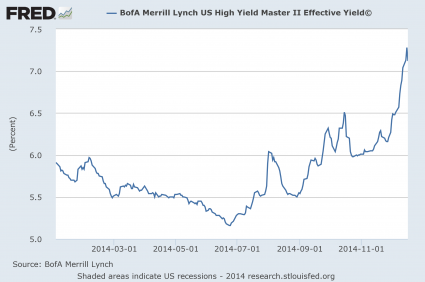
The reason why so many analysts are becoming extremely concerned about this shift in junk bonds is because we also saw this happen just before the great stock market crash of 2008.  In the chart below, you can see how yields on junk bonds started to absolutely skyrocket in September of that year…

High Yield Debt 2008

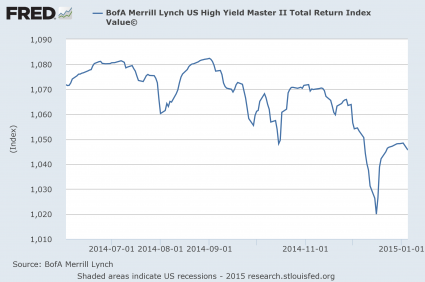
Of course we have not seen a move of that magnitude quite yet this year, but without a doubt yields have been spiking.  The next chart that I want to share is of this year.  As you can see, the movement over the past month or so has been quite substantial…

High Yield Debt 2014

And of course I am far from the only one that is watching this.  In fact, there are some sharks on Wall Street that plan to make an absolute boatload of cash as high yield bonds crash.

One of them is Josh Birnbaum.  He correctly made a giant bet against subprime mortgages in 2007, and now he is making a giant bet against junk bonds

When Josh Birnbaum was at Goldman Sachs in 2007, he made a huge bet against subprime mortgages.

Now he’s betting against something else: high-yield bonds.

From The Wall Street Journal:

Joshua Birnbaum, the ex-Goldman Sachs Group Inc. trader who made bets against subprime mortgages during the financial crisis, now has more than $2 billion in wagers against high-yield bonds at his Tilden Park Capital Management LP hedge-fund firm, according to investor documents.

Could you imagine betting 2 billion dollars on anything?

If he is right, he is going to make an incredible amount of money.

And I have a feeling that he will be.  As a recent New American article detailed, there is already panic in the air…

It’s a mania, said Tim Gramatovich of Peritus Asset Management who oversees a bond portfolio of $800 million: “Anything that becomes a mania — ends badly. And this is a mania.”

Bill Gross, who used to run PIMCO’s gigantic bond portfolio and now advises the Janus Capital Group, explained that “there’s very little liquidity” in junk bonds. This is the language a bond fund manager uses to tell people that no one is buying, everyone is selling. Gross added: “Everyone is trying to squeeze through a very small door.”

Bonds issued by individual energy developers have gotten hammered. For instance, Energy XXI, an oil and gas producer, issued more than $2 billion in bonds just in the last four years and, up until a couple of weeks ago, they were selling at 100 cents on the dollar. On Friday buyers were offering just 64 cents. Midstates Petroleum’s $700 million in bonds — rated “junk” by both Moody’s and Standard and Poor’s — are selling at 54 cents on the dollar, if buyers can be found.

So is there anything that could stop junk bonds from crashing?

Yes, if the price of oil goes back up to 80 dollars or more a barrel that would go a long way to settling things back down.

Unfortunately, many analysts are convinced that the price of oil is going to head even lower instead…

“We’re continuing to search for a bottom, and might even see another significant drop before the year-end,” said Gene McGillian, an analyst at Tradition Energy in Stamford, Connecticut.

As I write this, the price of U.S. oil has fallen $1.69 today to $54.78.

If the price of oil stays this low, junk bonds are going to keep crashing.

If junk bonds keep crashing, the stock market is almost certainly going to follow.

For additional reading on this, please see my previous article entitled “‘Near Perfect’ Indicator That Precedes Almost Every Stock Market Correction Is Flashing A Warning Signal“.

But just like in the years leading up to the crash of 2008, there are all kinds of naysayers proclaiming that a collapse will never happen.

Even though our financial problems and our underlying economic fundamentals have gotten much worse since the last crisis, they are absolutely convinced that things are somehow going to be different this time.

In the end, a lot of those skeptics are going to lose an enormous amount of money when the dominoes start falling.