The Pure Hell At The Heart Of The Ebola Pandemic In Africa Could Soon Be Coming To America

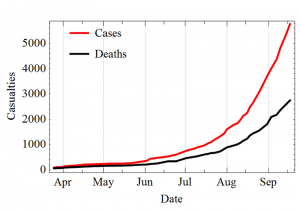
Ebola Cases And Deaths - Photo by Leopoldo Martin RDid you know that the number of Ebola cases in Liberia and Sierra Leone is approximately doubling every 20 days?  People are dropping dead in the streets, large numbers of bodies are being dumped into the rivers, and gravediggers can hardly keep up with the the number of corpses that are being delivered to the cemeteries.  As you read this, life is pure hell in many areas of West Africa, and now the CDC is warning that things may get far, far worse in the very near future.  According to the CDC, the number of Ebola cases could potentially soar to 1.4 million by the end of January.  Of course the CDC says that this is a “worst-case scenario”, but for our health officials to even suggest that such a huge number is possible is quite chilling.  We are now being told that the fatality rate for this Ebola outbreak has risen to 71 percent, and so most of the “cases” will eventually turn into deaths.  If we do eventually see 1.4 million cases of Ebola in West Africa, it is incredibly naive to think that it will not spread to other parts of the globe as well.

The World Health Organization has been trying to document the number of cases and deaths that are happening, but at this point even the WHO admits that the official statistics “vastly underestimate the magnitude of the outbreak.

And for the first time, health officials are conceding that this crisis may never have an end point.  A study that was published this week in the New England Journal of Medicine says that Ebola could potentially become endemic to West Africa.  In other words, it could become a disease that is continually spread and that we have to deal with on a regular basis like malaria or the flu.

Hopefully this outbreak will be brought under control shortly.  But at the moment there are no signs that this is happening.  In fact, hundreds of health workers have contracted the disease themselves.  And if current trends continue, the CDC warns that we could see up to 1.4 million cases of Ebola by the end of January

Researchers say the total number of cases is vastly underreported by a factor of 2.5 in Sierra Leone and Liberia, two of the three hardest-hit countries. Using this correction factor, researchers estimate that approximately 21,000 total cases will have occurred in Liberia and Sierra Leone by Sept. 30. Reported cases in those two countries are doubling approximately every 20 days, researchers said.

“Extrapolating trends to January 20, 2015, without additional interventions or changes in community behavior,” such as much-improved safe burial practices, the researchers estimate that the number of Ebola cases in Liberia and Sierra Leone could be between approximately 550,000 to 1.4 million.

Over the past several weeks, there have been numerous reports of dead bodies lying in the streets of major cities over in West Africa.

And now even the WHO is admitting that many Ebola corpses have been dumped into nearby rivers…

“The true number of deaths will likely never be known, as bodies in the notoriously poor, filthy and overcrowded West Point slum, in the capital, Monrovia, have simply been thrown into the two nearby rivers,” WHO said in a separate statement.

No wonder Ebola is spreading so rapidly.

So far authorities have been able to keep this crisis mostly contained to just a few countries.

But what happens when we have over a million people running around with Ebola?

How in the world do we keep that contained?

There are some in the scientific community that are expressing skepticism that we will be able to…

That sort of exponential increase in cases makes it more likely that Ebola will become entrenched in West Africa, said Robert Murphy, a professor of medicine and biomedical engineering at Northwestern University.

If there are hundreds of thousands of Ebola cases, then “many more countries will have cases, and it won’t be just West Africa,” Murphy said. “There is so much mobility now, this can spread anywhere.”

If Ebola continues to spread like wildfire throughout West Africa, it is probably just a matter of time before it starts popping up in major cities in other areas of the globe.

If this were to happen in the United States, life would change for all of us almost overnight.

It is hard to put into words that kind of chaos that we are witnessing over in Liberia, Guinea and Sierra Leone right now.  Panic and fear are everywhere, and the corpses just keep piling up.  The following is an excerpt from a recent New York Times article

The Ebola epidemic is spreading rapidly in Sierra Leone’s densely packed capital – and it may already be far worse than the authorities acknowledge.

Various models of the growth of the epidemic here “all show an exponential increase,” said Peter H. Kilmarx, the head of the Centers for Disease Control and Prevention team in Sierra Leone. “The conditions are amenable to Ebola spread.”

“Since last month, it’s every day, any minute and hour, and often, they are coming” to bury the Ebola dead, said Desmond Kamara, a police officer.

A cloudy stream drains from the area of the new graves into the slum, further frightening the residents.

“We are at risk, big risk,” said Ousman Kamara, a resident. “We have made many complaints.”

But the bodies, he said, keep coming.

“Even at night,” he said. “You stand here, and you see them coming.”

Could you imagine something like that happening in America?

At this stage of the crisis in West Africa, all existing treatment facilities are absolutely overwhelmed.

Because there are no more beds, large numbers of people with Ebola are being turned away.  Many end up dying just outside of the walls of some of these clinics

A new Ebola clinic opened in Monrovia this week, but bodies lay on the ground outside its walls. Ambulances filled with Ebola patients, some that have traveled seven hours to get there, are not unloaded. Without help to get them inside, the patients fall in the dirt, mere feet away from treatment.

If things are this bad already when we only have thousands of cases, what are things going to look like when we have more than a million cases?

A representative for Samaritan’s Purse admitted the other day that “it’s too late. Nobody’s going to build 100,000 beds.

And it can be absolutely heartbreaking for health workers to turn away people that are dying.

The following is firsthand testimony from a health worker that is on the front lines of this crisis that is actually having to do this…

The first person I had to turn away was a father who had brought his sick daughter in the trunk of his car. He pleaded with me to take his teenage daughter, saying that whilst he knew we couldn’t save her life, at least we could save the rest of his family from her.

Other families just pulled up in cars, let the sick person out and then drove off, abandoning them. One mother tried to leave her baby on a chair, hoping that if she did, we would have no choice but to care for the child.

I had to turn away one couple who arrived with their young daughter. Two hours later the girl died in front of our gate, where she remained until the body removal team took her away.

Those that are working on burial teams often see things that are even worse.  Just consider the following example

Dressed from head to toe in white protective suits and thick goggles, the burial teams try to stay safe, but nothing can shield them from the unspeakable horrors they’ve seen when they make their regular rounds. On Friday, Kiyee described what he saw when he entered a home:

“I took the key and opened the door and went in and saw a 6-month-old child licking on the mother’s skin,” said Kiyee. The mother was lying on her stomach. She had died from Ebola. The baby was searching for the mother’s milk. “Right away I started shedding tears.”

This is the kind of pure hell that we could see in the United States if Ebola starts spreading here.

Just because we have a more advanced medical system and better living conditions does not mean that we will be able to stop the spread of this virus.

In fact, some medical professionals are already warning that we are not prepared for an Ebola pandemic.

If cases of Ebola do start appearing in major cities throughout America, you will want to be prepared to stay at home as much as possible.  There will not be any magic pill that you can pop that will “cure” you of this disease.  It is a brutally efficient killer that does not show any mercy.

So let us hope that global health officials know what they are doing and that this pandemic will be brought under control soon.

But it would also be foolish not to prepare for the worst.

Ferguson Is A Perfect Example Of How Quickly The Streets Of America Can Descend Into Chaos

Ferguson RiotsRioting, looting, burning down stores and shooting police officers – is this about to become the “new normal” in America?  What we just witnessed happen in the streets of Ferguson, Missouri is a prime example of how quickly the streets of America can descend into chaos.  There is so much anger and frustration in this country, especially among our young people, that all it takes is a “trigger event” to spark a wildfire.  In this case, it was the shooting of an unarmed black teen by a police officer.  According to the police, 18-year-old Michael Brown got into a physical altercation with an officer and was subsequently shot.  Word spread quickly throughout the community, and protests were rapidly organized.  But the protests didn’t stay peaceful.  People started chanting “kill the police” and throwing rocks and bottles.  Store windows were smashed, the looting began, and people went absolutely crazy.  And it wasn’t just a few people that were doing the looting.  Huge mobs of people looted stores all over Ferguson.  At one point an ATM was even dragged out of a QuikTrip gas station and a while after that the store was set on fire.  But this is what happens when things descend into chaos.  The owners of those stores didn’t have anything to do with the shooting of Michael Brown, but the violence got directed at them anyway.  And someday when we see similar scenes erupt in major cities all over the nation, it won’t matter what your political beliefs are.  You just better not be in the wrong place at the wrong time.

Ferguson is a little town just outside of St. Louis with a population of about 21,000 people.  You wouldn’t think that it would be possible to see such massive rioting in such a small community.  But that is precisely what happened.  On Monday, millions of Americans were absolutely mesmerized by the images coming out of Ferguson.  The following is how one news source described what happened…

Brian Schellman, with the St. Louis County Police Department, said close to 300 police officers from at least 15 different departments were called to Ferguson when angry mobs began smashing windows, setting fires and looting businesses in the area.

Schellman said a St. Louis County officer injured his knee while at a Foot Locker store during the rioting. He said another officer was injured when he had a brick thrown at him.

Throughout the evening, numerous cop cars sustained damage and Ferguson Police Chief Tom Jackson said someone in a yellow pickup truck fired shots at officers while circling a WalMart parking lot.  Chief Jackson said he got into a cop car to give chase to the truck but the truck got away.

Police said shots were also fired at a police helicopter in the area.

But words do not really accurately convey the level of craziness that was unleashed.  I would encourage you to watch some of the videos on YouTube of the rioting and looting that were going on in Ferguson.  The video posted below is just one example…

Sadly, this violence might continue for a while.

Just check out what one very angry 30-year-old man told the St. Louis Post-Dispatch

DeAndre Smith, 30, of Ferguson was happy to justify the looting when a reporter asked him about it Monday morning.

“This is exactly what is supposed to be happening when an injustice is happening in your community,” he said, adding: “You have kids getting killed for nothing.”

Smith, who moved to St. Louis from New York in December, said there could be more to come.

I don’t think it’s over honestly,” he said. “I just think they got a taste of what fighting back means.”

Of course this is not the first time that we have seen this kind of thing happen.  Earlier this year, all it took was a snow storm for people in Atlanta to start behaving like crazed lunatics.  And late last year we saw rioting and looting all over the nation when a technical glitch caused the EBT system to go down for a short while.

Even though the economy has somewhat stabilized (at least for the moment), levels of anger and frustration have continued to grow in this country.  We have been taught to hate one another and to blame one another for our problems, and so now the U.S. is more divided than at any other point in recent memory.  For much more on this, please see my previous article entitled “America The Divided: Everyone Knows We Have Problems But There Is Very Little Agreement On Solutions“.

We live at a time when things are so tense that even a small spark can light an absolutely huge fire.  America has become a tinderbox.  Next time it might not be a racially-charged shooting.  Next time it might be an Ebola outbreak that sparks looting and panic.  Or it might be some sort of financial collapse.  We just don’t know.

But what we do know is that there are lots and lots of people that are willing to riot and loot and commit unspeakable crimes given the right circumstances.

Decades of social decay have gotten us to the point where the thin veneer of civilization that we all take for granted every single day is wearing dangerously thin.

The truth is that it is not going to take much to push this nation over the edge.

If this kind of rioting can take place in a community with just over 20,000 people, what would a full-blown riot look like in a city with millions of people?

That is a very sobering thing to think about.

Once upon a time in America, you could leave your doors unlocked at night and you could let your kids play in the streets without ever having to worry.

But now we are a sick, decaying nation that has millions of people ready to riot and loot at the drop of a hat.

Is there any hope for us?

America The Divided: Everyone Knows We Have Problems But There Is Very Little Agreement On Solutions

Argument - Public DomainA house divided against itself will surely fall.  America is more divided today than it has been in decades, and the deep divisions that are tearing us apart continue to get even worse.  In fact, a newly released Rasmussen Reports national survey discovered that 67 percent of voters believe that America is even more divided now than it was four years ago.  We are angry, we are frustrated and we love to fight with one another, but none of this strife and discord is getting us anywhere.  What most Americans can agree on is that we are facing tremendous problems as a nation.  One average of recent polls found that only 26 percent of Americans believe that this country is heading in the right direction and 63.8 percent of Americans believe that this country is heading in the wrong direction.  Unfortunately, there is very little agreement on what the solutions to our problems are.  That is where the division is.  As a nation, we no longer have a shared set of values or principles that provides a foundation for our decisions.  Everyone just kind of does whatever is right in their own eyes, and the result is chaos.  At a minimum, the U.S. Constitution was supposed to bond all of us together, but it has become clear that very few of our lawless politicians have any respect for that document at this point.  And the American people must not have too much respect left for the Constitution either, because they keep sending the very same politicians back to Washington over and over again.  Unless a miracle happens, everyone is going to keep pulling in different directions, and that is going to continue ripping our country to shreds.

The issues that divide us are countless.  The following are just a few examples…

-Illegal Immigration

-Taxes

-Obamacare

-Government Debt

-U.S. Military Intervention In Foreign Countries

-Gay Marriage

-Abortion

-Racial Relations

-Unemployment

-Shipping Our Jobs Overseas

-Cost Of Living/Inflation

-The Gap Between The Wealthy And The Poor

-Social Security/Medicare/Entitlements

-The Size And Role Of Government

-Welfare

-Political Correctness

-Sexual Morality

-Global Warming/Climate Change

-Guns/Gun Control

-Common Core

-Corporate Corruption

-Government Surveillance

-The Emerging Big Brother Police State

-The War On Drugs

-The War On Terror

-U.S. Relationship With Israel

-The Role Of Faith In Society

I could go on and on with this list, but I think that you get the point.

If you pick just about any issue on that list, there are large numbers of Americans that want to take us one way and large numbers of Americans that want to take us exactly in the opposite direction.  In many instances, both sides consider their opponents to be the epitome of evil.

Sadly, the fights that take place among those that are supposed to be on the same side are often even more disturbing.  Some of the most bitter fighting that I have ever witnessed has been between people that should be working together.  In fact, it often seems like a lot of people would rather fight others in their own “movement” than do something constructive.

And actually the establishment loves when we fight with one another.  The more divided that we are, the easier we are to control.

I am often asked if I think that there is any hope for a political solution in this country.

I wish that I could be more optimistic when I answer, but as divided as this country is right now I see absolutely no hope for a political solution on the national level any time soon.

Even though Darth Vader has a higher favorability rating than any 2016 White House contenders, it is inevitable that one of them (with the full backing of the elite) will be our next president.  And even though a few incumbents will be knocked out of Congress in 2014 and 2016, history has shown us that incumbents typically have a victory rate of more than 80 percent in election after election.

We keep sending the same jokers back to D.C. again and again and yet we continue to keep expecting different results.

Are we insane or what?

In a previous article, I noted a whole bunch of other polls and surveys that show how dissatisfied the American people have become with our government…

#1 65 percent of Americans are dissatisfied “with the U.S. system of government and its effectiveness”.  That is the highest level of dissatisfaction that Gallup has ever recorded.

#2 66 percent of Americans are dissatisfied “with the size and power of federal government”.

#3 70 percent of Americans do not have confidence that the government will “make progress on the important problems and issues facing the country in 2014.”

#4 Only 8 percent of Americans believe that Congress is doing a “good” or “excellent” job.

#5 Only 4 percent of Americans believe that it would “change Congress for the worse” if every member was voted out during the next election.

#6 60 percent of Americans report feeling “angry or irritable”.  Two years ago that number was at 50 percent.

#7 53 percent of Americans believe that the Obama administration is “not competent in running the government”.

#8 An all-time low 31 percent of Americans identify themselves as Democrats.

#9 An all-time low 25 percent of Americans identify themselves as Republicans.

#10 An all-time high 42 percent of Americans identify themselves as Independents.

Clearly the American people are sick and tired of politics as usual.

But even if we voted out every single member of Congress, who would we replace them with?

That is where not having a shared set of values and principles comes into play.

Even if we could start from scratch, the new politicians that the American people would send to Congress would not suddenly look like the founding fathers.

That is because we no longer believe in the same values and principles that they did.

Instead, an entirely new Congress would probably end up looking very much like the old Congress did.

I wish that national unity was just as easy as saying something like this: “Come on guys – let’s all just get together and agree to do what is right for the country.”

That sounds really good, but what is right for the country?

In America today, there is very little agreement about what is right and wrong anymore.

And politically, it is hard enough to get a handful of people to agree on much of anything these days, much less the millions upon millions of people that would be required to form a viable political movement.

So no, I don’t believe that there will be a political solution on the national level any time soon.  The government that we have already reflects what is in the hearts of the American people.

Until we start seeing hearts change on a widespread basis, we are not going to see any significant change in Washington.

The United States Of Debt: Total Debt In America Hits A New Record High Of Nearly 60 Trillion Dollars

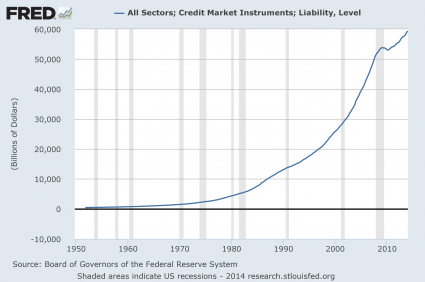
America Is BrokeWhat would you say if I told you that Americans are nearly 60 TRILLION dollars in debt?  Well, it is true.  When you total up all forms of debt including government debt, business debt, mortgage debt and consumer debt, we are 59.4 trillion dollars in debt.  That is an amount of money so large that it is difficult to describe it with words.  For example, if you were alive when Jesus Christ was born and you had spent 80 million dollars every single day since then, you still would not have spent 59.4 trillion dollars by now.  And most of this debt has been accumulated in recent decades.  If you go back 40 years ago, total debt in America was sitting at about 2.2 trillion dollars.  Somehow over the past four decades we have allowed the total amount of debt in the United States to get approximately 27 times larger.  This is utter insanity, and anyone that thinks this is sustainable is completely deluded.  We are living in the greatest debt bubble of all time, and there is no way that this is going to end well.  Just check out the chart…

Total Debt

When the last recession hit, total debt in America actually started going down for a short period of time.

But then the Federal Reserve and our politicians in Washington worked feverishly to reinflate the bubble and they assured everyone that everything was going to be just fine.  So Americans once again resorted to their free spending ways, and now total debt in the United States is rising at almost the same trajectory as before and has hit a new all-time record high.

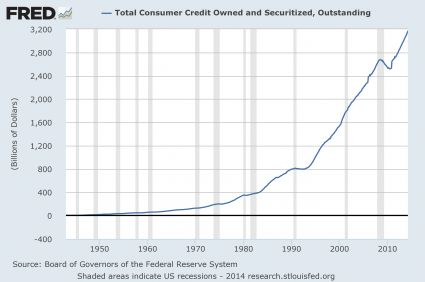
We see a similar thing when we look at a chart for consumer debt in America…

Total Consumer Credit

For a while after the recession it was trendy to cut up your credit cards and get out of debt.

But that fad wore off rather quickly, didn’t it?

It is almost as if 2008 never happened.  We are making the same mistakes with debt that we did before.

As I noted recently, total consumer credit in the U.S. has risen by 22 percent over the past three years alone, and at this point 56 percent of all Americans have a subprime credit rating.

And have you noticed that a lot of people are not afraid to extend themselves in order to buy shiny new vehicles these days?

During the first quarter 0f this year, the size of the average vehicle loan soared to a new all-time record high of $27,612.

Five years ago, that number was just $24,174.

And as I noted in one recent article, the size of the average monthly car payment in this country is now up to $474.

That is practically a mortgage payment.

Speaking of mortgage payments, even though home sales have been falling and the rate of homeownership in the United States is the lowest that it has been in 19 years, a very large percentage of those who own homes are still overextended.

In fact, one recent survey discovered that a whopping 52 percent of Americans cannot even afford the house that they are living in right now.

At the same time, an increasing number of Americans are acting as if the last financial crisis never happened and are treating their homes like piggy banks.   Home equity loans are soaring again, and when the next great crisis strikes a lot of those people are going to end up getting into a lot of financial trouble.

There has been much written about what is wrong with the housing industry, but the truth is that home prices are still way too high and young adults cannot afford to purchase homes because they are already loaded down by huge amounts of debt even before they get to the point where they are ready to buy.

In fact, a newly released survey found that 47 percent of millennials are spending at least half of their paychecks on paying off debt…

Four in 10 millennials say they are “overwhelmed” by their debt — nearly double the number of baby boomers who feel that way, according to a Wells Fargo survey of more than 1,600 millennials between 22 and 33 years old, and 1,500 baby boomers between 49 and 59 years old.

To try to get out from underneath it, 47% said they spend at least half of their monthly paychecks on paying off their debts.

When I read that I was absolutely astounded.

Of course the biggest debt that many young adults are facing is student loan debt.  According to the Federal Reserve, there is now more than 1.2 trillion dollars of student loan debt in this country, and about 124 billion dollars of that total is more than 90 days delinquent.

What we have done to our young people is shameful.  We have encouraged them to sign up for a lifetime of debt slavery before they even understand what life is all about.  The following is an excerpt from my previous article entitled “Is College A Waste Of Time And Money?“…

In America today, approximately two-thirds of all college students graduate with student loan debt, and the average debt level has been steadily rising.  In fact, one study found that “70 percent of the class of 2013 is graduating with college-related debt – averaging $35,200 – including federal, state and private loans, as well as debt owed to family and accumulated through credit cards.”

That would be bad enough if most of these students were getting decent jobs that enabled them to service that debt.

But unfortunately, that is often not the case.  It has been estimated that about half of all recent college graduates are working jobs that do not even require a college degree.

Considering what you just read, is it a surprise that half of all college graduates in America are still financially dependent on their parents when they are two years out of college?

According to the U.S. Census Bureau, only 36 percent of all Americans under the age of 35 own a home at this point.  That is the lowest level that has ever been recorded.

And we are passing on to our young people the largest single debt in all of human history.  Weighing in at 17.5 trillion dollars, the U.S. national debt is a colossal behemoth.  And almost all of that debt has been accumulated over the past 40 years.  In fact, 40 years ago the U.S. national debt was less than half a trillion dollars.

But this is just the beginning.  As the Baby Boomer “demographic tsunami” washes through our economy, we are going to be facing a wave of red ink unlike anything we have ever contemplated before.

Meanwhile, the rest of the planet is drowning in debt as well.

As I wrote about the other day, the total amount of debt in the world has risen to a new all-time record high of $223,300,000,000,000.

Our “leaders” keep acting as if these debt levels can keep growing much faster than the overall level of economic growth indefinitely.

But anyone with even a shred of common sense knows that you can’t spend more money that you bring in forever.

At some point, a day of reckoning arrives.

2008 should have been a major wake up call that resulted in massive changes.  But instead, our leaders just patched up the old system and reinflated the old bubbles so that they are now even larger than they were before.

They assure us that they know exactly what they are doing and that everything will be just fine.

Unfortunately, they are dead wrong.

America’s Insatiable Demand For More Expensive Cars, Larger Homes And Bigger Debts

McMansionOne of the things that this era of American history will be known for is conspicuous consumption.  Even though many of us won’t admit it, the truth is that almost all of us want a nice vehicle and a large home.  They say that “everything is bigger in Texas”, but the same could be said for the entire nation as a whole.  As you will see below, the size of the average new home has just hit a brand new record high and so has the size of the average auto loan.  In the endless quest to achieve “the American Dream”, Americans are racking up bigger debts than ever before.  Unfortunately, our paychecks are not keeping up and the middle class in the United States is steadily shrinking.  The disparity between the lifestyle that society tells us that we ought to have and the size of our actual financial resources continues to grow.  This is leading to a tremendous amount of frustration among those that can’t afford to buy expensive cars and large homes.

I remember the days when paying for a car over four years seemed like a massive commitment.  But now nearly a quarter of all auto loans in the U.S. are extended out for six or seven years, and those loans have gotten larger than ever

In the latest sign Americans are increasingly comfortable taking on more debt, auto buyers borrowed a record amount in the first quarter with the average monthly payment climbing to an all-time high of $474.

Not only that, buyers also continued to spread payments out over a longer period of time, with 24.8 percent of auto loans now coming with payment terms between six and seven years according to a new report from Experian Automotive.

That’s the highest percentage of 6 and 7-year loans Experian has ever recorded in a quarter.

Didn’t the last financial crisis teach us about the dangers of being overextended?

During the first quarter 0f 2014, the size of the average auto loan soared to an all-time record $27,612.

But if you go back just five years ago it was just $24,174.

And because we are taking out such large auto loans that are extended out over such a long period of time, we are now holding on to our vehicles much longer.

According to CNBC, Americans now keep their vehicles for an average of six years and one month.

Ten years ago, it was just four years and two months.

My how things have changed.

And consumer credit as a whole has also reached a brand new all-time record high in the United States.

Consumer credit includes auto loans, but it doesn’t include things like mortgages.  The following is how Investopedia defines consumer credit…

Consumer credit is basically the amount of credit used by consumers to purchase non-investment goods or services that are consumed and whose value depreciates quickly. This includes automobiles, recreational vehicles (RVs), education, boat and trailer loans but excludes debts taken out to purchase real estate or margin on investment accounts.

As you can see from the chart below, Americans were reducing their exposure to consumer credit for a little while after the last financial crisis struck, but now it is rapidly rising again at essentially the same trajectory as before…

Consumer Credit 2014

Have we learned nothing?

Meanwhile, America also seems to continue to have an insatiable demand for even larger homes.

According to Zero Hedge, the size of the average new home in the United States has just hit another brand new record high…

There was a small ray of hope just after the Lehman collapse that one of the most deplorable characteristics of US society – the relentless urge to build massive McMansions (funding questions aside) – was fading. Alas, as the Census Bureau today confirmed, that normalization in the innate desire for bigger, bigger, bigger not only did not go away but is now back with a bang.

According to just released data, both the median and average size of a new single-family home built in 2013 hit new all time highs of 2,384 and 2,598 square feet respectively.

And while it is known that in absolute number terms the total number of new home sales is still a fraction of what it was before the crisis, the one strata of new home sales which appears to not only not have been impacted but is openly flourishing once more, are the same McMansions which cater to the New Normal uberwealthy (which incidentally are the same as the Old Normal uberwealthy, only wealthier) and which for many symbolize America’s unbridled greed for mega housing no matter the cost.

There is certainly nothing wrong with having a large home.

But if people are overextending themselves financially, that is when it becomes a major problem.

Just remember what happened back in 2007.

And just like prior to the last financial crisis, Americans are treating their homes like piggy banks once again.  Home equity lines of credit are up 8 percent over the past 12 months, and homeowners are increasingly being encouraged to put their homes at risk to fund their excessive lifestyles.

But there has been one big change that we have seen since the last financial crisis.

Lending standards have gotten a lot tougher, and many younger adults find that they are not able to buy homes even though they would really like to.  Stifled by absolutely suffocating levels of student loan debt, many of these young adults are putting off purchasing a home indefinitely.  The following is an excerpt from a recent CNN article about this phenomenon…

The Millennial generation is great at many things: texting, social media, selfies. But buying a home? Not so much.

Just 36% of Americans under the age of 35 own a home, according to the Census Bureau. That’s down from 42% in 2007 and the lowest level since 1982, when the agency began tracking homeownership by age.

It’s not all their fault. Millennials want to buy homes — 90% prefer owning over renting, according to a recent survey from Fannie Mae.

But student loan debt, tight lending standards and stiff competition have made it next to impossible for many of these younger Americans to make the leap.

This is one of the primary reasons why homeownership in America is declining.

A lot of young adults would love to buy a home, but they are already financially crippled from the very start of their adult lives by student loan debt.  In fact, the total amount of student loan debt is now up to approximately 1.1 trillion dollars.  That is even more than the total amount of credit card debt in this country.

We live in a debt-based system which is incredibly fragile.

We experienced this firsthand during the last financial crisis.

But we just can’t help ourselves.

We have always got to have more, and society teaches us that if we don’t have enough money to pay for it that we should just go into even more debt.

Unfortunately, just as so many individuals and families have found out in recent years, eventually a day of reckoning arrives.

And a day of reckoning is coming for the nation as a whole at some point as well.

You can count on that.

Cities All Over America Are Becoming Extremely Cruel To The Homeless

Homeless - Photo by psyberartistHave you ever given food to a homeless person?  Well, if you do it again in the future it might be a criminal act depending on where you live.  Right now, there are dozens of major U.S. cities that have already passed laws against feeding the homeless.  As you will read about below, in some areas of the country you can actually be fined hundreds of dollars for just trying to give food to a hungry person.  I know that sounds absolutely insane, but this is what America is turning into.  Communities all over the country are attempting to “clean up the streets” by making it virtually illegal to either be homeless or to help those that are homeless.  Instead of spending more money on programs to assist the homeless, local governments are bulldozing tent cities and giving homeless people one way bus tickets out of town.  We are treating some of the most vulnerable members of our society like human garbage, and it is a national disgrace.

What does it say about our country when we can’t even give a warm sandwich to a desperately hungry person that is sleeping on the streets?  A retired couple down in Florida named Debbie and Chico Jimenez wanted to do something positive for their community during their retirement years, so they started feeding the homeless in Daytona Beach.  But recently the police decided to crack down on their feeding program and slapped everyone involved with a $373 fine

For the past year, the Jimenezes have set up shop every Wednesday on Manatee Island in Daytona Beach, Fla., where they feed hot dogs, chicken, pasta salad and other BBQ staples to about 100 homeless people, WFTV reported. Handing out meals is just one aspect of the ministry the two founded, Spreading the Word Without Saying a Word, to help people living in poverty.

But on Wednesday, the Jimenezes said that without warning, they and four other volunteers were accosted by police, fined and told that they could be thrown in jail if they continue their program, according to NBC News.

Each of the six was fined $373 and were given 10 days to either pay up or go to court.

“We’re going to court,” Debbie Jimenez, 52, a former auto parts store manager, told NBC News. “The police don’t like it. But how can we turn our backs on the hungry? We can’t.”

Don’t the police down in Daytona Beach have something better to do with their time?

Sadly, more than 50 major cities have passed laws against feeding the homeless at this point.  It appears that “cleaning up the streets” has become a big point of emphasis all over the nation.

And what the city of Camden, New Jersey just did is even worse than what happened in Daytona Beach.

Camden just bulldozed an entire tent city and dumped all of the belongings of the homeless people living there into the trash…

Hazmat teams showed up at the camps in the early morning to search for syringes. A drug-sniffing dog followed a police officer around the area. And bulldozers tossed trash and discarded belongings into dumpsters before razing the premises.

Over the past few weeks, flyers had warned people in the tent cities that this was going to happen. Yet it still seemed surreal to many of them that their communities were about to be demolished for good.

But for most of the people that were living in that tent city, there is no place else for them to go.  The homeless shelters in the area are at max capacity, and so many of them will end up sleeping in the streets without any shelter at all

Aaron Howe, the “mayor” of a tent city that had 12 tents the night before eviction day, said he had called every shelter in town and not a single place had room for him and his girlfriend.

“There’s no available spots, and the city is saying if we pitch a tent somewhere else they’re gonna rip it down,” he said. “It’s not gonna look good when there’s a bunch of homeless on the streets.”

Camden has got to be one of the most mismanaged communities in the entire country.  Why is Camden spending time and money bulldozing homeless communities when it has so many other problems?  For much more on the nightmare that Camden has become, please see my previous article entitled “Camden, New Jersey: One Of Hundreds Of U.S. Cities That Are Turning Into Rotting, Decaying Hellholes“.

Other big cities that are a little bit more “progressive” are attempting to get rid of their homeless populations by giving them one way tickets out of town.  Some of the major cities that are doing this include San Diego and San Francisco

When her Greyhound bus pulled into town 6 months ago, Maria Castillo got off with two bags and dream.

“Start over, start a new life,” said the 42-year-old.

Castillo had been homeless in San Diego when a social worker offered her a one-way bus ticket to Portland.

“They said come here because all the opportunities in Portland, Oregon,” she said.

But Castillo said life isn’t much better in her new town. She’s still homeless. A Unit 8 investigation found several cities from San Diego to San Francisco are providing one-way bus tickets to the homeless.

As shocking as everything that you just read is, what one lawmaker out in Hawaii is doing tops it all.  In a previous article, I described how a state representative named Tom Brower has actually been using a sledgehammer to destroy shopping carts used by homeless people.  Just check out the following short excerpt from an RT article that was published a few months ago…

In the past two weeks residents in Hawaii noticed what appeared to be a crazed individual carrying a sledgehammer through the streets of Honolulu, a state lawmaker looking to rid the city of homeless people by targeting their belongings.

State Representative Tom Brower (D) is currently dedicated to dealing out his own personal brand of “justice” by seeking out homeless people and destroying their possessions. Brower estimates that he has used the sledgehammer to smash at least 30 shopping carts, rendering them useless by bashing in the front wheels.

I got tired of telling people I’m trying to pass laws. I want to do something practical that will really clean up the streets,” he told Hawaii News Now. “I find abandoned junk, specifically shopping carts, and I remove them.”

Is this how our society is going to treat those that are down on their luck from now on?

Where is the love?

Where is the compassion?

Why can’t we seem to be able to take care of these people?

The federal government sure seems to have plenty of money to waste on other things.  For example, it is being reported that workers at an Obamacare processing facility in Missouri are being paid to do nothing but stare at their computers

Employees at an ObamaCare processing center in Missouri with a contract worth $1.2 billion are reportedly getting paid to do nothing but sit at their computers.

“Their goals are set to process two applications per month and some people are not even able to do that,” a whistleblower told KMOV-TV, referring to employees hired to process paper applications for ObamaCare enrollees.

The facility in Wentzville is operated by Serco, a company owned by a British firm that was awarded $1.2 billion in part to hire 1,500 workers to handle paper applications for coverage under the law, according to The Washington Post.

The whistleblower employee told the station that weeks can pass without data entry workers receiving even a single application to process. Employees reportedly spend their days staring at their computers, according to a KMOX-TV report.

So we have millions upon millions of dollars to waste on that, but we can’t take care of our homeless population?

And without a doubt, the need to help the homeless is greater than it ever has been before.  Right now, there are 1.2 million public school students in America that are homeless.  That number is an all-time record, and it has grown by 72 percent since the start of the last recession.

In addition, there are 49 million Americans that are dealing with food insecurity.  Even in the midst of this so-called “economic recovery“, poverty is absolutely exploding.

And it is going to get a whole lot worse.  This is only just the beginning.

What is going to be needed in the years ahead is a tremendous amount of love and compassion.

But instead, it appears that hearts are becoming colder in America with each passing day.

So what do you think the solution is?  Please share your thoughts by posting a comment below…

The Middle Class In Canada Is Now Doing Better Than The Middle Class In America

Canada - Photo by SsolbergjFor most of Canada’s existence, it has been regarded as the weak neighbor to the north by most Americans.  Well, that has changed dramatically over the past decade or so.  Back in the year 2000, middle class Canadians were earning much less than middle class Americans, but since then there has been a dramatic shift.  At this point, middle class Canadians are actually earning more than middle class Americans are.  The Canadian economy has been booming thanks to a rapidly growing oil industry, and meanwhile the U.S. middle class has been steadily shrinking.  If current trends continue, a whole bunch of other countries are going to start passing us too.  The era of the “great U.S. middle class” is rapidly coming to a bitter end.

In recent years, I have been up to Canada frequently, and I am always amazed at how much nicer things are up there.  The stores and streets are cleaner, the people are more polite and it seems like almost everyone that wants to work has a job.

But despite knowing all this, I was still surprised when the New York Times reported this week that middle class incomes in Canada have now surpassed middle class incomes in the United States…

After-tax middle-class incomes in Canada — substantially behind in 2000 — now appear to be higher than in the United States. The poor in much of Europe earn more than poor Americans.

And things are particularly dire for those in the U.S. on the low end of the scale…

The struggles of the poor in the United States are even starker than those of the middle class. A family at the 20th percentile of the income distribution in this country makes significantly less money than a similar family in Canada, Sweden, Norway, Finland or the Netherlands. Thirty-five years ago, the reverse was true.

Even while our politicians and the media continue to proclaim that everything is “just fine”, the U.S. middle class continues to slide toward oblivion.

The biggest reason for this is the lack of middle class jobs.  Millions of good jobs have been shipped overseas, and millions of other good jobs have been replaced by technology.

The value of our labor is declining with each passing day, and this has forced millions upon millions of very qualified Americans to take whatever they can get.  As NBC News recently noted, this is a big reason why the temp industry has been booming…

For Americans who can’t find jobs, the booming demand for temp workers has been a path out of unemployment, but now many fear it’s a dead-end route.

With full-time work hard to find, these workers have built temping into a de facto career, minus vacation, sick days or insurance. The assignments might be temporary — a few months here, a year there — but labor economists warn that companies’ growing hunger for a workforce they can switch on and off could do permanent damage to these workers’ career trajectories and retirement plans.

“It seems to be the new norm in the working world,” said Kelly Sibla, 54. The computer systems engineer has been looking for a full-time job for four years now, but the Amherst, Ohio, resident said she has to take whatever she can find.

It has been estimated that one out of every ten jobs is now filled by a temp agency.  I have worked for temp agencies myself in the past.  Big companies like the idea of having “disposable workers”, and this is a trend that is likely to only grow in the years ahead.

But temp jobs and part-time jobs don’t pay as well as normal jobs.  And those kinds of jobs generally cannot support middle class families.

At this point, nine out of the top ten occupations in the United States pay an average wage of less than $35,000 a year.

That is absolutely stunning.

These days most families are barely scraping by, and they don’t have much extra money to go shopping with.

This is a big reason for the “retail apocalypse” that we are now witnessing.  This week we learned that retail stores in the United States are closing at the fastest pace that we have seen since the collapse of Lehman Brothers.  But you won’t hear much about that on the mainstream news.

You can find lots of “space available” signs and empty buildings in formerly middle class neighborhoods all over the country.  For example, one of my readers recently shot the following YouTube video in Scottsdale, Arizona.  As you can see, empty commercial buildings are all over the place…

As the middle class shrinks, more families are being forced to take in family members that can’t find decent work.  I have written previously about the huge rise in the number of young adults that are moving back in with their parents.  But this is not just happening to young people.  As the Los Angeles Times recently detailed, the number of Americans 50 and older that are moving in with their parents has absolutely soared in recent years…

For seven years through 2012, the number of Californians aged 50 to 64 who live in their parents’ homes swelled 67.6% to about 194,000, according to the UCLA Center for Health Policy Research and the Insight Center for Community Economic Development.

The jump is almost exclusively the result of financial hardship caused by the recession rather than for other reasons, such as the need to care for aging parents, said Steven P. Wallace, a UCLA professor of public health who crunched the data.

“The numbers are pretty amazing,” Wallace said. “It’s an age group that you normally think of as pretty financially stable. They’re mid-career. They may be thinking ahead toward retirement. They’ve got a nest egg going. And then all of a sudden you see this huge push back into their parents’ homes.”

The U.S. economy is slowly but steadily falling apart, and more people fall out of the middle class every single day.

A recent Gallup survey found that 14 percent of all Americans would experience “significant financial hardship” within one week of a job loss.

An additional 29 percent of all Americans would experience “significant financial hardship” within one month of a job loss.

That means that 43 percent of the entire country is living right on the edge.

It is no wonder why only about 30 percent of all Americans believe that we are moving in the right direction as a nation.

Most people know deep down that something is seriously wrong.  But most people can’t explain exactly what that is or how to fix it.

Meanwhile, the politicians and the media keep telling us that if we just keep doing the same old things that everything will work out okay somehow.  The blind are leading the blind, and we are rapidly marching toward disaster.

This Is What Employment In America Really Looks Like…

Warren Buffett - Photo by Mark HirscheyThe level of employment in the United States has been declining since the year 2000.  There have been moments when things have appeared to have been getting better for a short period of time, and then the decline has resumed.  Thanks to the offshoring of millions of jobs, the replacement of millions of workers with technology and the overall weakness of the U.S. economy, the percentage of Americans that are actually working is significantly lower than it was when this century began.  And even though things have stabilized at a reduced level over the past few years, it is only a matter of time until the next major wave of the economic collapse strikes and the employment level goes even lower.  And the truth is that more good jobs are being lost every single day in America.  For example, as you will read about below, Warren Buffett is shutting down a Fruit of the Loom factory in Kentucky and moving it to Honduras just so that he can make a little bit more money.  We see this kind of betrayal over and over again, and it is absolutely ripping the middle class of America to shreds.

Below I have posted a chart that you never hear any of our politicians talk about.  It is a chart that shows how the percentage of working age Americans with a job has steadily declined since the turn of the century.  Just before the last recession, we were sitting at about 63 percent, but now we have been below 59 percent since the end of 2009…

Employment Population Ratio 2014

We should be thankful that things have stabilized at this lower level for the past few years.

At least things have not been getting worse.

But anyone that believes that “things have returned to normal” is just being delusional.

And nothing is being done about the long-term trends that are absolutely crippling our economy.  One of those trends is the offshoring of middle class jobs.  As I mentioned above, Fruit of the Loom (which is essentially owned by Warren Buffett) has made the decision to close their factory in Jamestown, Kentucky and lay off all the workers at that factory by the end of 2014

Clothing company Fruit of the Loom announced Thursday that it will permanently close its plant in Jamestown and lay off all 600 employees by the end of the year.

The Jamestown plant is the last Fruit of the Loom plant in a state where the company had once been a manufacturing titan second only to General Electric.

This isn’t being done because Fruit of the Loom is going out of business.  They are still going to be making t-shirts and underwear.  They are just going to be making them in Honduras from now on…

The company, owned by Warren Buffett’s Berkshire Hathaway but headquartered in Bowling Green, said the move is “part of the company’s ongoing efforts to align its global supply chain” and will allow the company to better use its existing investments to provide products cheaper and faster.

The company said it is moving the plant’s textile operations to Honduras to save money.

So what are those workers supposed to do?

Go on welfare?

The number of Americans that are dependent on the government is already at an all-time record high.

And doesn’t Warren Buffett already have enough money?

In business school, they teach you that the sole responsibility of a corporation is to maximize wealth for the shareholders.

And so when business students get out into “the real world”, that is how they behave.

But the truth is that corporations have a responsibility to treat their workers, their customers and the communities in which they operate well.  This responsibility exists whether corporate executives want to admit it or not.

And we all have a responsibility to our fellow citizens.  When we stand aside and do nothing as millions of good paying American jobs are shipped overseas so that the “one world economic agenda” can be advanced and so that men like Warren Buffett can stuff their pockets just a little bit more, we are failing our fellow countrymen.

Because so many of us have fallen for the lie that “globalism is good”, we have allowed our once great manufacturing cities to crumble and die.  Just consider what is happening to Detroit.  It was once the greatest manufacturing city in the history of the planet, but now foreign newspapers publish stories about what a horror show that it has become…

Khalil Ligon couldn’t tell if the robbers were in her house. She had just returned home to find her front window smashed and a brick lying among shattered glass on the floor. Ligon, an urban planner who lives alone on Detroit’s east side, stepped out and called the police.

It wasn’t the first time Ligon’s home had been broken into, she told me. And when Detroit police officers finally arrived the next day, surveying an area marred by abandoned structures and overgrown vegetation, they asked Ligon a question she often ponders herself: why is she still in Detroit?

Of course this kind of thing is not just happening to Detroit.  The truth is that it is happening all over the nation.  For example, this article contains an incredible graphic which shows how the middle class of Chicago has steadily disappeared over the past several decades.

Once again, even though we have never had a “recovery”, it is a good thing that things have at least stabilized at a lower level for the past few years.

But now there are all sorts of indications that we are rapidly heading toward yet another economic downturn.  The tsunami of retail store closings that is now upon us is just one sign of this.  The following is a partial list of retail store closings from a recent article by Daniel Jennings

  • Quiznos has filed for bankruptcy, USA Today reported, and could close many of its 2,100 stores.
  • Sbarro which operates pizza and Italian restaurants in malls, is planning to close 155 locations in the United States and Canada. That means nearly 20 percent of Sbarro’s will close. The chain operates around 800 outlets.
  • Ruby Tuesday announced plans to close 30 restaurants in January after its sales fell by 7.8 percent. The chain currently operates around 775 steakhouses across the US.
  • An unknown number of Red Lobster stores will be sold. The chain is in such bad shape that the parent company, Darden Restaurants Inc., had to issue a press release stating that the chain would not close. Instead Darden is planning to spin Red Lobster off into another company and sell some of its stores.
  • Ralph’s, a subsidiary of Kroger, has announced plans to close 15 supermarkets in Southern California within 60 days.
  • Safeway closed 72 Dominick’s grocery stores in the Chicago area last year.

And the following are some more signs of trouble for the retail industry from one of my recent articles entitled “20 Facts About The Great U.S. Retail Apocalypse That Will Blow Your Mind“…

#1 As you read this article, approximately a billion square feet of retail space is sitting vacant in the United States.

#2 Last week, Radio Shack announced that it was going to close more than a thousand stores.

#3 Last week, Staples announced that it was going to close 225 stores.

#4 Same-store sales at Office Depot have declined for 13 quarters in a row.

#5 J.C. Penney has been dying for years, and it recently announced plans to close 33 more stores.

#6 J.C. Penney lost 586 million dollars during the second quarter of 2013 alone.

#7 Sears has closed about 300 stores since 2010, and CNN is reporting that Sears is “expected to shutter another 500 Sears and Kmart locations soon”.

#8 Overall, sales numbers have declined at Sears for 27 quarters in a row.

#9 Target has announced that it is going to eliminate 475 jobs and not fill 700 positions that are currently empty.

#10 It is being projected that Aéropostale will close about 175 stores over the next couple of years.

#11 Macy’s has announced that it is going to be closing five stores and eliminating 2,500 jobs.

#12 The Children’s Place has announced that it will be closing down 125 of its “weakest” stores by 2016.

But it isn’t just the retail industry that is deeply troubled.

All over America we are seeing economic weakness.

In this economic environment, it doesn’t matter how smart, how educated or how experienced you are.  If you are out of work, it can be extremely difficult to find a new job.  Just consider the case of Abe Gorelick

Abe Gorelick has decades of marketing experience, an extensive contact list, an Ivy League undergraduate degree, a master’s in business from the University of Chicago, ideas about how to reach consumers young and old, experience working with businesses from start-ups to huge financial firms and an upbeat, effervescent way about him. What he does not have — and has not had for the last year — is a full-time job.

Five years since the recession ended, it is a story still shared by millions. Mr. Gorelick, 57, lost his position at a large marketing firm last March. As he searched, taking on freelance and consulting work, his family’s finances slowly frayed. He is now working three jobs, driving a cab and picking up shifts at Lord & Taylor and Whole Foods.

So what does Abe need in order to find a decent job?

More education?

More experience?

No, what he needs is an economy that produces good jobs.

Sadly, the cold, hard reality of the matter is that the U.S. economy will never produce enough jobs for everyone ever again.

The way that America used to work is long gone, and it has been replaced by a cold, heartless environment where the company that you work for could rip your job away from you at a moment’s notice if they decide that it will put a few extra pennies into the pockets of the shareholders.

You may have worked incredibly hard for 30 years and been super loyal to your company.

It doesn’t matter anymore.

All that matters is the bottom line, and in the process the middle class is being destroyed.  But by destroying the middle class, those corporations are destroying the consumer base that their corporate empires were built upon in the first place.

Read more here: http://www.kentucky.com/2014/04/03/3177378/fruit-of-the-loom-to-close-jamestown.html#storylink=cpy