
Is The Mainstream Media Dying?

CNN News Studio - Photo by DougRatings at CNN, MSNBC and Fox News have all been plummeting in recent years, and newspaper ad revenues are about a third of what they were back in the year 2000.  So is the mainstream media dying?  Despite what you may have heard, the mainstream media is certainly not completely dead just yet.  The average American watches approximately 153 hours of television a month, and as I pointed out in a previous article, about 90 percent of the “information” that is endlessly pumped into our heads through our televisions is controlled by just six gigantic media corporations.  However, there are a whole host of signs that things are changing – especially when it comes to news.  More Americans than ever are losing faith in the establishment-controlled media and are seeking out alternative sources of information.  Is this a trend that the big media companies are going to be able to reverse at some point?

For years, the “news business” has been dominated by CNN, Fox News and MSNBC.  But now all three channels are rapidly losing viewers.  According to a recently released Pew Research study, the number of prime time viewers for all three networks combined fell by 11 percent last year…

In 2013, the cable news audience, by nearly all measures, declined. The combined median prime-time viewership of the three major news channels—CNN, Fox News and MSNBC—dropped 11% to about 3 million, the smallest it has been since 2007. The Nielsen Media Research data show that the biggest decline came at MSNBC, which lost nearly a quarter (24%) of its prime-time audience. CNN, under new management, ended its fourth year in third place, with a 13% decline in prime time. Fox, while down 6%, still drew more viewers (1.75 million) than its two competitors combined (619,500 at MSNBC and 543,000 at CNN).

And the decline is far more dramatic when you look at just the key 25 to 54-year-old demographic.

From November 2012 to November 2013, CNN’s ratings for that demographic dropped by a staggering 59 percent, and MSNBC’s ratings for that demographic dropped by a staggering 52 percent.

Is this a sign that Americans are finally getting fed up with the endless propaganda being spewed by those establishment mouthpieces?

A recent survey conducted by a liberal polling firm would indeed seem to indicate that this is the case.  That survey found that only 6 percent of Americans consider MSNBC to be their most trusted source for news…

NBC News and sister cable network MSNBC rank at the bottom of media outlets Americans trust most for news, with Fox News leading the way, according to a new poll from the Democratic firm Public Policy Polling.

In its fifth trust poll, 35 percent said they trusted Fox news more than any other outlet, followed by PBS at 14 percent, ABC at 11 percent, CNN at 10 percent, CBS at 9 percent, 6 percent for MSNBC and Comedy Central, and just 3 percent for NBC.

And of course it is not just the big mainstream news networks that are in decline.

A recently released Pew Research study discovered that the decline of America’s newspapers continued in 2013 as well…

The Newspaper Association of America has stopped compiling quarterly reports on advertising revenue. According to its annual numbers, which were released in April 2014, overall revenue for newspapers in 2013 was $37.6 billion, a decrease of 2.6% from 2012. Within that total, combined print and digital ad revenue decreased by 7%—to $20.7 billion.

Seven percent may not sound like much, but you have to realize that these declines have been happening year after year.  When you look back over a longer time frame, it really puts the massive decline that we have witnessed in advertising revenues in perspective

It took a half century for annual newspaper print ad revenue to gradually increase from $20 billion in 1950 (adjusted for inflation in 2013 dollars) to $65.8 billion in 2000, and then it took only 12 years to go from $65.8 billion in ad revenues back to less than $20 billion in 2012, before falling further to $17.3 billion last year.

Even when revenues from digital advertising and other categories described by the NAA as “niche publications, direct marketing and non-daily publication advertising” are added to print ad revenue (see red line in chart), the combined total revenues for print, digital and other advertising last year was still only $23.56 billion in 2013 dollars, which was the lowest amount of annual ad revenue since 1954, when $23.3 billion was spent on print advertising alone.

Yes, you read those numbers correctly.  As you can see from this chart, newspaper ad revenues are now about a third of what they were back in the year 2000.

That is not just a “shift” – that is a massive tsunami.

Needless to say, the big newspapers are quite distressed by all of this.

For example, “the Grey Lady” herself is essentially in a state of panic at this point.  Just recently, a 96 page internal New York Times report was obtained by BuzzFeed that basically skewers the company’s current strategy when it comes to the Internet…

A 96-page internal New York Times report, sent to top executives last month by a committee led by the publisher’s son and obtained by BuzzFeed, paints a dark picture of a newsroom struggling more dramatically than is immediately visible to adjust to the digital world, a newsroom that is hampered primarily by its own storied culture.

But they still don’t understand the true cause of their decline.

It isn’t the fact that they haven’t adapted to the Internet very well that is the primary reason for their decline.

Rather, it is the fact that the American people are losing faith in the New York Times and other similar establishment mouthpieces.

News magazines are also experiencing a dramatic multi-year decline.  Ad revenues are way down across the entire industry, and any publication that can keep their yearly losses to the single digits is applauded for it

For a third year in a row, news magazines faced a difficult print advertising environment. Combined ad pages (considered a better measure than ad revenue) for the five magazines studied in this report were down 13% in 2013, following a decline of 12.5% in 2012, and about three times the rate of decline in 2011, according to the Publishers Information Bureau. Again, hardest hit was The Week, which suffered a 20% drop in ad pages. The Atlantic fell 17%, The Economist 16%, and Time about 11%, while The New Yorker managed to keep its ad pages losses in single digits (7%).

Mainstream media executives appear to be optimistic that they can reverse these declines at some point, but they simply don’t realize that there has been a fundamental paradigm shift when it comes to the news media in the United States.

The general population has lost a tremendous amount of faith in the mainstream media.  They are increasingly becoming aware that it is deeply controlled by the establishment.

At this point, the charade is so out in the open that even reporters are talking about it.  For example, former CBS reporter Sharyl Attkisson says that the “influence on the media” by political and corporate interests is “unprecedented”

There is unprecedented, I believe, influence on the media, not just the news, but the images you see everywhere. By well-orchestrated and financed campaign of special interests, political interests and corporations. I think all of that comes into play.

Wow.

Remember, this is not just some outsider that is saying these things.  Attkisson worked in the industry for more than 30 years.

And the American people know that they are getting very little truth from the establishment media these days.  A recent Gallup survey found that only 23 percent of Americans have a great deal of confidence in the mainstream media at this point.  Increasingly, Americans are turning to other sources for news and information.

This is fueling an unprecedented alternative news boom, and more Americans than ever are relying on the Internet as their main source of news.  If you doubt this, just check out this chart.

30 years ago, you would have never been able to read this article.  It never would have gotten past the gatekeepers that had almost total control over what Americans read, watched and listened to.

But now things have changed.  The Internet has allowed ordinary Americans to communicate with each other on a scale that has never been possible before.  As we share information with each other, we are increasingly becoming aware that we don’t need the mainstream media to define what reality is for us after all.

If the mainstream media really wants to keep from dying, they should at least try to start telling us the truth.

Unfortunately, that simply is not going to happen.  The political and corporate interests that control the big media corporations have way too much to lose.

So we will have to continue to learn to think for ourselves and to share news and information with each other over the Internet.

In the end, we will all be much better off being unplugged from “the matrix” anyway.

The Meat Crisis Is Here: Price Of Shrimp Up 61% – 7 Million Pigs Dead – Beef At All-Time High

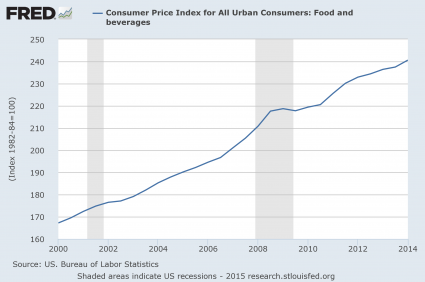
California Drought 2014As the price of meat continues to skyrocket, will it soon be considered a “luxury item” for most American families?  This week we learned that the price of meat in the United States rose at the fastest pace in more than 10 years last month.  Leading the way is the price of shrimp.  According to the U.S. Bureau of Labor Statistics, the price of shrimp has jumped an astounding 61 percent compared to a year ago.  The price of pork is also moving upward aggressively thanks to a disease which has already killed about 10 percent of all of the pigs in the entire country.  And the endless drought in the western half of the country has caused the size of the U.S. cattle herd to shrink to a 63 year low and has pushed the price of beef to an all-time high.  This is really bad news if you like to eat meat.  The truth is that the coming “meat crisis” is already here, and it looks like it is going to get a lot worse in the months ahead.

A devastating bacterial disease called “early mortality syndrome” is crippling the shrimping industry all over Asia right now.  According to Bloomberg, this has pushed the price of shrimp up 61 percent over the past 12 months…

In March, shrimp prices jumped 61 percent from a year earlier, according to the U.S. Bureau of Labor Statistics. The climb is mainly due to a bacterial disease known as early mortality syndrome. While the ailment has no effect on humans, it’s wreaking havoc on young shrimp farmed in Southeast Asia, shrinking supplies.

This disease has an extremely high mortality rate.  In fact, according to the article that I just quoted, it kills approximately nine out of every ten shrimp that it infects…

Cases of early mortality syndrome, which destroys the digestive systems of young shrimp, were first reported in China in 2009, said Donald Lightner, a professor of animal and comparative biomedical sciences at University of Arizona in Tucson.

The disease, which kills about 90 percent of the shrimp it infects, traveled from China to Vietnam to Malaysia and then to Thailand, he said. Cases also were reported in Mexico last year, Lightner said.

A different disease is driving up the price of pork in the United States.  It is known as the porcine epidemic diarrhea virus, and in less than a year it has spread to 30 states and has killed approximately 7 million pigs.

The price of bacon is already up 13.1 percent over the past year, but this is just the beginning.

It is being projected that U.S. pork production could be down by as much as 10 percent this year, and Americans could end up paying up to 20 percent more for pork by the end of 2014.

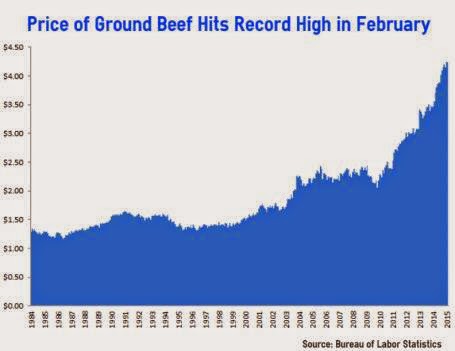
The price of beef has also moved to unprecedented heights.  Thanks to the crippling drought that never seems to end in the western half of the nation, the size of the U.S. cattle herd has been declining for seven years in a row, and it is now the smallest that is has been since 1951.

Over the past year, the price of ground chuck beef is up 5.9 percent.  It would have been worse, but ranchers have been slaughtering lots of cattle in order to thin their herds in a desperate attempt to get through this drought.  If this drought does not end soon, the price of beef is going to go much, much higher.

As prices for shrimp, pork and beef have risen, many consumers have been eating more chicken.  But the price of chicken is rising rapidly as well.

In fact, the price of chicken breast is up 12.4 percent over the past 12 months.

Unfortunately, this could just be the very beginning of this meat crisis.  As I wrote about recently, some scientists are warning that we could potentially be facing “a century-long megadrought“.

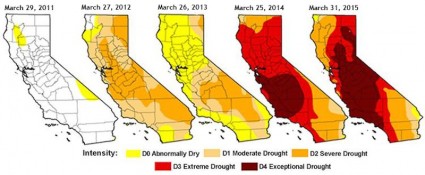
And right now, there are no signs that the drought out west is letting up.  Just check out the map posted below.  It comes from the U.S. Drought Monitor, and it shows how the drought in California has significantly intensified since the beginning of the year…

California Drought 2014

And considering how much the rest of the nation relies on the agricultural production coming out of California, it is very alarming to see that the drought is getting even worse.

Right now, things are so bone dry in most of the state that it is easy for wildfires to get out of control.  In fact, Governor Jerry Brown has just declared a state of emergency in San Diego County because of the vicious wildfires that are raging there…

Officials ordered another round of evacuations early Thursday north of San Diego as gusty winds and near 100-degree temperatures offer little relief from at least nine fires that have consumed a 14-square mile area of Southern California.

Gov. Jerry Brown declared a state of emergency for San Diego County, which frees up special resources and funding for the firefight.

The fires, coming earlier than normal in the wildfire season, are being fed by brush and trees left brittle by prolonged drought. They are also being whipped by a Santa Ana wind system that reverses the normal flow of wind from the Pacific Ocean and creates tinderbox fire conditions.

For the first time in its 14-year-history, the U.S. Drought Monitor, a federal website that tracks drought, designated the entire state of California as in a severe (or worse) drought.

If you do not live out west, you may have no idea how very serious this all really is.

For years, I have been warning about the potential for dust bowl conditions to return to the western half of the country.

Now it is actually starting to happen.

And we already have tens of millions of people in this country that are struggling to feed themselves.  If you doubt this, please see my previous article entitled “Epidemic Of Hunger: New Report Says 49 Million Americans Are Dealing With Food Insecurity“.

So what happens if drought, diseases and plagues continue to cause food production in this country to plummet?

Those that have studied these things tell us that there is a clear correlation between food prices and civil unrest.  For example, the following is a short excerpt from a recent Scientific American article

Since the beginning of 2014, riots have occurred in countries including Thailand and Venezuela. Although they’re different cultures on different continents, these mass protests movements may all have one commonality; increasing food prices may have contributed to their occurrence. The cost of food has been steadily increasing in both Thailand and Venezuela; last month demonstrators in Caracas took to the streets marching with empty pots to protest food shortages. According to Dr. Yaneer Bar-Yam and fellow researchers at the New England Complex Systems Institute (NECSI), events such as these may be anticipated by a mathematical model that examines rising food costs.

The events of 2014 aren’t without precedent; the price of food has provoked (and placated) throughout history, beginning in Imperial Rome when Augustus introduced grain subsidies. In recent years, the Middle East has been particularly affected by the cost of grain. Centuries after Egypt developed bread as we recognize it, the nation experienced a bread intifada – the country rioted for two days in January 1977 following Anwar Sadat’s decision to drastically decrease food subsidies. More recently, under the rule of Hosni Mubarak, the price of grain rose 30 percent between 2010 and 2011. Then, on January 25, 2011 a new revolution began in Egypt.

Could rapidly rising food prices cause civil unrest in the United States eventually?

It won’t happen today, and it won’t happen tomorrow, but some day it might.

Meanwhile, you might want to start carving out a significantly larger portion of the family budget for food for the foreseeable future.

The Economics Of Marriage

Marriage - Photo by Eric WardThe marriage rate in the United States has fallen to the lowest level ever recorded.  So why is this happening?  Well, the truth is that there are a lot of reasons why so many young people are choosing not to get married today.  One big reason is money.  Young adults in the U.S. are really struggling to find good jobs, and many are hesitant to take a big step like marriage without achieving a certain level of financial security first.  And as you will see below, many young adults (especially women) do not even want to date someone that is not employed.  In this harsh economic environment, money makes a big difference in the world of romance.  Another big reason for the decline of marriage in America is a seismic shift in cultural attitudes.  Americans (especially young people) do not place the same kind of importance on marriage and having children that they once did.  Instead, more Americans are choosing to “move in together” than ever before.  But if the percentage of Americans that choose to get married continues to decline, what is that going to mean for our future, and what is our country going to look like moving forward?

According to a startling new study conducted at Bowling Green University, the marriage rate in America has fallen precipitously over the past 100 years.

In 1920, there were 92.3 marriages for every 1,000 unmarried women.  In 2012, there were only 31.1 marriages for every 1,000 unmarried women.

That is not just a new all-time low, that is a colossal demographic earthquake.

That same study found that the marriage rate has fallen by an astounding 60 percent since 1970 alone.

As a result, U.S. households look far different today than they once did.

Back in 1950, 78 percent of all households in the U.S. contained a married couple.  Today, that number has declined to 48 percent.

That is a very troubling sign if you consider the family to be one of the fundamental building blocks of society.

When young people are asked why they are delaying marriage today, one of the things that always seems to get brought up is money.  There is a feeling (especially among men) that you should achieve a certain level of financial security before making the big plunge.

And it is a fact that the more money you have, the more likely you are to be married.  Just check out the following stats about income and marriage from a recent Business Insider article

83% of 30- to 50-year-old men in the top 10% of annual earnings are married today, whereas only 64% of median earners and half of those in the bottom 25th percentile are hitched.

Now, compare that to men in 1970, whose marriage rates were 95% (top earners), 91% (median earners), and 60% (bottom 25th percentile of earners), respectively.

A lot of people like to think that “love is the only thing that matters” when it comes to marriage, but the cold, hard numbers tell a different story.  In fact, one very shocking survey discovered that 75 percent of all American women would have a problem even dating an unemployed man…

Of the 925 single women surveyed, 75 percent said they’d have a problem with dating someone without a job. Only 4 percent of respondents asked whether they would go out with an unemployed man answered “of course.”

“Not having a job will definitely make it harder for men to date someone they don’t already know,” Irene LaCota, a spokesperson for It’s Just Lunch, said in a press release. “This is the rare area, compared to other topics we’ve done surveys on, where women’s old-fashioned beliefs about sex roles seem to apply.”

Unfortunately for American men, there simply are not enough good jobs to go around.  In fact, the number of working age Americans without a job has increased by 27 million since the year 2000, and businesses in the U.S. are being destroyed faster than they are being created.

Due to a lack of economic opportunities, a rising percentage of our young people have been giving up on the “real world” and have been moving back in with Mom and Dad.  For much more on this, please see my previous article entitled “29 Percent Of All U.S. Adults Under The Age Of 35 Are Living With Their Parents“.  And when you break down the numbers, you find that young men are almost twice as likely to move back in with their parents as young women are.

But economic factors alone certainly do not account for the tremendous decline in the marriage rate that we have witnessed in this country.  Shifting cultural attitudes also play a huge role.

A whole host of opinion polls and surveys show that Americans simply do not value marriage and having children as much as they once did.  For example, the Pew Research Center has found that the younger you are, the more likely you are to believe that “marriage is becoming obsolete” and that “children don’t need a mother and a father to grow up happily”.

In fact, an astounding 44 percent of all Americans in the 18 to 29-year-old age bracket now believe that “marriage is becoming obsolete”.

And why should they get married?  Our movies and television shows constantly tell them that they can have the benefits of being married without ever having to make a lifelong commitment.

This sounds particularly good to men, since they can run around and have sex with lots of different women without ever having to “settle down”.

But there are most definitely consequences for this behavior.  The “sexual revolution” has left behind countless broken hearts, shattered dreams, unintended pregnancies and devastated families.

In addition, the U.S. has become a world leader when it comes to sexually-transmitted disease.

It is hard to believe this number, but according to the Centers for Disease Control and Prevention approximately one-third of the entire population of the United States (110 million people) currently has a sexually transmitted disease.

So nobody should claim that the “sexual revolution” has not had any consequences.

But most Americans don’t actually run around and sleep with lots of different people at the same time.  Instead, most Americans seem to have adopted a form of “serial monogamy“.

In America today, most people only sleep with one person at a time, and “living together” is being called “the new marriage”.

According to the CDC, 74 percent of all 30-year-old women in the U.S. say that they have cohabitated with a romantic partner without being married to them, and it has been estimated that 65 percent of all couples that get married in the United States live together first.

Many believe that by “trying out” the other person first that it will give them a much better chance of making marriage work if they eventually do choose to go down that path.  Unfortunately, that does not seem to work out very well in practice.  In fact, the divorce rate for couples that live together first is significantly higher than for those that do not.

And when it comes to divorce, America is the king.

For years, the U.S. has had the highest divorce rate in the developed world.

But it wasn’t always this way.  Back in 1920, less than one percent of all women in the United States were currently divorced or separated.  Today, approximately 15 percent of all women in the United States are currently divorced or separated.

So why are so many people getting divorced?

Of course there are a lot of factors involved (including money), but a big one is cheating.  According to one survey, 41 percent of all spouses admit to infidelity.  Many Americans simply find it very difficult to stay committed to one person for an extended period of time.

As a result of what I have discussed so far, it is easy to see why people in our society are so lonely and so isolated.  Less people are getting married, more divorces are happening and couples are having fewer children.  This means that our households are smaller and we have far fewer family connections than we once did.

100 years ago, 4.52 people were living in the average U.S. household, but now the average U.S. household only consists of 2.59 people.

That is an astounding figure.

And the United States has the highest percentage of one person households on the entire planet.

But we weren’t meant to live alone.  We were meant to love and to be loved.

Often, those that are being hurt the most by our choices as a society are the children.  They need strong, stable homes to grow up in, and we are not providing that for millions upon millions of them.

When you look at just women under the age of 30 in the United States, more than half of all babies are being born out of wedlock.

That would have been unimaginable 100 years ago.

And of course when there is no marriage involved, a lot of times the guy does not stick around.  At this point, approximately one out of every three children in the United States lives in a home without a father, and in many impoverished areas of the country the rate is well over 50 percent.

In addition, women are waiting much longer to have children than they once did.

In 1970, the average woman had her first child when she was 21.4 years old.  Now the average woman has her first child when she is 25.6 years old.

The biggest reason for this, once again, is money

In the United States, three-quarters of people surveyed by Gallup last year said the main reason couples weren’t having more children was a lack of money or fear of the economy.

The trend emerges as a key gauge of future economic health — the growth in the pool of potential workers, ages 20-64 — is signaling trouble ahead. This labor pool had expanded for decades, thanks to the vast generation of baby boomers. Now the boomers are retiring, and there are barely enough new workers to replace them, let alone add to their numbers.

We are waiting longer to have children and having fewer of them, but those children are needed for the economic future of this country.

Fifteen years from now, one out of every five Americans will be over the age of 65.  All of those elderly Americans are going to want the rest of us to keep the financial promises that were made to them.  But that is going to turn out to be quite impossible.  We simply do not have enough people.

In the end, the economics of marriage does not just affect those that are thinking of getting married or those that are already married.

The truth is that the economics of marriage affects all of us.

So what do you think is in store for the future of the institution of marriage in this country?

Please feel free to share what you believe by posting a comment below…

The Pope Is Completely Wrong About Capitalism And Inequality

Pope Francis - Photo by Tania RegoOn Monday, the following message was posted on the Pope’s official Twitter account: “Inequality is the root of social evil.”  This follows on the heels of several other extremely harsh statements that he has made about capitalism over the past year.  The Pope appears to believe that inequality is one of the greatest evils that humanity is facing.  So if we redistributed all money and all property and made sure that everyone had an equal amount, would that wipe out social evil?  Of course not.  Such a notion is absolutely absurd.  Being the Pope, he should know that the evil that we see all around us is not the result of the distribution of wealth.  Rather, it is the result of humanity’s deep rebellion against God.  Yes, the fact that the wealth of the planet is being increasingly funneled to a very small minority at the top of the pyramid is a major problem.  This is something that I have written about repeatedly.  But the answer is not to make sure that everyone has the exact same amount of money and property.  In the end, that would only turn us into North Korea.

In case you missed it, here is the tweet by the Pope that is causing such an uproar…

https://twitter.com/Pontifex/status/460697074585980928

By itself, that statement could perhaps be “interpreted” a number of different ways.  But this follows other statements by the Pope that make it exceedingly clear what he is talking about.  Here is one example

Just as the commandment “Thou shalt not kill” sets a clear limit in order to safeguard the value of human life, today we also have to say “Thou shalt not” to an economy of exclusion and inequality. Such an economy kills. How can it be that it is not a news item when an elderly homeless person dies of exposure, but it is news when the stock market loses two points? This is a case of exclusion. Can we continue to stand by when food is thrown away while people are starving? This is a case of inequality.

Yes, the Pope is correct to highlight the plight of the homeless and the needy.  Even in “wealthy America”, we have an epidemic of hunger.  This is something that I wrote about yesterday.

And yes, the Pope is correct to point out society’s obsession with the stock market.  Personally, I have been relentless in criticizing the big Wall Street banks.

But the solution is not to take everything away from everybody and put it into a giant pile and redistribute it equally.

History has shown us what happens when a society adopts an extreme form of socialism or communism.

The incentive to work is destroyed, the incentive to create new ideas and new businesses is destroyed, and living standards for everyone go down.

Please don’t think that I am defending our current system.  What we have in the United States today is not the kind of pure capitalism that our founders intended.  Instead, it is a form of collectivism where nearly all of the economic power is now in the hands of giant collectivist institutions.  That includes public collectivist institutions (the government) and private collectivist institutions (large corporations).  In this type of economic environment, it should not be a surprise that government dependence is at an all-time high, the number of Americans that are self-employed is at an all-time low and millions of small businesses are being regulated out of existence.

Collectivism, socialism and communism are all close cousins.  People are promised that such systems will result in greater “equality”, but it never seems to actually work out that way.  Instead, the small elite that hold all the power usually end up enjoying the vast majority of the benefits.

And without a doubt, as the power of the government and the power of the corporations has increased, inequality has been rising.  Just check out the following chart from a new book by 42-year-old French economist Thomas Piketty entitled “Capital In The Twenty-First Century“…

Thomas Piketty Inequality

As I write this, Pinketty’s book is the number one seller on Amazon.  That is pretty remarkable for an economics treatise.  But Pinketty fails to realize what actually caused U.S. income inequality to start skyrocketing in 1971.  As Brian Domitrovic recently detailed, that was the year when the U.S. completely went off the gold standard and the Federal Reserve started running wild…

The big switch to the foundation of the American financial structure at the advent of this period was the U.S. decision in 1971 to go off the gold standard. Before that time, it was basically clear that outside of wartime (when gold-standard conventions were often suspended), you could basically count on the dollar holding its value against major things like the consumer price level, foreign currencies, and commodities such as gold itself.

After 1971, in contrast, it became basically clear that you could count on no such thing. The CPI might go up 125% in one decade (as it did 1971-1981), the dollar could permanently lose 66% against major currencies (as it did against the yen in this period), and commodities could shoot up ten-to twenty-five fold (as was the case with oil and gold).

Therefore a new day in financial planning also arrived. Suddenly the importance of simply saving money diminished. Money that was saved also had to be hedged. If you simply saved money after 1971, you stood to get killed as the dollar lost value against things it was supposed to be able to procure in the future.

This is where the financial services industry began its long march upward in the share of U.S. economic output it gobbled up. People who had significant money—the rich—threw their money into the products offered by the financial sector, in that the worst thing to happen to a fortune diligently built up over the years would be to see it frittered away on account of currency depreciation.

So much has gone wrong since 1971.  Out national debt has gotten more than 40 times larger, our economic infrastructure has been absolutely gutted and the value of the U.S. dollar has declined by well over 80 percent.

Once again, we need to go back to a system that much more closely resembles what our founders intended.

Did you know that the greatest period of economic growth in U.S. history was when there was no income tax, no IRS and no Federal Reserve?

We could have such a system again.

But the solutions being proposed by the mainstream media, our politicians and even the Pope involve even more centralization of economic power.

If we follow this path to the end, we will ultimately become like North Korea.

It is hard to describe the crushing poverty that exists in that hellhole of a country.  In North Korea, there is so little electricity that the country appears almost totally dark from space at night.  Just check out this picture taken by NASA…

North Korea At Night

North Korea may have more “equality” than we do, buy in that country “a ballpoint pen is considered a luxury item“.  Here is much more on what life is like for ordinary people inside North Korea from the New York Post

Jobs often come without salaries. Those who do get a paycheck, earn, on average, between $1,000-2,000 a year. Food and clothing are rationed by the government.

Most North Koreans have access to that one TV station and one newspaper, both state-run; they are told that their country is the only functioning and prosperous nation on Earth and that outside rages an apocalypse. Only elites are allowed cellphones, but they can just make calls or text — there is no Internet.

Would you like to live in such a society?

When you take away the incentive to work and the incentive to create, you end up with a much poorer society.  Without outside help, much of North Korea would have already starved to death by now

“The majority of North Koreans believe completely in the regime,” says Barbara Demick, a Seoul-based journalist and author of “Nothing to Envy: Ordinary Lives in North Korea.”

“They are barely surviving,” she says. “Only the rich can afford to eat rice. They’re in a chronic state of food shortage.”

The average citizen eats twice a day — a manageable state of affairs for citizens who lived through the great famine of the ’90s, which reduced millions of people to eating tree bark and plucking undigested kernels of corn from animal excrement.

Yes, something needs to be done about the rising level of income inequality in our country.  The middle class is being systematically destroyed and most of our politicians do not seem to care.  Some big steps in that direction would be going back to a much purer form of capitalism, shutting down the Federal Reserve, changing laws to shift power much more in the direction of individuals and small businesses, and ending the practice of shipping millions of our good paying jobs to communist nations such as China.

We also need a massive shift in our culture.  We need to shift away from a culture of greed and selfishness to a culture of love, compassion and generosity.  Those that have been blessed have a responsibility to be a blessing.  That is something that we have largely forgotten.

But trying to use government and taxation to wipe out inequality never works and will only make society poorer.  This is a lesson that Barack Obama, the Democrats, the Republicans, the mainstream media and the Pope all desperately need to learn.

12 Numbers Which Prove That Americans Are Sick And Tired Of Politics As Usual

Barack_Obama_and_John_Boehner_enjoying_Saint_Patrick's_Day_2014The American people are increasingly waking up to the fact that nothing ever seems to change in Washington D.C. no matter which political party is in power.  In fact, as you will see later on in this article, an all-time high 53 percent of all Americans believe that neither party “represents the American people”.  Over the past several decades, we have sent a Bush, a Clinton, another Bush and an Obama to the White House, but the policies coming out of Washington have remained pretty much the same the entire time.  The mainstream media would have us believe that the Republicans and the Democrats are constantly fighting like cats and dogs, but the truth is that the Republicans want to take us to the same place that the Democrats want to take us – just a little more slowly perhaps.  And behind the scenes, Republicans and Democrats have a good time with one another and they are ultimately controlled by the same set of oligarchs.  The Americans people are really starting to recognize what a sham our system has become, and the numbers show that they are quite fed up with it.

I truly wish that things were different.  When I was much younger, I was actively involved in politics and I enthusiastically campaigned for certain candidates.  But then when they got to Washington D.C., they never did most of the things that they promised to do during their campaigns.

I was quite bewildered by this.  At the time, I concluded that we just needed to send even more “good politicians” to D.C. and then things would finally turn around.

But things never did turn around.  No matter which party had the upper hand, the same garbage continued to spew forth from Washington.

Ultimately, like millions of other Americans, I have come to see that there is not really much of a difference between Barack Obama, Hillary Clinton, Harry Reid and Nancy Pelosi on one side, and John Boehner, John McCain, Mitch McConnell and Jeb Bush on the other side.

Sure, if you listen to their campaign speeches you might be tempted to think that they were polar opposites, but when you watch what they actually do there is not that much that really separates them.

Fortunately, large numbers of Americans are starting to see through this disgusting charade.  Most of our politicians are con men that tell us what we want to hear during their campaigns, and then after they are elected they forget all about us.  Dissatisfaction with these politicians has risen to unprecedented levels in recent years, and that could be a good thing.  The following are 12 numbers which prove that Americans are sick and tired of politics as usual…

#1 A national Rasmussen Reports survey has found that an all-time high 53 percent of all Americans believe that neither major political party “represents the American people”.

#2 According to a Real Clear Politics average of national polls, only 29 percent of Americans believe that the country is heading in the right direction.

#3 According to a Real Clear Politics average of national polls, Americans disapprove of the job that Barack Obama is doing by a 52.2 to 43.7 percent margin.

#4 According to a Real Clear Politics average of national polls, Americans disapprove of the job that Congress is doing by a 77.6 percent to 14.2 percent margin.

#5 52 percent of Americans “do not think the economy is fair to those willing to work hard”.

#6 65 percent of Americans are dissatisfied “with the U.S. system of government and its effectiveness”.  That is the highest level of dissatisfaction that Gallup has ever recorded.

#7 Only 4 percent of Americans believe that it would “change Congress for the worse” if every member was voted out during the next election.

#8 An all-time low 31 percent of Americans identify themselves as Democrats.

#9 An all-time low 25 percent of Americans identify themselves as Republicans.

#10 An all-time high 42 percent of Americans identify themselves as Independents.

#11 60 percent of Americans report feeling “angry or irritable”.  Two years ago that number was at 50 percent.

#12 70 percent of Americans do not have confidence that the federal government will “make progress on the important problems and issues facing the country in 2014”.

Of course at the heart of much of this dissatisfaction is the continuing problems in our economy.  For example, check out the Gallup daily employment tracking survey that you can find right here.  As you can see, the payroll to population number (those Americans working 30 hours a week or more) has been flatlining in the low forties for more than four years now.  The truth is that there never has been an employment recovery in this nation since the last recession. For much more on all this, please see my previous article entitled “This Is What Employment In America Really Looks Like…

The last wave of the economic crisis really devastated the middle class, and as a result record numbers of Americans have become dependent on the government.  As I mentioned in one recent article, ten years ago the number of women working outnumbered the number of women on food stamps by more than a 2 to 1 margin. But now the number of women on food stamps actually exceeds the number of women that have jobs.

No wonder so many Americans are so angry.  Things are not nearly as good as they used to be.

Unfortunately, even though so many people are angry and frustrated, there is very little consensus on the solutions to our problems.

Many Americans even want to throw out the principles that this country was founded upon entirely.  For example, one recent survey discovered that 59 percent of all Americans believe that the U.S. Constitution is “outdated”.

That is a very chilling number.  We live at a time when Americans are becoming increasingly ignorant about who we are, where we came from and how we get here.

And a lot of our fellow citizens do not even know how our system of government works.  One survey actually found that only 25 percent of all Americans knew how long U.S. Senators are elected for (6 years), and only 20 percent of all Americans knew how many U.S. senators there are (100).

In the final analysis, it is hard to be optimistic about a political solution to any of our major problems in the near future.  Most of our politicians are deeply corrupt, the American people are incredibly angry and are deeply divided, and the vast majority of campaigns for federal office are won by the candidate that raises the most money.

But perhaps there is something that I am missing.  So what do you think?  Do you believe that there is hope that we can get Washington D.C. turned around in the near future?  Please feel free to share your thoughts by posting a comment below…

12 Signs That Something Big Is Happening To The Earth’s Crust Under North And South America

Earthquake Damage - Cracks In The Earth - Photo by Martin LuffWhy are fault lines and volcanoes all over North and South America suddenly waking up?  Are we moving into a time when major earthquakes and volcanic eruptions will become much more common?  For the past several decades, we have been extremely fortunate to have experienced a period of extremely low seismic activity along the west coast of the United States.  You see, the west coast lies right along the infamous Ring of Fire.  Approximately 75 percent of all the volcanoes in the world are on the Ring of Fire, and approximately 90 percent of all global earthquakes occur along the Ring of Fire.  Scientists tell us that it is inevitable that “the Big One” will hit California someday, but people have gotten very apathetic about this because things have been so quiet out there for so many years.  Well, now it appears that things are changing in a big way – and not just along the California coast.  The following are 12 signs that something big is happening to the earth’s crust under North and South America…

#1 The 5.1 earthquake that shook Los Angeles on Friday was the worst earthquake that the city had seen in many years.

#2 Following that earthquake, there were more than 100 aftershocks.

#3 A 4.1 earthquake shook Los Angeles on Saturday.  Scientists are hoping that this earthquake swarm in southern California will end soon.

#4 Earlier this month, a 4.4 earthquake rattled Los Angeles so badly that it caused news anchors to dive under their desks.

#5 A 6.9 earthquake just off the coast of northern California in early March was the largest earthquake to hit the west coast of the United States since 2010.

#6 Up in Oregon, Mt. Hood recently experienced more than 100 earthquakes over the course of just a few days.

#7 During the past month, there have also been some other very unusual geologic events that have been happening up in Oregon

  • Two large landslides – one in the Columbia River Gorge dumped about 2,000 cubic yards of rock and debris on highway I84 just 3 miles west of the Hood River, and another blocked US30 near Portland.
  • Loud booms and ground shaking reported by people from Lincoln to Tillamook Counties; some reported hearing a rumble, as well (No earthquakes recorded by the USGS in the area at the time.)
  • A 20 ft. deep sinkhole swallowed a woman and her dog in her Portland backyard.

#8 A 4.8 earthquake rattled Yellowstone National Park on Sunday, and there have been at least 25 earthquakes at Yellowstone since Thursday.

#9 Scientists recently discovered that the Yellowstone supervolcano is now releasing far more helium gas than they had anticipated.

#10 Over the past month, there have been more than 130 earthquakes in the state of Oklahoma.  This is highly unusual.

#11 There have been several dozen earthquakes in Peru over the past month, including a 6.3 earthquake that made headlines all over the globe.

#12 Earlier this month, the northern coast of Chile was hit by more than 300 earthquakes in a seven day stretch.  41 of those earthquakes were stronger than magnitude 4.5.

Fortunately, the quake that hit Los Angeles on Friday did not cause too much lasting injury.  But it sure did shake people up.  The following is how the Los Angeles Times described the damage…

The quake, centered near La Habra, caused furniture to tumble, pictures to fall off walls and glass to break. Merchandise fell off store shelves, and there were reports of plate glass windows shattered.

In Brea, several people suffered minor injuries during a rock slide that overturned their car. Fullerton reported seven water main breaks. Carbon Canyon Road was closed.

Residents across Orange and Los Angeles counties and the Inland Empire reported swinging chandeliers, fireplaces dislodging from walls and lots of rattled nerves. The shake caused a rock slide in Carbon Canyon, causing a car to overturn, according to the Brea Police Department.

Why this particular earthquake is of such concern is because it occurred along the Puente Hills fault line.  According to one seismologist, this is the fault line that would be most likely to “eat L.A.”

Experts said that the earthquakes occurred on the Puente Hills thrust fault, which stretches from the San Gabriel Valley to downtown Los Angeles.

Last night’s quake was shallow, which ‘means the shaking is very concentrated in a small area,’ said Caltech seismologist Egill Hauksson.

Hauksson revealed that the earthquake was unusual because the 5.1 quake was preceded by the weaker foreshock.

Scientists such as Hauksson are very concerned about the Puente Hills fault because it runs directly under downtown Los Angeles.

This is the fault that could eat L.A.,’ seismologist Sue Hough told The LA Times in 2003.

The fact that this fault appears to be waking up is really bad news.

According to seismologists, a major earthquake along this fault line could cause hundreds of billions of dollars of damage

Video simulations of a rupture on the Puente Hills fault system show how energy from a quake could erupt and be funneled toward L.A.’s densest neighborhoods, with the strongest waves rippling to the west and south across the Los Angeles Basin.

According to estimates by the USGS and Southern California Earthquake Center, a massive quake on the Puente Hills fault could kill from 3,000 to 18,000 people and cause up to $250 billion in damage. Under this worst-case scenario, people in as many as three-quarters of a million households would be left homeless.

For years, we have watched as the rest of the Ring of Fire has been absolutely ravaged by major seismic events.

We all remember the earthquakes that caused the Indonesian tsunami of 2004 and the Japanese tsunami of 2011.

And the world mourned when major earthquakes devastated New Zealand, Chile, Peru, Japan and the Philippines.

Scientists assured us that it was only a matter of time before the west coast started to become seismically active again, and now it is happening.

If you live on the west coast, I hope that you will consider these things very carefully.

Just because the earth under your feet has been relatively quiet for a very long time does not mean that it will always be that way.

Something big appears to be happening to the earth’s crust, and you won’t want to be in the “danger zone” when things finally break loose.

Meet 5 People Who Made A Decision To Shine A Light In The Darkness

Heart - Photo by Louise Docker from Sydney, AustraliaAre you ready for some inspirational stories that will make your heart jump for joy?  These days, it is so easy to get down.  Both individually and as a nation, we have so many problems and it often seems like things just keep getting worse.  For example, this week we learned that pending home sales in the United States just dropped by the most in 3 years and that they have now been declining for 8 months in a row.  And without a doubt, incredibly challenging times are on the horizon.  In response, a lot of people are going to choose to complain bitterly and curse the darkness.  Others are going to respond with fear and will try to hide from the world as much as they can.  But I don’t think that either of those approaches is a good way to react to the problems that we will be facing.  Rather, I believe that the right choice is to be a light in the darkness and to try to make a difference.  As you will see below, there are many ways that this can be done.  You don’t have to be famous, or run for political office, or have a million dollars.  All that it takes is a willingness to reach out and love the one in front of you.  If all of us decided to do what we could to truly make a difference in the life of one other person, our nation would be a far better place.  The following are 5 people who made a conscious decision to shine a light in the darkness…

Kelly Nixon Mayr

It takes a lot of love and compassion to adopt a child into your own home.  When that child has special needs, it can be especially challenging.  That is why the story of Kelly Nixon Mayr is so inspiring.  Along with her husband, she has made a lifestyle out of helping children with special needs

Kelly Nixon Mayr of Colorado has birthed five children, adopted one troubled teen and fostered several special-needs infants. On Tuesday, she and husband Paul announced, through their family blog, that they had finalized their adoption of Angie, a 2-year-old who was born drug-exposed and clubfooted, whom they had fostered on and off since she was 1.

Now they are preparing for their next adoption—of Rita, an 8-year-old Eastern European orphan with arthrogryposis (a rare syndrome causing unbendable joints) and a case of post-traumatic stress disorder.

But Nixon Mayr, 45, who speaks about her close-knit brood with equal parts passion and humor, insists that she and her husband are not extraordinary.

“I yell at my kids, and I think one might have had Goldfish for breakfast the other day,” she tells Yahoo Shine with a laugh. “The only thing we are is willing.”

It takes a lot of money to raise those children.  Kelly and her husband could have used that money on a larger house, luxury cars and expensive vacations.  But instead, they willingly chose to live their lives in service to others.

Rahat

Younger Americans are capable of feats of great compassion as well.  For example, a YouTube personality known as “Rahat” could have easily ignored the homeless man that he would often see at the local shopping mall.  But instead, he decided to do something about it

On March 4, a YouTube magician and prankster name Rahat set aside his mischievous pranks to do something really kind for a homeless man he’d often seen hanging around his shopping mall.

He heard that the man named Eric was a “nice and respectable guy,” so he gave him a lottery ticket telling him it was a winner and that he should come to the shop and claim his prize. The store clerk was privy to the stunt and pretended the ticket was indeed a winner and handed over $1,000 in cash to the homeless gentleman.

Rahat, who had secretly given the clerk the cash to give to Eric recorded a video of how excited Eric was to “win” the money.

And thanks to Rahat’s YouTube video and fundraising efforts, a total of $42,000 has been raised for that homeless man, and his future is looking bright for the first time in a very long while.

Annie Hart

Sometimes it is an animal that desperately needs some love and compassion.  In this economic environment, there are a lot of people that are abandoning their pets, and there are a lot of homeless dogs and cats that are in a tremendous amount of pain right now.

That is why what people like Annie Hart are doing is so wonderful

When Annie Hart rescued a sick, homeless pit bull, not even she could have predicted the miraculous transformation the animal would undergo.

Hart is the executive director of the Bill Foundation and is no stranger to rescuing animals.

She ended up naming the pit bull Gideon. The dog was in such bad shape that he actually trembled at the sight of humans.

Doctors also discovered that Gideon was suffering from multiple severe bacterial and highly contagious fungal infections. He was put in quarantine.

As you watch the video of the transformation of this dog that I have posted below, you might just find yourself getting choked up over it…

Mark A. Mayo

How many of you would be willing to give your life so that someone else could live?

That is precisely what Master-at-Arms 2nd Class Mark A. Mayo recently did.  It is this kind of heroism that America desperately needs more of

Master-at-Arms 2nd Class Mark A. Mayo, 24, was killed during a shooting incident at Naval Station Norfolk Monday. Mayo was assigned to Naval Security Forces, Naval Station Norfolk.

Norfolk Naval Base commander Robert Clark said the young sailor sacrificed himself to save others.

“It was incredibly extraordinary,” says Clark.

The shooting happened around 11:20pm Monday night at Pier 1 onboard the USS Mahan.

Mark Mayo was protecting a sailor who first confronted a civilian intruder. That man, a truck driver, tried to board the destroyer Mahan. He disarmed the watch stander and then turned the watch stander’s gun at Mayo.

“He jumped into the way between the gunman and the petty officer of the watch. She fell to the ground. He covered her and he basically gave his life for hers,” says Clark.

“Doing that, that’s something he would do,” says Virgil Savage, a fellow sailor and close friend of Mayo. “He always stood up for the little guy.”

You can read more about Mayo’s incredible act of bravery right here.

Dan And Linda Catlin

It takes a very special individual to commit your entire life to serving the homeless.

But that is exactly what Pastor Dan Catlin and his wife Linda have been doing for many years.

The following is an excerpt from a profile of the Messiah’s Branch homeless ministry in Wichita, Kansas that was written by Jessiqua Wittman

Messiah’s Branch is a family-owned homeless ministry. Since the year 2000, Dan and Linda Catlin have been traveling an hour, at least twice a week, to help the homeless in the city of Wichita, Kansas.

When I was a teenager (before we were homeless ourselves), my family had the privilege of working with this family.

We’d arrive at the mission building (a renovated bar), around 12:30 on Tuesdays and Fridays. The homeless people of the city, usually about 50 to 70 of them, would already be trickling into the area. There are a lot more homeless people than that in Wichita. Those were just the people from the surrounding area that could walk there, and had no other ministry that they could go for food. Most churches (besides Messiah’s Branch) require identification before they feed people off the street, and oftentimes homeless people have lost their identification long ago, whether because of drugs, mugging, or police raids (many of the police in Wichita are very hostile towards homeless people).

When you serve the homeless, there are no vacations.  It is just a relentless battle against human pain and suffering.  To do this year after year, you have got to be driven by compassion…

Sister Linda can hold a knife and cut a potato at the same time, in the same hand! The whole time seasoning her stew and chatting and laughing with a young homeless couple that are hanging around the kitchen door, hungry for more than just food.

And Pastor Dan? What does he do? He takes some people to doctor’s appointments, some to the hospital. Sometimes he buys shoes, or makes sure they find a coat that will fit just right. The way I remember him most is being the resident jar-opener.

In the wintertime, when it reaches a certain temperature, Pastor Dan and Sister Linda open up the building full time. There are so many people that come, they lay them all side-by-side in rows on the floor. For a week sometimes, it’s like this.

I have personally talked to Pastor Dan and I know how hard he has worked to help the homeless of Wichita for so many years.

But the need just keeps getting greater.

All over the country, the middle class is shrinking and more people are falling into poverty.

We are going to need a lot more people like the ones you just read about above.

And you don’t have to do exactly what they are doing.  Find your own way to make a difference.  We all have different gifts, and together we can make this country a better place.

So make a conscious decision to shine a light in the darkness.

In the end, you will be glad that you did.

Is College A Waste Of Time And Money?

GraduationAre you thinking of going to college?  If so, please consider that decision very carefully.  You probably have lots of people telling you that an “education” is the key to your future and that you will never be able to get a “good job” unless you go to college.  And it is true that those that go to college do earn more on average than those that do not.  However, there is also a downside.  At most U.S. colleges, the quality of the education that you will receive is a joke, the goal of most colleges is to extract as much money from you and your parents as they possibly can, and there is a very good chance that there will not be a “good job” waiting for you once you graduate.  And unless you have someone that is willing to pay your tuition bills, you will probably be facing a lifetime of crippling student loan debt payments once you get out into the real world.  So is college a waste of time and money?  In the end, it really pays to listen to both sides of the debate.

Personally, I spent eight years at U.S. public universities, and I really enjoyed those times.

But would I trade my degrees today for the time and money that I spent to get them?

Absolutely.

Right now, Americans owe more than a trillion dollars on their student loans, and more than 124 billion dollars of that total is more than 90 days delinquent.

It is a student loan debt bubble unlike anything that we have ever seen before, and now even those that make their living from this system are urging reform.  For example, consider what a law professor at the University of Tennessee recently wrote for the Wall Street Journal…

In the field of higher education, reality is outrunning parody. A recent feature on the satire website the Onion proclaimed, “30-Year-Old Has Earned $11 More Than He Would Have Without College Education.” Allowing for tuition, interest on student loans, and four years of foregone income while in school, the fictional student “Patrick Moorhouse” wasn’t much better off. His years of stress and study, the article japed, “have been more or less a financial wash.”

“Patrick” shouldn’t feel too bad. Many college graduates would be happy to be $11 ahead instead of thousands, or hundreds of thousands, behind. The credit-driven higher education bubble of the past several decades has left legions of students deep in debt without improving their job prospects. To make college a good value again, today’s parents and students need to be skeptical, frugal and demanding.

When a lot of young Americans graduate from college and can’t find a decent job, they are told that if they really want to “be successful” that what they really need is a graduate degree.

That means more years of education, and in most cases, even more debt.

But by the time many of these young achievers get through college and graduate school, the debt loads can be absolutely overwhelming

The typical debt load of borrowers leaving school with a master’s, medical, law or doctoral degree jumped an inflation-adjusted 43% between 2004 and 2012, according to a new report by the New America Foundation, a left-leaning Washington think tank. That translated into a median debt load—the point at which half of borrowers owed more and half owed less—of $57,600 in 2012.

The increases were sharper for those pursuing advanced degrees in the social sciences and humanities, versus professional degrees such as M.B.A.s or medical degrees that tend to yield greater long-term returns. The typical debt load of those earning a master’s in education showed some of the largest increases, rising 66% to $50,879. It climbed 54% to $58,539 for those earning a master of arts.

In particular, many are questioning the value of a law school education these days.  Law schools are aggressively recruiting students even though they know that there are way, way too many lawyers already.  There is no way that the legal field can produce enough jobs for the huge flood of new law school graduates that are hitting the streets each year.

The criticism has become so harsh that even mainstream news outlets are writing about this.  For instance, the following comes from a recent CNN article

For the past three years, the media has picked up the attacks with relish. The New York Times, in an article on a graduate with $250,000 in loans, put it this way: “Is Law School a Losing Game?” Referring to the graduate, the Times wrote“His secret, if that’s the right word, is to pretty much ignore all the calls and letters that he receives every day from the dozen or so creditors now hounding him for cash,” writes the author.  Or consider this blunt headline from a recent Business Insider article: “‘I Consider Law School A Waste Of My Life And An Extraordinary Waste Of Money.’” Even though the graduate profiled in the piece had a degree from a Top 20 law school, he’s now bitterly mired in debt. “Because I went to law school, I don’t see myself having a family, earning a comfortable wage, or having an enjoyable lifestyle,” he writes. “I wouldn’t wish my law school experience on my enemy.”

In America today, approximately two-thirds of all college students graduate with student loan debt, and the average debt level has been steadily rising.  In fact, one study found that “70 percent of the class of 2013 is graduating with college-related debt – averaging $35,200 – including federal, state and private loans, as well as debt owed to family and accumulated through credit cards.”

That would be bad enough if most of these students were getting decent jobs that enabled them to service that debt.

But unfortunately, that is often not the case.  It has been estimated that about half of all recent college graduates are working jobs that do not even require a college degree.

Could you imagine that?

Could you imagine investing four or five years and tens of thousands of dollars in a college degree and then working a job that does not even require a degree?

And the really sick thing is that the quality of the education that most college students are receiving is quite pathetic.

Recently, a film crew went down to American University and asked students some really basic questions about our country.  The results were absolutely stunning

When asked if they could name a SINGLE U.S. senator, the students blanked. Also, very few knew that each state has two senators. The guesses were all over the map, with some crediting each state with twelve, thirteen, and five senators.

I have posted the YouTube video below.  How in the world is it possible that college students in America cannot name a single U.S. senator?…

These are the leaders of tomorrow?

That is a frightening thought.

If parents only knew what their children were being taught at college, in most instances they would be absolutely horrified.

The following is a list of actual college courses that have been taught at U.S. colleges in recent years…

-“What If Harry Potter Is Real?

-“Lady Gaga and the Sociology of Fame

-“Philosophy And Star Trek

-“Invented Languages: Klingon and Beyond

-“Learning From YouTube

-“How To Watch Television

-“Sport For The Spectator

-“Oh, Look, a Chicken!

That last one is my favorite.

The truth is that many of these colleges don’t really care if  your sons and daughters learn much at all.  They just want the money to keep rolling in.

And our college students are discovering that when they do graduate that they are woefully unprepared for life on the outside.  In fact, one survey found that 70% of all college graduates wish that they had spent more time preparing for the “real world” while they were still in college.

In America today, there are more than 300,000 waitresses that have college degrees, and close to three out of every ten adults in the United States under the age of 35 are still living at home with Mom and Dad.

Our system of higher education is not working, and it is crippling an entire generation of Americans.

So what do you think?

Do you believe that college is a waste of time and money?

Please feel free to share your thoughts by posting a comment below…